
 Sara Carmen
The warning signs that end marriages almost never look like warning signs, and that is exactly what makes them so dangerous.
Key Points
- The most damaging red flags before marriage are not dramatic events. They are quiet, repeating patterns that feel excusable in the moment and predictable in hindsight.
- Marriage does not reset a relationship. It magnifies what already exists, which is why spotting red flags before marriage is an act of love, not suspicion.
- Knowing the difference between cold feet and a genuine warning sign gives you something most engaged couples never get: a real choice.
Contents
Table of Contents
Everything you have been told about red flags might be making you worse at seeing them. You were taught to watch for shouting, jealousy, and cruelty. So when the trouble arrives quietly, wearing a smile and holding a ring, you miss it completely.
You have probably felt it already. A small knot in your stomach after a conversation about money. A flicker of unease when they rolled their eyes at you in front of friends. You told yourself you were overthinking. Maybe. But maybe your nervous system noticed a pattern before your heart was ready to name it.
The short answer: Genuine red flags before marriage are specific, persistent behavioral patterns, not vague doubts. They include contempt, financial secrecy, future faking, and refusal of accountability. Because marriage magnifies existing dynamics rather than fixing them, naming these patterns before the wedding is the single most protective step you can take.
Why Red Flags Before Marriage Are So Hard to See
There is a psychological reason you excuse things in your partner that you would instantly flag in a friend’s relationship. Researchers call it positive sentiment override: when overall feelings about someone are warm, your brain reinterprets negative behavior as neutral or accidental. In plain terms, love edits the footage.
Add cognitive dissonance, the mental discomfort of holding two conflicting beliefs at once (“I’m marrying this person” and “this behavior worries me”), and your mind resolves the tension the easy way. It shrinks the worry instead of questioning the wedding.
Here is the distinction that changes everything. Cold feet are vague and general: “What if marriage isn’t for me?” Red flags are specific and persistent: “Every time I bring up our debt, he shuts the conversation down.” Vague doubts usually soften with reassurance. Specific patterns repeat no matter how much reassurance you give.
This matters because the stakes are not abstract. According to national data from the CDC, a large share of first marriages end in divorce within the first decade. Those numbers are not made of strangers. They are made of people who saw something early and decided love would outrun it.
Think of a red flag before marriage as a hairline crack in a foundation. Under fresh paint it is invisible. But every ton of weight you add later, a mortgage, a baby, a job loss, will find that crack and widen it. Let’s look at the eight cracks that matter most, including three modern ones almost nobody warns you about.
1. Financial Secrecy Is a Red Flag Before Marriage, Not a Money Quirk
Different spending styles are workable. Hidden debt, secret accounts, and refusal to discuss money are not. Psychologists call the deceptive version financial infidelity: deliberately concealing financial behavior from a partner, and it erodes trust the same way an affair does.
A 2023 Forbes Advisor survey found that roughly a quarter of divorced respondents named financial conflict as a reason their marriage ended. Notice what the real signal is here. It is rarely the amount of money. It is the secrecy, the impulsivity, and the refusal to plan together.
What to do: Before engagement, have a full transparency conversation. Credit scores, debts, spending habits, financial goals. A partner who resists that conversation is showing you how they will handle every hard conversation in your marriage.
2. Contempt, the Divorce Predictor Science Keeps Confirming
After four decades of observing couples, researcher John Gottman identified contempt as the single strongest predictor of divorce. Contempt is not frustration or a bad day. It is communication that positions you as beneath respect: eye-rolling, mockery, sarcasm aimed at your character, put-downs disguised as jokes in front of family.
The Gottman Institute groups contempt with criticism, defensiveness, and stonewalling as the “Four Horsemen,” the four communication patterns most corrosive to lasting love. Frustration says “I’m upset about this situation.” Contempt says “You are the problem, and you are less than me.”
What to do: Treat contempt as non-negotiable. Unlike clumsy communication, which improves with effort, contempt reflects a settled attitude of superiority. If it appears before the wedding, when people are on their best behavior, believe it.
3. Future Faking, the Promise That Never Lands
Future faking is when a partner makes vivid, detailed promises about your shared future, marriage, a home, a timeline, real change, primarily to keep you invested in an unsatisfying present. The promises are the product. Delivery was never the plan.
Modern future faking rarely sounds grandiose anymore. It sounds mature and grounded: “Once work settles down, we’ll get serious about the wedding.” Marriage and family therapists note that commitment avoidance often shows up exactly this way, as plans that are always announced and never executed.
Consider Maya, a composite of many people I have worked with. For three years her boyfriend described their future in loving detail: the proposal, the house, the kids’ names. Every time she asked for a date, the timeline slid. When she finally asked for one concrete step, meeting with a premarital counselor that month, he called her pushy. That word told her more than three years of promises had. Six months later, in a healthier relationship, she understood the difference between a partner who dreams with you and one who dreams at you.
What to do: Stop evaluating the vision and start evaluating the follow-through. Ask for one specific, near-term, verifiable action. Watch what happens next.
4. Weaponized Therapy Language, When Self-Awareness Is Really Avoidance

Here is the flag almost no one is writing about. Therapy vocabulary is everywhere now: boundaries, triggers, attachment styles, gaslighting. That fluency can be wonderful. It can also become armor.
A partner who says “I can’t discuss this, you’re violating my boundaries” every time you raise a concern is not setting a boundary. They are ending accountability. A partner who explains every hurtful action as a “trauma response” but never changes the action is narrating their behavior, not taking ownership of it.
But here’s what no one tells you.
Psychological fluency without behavioral change is not growth. It is avoidance with better vocabulary. And it is harder to confront than old-fashioned defensiveness, because objecting to it makes you feel like the unhealthy one. The tell is simple: in genuine growth, the behavior changes over time. In performed self-awareness, only the language does.
What to do: Track actions across months, not explanations across arguments. Insight that never becomes change is not insight worth marrying.
5. Emotional Unavailability Hiding Behind Constant Texting
Your partner messages you all day. Memes, check-ins, heart emojis. It feels like closeness. Then a real conflict arrives and they go silent, deflect, or reach for their phone. Digital contact delivers micro-doses of connection, but emotional intimacy requires sustained, in-person presence, especially under stress.
This is one of the most deceptive warning signs in modern relationships because the volume of contact masks the absence of depth. Availability on a screen is easy. Availability during your worst week is the actual test of emotional readiness for marriage.
What to do: Observe your partner in three conditions before you commit: during conflict, during your bad news, and during boredom. Presence in those moments predicts presence in marriage far better than a full text thread ever will.
6. Unequal Mental Load, the Red Flag You Can See Before You Move In
The mental load is the invisible cognitive work of running a shared life: noticing what needs doing, planning it, remembering it. Time-use data from the Bureau of Labor Statistics has shown for two decades that domestic labor remains stubbornly unequal in different-sex couples, and the gap has narrowed only slowly.
Here is why that matters before the wedding. If your partner only helps when handed a task, never notices what needs doing, and treats your reminders as nagging, that pattern is already set. Research on emotional labor suggests these dynamics harden after marriage and children, not soften.
What to do: Watch who notices. Not who complies when asked, but who sees the empty fridge, the unanswered invitation, the upcoming bill, without being told. Then have the conversation explicitly, before you share a lease.
7. Zero Accountability: Always an Explanation, Never an Apology
Everyone makes mistakes. The red flag is a partner who cannot own one. Every misstep has a context, a justification, or a way it was secretly your fault. Psychologists call this pattern externalization, consistently locating the cause of one’s behavior outside oneself.
The danger compounds over time. Unrepaired hurts do not evaporate in marriage. They accumulate, and each new conflict gets fought on top of the last unresolved one. There is a meaningful difference between explaining (“I snapped because I was exhausted, and I’m sorry”) and deflecting (“I snapped because you brought it up at a bad time”). The first includes ownership. The second transfers it to you.
What to do: Watch how they handle small mistakes: a forgotten errand, a late arrival. Small mistakes are the truest preview of how big ones will be handled.
8. Believing Marriage Will Fix What Love Hasn’t
This last red flag before marriage may live inside you rather than your partner. It is the quiet belief that the ceremony will change the person, that commitment will cure the distance, the temper, the drinking, the avoidance.
Most people in this situation do not realize they are doing it. Rationalizing feels like optimism. But a wedding changes your legal status, your finances, and your obligations. It does not change a single established behavioral pattern. It puts weight on the foundation, and weight finds cracks.
What to do: Ask yourself one honest question: “If nothing about this changes after the wedding, can I live with it for decades?” If the answer is no, the flag is real, and it is yours to act on.
What to Do When You Spot Red Flags Before Marriage

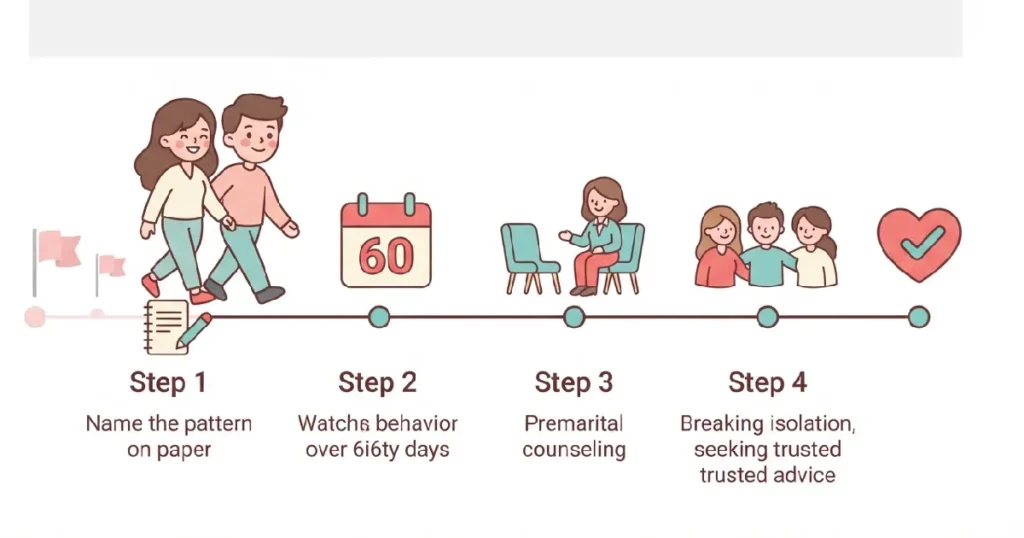
Identifying a warning sign is only half the work. Here is a framework you can actually use, starting today.
Name It on Paper. Write the specific behavior down in concrete language: “He has hidden purchases from me three times this year.” Writing interrupts the mental softening that love performs. Vague worries stay negotiable. Written patterns become visible.
Run the 60-Day Behavior Window. After one calm, direct conversation about what you have observed and what you need, watch behavior, not promises, for 60 days. Genuine change shows up as consistent action without reminders. Performed change shows up as a two-week burst followed by relapse.
Book Premarital Counseling Early. Frame it as preparation, not crisis management. A skilled couples therapist can surface patterns in weeks that might otherwise take you years of marriage to name. A partner’s reaction to the suggestion is itself useful information.
Break the Isolation. Share your specific observations with one or two trusted people outside the relationship. Isolation is a red flag multiplier; secrecy lets small patterns feel normal. A useful question to ask someone you trust: “If your daughter described this exact behavior, what would you tell her?”
The Most Loving Thing You Can Do Before Saying Yes
Remember that knot in your stomach from the beginning? It was never disloyalty. It was data.
You now have what most people walking down the aisle never had: the ability to tell cold feet from cracks in the foundation, language for the quiet patterns, and a concrete way to test whether change is real. Left unexamined, these patterns do not just strain a marriage. They quietly become the reason it ends.
Seeing a red flag is not the failure. Ignoring it is.
Love that survives is not love that never saw the warning signs. It is love that looked at them honestly, before the paint went on.
My Closing Remarks:
I will be blunt with you, friend to friend. In my practice, I have never once heard a divorcing client say the signs weren’t there. Not once. Every single one says some version of “I knew, and I married them anyway.” That sentence, repeated across years of sessions, changed how I think about weddings. The bravest thing I have watched people do is not walk down the aisle. It is pausing at the edge of it, asking hard questions, and trusting themselves with the answers. You deserve that same courage.
More related stories for you:
- If you’re wondering whether commitment is genuinely coming, read the real signs he is going to propose and how to tell them apart from future faking.
About The Author