
 Sara Carmen
Let us be completely honest for a second. You do not want to sound stiff, cheesy, or wildly inappropriate when you stand up with that microphone. You want the room to laugh, but absolutely not at your daughter’s expense. I know the pressure is heavy. You are standing between two families, holding a glass of champagne, and everyone is staring. Right now, you might be staring at a blank page thinking that you are not a stand up comedian. You just need a good first line to break the ice.
Most Father of the Bride Speech advice fails completely because it assumes every dad should tell a big, theatrical joke. The uncomfortable truth is that the real win is choosing the right type of opener for your specific personality and your specific room.
The best funny Father of the Bride Speech starter is short, affectionate, and room safe. Start with self aware humor or a gentle wedding joke, then pivot quickly into gratitude, love, and a clear toast that sounds naturally like you.
This guide will skip the generic fluff that frustrates nervous speakers. You will get ten funny starter types, exactly when to use each one, and strict Do This Not That guidance. We will also look at a helpful comparison table to match your room, a real story about tricky family dynamics, and practical help for nervous speakers.
The Core Concept: Father Of The Bride Speech Redefined
A strong opening is not just a collection of words. It is a tone setting welcome, a public expression of love, and a bridge connecting two different families. The opening seconds matter most because they immediately tell the room whether to relax, laugh, and trust you for the next five minutes.
Table of Contents
What Is A Father Of The Bride Speech Really?
You need to go beyond the basic dictionary definition. This is a relationship speech, not a performance speech. It usually has four very specific jobs to do. You must welcome the wedding guests, honor the bride, acknowledge the new spouse, and finally raise a toast.
The opener should lower tension, establish warmth, and create positive momentum. You have to reframe humor as a tool for connection, rather than treating it like a comedy routine. When people laugh together, their physical tension drops. That makes them much more receptive to the emotional, heartfelt words you will share later.
The Science Behind What Works
According to Vanessa Van Edwards, founder of Science of People and behavioral researcher, effective icebreakers depend on warmth and authenticity, not cleverness. In her research on public speaking and first impressions, she found that audiences respond more to vulnerability and genuine emotion than to polished performance.
The benign violation theory, developed by researchers at the University of Colorado Boulder, explains why safe, affectionate humor lands better than edgy jokes at weddings. Humor works when it’s surprising but emotionally safe. A joke about your own nerves? Safe. A joke about your daughter’s past relationships? Violation without the benign part.
Wedding speeches are also remembered more for tone and emotional arc than for individual punchlines. That’s why the best father of the bride speech opening lines don’t try to be the funniest thing anyone has ever heard. They try to sound like you, make the room smile, and set up the next three minutes of sincerity.
What you’re really doing in those first 20 seconds is audience calibration: matching humor to the room, the age mix, and the family dynamics. A room full of college friends will laugh at different things than a room full of grandparents and coworkers. A blended family or a second marriage might need a different tone than a traditional first wedding.
Understanding toast etiquette also helps. The speech is not stand-up. It’s a welcome, a tribute, and a blessing. The humor serves the relationship, not the other way around.
“An Audience Decides Whether To Trust A Speaker Within The First Seven Seconds Of Hearing Their Voice.” This principle dictates why your opening line carries so much weight. You do not need the funniest joke in the world, but you do need an opener that signals safety and warmth immediately.
10 Actionable Steps To Get The First Laugh Without Sounding Cringe
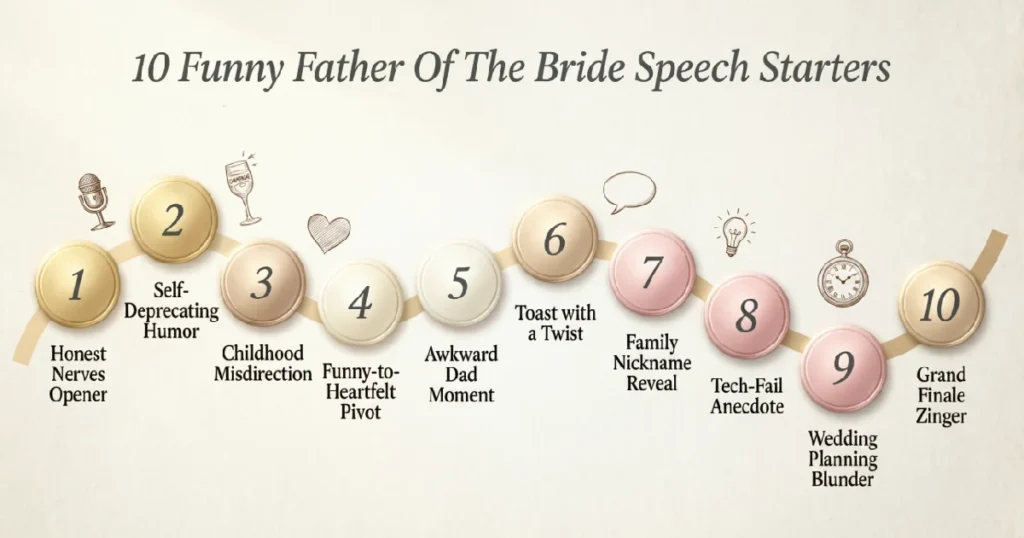
Not every funny opener fits every father. The absolute best one depends entirely on your delivery style, your family dynamic, and exactly how formal the wedding feels.
Here are ten practical steps to finding your perfect opening line.
Step 1: Use The Honest Nerves Opener
This is best for dads who are visibly nervous or not naturally theatrical. If your hands are shaking, call it out.
- Starter angle: Admit your nerves in one short, human line.
- Example direction: “If I seem surprisingly calm tonight, please know that it is entirely the work of this rented suit holding me together.”
- Do This, Not That:
- Do this: Deliver one light line that humanizes you.
- Not that: Do not open with three long apologies about how much you hate public speaking.
Step 2: Choose Self Deprecating Humor First
This is the best route for completely safe laughs. Joke gently about yourself, your memory, your emotions, or your protective role as a dad. Self targeted humor feels warm and carries a very low risk.
- Starter angle: Make yourself the gentle target.
- Example direction: “I spent six months preparing for this speech, which mostly involved me crying alone in my car while listening to country music.”
- Do This, Not That:
- Do this: Be the sole target of the joke.
- Not that: Never tease the bride about her appearance, her exes, or truly embarrassing childhood moments.
Step 3: Use The “I Was Told To Keep This Short” Opener
This works perfectly for lively, casual receptions. It is highly familiar, fast, and very easy to personalize.
- Starter angle: Add a twist tied to your daughter, the open bar, or the dance floor.
- Example direction: “My daughter gave me strict instructions to keep this under five minutes. She also said if I cry, she will cut off my microphone. So, let us move quickly.”
- Do This, Not That:
- Do this: Keep the twist fresh and affectionate.
- Not that: Do not just copy a tired, generic one liner exactly as you found it online.
Step 4: Open With A Warm Childhood Misdirection
This is best for sentimental families who still want a good laugh. Start with a sweet childhood detail, then completely flip the expectation.
- Starter angle: Set up a sweet memory, then pivot to a funny reality.
- Example direction: “When she was five years old, she already had her entire life planned out. Luckily for all of us, she dropped the dream of marrying a horse, and chose a wonderful human instead.”
- Do This, Not That:
- Do this: Pick a memory that shows her unique personality.
- Not that: Do not tell a rambling story that requires five minutes of setup before the punchline.
Step 5: Try The “I Knew They Were The One When” Opener
This is excellent when you genuinely like the new spouse and want to establish warmth early. This instantly includes the partner and reduces any outdated protective father tension. It helps modernize the speech wonderfully.
- Starter angle: Start with praise, end with a light joke about the partner’s quirks.
- Example direction: “I knew he was the one for my daughter when he willingly volunteered to help me clean the garage, and actually came back the next day.”
- Do This, Not That:
- Do this: Praise their relationship with a light smile.
- Not that: Do not frame the partner as someone who merely survived your daughter’s bad habits.
Step 6: Use A Wedding Day Observation
This is best for modern, witty, observational humor. Make one light comment about the day itself, the venue, the tears, the flowers, the planning process, or the sheer emotion of it all. Keep it universal and elegant.
- Starter angle: State an obvious truth about the wedding day.
- Example direction: “I want to thank you all for coming. I also want to thank waterproof mascara, which is the only reason my side of the family looks presentable right now.”
- Do This, Not That:
- Do this: Use a shared truth everyone in the room recognizes.
- Not that: Do not joke about the financial cost, the alcohol consumption, or the planning stress in a way that sounds bitter.
Step 7: Open With A Universal Dad Truth
This is perfect if you want the room to laugh and soften at the exact same time. It works incredibly well because it blends humor with your core identity.
- Starter angle: Share a broad, relatable fact about fatherhood.
- Example direction: “Every dad has two main jobs at a wedding. Pay the vendors on time, and try not to ugly cry in front of two hundred people. I am currently failing at one of these.”
- Do This, Not That:
- Do this: Use broad, highly relatable fatherhood truths.
- Not that: Do not overplay the losing my daughter trope in a possessive or weirdly territorial way.
Step 8: Use A Gentle Welcome Line For The New Partner
This is best for warm, close knit family rooms. This can create a great laugh while strongly signaling your total acceptance. It should always feel like a welcome, never a warning.
- Starter angle: Address the new spouse directly with a smile.
- Example direction: “Welcome to our family. We are loud, we argue about board games, and we never leave on time. You are officially trapped with us now.”
- Do This, Not That:
- Do this: Keep it highly affectionate and brief.
- Not that: Do not threaten, interrogate, or mock intimidate the groom.
Step 9: Use The Rule Of Three
This is best for speakers who want a polished, well crafted opening. Create a list of three traits, memories, or observations. The third item always carries the funny twist.
- Starter angle: Set up a pattern, then break it on the third point.
- Example direction: “My daughter is brilliant, she is incredibly kind, and she is absolutely terrible at parallel parking.”
- Do This, Not That:
- Do this: Use snappy rhythm and brevity.
- Not that: Do not stuff the opener with too many adjectives or confusing inside jokes.
Step 10: Use A Funny To Heartfelt Pivot
This is best for dads who want one single laugh, followed immediately by deep sincerity. Open with a light line, then turn very quickly toward love and pride. This is often the strongest real world format.
- Starter angle: One joke, then direct eye contact with your daughter.
- Example direction: “I promised myself I would not be the emotional dad tonight. But looking at you right now, I can see that was a completely ridiculous promise. You look breathtaking.”
- Do This, Not That:
- Do this: Shift into pure gratitude by sentence two or three.
- Not that: Do not chase more jokes and delay the emotional heart of your speech.
The Humor Safety Filter
Before you finalize your opening, run it through this strict checklist. If your opening line does any of these things, you must cut it out immediately:
- Embarrasses the bride in front of her peers.
- Targets physical appearance in any way.
- Mentions past relationships or exes.
- Requires a deeply private family backstory to understand.
- Sounds genuinely bitter about money or wedding costs.
- Turns the groom into the punchline of a cruel joke.
- Confuses half the room who do not know the context.
Comparison Table: Which Funny Starter Fits Your Room?
| Starter Type | Best For | Room Formality | Risk Level | Best Bridge Line | Avoid If |
|---|---|---|---|---|---|
| Honest Nerves | Anxious speakers | Any | Very Low | “But seriously, I am so glad you are all here.” | You are highly confident. |
| Self Deprecating | Safe, warm laughs | Casual/Semi | Low | “Jokes aside, today is about two amazing people.” | You lack basic self esteem. |
| Keep It Short | Lively crowds | Casual | Low | “I will keep my promise and just say this…” | The room is highly formal. |
| Childhood Misdirection | Sentimental families | Formal/Semi | Medium | “She has always known exactly what she wanted.” | You cannot tell a brief story. |
| Knew They Were The One | Welcoming the partner | Any | Low | “Seeing them together just makes sense.” | The partner is very shy. |
What to say if the first joke gets only a polite laugh:
Do not panic. Have a recovery line ready. Just smile and say, “Right, that was my warm up. The good material is emotional anyway.” Or try, “I can see my daughter approved a much shorter version than I wrote.” This adds practical charm and shows you are totally in control of the room.
The Simplified True Story: The Turnaround
Meet Martin. He is a fifty five year old architect from Chicago. It was 6:30 PM on a humid Saturday in July. The reception hall buzzed with two hundred guests, and the clinking of silverware against expensive china echoed off the high ceilings. Martin stood in the corner, nervously adjusting his tight collar, sweating through his custom suit.
He was divorced, and the tension between his side of the family and his ex wife’s side was thick enough to cut with a butter knife. He kept finding the same recycled advice online. Just be yourself. Tell a funny story. Keep it short. That frustrated him endlessly. His real problem was that he had no idea how to actually open the speech without making things awkward. He was terrified that any joke about marriage or family dynamics would land terribly given the room’s history.
He decided to apply The Safe Tension Release Model. This specific model has three simple steps. First, acknowledge the obvious elephant in the room safely. Second, use self targeted humor. Third, pivot to immediate gratitude.
When the microphone was handed to him, he did not try to be a comedian. He looked at his notes, smiled nervously, and said his opening line. “If I seem surprisingly calm tonight, please know it is entirely the structural integrity of this suit holding me together.”
The entire room erupted in warm, supportive laughter. He visibly relaxed, dropping his shoulders. He then pivoted smoothly into how fiercely proud he was of his daughter. The tension evaporated. His daughter later hugged him tight and whispered that it sounded exactly like him. That is the ultimate goal. You want authentic connection, not a cheap laugh.
Comparative Analysis: Funny Personalized Opener Vs Quote Opener
You might be wondering if you should just steal a famous quote to start your speech. Competitors often offer long lists of quotes because they are very easy to publish. But a quote may sound polished, while a short original line usually sounds much more human.
Funny Personalized Opener:
- Offers much stronger authenticity.
- Is far more memorable to the couple.
- Better for building immediate connection and room energy.
Quote Opener:
- Easier if the speaker is very formal or not confident writing original lines.
- Can sound highly generic if overused.
The Best Compromise: Open with one original, funny line about your nerves or the day itself. Then, place a meaningful quote much later near the toast or the blessing. This gives you the best of both worlds.
Common Mistakes And How To Avoid Them
It is entirely normal to feel overwhelmed. To protect your speech, you must avoid these three frequent traps that derail otherwise great fathers.
“Authenticity In Public Speaking Is Not About Perfection, But About Allowing The Audience To See Your True Intentions.” This matters because your family wants to see your heart, not a polished theatrical performance that lacks soul. Give yourself permission to be human.
Mistake 1: Opening With Too Many Apologies
The problem: Starting with “I’m not good at this” or “I hate public speaking” tells the room you don’t want to be there. It also wastes precious time during the primacy effect window.
How to avoid it:
- Write your opening line, then delete any apologies before it
- If you’re nervous, use Step 1 instead: one quick self-aware line, then move forward
- Practice saying your opener out loud until it feels natural
What to say instead: “I’ve been practicing this all week, so let’s see if I remember it.”
Mistake 2: Telling A Joke That Needs Explanation
The problem: If you have to explain the context, the backstory, or why it’s funny, you’ve already lost the room.
How to avoid it:
- Test your joke on someone who wasn’t there for the original moment
- If they don’t laugh immediately, cut it
- Choose a joke based on universal truths, not private family history
What to say instead: Use Step 7 or Step 9, both of which rely on broad, relatable humor everyone in the room can understand.
Mistake 3: Forgetting To Pivot From Funny To Heartfelt
The problem: You get a good laugh, then keep chasing more laughs. The speech starts to feel like a roast instead of a toast.
How to avoid it:
- Plan your pivot point in advance (usually after your opener or first story)
- Write a bridge line like “But in all seriousness…” or “And that’s what today is really about.”
- Remember that emotional pacing means alternating lightness with sincerity, not choosing one or the other
What to say instead: “I could tell stories all night, but what I really want to say is this: I’m proud of you.”
Frequently Asked Questions (FAQs)
1) How long should it be?
A good wedding toast usually runs four to six minutes. That is roughly five hundred to seven hundred spoken words. Your opening should take only twenty seconds before you move into your main story. If guests remember your warmth more than your runtime, you found the perfect balance. This range leaves room for laughter.
2) Can I roast the groom?
Yes, but you must keep it incredibly light, brief, and affectionate. A joke about the new partner should feel like a warm welcome, never a warning. Avoid anything about past relationships, money, or private family issues. The safest formula is one gentle line, followed immediately by sincere praise for how he supports your daughter.
3) What if I am not naturally funny?
Then please do not try to become a comedian overnight. Use one simple, truthful line that sounds like something you would actually say. Then, move right into a warm story. The goal is not a massive laugh. The goal is a relaxed room. Self aware honesty works better than complicated punchlines for most fathers.
4) Can a stepfather give the speech?
Absolutely. Wedding etiquette is much less rigid than many people think. The right speaker is simply the person who has earned a meaningful role in the bride’s life. A stepfather, grandfather, or father figure can speak if the couple agrees. The only key is clarity, warmth, and prioritizing the couple’s comfort above all else.
5) Should I mention a deceased parent?
Yes, if doing so feels loving, brief, and appropriate for the couple. Mention them in a way that honors the joyous day rather than shifting the entire room into prolonged grief. One heartfelt sentence is often plenty. If you are ever unsure, just ask the couple beforehand. Their emotional bandwidth absolutely matters the most.
Final Takeaway
Do not just summarize what you read today. You need to take immediate action to conquer your anxiety. Tonight, sit down at your kitchen table and write out three possible opening lines from the list above. Read them out loud into your phone’s voice memo app. Listen back to them, and strictly keep only the one that actually sounds like your real speaking voice. If it feels completely natural when spoken, you have found your absolute right starter.
A successful Father of the Bride Speech is never about achieving comedic perfection. It is about standing up in front of the people you love, acknowledging the immense beauty of the moment, and guiding the room toward a joyous celebration. When you look at your daughter sitting there in her gorgeous dress, what is the one true thing you want her to know before the night is over? Start there, add a little safe humor, and you will do remarkably well.
My closing remarks:
Look, I will be completely blunt with you. Nobody cares if your suit is perfectly tailored or if your voice cracks a little bit on the microphone. Perfection is entirely overrated and honestly, it is boring. People want to see the real you. As someone who has watched hundreds of people freeze on stage, I promise that your vulnerability is your greatest asset tonight. Do not hide behind a fake comedian persona. Let them see your heart. You have absolutely got this.
More Related Stories For You
- If you’re looking for more ways to strengthen the relationships that matter most, read our guide on good advice for a relationship, which covers practical steps for building trust and connection.
- Understanding mental health in relationships can also help you support your partner or family members through difficult times.
- And if you’re navigating complex dynamics, learning about bipolar disorder and relationships can provide clarity and compassion when it’s needed most.
About The Author