
 Nicole Adkins
The public man is not the private man. Once you see the split, the confusion finally has a name.
Key Points
- A Narcissist Man Act in a Relationship is rarely chaos. It is a two-track system of public charm and private control.
- He does not lose control. He uses withdrawal, criticism, and unpredictable affection to keep you off balance.
- Naming the pattern gives you proof you are not imagining it, and a safer way out.
Contents
Table of Contents
We have been taught to recognize cruelty by its volume. Raised voices. Public scenes. Harm other people can see. Then you end up with a man who is adored at dinner parties and ice-cold once the door closes. You start wondering if the problem is you.
Someone might think he is simply tired from work. But what they do not see is the way his warmth returns the second a friend texts, then vanishes again when it is only you in the room.
Someone might think you are too sensitive. But what they do not see is the hours you spend replaying a single comment, trying to find the version of yourself that would not have set him off.
Someone might think your relationship looks enviable. But what they do not see is the mental list of safe topics you now carry like a second spine.
A narcissist man in a relationship runs on two tracks. Public charm protects his image. Private control protects his power. He uses withdrawal, criticism, and unpredictable affection on purpose. The pattern holds because it works. You keep trying to fix what was never broken on your end.
This is not a personality quirk. According to a clinical review from the National Institutes of Health, narcissistic personality disorder appears in roughly 0.5 to 5 percent of people. The quieter form is missed even more often, which is why so many partners spend years second-guessing their own memory. The Mayo Clinic description of narcissistic personality disorder names the core pattern plainly: a deep need for admiration, a fragile sense of self, and a limited ability to feel another person’s inner world.
That last part is the one that rearranges your daily life.
The Two Faces of a Narcissist Man in a Relationship
He is not one man who sometimes has a bad day. He is two performances sharing one body.
In public he remembers names. He pulls out chairs. He tells the story of how you met in a way that makes other couples glance at each other and smile. This is not kindness leaking out. This is reputation management, the careful upkeep of the character he needs other people to believe in.
At home the script changes. Your question about money becomes “nagging.” Your request for closeness becomes “pressure.” Your hurt becomes “drama.” The same mouth that praised you at dinner can go silent for two days over a tone of voice no one else heard.
He keeps two versions of the relationship running at the same time, like a house with the lights wired to two different switches. When company is over, every room is bright. When it is just you, he kills the power and then asks why you are sitting in the dark.
Reputation Management: Why a Narcissist Man Guards His Image
His image is not vanity. It is armor.
If friends, family, or coworkers see him as generous and steady, then your private account of him sounds unhinged. That gap is useful. It isolates you without him ever needing to lock a door. Later, if you leave, the same gap becomes a smear campaign. He does not have to invent a new story. He only has to activate the one people already like.
This is why he can be tender at a wedding and punishing in the car ride home. The audience changed.
How a Narcissist Man Turns Affection Into Control
Affection in this relationship is not a language. It is a lever.
Early on, the warmth can feel like relief after years of being unseen. Texts arrive fast. Plans appear. You are “different from other women.” That rush is often called love bombing, a flood of attention that creates attachment before you have enough data to judge the person in front of you.
Then the supply becomes irregular. A good weekend. A brutal week. An apology that sounds almost right, followed by the same cut two days later. Psychologists call this intermittent reinforcement: unpredictable reward that trains the brain to keep hoping. It is the same mechanism that keeps a person pulling a slot machine. The American Psychological Association’s overview of trauma helps explain why the bond can feel physical, not just emotional. Your nervous system starts treating his approval like safety and his silence like danger.
He is not losing control. He is using it.
Sex can follow the same pattern. It may be used as a peace offering, a proof of ownership, or a withdrawal of closeness when you set a boundary. Intimacy stops being mutual. It becomes a weather system you try to predict.
If you have been asking yourself why you cannot just walk away, the answer is not weak will. It is a trained attachment to an unstable source of relief.
The DARVO Cycle: How a Narcissist Man Flips Blame
There is a name for the moment you finally speak up and somehow end up apologizing.
DARVO stands for Deny, Attack, Reverse Victim and Offender. Psychologist Jennifer Freyd mapped this sequence. He denies the harm. He attacks your tone, your timing, or your sanity. Then he reverses the roles until you are comforting the person who hurt you.
Here is how it looks in a kitchen at 10 p.m.
You say he humiliated you in front of his brother. He says that never happened. Then he says you are always looking for a fight. Then he is wounded that you would “make him the villain” after everything he does for you. Twenty minutes later you are explaining yourself. The original injury has disappeared.
Most people in this situation do not realize they were provoked on purpose. A raised eyebrow. A late arrival. A joke at your expense. He collects your reaction the way some people collect evidence. Your anger becomes his exhibit A.
This is why you leave arguments feeling crazy rather than clear. The goal was never resolution. The goal was to make your reality look less stable than his.
Covert Narcissism: Why the Quiet Narcissist Man Is Harder to Spot

The loud type is easier to explain to other people. He boasts. He interrupts. He needs the biggest story in the room.
The covert type is the one that keeps you in the relationship longer. He may look humble, wounded, or chronically disappointed by life. He does not shout that he is superior. He sighs that no one understands him, including you. Grandiosity hides inside grievance.
This is the diagnostic blind spot. Friends see a sensitive man. You live with a man who treats your needs as an attack on his suffering.
The Victim-Mindset Narcissist and Weaponized Vulnerability
Watch what happens when you are hurting.
A partner with ordinary emotional immaturity may shut down and later feel genuine remorse. A narcissist man often turns his own fragility into a shield. Your cancer scare becomes his stress. Your promotion becomes his insecurity. Your boundary becomes the reason he “cannot be himself.”
Vulnerability is supposed to create closeness. In his hands it creates debt. You start managing his feelings so carefully that your own life shrinks to the size of his comfort.
A useful boundary test: an avoidant man often pulls away because closeness scares him, and he can still recognize your pain. A narcissist man pulls away to punish you, then uses your distress as proof that you are the unstable one. The first pattern can grow inside safety. The second pattern feeds on your self-doubt.
Not every cold or selfish partner has a personality disorder. Armchair labels have gotten sloppy. The difference that matters is empathy under stress. Does he become more human when you are in pain, or more strategic?
The Fleas Effect: When Narcissistic Behavior Starts Changing You
Here is the part almost no one prepares you for.
Stay long enough and you may start recognizing him in your own voice. You monitor. You snap. You control small things because the big things were never yours to hold. Therapist Pete Walker described this as “fleas,” the defensive traits a person can pick up after long exposure to abuse, the way you might pick up fleas from a neglected animal.
This reaction is common and it is not a character flaw.
Maya, 38, married nine years, used to be the friend who gave people the benefit of the doubt. Her husband was the man who remembered every drink order at a party. At home he could go silent for days if she questioned a credit card charge. She began keeping a private list of safe subjects. She caught herself cutting off her younger sister with the same icy precision he used on her. That frightened her more than his rages. She started a hidden dated log of incidents. Four months later she moved money, secured a room with a friend, and left during a work trip. The smear campaign started within a week. She was shaky. She was also ready, because she finally understood that the charming public man and the private man were not a contradiction. They were a system.
If you hate who you are becoming, that hatred may be information. It may be the part of you that still knows the difference.
Signs a Narcissist Man Is Acting This Way
You do not need a courtroom. You need a pattern you can see without him narrating it.
Look for repeats, not one ugly night.
- He is generous in front of witnesses and stingy with respect when you are alone.
- Your memory of events is constantly under revision. He says you are “too emotional” when you recall specifics.
- Affection arrives after compliance and disappears after a boundary.
- He isolates you through jokes about your friends, guilt about your family, or monitoring of your phone.
- Money, time, or transportation somehow remain under his practical control.
- After conflict, you are the one repairing, explaining, and shrinking.
- He can describe your flaws in high detail and goes blank when asked to describe your inner life.
- When you pull away, he hoovers: sudden sweetness, nostalgia, or crisis designed to pull you back.
The NHS list of signs of an abusive relationship is worth reading if you have been calling this “just a rough patch.” Isolation, fear, and the need to watch every word are not communication problems. They are control.
If three or more of these show up as a rhythm rather than an exception, you are not overreacting. You are noticing.
How to Safely Leave a Relationship With a Narcissist Man

Insight without a plan can keep you stuck inside a smarter version of the same hope. One place to start is action that does not require his agreement.
Private documentation. Keep a hidden, dated log of specific incidents, exact quotes, and contradictions. A notes app on a cloud account he cannot access works. So does a notebook at work. This counters gaslighting, the tactic of making you distrust your own memory. It also becomes useful if custody, finances, or a protective order enter the picture.
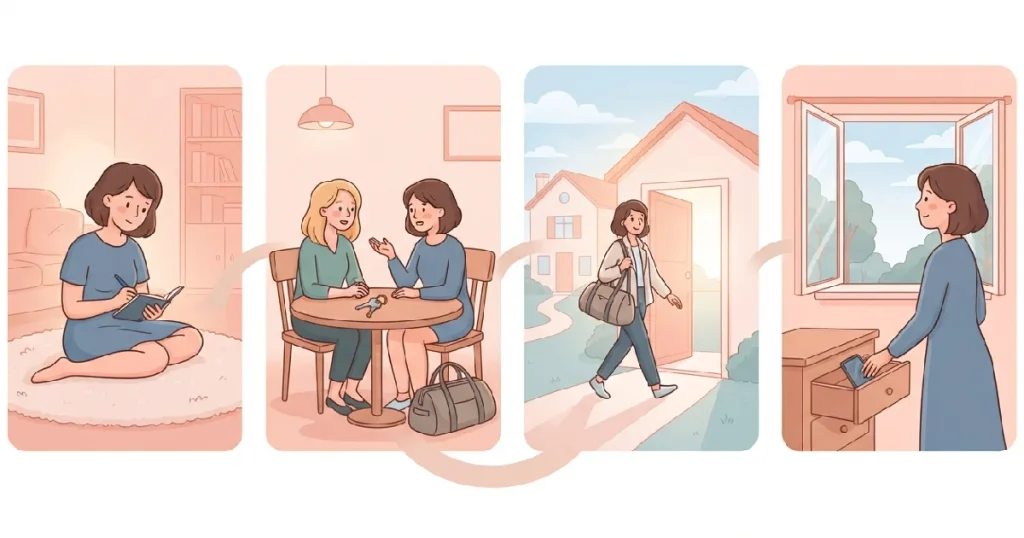
The silent discard exit. Warning him can escalate the very control you are trying to escape. Quietly line up housing, documents, transportation, and a trusted third party first. Then leave without a closing speech. Closure is a conversation he will treat as new material.
Total no-contact. Block every channel. Any reply, even a calm one, restarts the intermittent reward cycle. Do not contact a new partner to “warn” her. That message will be recast as jealousy or harassment and used against you.
Coercive control laws. If he isolated you, tracked you, or restricted money, look up whether your region treats coercive control as abuse. The National Domestic Violence Hotline explanation of coercive control is a clear starting point. Some places already recognize non-physical patterns as legally relevant. That can change a custody or protection case more than a diary of feelings ever will.
Couples counseling is rarely the right room when one person uses the session to collect ammunition. Individual trauma-informed therapy is the better path. Waiting for him to change is not a safety plan. Lasting change in these traits requires long, voluntary treatment and a capacity for self-reflection that is often the very thing missing.
A useful question to ask yourself tonight is simple. If a friend described this exact week, would you tell her to try harder?
Why You Keep Attracting a Narcissist Man
If this is not your first time, the shame can feel heavier than the relationship.
Repeat attraction is often tied to a fawn response, a survival style in which you keep the peace by pleasing the person who could hurt you. It pairs easily with anxious attachment, the early lesson that love is inconsistent and must be earned through effort. You did not “choose badly” because you are foolish. You recognized a familiar weather system and called it home.
That is not weakness. That is wiring.
Wiring can be updated. The work is not becoming colder. The work is staying present when a charming man rushes closeness, and treating intensity as data rather than destiny. Slow is not a lack of passion. Slow is how you finally see which switch he is holding.
You now have language for the two-faced pattern, a name for the blame flip, a way to tell fleas from your actual self, and a quieter exit than the confrontation he is better at winning. The house is still dark if you are still inside it. You are no longer confused about who cut the power.
The confusion was the trap. Clarity is the way out.
My Closing Remarks
In my practice I have watched brilliant women edit themselves down to a size that would not threaten a fragile man. The most brutal part is not his cruelty. It is the years you spent cross-examining your own knowing. Stop auditioning for a version of him that would require a different childhood, a different nervous system, and a different soul. That man is not late. He is fictional. Your life does not need his review. It needs your exit.
More Related Stories for You
- If your body is still braced for the next mood shift, these mindfulness exercises for anxiety can help you settle the alarm he trained into you.
About The Author