


If you are reading this right now, you are probably living in a house that feels like a hidden minefield. You are exhausted from constantly walking on eggshells. You do this not because you are overly sensitive, but because you are married to a person who perceives a completely neutral comment as a literal act of war. You remember a man who was incredibly charming, attentive, and perhaps even a little too good to be true. Today, however, that man has been entirely replaced by a cold stranger who dismisses your feelings, controls your free time, and constantly makes you doubt your own memory.
Identifying the 10 Signs of a Narcissistic Husband is your very first step out of the heavy fog. Most articles and well-meaning friends will tell you to simply communicate more or seek traditional marriage counseling. As a therapist, I am telling you that is often dangerous advice. For a highly toxic partner, communication is never a tool for connection. It is a weapon for dominance.
A narcissistic husband displays a pervasive pattern of grandiosity, a total lack of affective empathy, and an obsessive need for admiration. The core behavioral signs include severe gaslighting, chronic entitlement, an inability to take accountability, and a predictable cycle of idealization followed by harsh devaluation. Self-protection requires establishing strict emotional boundaries and utilizing the gray rock communication method immediately.
In the following psychological breakdown, I am going to give you the forensic tools to identify these destructive patterns. More importantly, I will give you the exact strategic steps you need to reclaim your cognitive autonomy and emotional safety starting today.
The Core Concept: 10 Signs of a Narcissistic Husband Redefined
To truly understand what you are dealing with in a modern marriage, we absolutely must look past the superficial concept of a big ego. Narcissism is not simply loving oneself too much. That is a dangerous myth. Narcissism is the pathological inability to regulate self-esteem internally. Because he cannot make himself feel good, he develops a desperate, often ruthless reliance on “Narcissistic Supply” to survive. This supply is the attention, admiration, or even the intense fear of others. He needs this supply to prevent a total emotional collapse known as a narcissistic injury.
Table of Contents
Let’s bring in some actual science to back this up. A fascinating 2025 psychological study by researchers Gori and Topino utilized advanced network analysis to determine exactly how these specific symptoms interact in the brain. They discovered something mind-blowing. The need for admiration is the central node of the entire disorder. It acts as the primary bridge between overt, grandiose behavior and covert, vulnerable presentations. When you deny him his required admiration, it does not just annoy him. It triggers a massive cascade of other toxic symptoms, heavily increasing his exploitation, arrogance, and anger. You can read more about how these narcissistic personality characteristics function on a clinical level, but the reality at home is simply exhausting.
“Narcissism is fundamentally a disorder of self-esteem regulation, masked by a facade of grandiosity.” – Dr. Craig Malkin.
This quote matters immensely because it shifts your entire perspective on the marriage. You are not fighting a strong, overly confident man, but rather a highly fragile ego that requires constant feeding at the expense of your sanity.
10 Definitive Signs to Recognize the Pattern
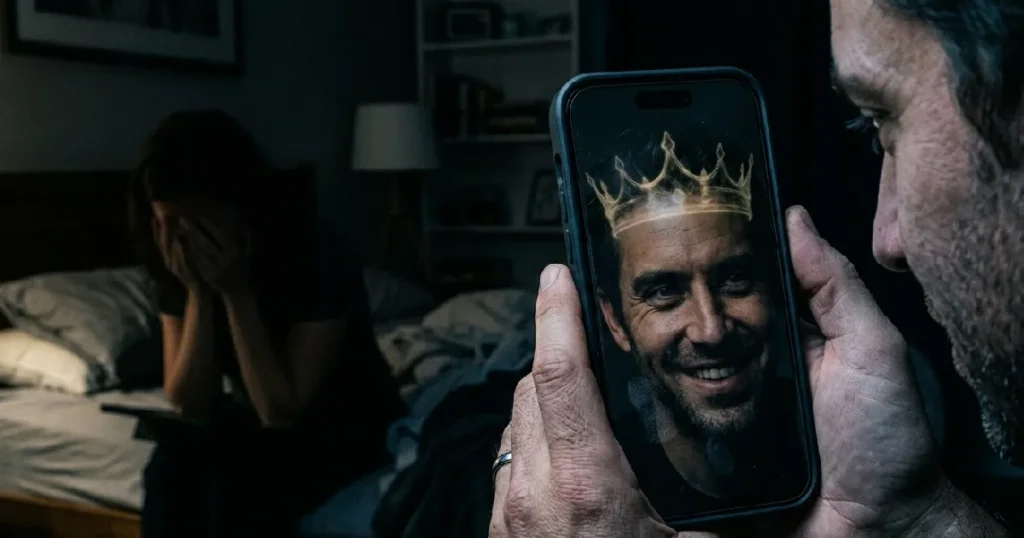
Here is the straightforward breakdown. The following signs are the clinical markers of a toxic marital structure. If your partner exhibits five or more of these behaviors on a consistent basis, you are likely trapped in a highly narcissistic dynamic.
1. The Grandiosity-Fragility Seesaw
He fluctuates wildly between believing he is the most important person in the room and feeling like a tragic victim of a world that just does not appreciate his absolute genius. He heavily exaggerates his professional achievements at dinner parties. Meanwhile, he expects you to treat him like an absolute hero for doing basic, everyday household tasks like taking out the trash. The modern marker of this is his obsession with his digital image. He might actively punish you with the silent treatment if you do not immediately “like” or share his social media posts, viewing your digital silence as a public betrayal of his greatness.
2. Strategic Digital Gaslighting
Gaslighting is not just standard lying. It is the active, malicious attempt to delete your reality. He will firmly deny that conversations ever happened, telling you that you are imagining things. He will twist obvious facts to make you deeply doubt your own sanity. Today, this often looks like deleting text threads, erasing browser histories, or altering smart-home settings, only to calmly tell you that the hard evidence you saw with your own eyes was just a technical glitch. If you want to understand the severe mental toll of this, the National Domestic Violence Hotline’s guide on gaslighting explains how this specific tactic destroys self-trust over time.
3. The Empathy Vacuum in Crisis
When you are terribly sick, grieving a loss, or incredibly stressed out, he is not just unhelpful. He is actively irritated by you. He views your physical or mental illness as a direct theft of the attention he deserves. If you try to share a deep personal struggle, he will quickly shift the entire conversation back to his own minor problems. He completely lacks affective empathy (the ability to truly feel what another person feels), even though he might retain cognitive empathy (the ability to mentally understand your feelings just enough to manipulate them).
4. Chronic Entitlement and Rule-Breaking
He operates under the firm belief that normal social and marital rules simply do not apply to him. He might spend large amounts of joint funds on flashy status symbols while putting you on a strict, humiliating financial allowance. In worse cases, he may openly justify his own infidelity because he claims his “needs” are simply not being met at home, yet he would fly into a jealous rage if you even looked at another person.
5. The Communal Mask (The Good Guy Syndrome)
This is often the most confusing part of the abuse. He is an absolute saint to the neighbors, the local PTA, or his work colleagues. He is always the first to volunteer for charity events. But behind closed doors, he is a tyrant. He heavily uses moral virtue signaling in public to build a bulletproof reputation. He does this intentionally, making it nearly impossible for you to be believed if you ever find the courage to speak out about his private abuse.
6. Weaponized Ostracism (The Silent Treatment)
When he is displeased with you, he does not sit down and discuss the issue like an adult. Instead, he withdraws all affection, eye contact, and communication for days at a time. This heavy silence forces you to anxiously chase him around the house, begging to find out what you did wrong so you can fix it. Recent psychological research shows this silent treatment is his aggressive way of managing his own deep, unhealed fear of being excluded or ignored.
7. Isolation via Flying Monkeys
He subtly and methodically poisons your relationships with outside support systems. He might whisper to your family members that you are currently struggling with your mental health, setting a narrative that you are unstable. He might tell you that your closest friends are secretly jealous of your marriage and cannot be trusted. The ultimate goal of this isolation tactic is to make himself your one and only source of truth.
8. Lack of Accountability and The DARVO Strategy
He has never, in the entire history of your relationship, given a completely sincere apology. If he does manage to say “I am sorry,” it is immediately followed by a “but it was really your fault because…” He relies heavily on DARVO. This stands for Deny the act, Attack you for bringing it up, and Reverse Victim and Offender. By the end of the argument, you are exhausted and apologizing to him for his bad behavior.
9. Perceived Split-Second Ostracism
He interprets completely neutral daily events as vicious personal attacks. If a mutual friend does not invite him to a casual lunch, or if you simply take a quick second to pause before answering a question, he interprets it as an intentional exclusion. He then reacts with intense, disproportionate rage or deep, punishing sulking that ruins the entire weekend.
10. Boundary Diffusion and Infantilization
He treats you like a naive child who simply cannot be trusted with adult decisions. He might closely monitor your physical location through phone apps under the guise of “caring for your safety.” He routinely dismisses your political or financial opinions as cute but entirely uninformed. Over a period of years, this constant belittling leads to boundary diffusion and a tragic loss of your own distinct identity.
5 Actionable Steps to Protect Your Autonomy Today
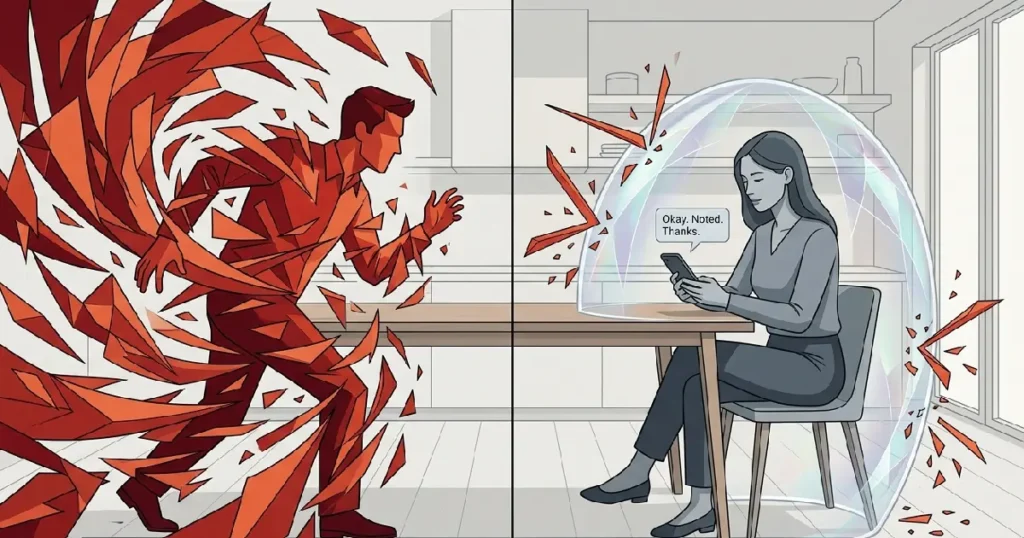
I want to be very clear with you. Protection in this scenario is never about changing him. It is entirely about changing your reaction to him. Here are the exact, step-by-step instructions you can apply today to protect your peace of mind and rebuild your cognitive autonomy.
Step 1: Implementation of the Gray Rock Method
You need to become as incredibly boring, non-reactive, and emotionally flat as a literal gray rock.
- Do This: Give very short, one-word answers to his probing questions. Say “Yes,” “No,” or “Okay.” Keep your facial expressions entirely neutral.
- Not That: Do not passionately defend your character. Do not tearfully explain your valid emotions. Stop trying to “win” the argument with logic.
Here is why this works. Toxic personalities feed on your emotional energy. Your tears and your screaming are both highly validating to them. When you completely stop reacting, you become a very low-quality source of supply. They usually get bored and stop the immediate attack.
Step 2: Utilize the BIFF Protocol for All Communication
If you must communicate about bills or children, use this specific psychological framework.
- Do This: Keep all of your text messages and emails Brief, Informative, Friendly (or emotionally neutral), and Firm.
- Not That: Avoid JADEing at all costs. Do not Justify, Argue, Defend, or Explain your position.
Here is the idea behind this. Long, heavily emotional explanations give him easy hooks to twist your words. The High Conflict Institute’s BIFF method creates a highly professional, polite distance that firmly protects you from falling into his exhausting verbal traps.
Step 3: Establish a Digital Fortress
Technology is frequently weaponized in modern toxic marriages.
- Do This: Immediately change all of your important passwords on a secure device that he definitely does not have access to (like a computer at your local public library). Start using heavily encrypted messaging apps for talking to your trusted therapist or a lawyer.
- Not That: Do not keep a deeply personal, secret journal on a shared home computer or write notes on a phone that has active family location tracking.
Digital coercive control is the primary way toxic spouses monitor their partners and stop escape plans before they even start. Protect your digital life first.
Step 4: The Concurrent Documentation Log
You need an anchor to keep you grounded in reality.
- Do This: Keep a very strict log of abusive incidents. Write down the exact date, the precise time, and objectively exactly what was said or done. Store this in a secure, hidden cloud folder.
- Not That: Do not ever pull out this log to confront him or prove him wrong during a fight.
Gaslighting works by slowly eroding your working memory. This private log is your personal reality anchor. It is an absolute necessity if you ever need to enter a difficult legal battle or custody dispute.
Step 5: Radical Self-Prioritization
You have likely abandoned yourself to keep the peace. It is time to reverse that.
- Do This: Reconnect with just one old hobby or one safe friend that is entirely yours and has absolutely nothing to do with him.
- Not That: Do not cautiously ask for his permission to be happy, or wait for him to approve of your new hobby.
Prolonged emotional abuse causes a deep fawn response. Reclaiming even a tiny piece of your independent self is the critical first step to getting your brain out of survival mode.
The Simplified True Story: The Turnaround of Elena

Let me share a story about a former client of mine. We will call her Elena to protect her privacy.
Elena had been married for fifteen years to a man everyone in their quiet suburban neighborhood considered an absolute saint. He enthusiastically coached Little League and organized all the summer block parties. But privately, his control was suffocating. He tracked her every single mile on her car’s GPS system and constantly told her she was simply too stupid to manage their weekly grocery budget.
I clearly remember the day Elena first logged onto our private telehealth session. It was late on a Tuesday evening. She was sitting on the floor of her dark laundry room, hiding right next to the loud hum of the dryer so her husband wouldn’t hear her quietly crying. She physically looked like she was shrinking. She kept nervously twisting her wedding ring around her finger, whispering to me that she felt like she was watching herself die in slow motion. She did not even have her own checking account.
We started very small. Elena applied just one specific tip from my clinical playbook: The BIFF Communication Method. Instead of spending three exhausting hours crying and explaining why she desperately needed fifty dollars for basic household supplies, she sent a very firm text: “I am taking fifty dollars from the joint account for groceries today. The receipt will be on the kitchen counter. Thanks.”
He raged, of course. But Elena remained completely Gray Rock. She didn’t shout back. She didn’t justify her need to eat. She simply walked into the other room and closed the door. Over the next six months, she slowly built her digital fortress, secured her own private documents, and found her inner strength. Today, Elena is legally separated and living in a bright, sunlit apartment. She no longer asks me if she is crazy, because she finally knows exactly who she is.
Common Mistakes and How to Avoid Them
The modern era brings totally new challenges to navigating toxic relationships. Avoid these four common traps to protect your fragile mental health.
1. Trying to Expose Him on Social Media
- The Mistake: Posting screenshots of his incredibly mean text messages on Facebook or Instagram to finally show the world who he really is behind the mask.
- The Solution: Do not do this. He will immediately use those emotional posts as solid proof in court, or with your extended family, that you are the unstable, crazy one. He absolutely thrives on public conflict and chaos, but you do not. Keep your hard evidence locked down for your lawyer’s eyes only.
2. Using “We” Language in Therapy
- The Mistake: Believing that if you just sit in counseling and say, “We really need to work on our communication,” he will magically understand your deep pain and change.
- The Solution: Switch completely to “I” statements that focus solely on your personal reality. Look at him and say, “I feel incredibly unheard when I am interrupted.” If he openly mocks this statement, it is highly valuable data for you that the relationship is not based on mutual respect. Stop trying to fix the “We” until you have safely secured the “I”.
3. Negotiating with Future Faking
- The Mistake: Believing him when he suddenly cries and says, “I will start therapy next month,” right when you are finally about to pack your bags and leave the house.
- The Solution: Watch his feet, not his lips. If there is no real action (like an appointment actually booked and attended), it is just Future Faking. This is a common manipulation tactic used to hoover you back into the abuse cycle. Use this exact text message: “I am glad you are considering therapy. Let’s talk about the state of our relationship after you have completed six full months of individual sessions.”
4. The Reasoning Trap
- The Mistake: Believing that if you can just find the perfect, magical combination of words to explain your pain, he will finally get it, apologize, and change.
- The Solution: Stop explaining yourself. He knows he is hurting you, he just does not care because he lacks affective empathy. Every time you deeply explain your feelings, you are just handing him a detailed map of your psychological triggers. Use this firm phrase instead: “I have shared how I feel about this situation. I am not going to explain it again.”
Frequently Asked Questions
How can I tell the difference between a narcissist and a selfish husband?
Selfishness is a behavior that can change with honest feedback, while narcissism is a rigid personality structure that totally resists change. A selfish husband can feel genuine remorse and adjust his behavior to stop hurting you. A narcissistic husband lacks affective empathy, cannot truly feel your pain, and will constantly blame you for having feelings.
What happens to children who grow up with a narcissistic father?
Children often suffer from massive boundary diffusion. They may become anxious people-pleasers exhibiting a fawn response, or develop narcissistic traits themselves through intergenerational transfer. They are frequently scapegoated or treated as a golden child, used solely as extensions of the father’s fragile ego. Intensive professional therapy is absolutely essential for children surviving these specific environments.
Can a narcissistic husband be physically abusive toward his spouse?
While narcissism is a psychological profile, it frequently overlaps with extreme coercive control, which can easily escalate to terrifying physical abuse. The malignant narcissist subtype is particularly associated with severe sadism and antisocial behaviors. If you ever feel physically unsafe, contact a domestic violence hotline or a local advocate immediately to create a secure exit plan.
Why does my husband only act this way with me privately?
This dynamic is incredibly common. You are his primary source of emotional supply. He must constantly maintain a flawless communal mask in public to secure admiration from outsiders. However, when the front door closes, that heavy mask drops. He views you as an extension of himself, feeling completely entitled to use you as a dumping ground.
Is there a cure for Narcissistic Personality Disorder in adults?
There is no pharmacological cure for this specific personality disorder. While a few individuals might show slight improvement through intensive, years-long specialized psychotherapy like schema therapy, most narcissists do not stay in treatment. They usually drop out very quickly the moment a trained therapist dares to challenge their grandiose self-image or demand real personal accountability.
What is narcissistic rage and how do I handle it safely?
Narcissistic rage is an explosive or deeply passive-aggressive reaction to a perceived slight or boundary. The best way to handle it is absolute non-engagement. Do not ever try to reason with a grown man in a state of rage. Quietly remove yourself from the room or the entire house until the dangerous situation has fully de-escalated.
Final Takeaway
You simply cannot fix your husband, but you absolutely can save yourself. Do not attempt to change everything in your complicated life today. Instead, focus entirely on reclaiming your own mind. Severe psychological abuse thrives in the dark, feeding heavily on your daily confusion and forced isolation. By finally recognizing these predictable behavioral patterns, you are already taking your power back. The 10 signs of a narcissistic husband are not just painful red flags. They are your actual roadmap out of the madness.
Start today with the reality anchor. Take a physical notebook or download a heavily encrypted app on your phone. Write down three very specific things that happened this week that he confidently told you never happened.
“Healing begins the moment you stop waiting for an apology you will never receive and start validating your own reality.” – Dr. Ramani Durvasula.
This profound quote matters because your long-term mental recovery is entirely dependent on your own self-trust, not his sudden, miraculous realization of guilt. If you are finally ready for deeper support, highly consider seeking a licensed professional who specifically lists cluster B personality disorders and abusive dynamics in their clinical expertise. You deeply deserve a beautiful life where your basic, everyday reality is not constantly up for debate. Find the courage to rebuild your foundation, and always remember that true trauma recovery is a process of returning to yourself.
My Closing Remarks
Listen to me carefully: You are not crazy, and you are not broken. You have been intentionally dismantled by someone who promised to protect you. I have sat across from countless women just like you, and the hardest truth to swallow is that the man you thought you married never actually existed. That is a terrifying realization, but it is also your key to freedom. Stop waiting for the ghost of a good man to return. Pack up your empathy, protect your peace, and walk away.