
 Nicole Adkins
Why your habits, relationships, and career choices aren’t random. The science behind the five traits steering it all.
Key Points
- Your personality traits aren’t fixed labels. They’re sliding scales that shift how you think, love, and lead every single day.
- The Big Five model explains why you and your partner argue about the same three things on repeat, and what to do about it.
- Understanding your personality traits gives you a map for predicting your own behavior before it costs you a relationship or a promotion.
Contents
Table of Contents
We all have that one habit we can’t quite explain. You check your email at 11 p.m. even though nothing good ever happens after 9. You say yes to plans you already know will drain you. You replay a small comment from a coworker for three days straight, even though they’ve probably already forgotten they said it.
Here’s the thing. None of that is random.
Someone might think you’re “just a worrier” or “just lazy” or “just too nice.” But what they don’t see is the quiet psychological wiring underneath those words. A friend might assume your need for structure is control freak behavior. What they miss is that your brain is wired to find comfort in order, and chaos genuinely costs you energy other people don’t have to spend.
Another person might watch you cancel plans for the third weekend in a row and label you flaky. What they don’t see is the invisible math happening in your head between social hunger and social exhaustion, a calculation running long before you ever picked up the phone to cancel.
That invisible math has a name. Psychologists call it personality traits, and once you understand how they work, you stop mistaking your wiring for a character flaw.
You’re Not Broken. You’re Wired a Certain Way.
You’ve tried to be more organized. You’ve tried to stop taking feedback so personally. You’ve tried to be the partner who doesn’t need six hours of alone time after a dinner party. And yet the same patterns keep showing up, and you start to wonder if something is wrong with you.
There isn’t.
What’s happening is that you’re running on a set of baseline traits that researchers have spent over 50 years measuring, testing, and confirming across cultures. Psychologists use a model called the Big Five, sometimes called the OCEAN model, to describe five core dimensions of personality that shape almost every choice you make without you noticing.
This matters because once you can name your pattern, you stop fighting it blindly. You start working with it. According to the research summarized in the Big Five personality traits framework, these five dimensions remain some of the most replicated findings in modern psychology, holding up across dozens of countries, languages, and decades of data.
Think of it like finally getting the owner’s manual to a car you’ve been driving for 30 years without instructions.
What Is the Big Five (OCEAN) Framework?
Back in the mid-20th century, researchers had a strange idea. They figured that if a personality trait was truly important to human survival and connection, language would have developed a word for it. This is called the lexical hypothesis, and it led scientists to comb through thousands of personality-related words in the dictionary.
Using a statistical method called factor analysis, which groups related traits together based on how often they show up together in the same person, researchers eventually narrowed thousands of descriptors down to five stable clusters. Those five clusters became the acronym OCEAN: Openness, Conscientiousness, Extraversion, Agreeableness, and Neuroticism.
Here’s what separates this model from the personality quiz you took in a magazine waiting room. You are not sorted into a box. You are placed somewhere on a spectrum for each trait, usually described as high, medium, or low.
You might score high on Openness and low on Extraversion at the same time. That combination alone describes a completely different person than someone high on both. This is why the Big Five feels more accurate than rigid personality “types.” It reflects how genuinely mixed real people actually are.
The 5 Core Personality Traits, Broken Down
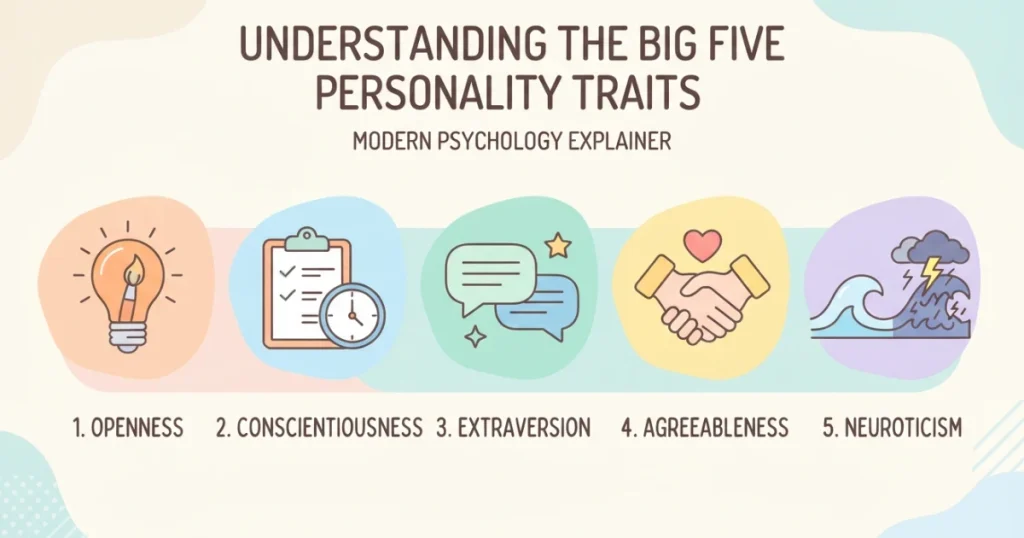
1. Openness to Experience: Curiosity vs. Comfort
Openness measures your appetite for new ideas, unfamiliar experiences, and abstract thinking. It’s the trait behind whether you’d rather try the restaurant with no reviews or order the usual.
If you score high, you probably enjoy debating theories, changing your mind when new evidence shows up, and seeking out art, travel, or ideas that stretch you. If you score low, you likely prefer proven methods, concrete facts, and traditions that have already been tested by time.
Neither is superior. High Openness fuels innovation. Low Openness fuels consistency and reliable expertise. This trait quietly decides how willing you are to update your beliefs when someone hands you information that contradicts what you already thought was true.
2. Conscientiousness: The Discipline Dial
Conscientiousness measures your capacity for self-discipline, organization, and follow-through on long-term goals. It’s the closest thing psychology has to a “success trait,” and we’ll get to why in a moment.
People high in Conscientiousness tend to plan ahead, meet deadlines, and keep their word almost compulsively. People low in Conscientiousness often work in bursts, thrive under looser structure, and sometimes let tasks slide until the pressure of a deadline forces action.
This trait shows up everywhere from whether your closet is color-coded to whether your boss trusts you with the client no one else can handle. Low Conscientiousness isn’t laziness. It’s often a different relationship with structure entirely, one that needs external scaffolding rather than internal willpower to function well.
3. Extraversion: Your Social Battery Setting
Extraversion measures how much stimulation and social contact energizes you versus depletes you. It’s less about shyness and more about how your nervous system processes reward.
High extraverts feel charged up by rooms full of people, thrive on external validation, and often think out loud. Low extraverts, commonly called introverts, recharge through solitude and tend to process their thoughts internally before speaking.
Most people don’t realize that introversion isn’t the opposite of confidence. It’s simply a different fuel source. This trait dictates how long you can stay “on” in a meeting before you need to disappear into a quiet room to reset.
4. Agreeableness: The Harmony Setting
Agreeableness measures how much you prioritize cooperation, empathy, and trust in your dealings with other people. This is often the trait that determines the emotional tone of your closest relationships.
High scorers tend to be warm, cooperative, and quick to forgive, sometimes to the point of avoiding necessary conflict. Low scorers are more comfortable with friction, more skeptical of others’ motives, and often better at negotiating on their own behalf.
But here’s what no one tells you. Extremely high Agreeableness isn’t automatically a virtue. It can quietly slide into people-pleasing, where you say yes to protect the relationship while slowly resenting yourself for it.
5. Neuroticism: Your Threat Detector
Neuroticism measures how easily you experience negative emotions like anxiety, irritability, or self-doubt, and how long those emotions stick around once triggered. This is not the same as being unstable or weak.
High scorers tend to notice threats faster, ruminate longer, and feel emotional shifts more intensely. Low scorers process the same stressful event and move on within the hour, sometimes barely registering it happened at all.
That’s not weakness. That’s wiring. High Neuroticism often comes paired with heightened empathy and vigilance, traits that made early humans excellent at spotting danger before it arrived.
The Trait Activation Secret Most People Miss
Here’s the part almost nobody talks about when they explain the Big Five, and it’s the piece that finally makes this model click for most of my clients.
Your personality traits don’t operate at full volume all the time. Psychologists call this Trait Activation Theory, and it explains something you’ve probably noticed but never had language for: why you can be the loudest person at a dinner party and the quietest one in a work meeting.
The theory says traits get “activated” more strongly in loosely structured, ambiguous situations, and get dialed down in highly structured, rule-bound ones. A wedding reception with no assigned seating gives your Extraversion full permission to show up. A formal client presentation with a strict agenda suppresses it, regardless of your baseline score.
This is why you’re not a hypocrite for behaving differently at home than you do at work. You’re the same person responding to different amounts of situational freedom. Once you see your behavior through this lens, the confusing inconsistencies in yourself start making a lot more sense.
How Your Personality Traits Secretly Control Your Success
Personality traits aren’t just interesting trivia about yourself. They quietly steer outcomes you’d swear were pure luck or hard work alone.
A large body of research, including a meta-analysis published through the National Institutes of Health, has found that Conscientiousness consistently predicts job performance, academic achievement, and even longevity better than most other single traits measured in psychology. It’s not intelligence alone that gets people promoted. It’s the reliable, unglamorous follow-through that Conscientiousness provides.
Relationships tell a similar story. When one partner scores high on Agreeableness and the other scores low, small disagreements can spiral because one person wants to smooth things over immediately while the other wants to hash it out completely. Left unexamined, this mismatch doesn’t just create tension. Over years, it can quietly become the reason a relationship ends, not because either partner did anything wrong, but because neither understood the other’s operating system.
There’s also a trap worth naming directly. High Neuroticism paired with low Conscientiousness creates what I call the anxiety avoidance loop in my practice. The anxiety makes a task feel overwhelming, so you avoid it. The avoidance creates a deadline crisis, which spikes the anxiety even higher, which fuels more avoidance. Breaking this loop requires addressing both traits at once, not just the anxiety or just the procrastination in isolation.
Real Examples of Personality Traits in Everyday Life

Reading trait definitions is one thing. Recognizing them in real people, including yourself, is another.
Positive Personality Traits You’ve Probably Seen This Week
Empathy shows up as the friend who notices you’ve gone quiet in a group text and checks in privately instead of calling you out.
Resilience looks like a coworker who gets laid off and, within weeks, treats it as a redirect rather than a verdict on their worth.
Authenticity sounds like someone admitting “I don’t actually know” in a meeting instead of bluffing through it.
Critical thinking is the person who hears a viral claim and quietly checks the source before repeating it.
Humility is knowing you’re good at your job while still asking a junior colleague for their honest opinion.
Emotional intelligence is staying calm enough during a hard conversation to actually hear what the other person means, not just what they said.
Negative Personality Traits That Quietly Sabotage Connection
Lack of self-awareness looks like someone dominating a conversation for twenty minutes, unaware the room checked out ten minutes ago.
Toxic positivity sounds like “everything happens for a reason” offered to someone who just needs to be heard, not fixed.
Perfectionism is rereading a single email six times, terrified one word choice will unravel your entire reputation.
Chronic procrastination is knowing a project is due Friday and still not opening the file until Thursday night.
Hypersensitivity to criticism turns one piece of feedback from a manager into a spiral of “they secretly think I’m incompetent.”
Arrogant stubbornness is holding your position in an argument even after someone shows you the receipts proving you’re wrong.
When Two Personalities Collide: Marcus and Elena’s Story
Marcus and Elena had been married for six years when they came in convinced they simply weren’t compatible anymore. Marcus scored high on Neuroticism and low on Extraversion, needing quiet evenings to reset after work. Elena scored low on Neuroticism and high on Extraversion, treating social plans as her main source of energy.
Every Friday became a fight. Elena wanted to invite friends over. Marcus wanted silence. Each one privately believed the other simply didn’t love them enough to compromise.
Once they understood these weren’t character flaws but baseline trait differences, the fight changed shape entirely. They built a rhythm: two social nights a week for Elena, two recovery nights for Marcus, with Sunday negotiated week to week. The conflict didn’t disappear completely, but it stopped feeling personal. It started feeling like logistics.
Now What? Turning Trait Awareness Into Action
Understanding your personality traits only helps if you actually do something with the information. Here are a few places to start this week.
Name your baseline. Consider taking a validated Big Five assessment rather than a casual online quiz, and write down where you land on each of the five dimensions. A useful question to ask yourself is which score surprised you the most, since that’s often where the most self-misunderstanding has been hiding.
Match your environment to your wiring, not against it. If you know you’re low in Extraversion, stop scheduling five meetings back to back and expecting to feel fine by 3 p.m. Build recovery time in, the same way you’d schedule a lunch break.
Use the activation lens on your relationships. The next time you and a partner clash, try asking whether this is a trait mismatch rather than a values mismatch. One requires compromise. The other requires an actual conversation about what matters most to each of you.
Separate the trait from the behavior it’s currently producing. High Neuroticism doesn’t have to mean chronic worry forever. It means you need more deliberate calming strategies than someone with a naturally quieter nervous system, not that something is wrong with you for needing them.
You Were Never the Problem. You Were Unlabeled.
Remember that 11 p.m. email check, the canceled plans, the three days spent replaying one small comment? None of that was a personal failing. It was your Conscientiousness, your Extraversion, your Neuroticism, doing exactly what they’re built to do.
Your personality traits were never meant to be judged as good or bad. They were meant to be understood.
You now have language for the parts of yourself that used to feel confusing or shameful. That alone changes how you move through your next hard conversation, your next deadline, your next quiet Friday night at home.
You’re not inconsistent. You’re a person with five dials, and now you finally know where they’re set.
My Closing Remarks
In my years working with couples and individuals, the moment someone learns their own trait profile is often the moment blame quietly leaves the room. I’ve watched partners stop calling each other “too sensitive” or “too cold” once they had real language instead. You deserve that same relief. Your wiring was never the enemy. It was just waiting to be understood.
More Related Stories for You
- If personality patterns fascinate you, you may also want to understand the darker end of the spectrum by reading about the characteristics of a narcissist man and how these traits show up in relationships.
About The Author