
 Nicole Adkins
The competent man who used to chase more now just wants the noise to stop.
Key Points
- The Delta male personality often arrives after you have already given more than the system returned.
- Quiet resignation is not laziness. It is your mind and body protecting what energy you have left.
- You do not need an Alpha rebrand to feel like yourself again. Small private wins and one protected boundary can start the shift.
Contents
Table of Contents
We show up. We do the work that keeps offices, homes, and entire teams running. We stay reliable even when no one is watching and the extra credit never comes. Somewhere along the way a lot of us simply stop reaching.
You know this if the next promotion looks like more of the same grind. Social plans feel like another performance you no longer want to give. The old fire has been replaced by a preference for routine, a small circle, and getting through the week without extra drama.
Someone might think you have become passive or lost your ambition. But what they do not see is how many late nights you put in for projects that got credited elsewhere.
Someone might assume you are content being average. What they miss is that you used to volunteer for more until the returns stopped matching the cost.
Your partner might wonder why you seem distant. The part they cannot see is that you are still providing and still competent. You just no longer believe any of it will finally be enough.
This pattern shows up often enough in conversations that people have given it a name: the Delta male personality. It describes the hard-working Average Joe who forms the backbone of most workplaces. He is good at his tasks. He does not want the spotlight or the people-management headaches. He values safety, close relationships, and predictability.
Many men who fit this description did not start here. They arrived after burnout, after a relationship that took more than it gave, or after watching traditional markers like home ownership slide further out of reach.
The Delta male personality is often a later chapter, not the opening one.
What Exactly Is a Delta Male Personality Beyond the Pop Hierarchy Labels
The term comes from informal ranking systems that try to sort men into Alpha, Beta, Sigma, and so on. Those labels grew out of observations of animal groups, but applying them rigidly to people has always been shaky science. Human social life does not sort itself into clean packs the way some writers pretend.
Still, the Delta description captures something real that a lot of men recognize. You are competent. You take quiet pride in doing a job well, whether that is engineering, accounting, firefighting, or keeping a household running. You prefer a small inner circle over a wide network. You like routine because it feels safe. You are not chasing status. You are trying to keep life from becoming more chaotic than it already is.
You can be family-oriented when the conditions feel stable. You can also carry a low-level resentment that you rarely voice. That mix of high output and low desire for leadership is the core of the Delta male personality.
Think of a character like Jim Halpert from The Office. Capable, well-liked in a small way, more interested in getting home than climbing. That is the surface. The deeper version includes the man who used to be more driven until something wore him down.
Key Delta Male Personality Traits You Might Recognize in Yourself
You stay private. You do not broadcast your plans or your disappointments. You focus on personal safety, a predictable schedule, and the few people you actually trust. You adapt when you have to, but you would rather not. You can harbor quiet cynicism about how little your extra effort ever changed the outcome.
These are not random quirks. They line up with what clinicians call adaptive withdrawal. That is a self-protection response where you pull energy inward after repeated experiences of high demand and low reward. It looks like checking out. It often feels like conservation.
Most men in this spot do not realize how common the pattern has become. You are not uniquely broken. You are responding to conditions that have gotten harder for a lot of people.
Delta Male Personality vs Sigma and the Former Alpha or Beta Path
A Sigma type actively steps outside the ranking game because he values independence and does not need the group’s approval. He rejects the hierarchy from a place of strength or indifference.
You, if this description fits, are still inside the system. You show up. You do the work. You just stopped investing hope in it. The checkout comes from fatigue, not from a philosophical decision to go your own way.
A lot of men who now fit the Delta male personality used to sit higher in the informal ranking. They pushed. They led projects. They dated with more energy. Then a layoff, a betrayal at work, a painful breakup, or simply years of unappreciated labor flipped a switch. The self-preservation response kicked in.
Psychologists have pointed out for years that dominance hierarchies in humans are far more fluid and context-dependent than pop lists suggest. You can read a clear overview of how these ideas started and why they get over-applied on the page for alpha and beta male. The same caution applies to the broader idea of a dominance hierarchy when we try to stamp it onto everyday life.
Using the label as a quick self-check can be useful. Treating it as a permanent identity usually makes the isolation worse.
Why the Delta Male Personality Shows Up After Burnout and Economic Pressure
The mechanism is not mysterious once you name it. Repeated workplace stress plus emotional exhaustion plus a shrinking sense of future reward produces a protective shutdown. Clinicians call the exhaustion-cynicism-reduced-efficacy cluster burnout. You can find a straightforward explanation of how widespread it has become in the American Psychological Association’s piece on burnout and stress.
In the UK a recent report found roughly a third of adults describing high or extreme pressure at work, with younger workers hit especially hard. You can see the generational split in the Mental Health UK Burnout Report. In the United States surveys keep landing around half the workforce reporting burnout symptoms. At the same time young men report some of the highest rates of loneliness. The U.S. Surgeon General’s advisory on our epidemic of loneliness and isolation lays out how damaging that combination can be.
Add the economic piece. Housing, family formation, and the old markers of “making it” feel further away than they did for previous generations. When the traditional prizes look unreachable, the rational move is to stop spending energy chasing them. That is not weakness. That is an energy-conservation strategy.
Left unexamined, the low-level resentment can harden. It can quietly become the reason the few close relationships you still have start to fray.
The Mental Health Link – Burnout as a Defense Mechanism
Burnout is not just being tired. It is a state where emotional resources have been overdrawn. The mind starts treating extra effort as a threat rather than an opportunity. Detachment is the circuit breaker. It trips so the whole system does not burn down.
You keep functioning at a competent level because competence itself feels safer than risk. The private cynicism is the leftover charge that has nowhere else to go.
This is why the Delta male personality so often looks like a former higher-status version of you. The earlier drive was real. The later withdrawal is the body and mind saying the old strategy is no longer sustainable.
How Cost of Living and Unreachable Milestones Fuel the Withdrawal
When rent or a mortgage takes most of the paycheck, when starting a family looks like a financial cliff, the old advice to “just hustle harder” starts to sound like a joke. You already hustled. The math did not change.
The result is a “just get by” mindset that looks like low ambition from the outside. Inside it is a realistic audit. Why keep climbing a ladder whose top rungs have been pulled further away?
Realistic Solutions: Moving the Delta Male Personality From Resentment to Quiet Strength

Grand rebrands fail because they ask you to spend energy you do not have. What actually helps is smaller and more private.
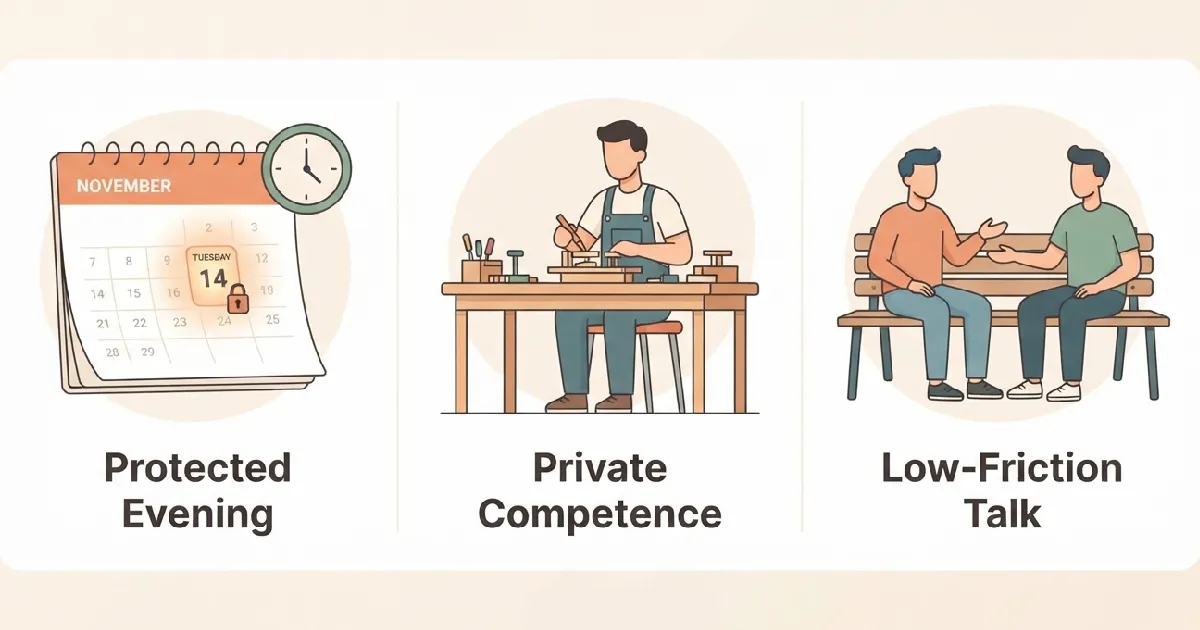
One place to start is the Protected Evening. Pick one night a week that is not available for extra work, extra favors, or extra emotional labor. Tell the people who need to know. Keep it. The bitterness drops when you stop giving away the last scraps of your time for free.
Another is the Private Competence Project. Choose something low-stakes that you can get better at for no one but yourself. Woodworking, a coding side project, solo hiking, learning a practical skill. The point is not to monetize it or post it. The point is to feel your own capability again without an audience.
A third is Low-Friction Processing. That might be a short-term therapist who understands male burnout, a men’s group that does not demand big emotional speeches, or even a couple of trusted friends who will sit with you without trying to fix you. The goal is to name the past setbacks so they stop running in the background.
Marcus was 36, a civil engineer who used to stay late and volunteer for every extra site visit. After a restructure that passed him over and a two-year relationship that ended with him feeling used, he went quiet. He still did excellent work. He just stopped offering more. At home he was present but flat. His partner thought he had given up. What she could not see was the constant low-grade calculation of how little any extra effort had ever changed the outcome. He started with one protected Thursday evening and a small garage project he never posted about. Six months later the resentment had not vanished, but it no longer ran the whole show. He had a little agency back.
That is the pattern that shows up again and again. Small restored control beats a forced personality transplant.
How Partners Can Support the Delta Male Personality Without Trying to Fix It
If you love someone in this place, the most useful thing is usually not a pep talk. It is non-judgmental space and respect for the need for quiet. Shared activity often works better than “we need to talk about your feelings.” Let him keep the inner circle small. Notice the competence that is still there instead of only the missing spark.
You cannot love someone out of burnout. You can stop adding to the load.
The circuit breaker already tripped. The question now is what you choose to power back on, and at what wattage.
You do not have to become louder to be whole. You do not have to pretend the old fire never existed. You also do not have to stay in the dimmest setting forever.
One protected evening. One private win. That is enough to start.
The quiet ones are not finished. They are conserving.
My Closing Remarks
I have sat across from enough men who look exactly like this description that I no longer see a type. I see a season. The man who used to have more gas in the tank is still in there. He is tired of performing hope he does not feel. What I notice, again and again, is that the moment he stops treating the quiet as a personal failure and starts treating it as information, something loosens. He does not suddenly become a different person. He just stops fighting his own nervous system. That small shift is usually enough to let a little life back in. You are allowed to want peace and still want more than this.
More Related Stories for You
- If the quiet checking out feels familiar and you want a low-pressure way to reconnect with yourself, these mindfulness exercises can help without asking you to become someone louder.
About The Author