
 Sara Carmen
The couples who stay happy for decades aren’t luckier than you. They just stopped waiting for love to run the household on its own.
Key Points:
- The real secret to a happy marriage has less to do with chemistry and more to do with daily systems most couples never build.
- Small, specific habits, like banning “always” and “never” during fights, protect a marriage more than grand romantic gestures ever will.
- Research on long-married couples shows most conflict never fully resolves, which means learning to manage it well matters more than winning it.
Contents
Table of Contents
We don’t fall out of love with the people we marry. We fall out of practice with them.
Somewhere between the wedding toast and the mortgage payment, most couples stop dating each other and start managing each other. You start negotiating whose turn it is to unload the dishwasher instead of reaching for their hand across the table. The romance doesn’t die in one dramatic moment. It gets buried under a thousand small transactions nobody signed up for.
You’ve probably felt this shift already. Maybe you still love your spouse deeply, but some nights you look at them across the kitchen and wonder when you turned into coworkers running a household instead of two people who chose each other.
That feeling isn’t proof your marriage is broken. It’s proof that no one ever taught you the actual mechanics of staying close. Not the greeting card version. The real one.
Here’s the short answer, before we get into the details: the secret to a happy marriage isn’t finding the right person. It’s building the right daily systems together, so love isn’t stuck carrying the entire household by itself.
The Psychological Shift Behind Every Secret to a Happy Marriage
Why the 50/50 Split Quietly Wrecks Marriages
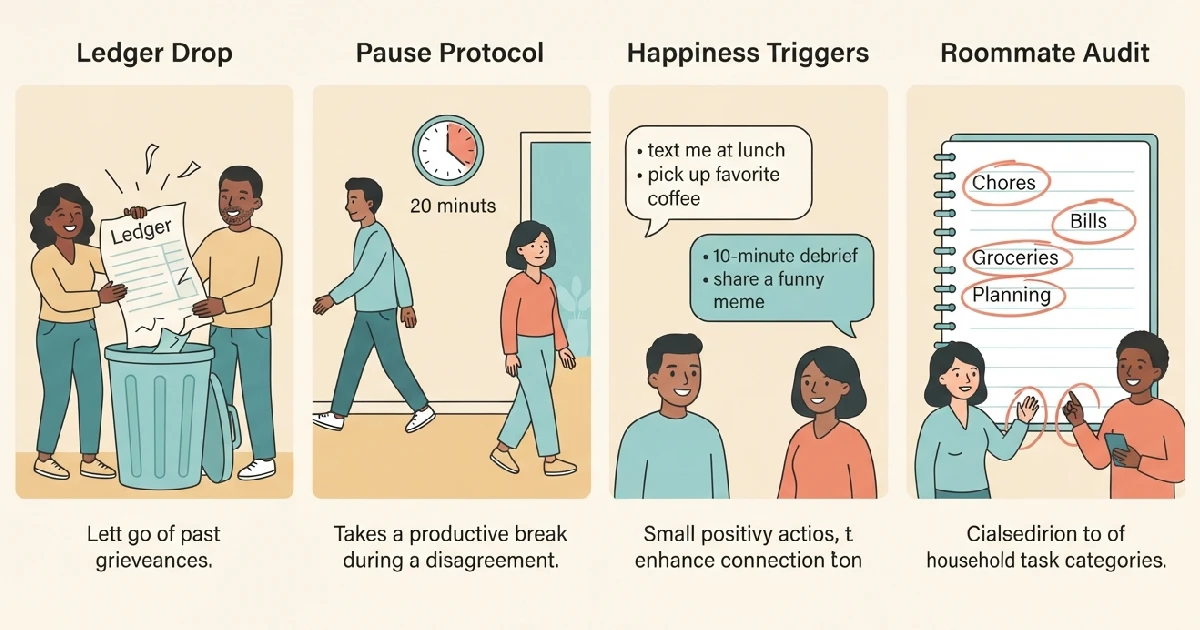
Psychologists sometimes call this the scorekeeping fallacy, the belief that a marriage should run like an evenly split ledger. Whoever cooked last night should get dishes tonight. Whoever handled the kids Tuesday gets a pass Wednesday.
The problem is that life doesn’t hand out even weeks. Some months your partner carries the newborn, the in-laws, and dinner while you’re drowning at work. Other months it flips completely.
Dr. John Gottman, who has spent decades observing married couples in his research lab at the University of Washington, found something that surprises most people. Roughly 69 percent of marital conflict is perpetual. It never fully resolves. The couples who stay happy for 20 or 40 years don’t solve these recurring issues. They build a way to live alongside them without keeping score.
This is where the 70/70 principle comes in. Instead of both partners aiming for an even 50 percent, both aim to give 70 percent of what they have that day. Some days you’ll give 90 percent because your partner has nothing left. Other days you’ll be the one running on empty.
Most couples who feel like roommates don’t actually have a broken marriage. They have an under-built one.
Reframing Conflict: You and Your Partner Versus the Problem
Here’s what no one tells you about arguing well. The goal was never to stop fighting. The goal is to stop fighting each other and start fighting the problem, together, from the same side of the table.
When couples argue face to face, adversarially, their nervous systems shift into what Gottman calls flooding, a state where your heart rate spikes past 100 beats per minute and your body treats your spouse like a physical threat. Logic shuts down. You’re not arguing anymore. You’re defending your life.
That’s why the smartest thing either of you can do mid-fight is leave the room. Not to punish. To let your body calm down enough for your brain to come back online.
15 Realistic Secrets to a Happy Marriage No One Talks About
Mindset and Individual Autonomy
Give 70 percent, not 50. Show up ready to over-contribute, and trust it evens out over the long run rather than tonight.
Your happiness is your job, not your spouse’s. A partner who is personally fulfilled, not one who is quietly outsourcing their entire self-worth to you, is the one who stays kind under pressure.
Keep your own friends and hobbies. Couples who maintain separate identities, according to relationship researchers, tend to report higher long-term attraction than couples who merge into one shared personality.
Practice sympathetic joy. When your spouse shares good news, match their energy instead of one-upping them or checking your phone. This single habit, borrowed from Gottman’s research on “turning toward” small emotional bids, predicts long-term satisfaction better than most people expect.
Protect the boring days. A quiet Tuesday with popcorn and a shared couch is not a sign your marriage has gone stale. It’s the actual substance of a long life together.
Communication and Conflict Resolution for a Happy Marriage
Ban “always” and “never.” These words turn a single frustrating moment into a permanent character indictment, and your partner will defend their character every single time.
Keep fights clean, keep the bedroom playful. Name-calling and old-wound digging during arguments cause damage that lingers for years. Save the intensity for the parts of your marriage that welcome it.
Apologize without the “but.” “I’m sorry, but you started it” isn’t an apology. It’s a defense wearing an apology’s clothes.
Agree on a pause signal in advance. A simple phrase, like “I need twenty minutes,” gives both of you permission to cool your nervous system before words get said that can’t be unsaid.
Tell your partner exactly what makes you feel loved. Stop testing them. Most couples don’t fail from a lack of love. They fail from a lack of translation.
Here’s the differentiator most marriage advice skips entirely: couples rarely fail because they can’t communicate. They fail because they communicate feelings without ever building the daily infrastructure to act on them. You can tell your spouse you feel overwhelmed a hundred times, but until you build an actual system, a shared calendar, a chore rotation, a check-in ritual, that feeling has nowhere to land. Communication names the problem. Infrastructure solves it.
A marriage without systems runs on willpower alone, and willpower is the weakest fuel there is. Systems are the highway. Feelings are just the weather passing over it.
Maya and Daniel’s Tuesday Night Truce
Maya and Daniel used to fight every Tuesday about the same thing: who forgot to schedule the babysitter. The fight was never really about the babysitter. It was about feeling unseen.
One night, instead of listing grievances, Maya said, “Can we sit on the same side of this instead of across from each other?” They moved their chairs. Literally. Side by side, facing a notepad instead of each other’s faces.
Within ten minutes they had a shared chore app and a standing Sunday planning coffee. The fight didn’t disappear. It just stopped being personal.
Domestic and External Alignment
Run a weekly roommate check-in. Fifteen minutes, once a week, dividing who owns what. This single habit prevents the invisible mental load, the constant background tracking of appointments and groceries and school forms, from landing on one person by default.
Be polite at home. Say please and thank you to your spouse the way you would to a stranger. Familiarity should never replace basic manners.
Build a shared money plan early. A joint account for the house, small private accounts for personal spending, removes one of the top predictors of marital distress before it starts.
Never badmouth your spouse to your family. Your partner might forgive the fight by morning. Your mother might not forgive them for years.
Take radical ownership of your own moods. The healthiest marriages aren’t drama-free. They’re built by two people who each manage their own baggage instead of handing it to the other person to carry.
Practical Connection Rules That Work

The 7-7-7 Rule for a Happy Marriage
One structure gaining real traction among long-married couples online is the 7-7-7 rule: a date every 7 days, a night away every 7 weeks, and a longer trip every 7 months. The Gottman Institute’s own breakdown of the 777 rule frames it less as a romantic obligation and more as scheduled maintenance, the same way you’d never skip an oil change and hope the engine holds.
If that rhythm feels financially or logistically out of reach, scale it down. A 30-minute phone-free walk counts as a date. A single overnight at a friend’s place counts as time away. The frequency matters more than the price tag.
What Gottman’s Research Reveals About Lasting Marriages
Gottman’s decades of lab observation produced what’s now called the 5:1 ratio, meaning stable couples maintain at least five positive interactions for every negative one during conflict. That’s not five compliments. It’s small things: a shared laugh, a hand on the back, a genuine “I hear you” before you disagree.
Physical touch does more than most couples realize here too. The American Psychological Association’s research on loving relationships notes that simple physical contact, a hand on the shoulder, a hug held for even 20 seconds, measurably lowers cortisol, the body’s primary stress hormone. Your body calms down before your mind even catches up.
How to Start Building Your Own Secret to a Happy Marriage Tonight
One place to start is the Tuesday Ten, ten minutes, once a week, where you and your partner each answer one question: “What made you feel loved this week, and what made you feel alone?” No fixing. Just listening.
Consider trying the Same Side Rule the next time a disagreement starts to heat up. Physically move next to your partner instead of across from them. It sounds small. It changes the entire tone of the conversation.
A useful question to ask yourself this week: when was the last time I told my spouse exactly what makes me feel appreciated, instead of expecting them to guess?
The next time an old argument resurfaces, try replacing “you always” with “right now, this specific thing.” Watch how much faster the conversation moves toward resolution instead of defense.
Conclusion
Marriage was never supposed to run on romance alone. Romance is the spark. Systems are what keep the fire burning through the boring Tuesdays, the sick kids, the tight months. The weather will always change. Build the highway anyway.
You now have something you didn’t have an hour ago: a real, unvarnished map of what actually keeps two people close for decades. Not the movie version. The one that works at 11 p.m. on a Tuesday when nobody’s watching.
A happy marriage isn’t a nonstop highlight reel. It’s a soft place to land.
My Closing Remarks
I’ve sat with enough couples to know that the ones who last aren’t the ones who never fight. They’re the ones who stopped expecting each other to be mind readers. In my own observation, the marriages that soften over time are the ones where both people quietly decided to build something, not just feel something. That distinction changes everything.
More Related Stories for You
- If you want more grounded, unfiltered good advice for a relationship, you’ll find a full breakdown of daily habits that keep couples close for the long haul.
About The Author