
 David Wall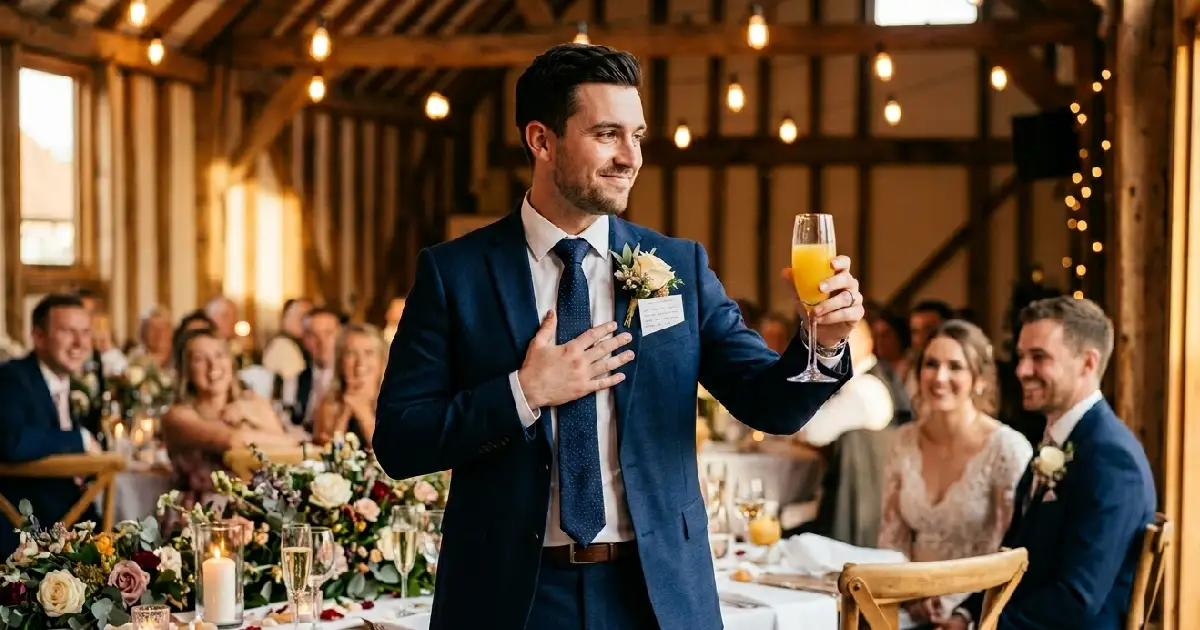
There is a specific kind of terror that hits you at 2:00 a.m., about three days before the wedding. It is not the fear of forgetting your tie or getting lost on the way to the venue. It is the cold, creeping realization that at some point, you will have to stand up, hold a glass, and say something that is supposed to be funny enough to keep people awake but deep enough to make the mother of the bride cry.
Most of the advice you have scavenged from the internet has told you to “keep it short” and “be funny.” That is the equivalent of telling someone who is drowning to “swim better.” You are not here because you lack the will to give a Best Groomsmen Speech. You are here because every other guide assumes you are a robot with a built-in laugh track. They do not tell you what to do when your brain goes completely blank, or how to choose between the ten half-baked stories you scribbled on a napkin. You need a plan that works for a human being with a dry mouth and a racing heart.
The best groomsmen speech is short, personal, and easy to follow: one strong opening, one revealing story, one sincere line about the couple, and a clear toast. Focus on clarity, warmth, and delivery, not forced jokes, rambling memories, or obscure references.
The real gap in wedding advice is not a lack of information; it is a lack of a decision-making framework. We are going to stop guessing and start building something that sounds like you, not a bad movie script. Here is what we will cover: the actual mechanics of a memorable moment, a role-specific formula that tells you exactly how long you should be holding that microphone, a way to pick a story that actually proves something about the groom, and a psychological safety net for when your mind inevitably goes to that empty white room. Let’s fix this.
The Core Concept: Best Groomsmen Speech Redefined
A Best Groomsmen Speech is not a stand-up comedy set, nor is it a chronological biography of the groom’s life from elementary school to last night’s rehearsal dinner. It is a short, audience-safe wedding toast anchored to a single, meaningful narrative that illuminates the groom’s character, validates the couple’s relationship, and culminates in a clean, unwavering toast. That is it. If you are trying to do more than that, you are already losing the room.
Table of Contents
What Is a Best Groomsmen Speech Really?
This is not about delivering a dictionary definition of a toast. This is about understanding the function of those two to five minutes you are about to occupy. A great speech in this context acts as a relationship bridge. It connects the people in the back of the room who have never met the groom to the reason you are all standing there holding overpriced champagne. It helps the guests feel the weight of the couple’s story through your specific, personal lens. It proves that you have real, tangible closeness with this man without you ever needing to say “we’re really close.”
It does this while making the bride or partner feel seen and respected, rather than like a footnote in a fraternity history lesson. The words you choose should prove closeness without hijacking the spotlight for a personal performance.
The best speech is not the funniest one. It is the one that feels personal, safe, and emotionally clear.
The Science of the Room
Before you write a single joke, you need to understand why certain words land and others cause people to suddenly become very interested in their bread plate. This requires a look at the engine under the hood of good communication and humor.
First, audience calibration. This is the art of writing for a room that contains your buddy from college who knows every stupid thing you have ever done, and the groom’s 87-year-old grandmother who thinks a “shot” is something you get at a doctor’s office. A wedding room is a mixed-generation minefield, and successful speakers adjust their tone to fit the collective ear, not just their own personality.
Second, there is the psychological mechanism of why the opening line works or fails. This is explained by the benign violation theory, which was developed by Dr. Peter McGraw at the University of Colorado Boulder’s Humor Research Lab. The theory states that humor arises when something feels wrong or out of place (a violation), but it is simultaneously perceived as safe or non-threatening (benign).
This is why self deprecating humor works: “I’m terrified to be standing here” is a mild violation of the confident speaker archetype, but it is benign because the audience knows you are okay. It is also why making a joke about an ex-girlfriend fails catastrophically: it is a severe violation with zero benign safety. The room does not feel safe.
Finally, the mechanics of your voice are not magic; they are biology. Diaphragmatic breathing is a method of inhaling deeply into your abdomen rather than shallowly into your chest. This type of breathing directly activates the parasympathetic nervous system—your body’s “rest and digest” mode—which counters the fight-or-flight response that makes your voice shake and your word count seem to double in speed. This is also the key to maintaining consistent eye contact. When your body is physically calm, you are able to look at the bride’s mother in the eyes without feeling like you are staring into the sun.
7 Actionable Steps to Write and Deliver a Groomsmen Speech That Lands
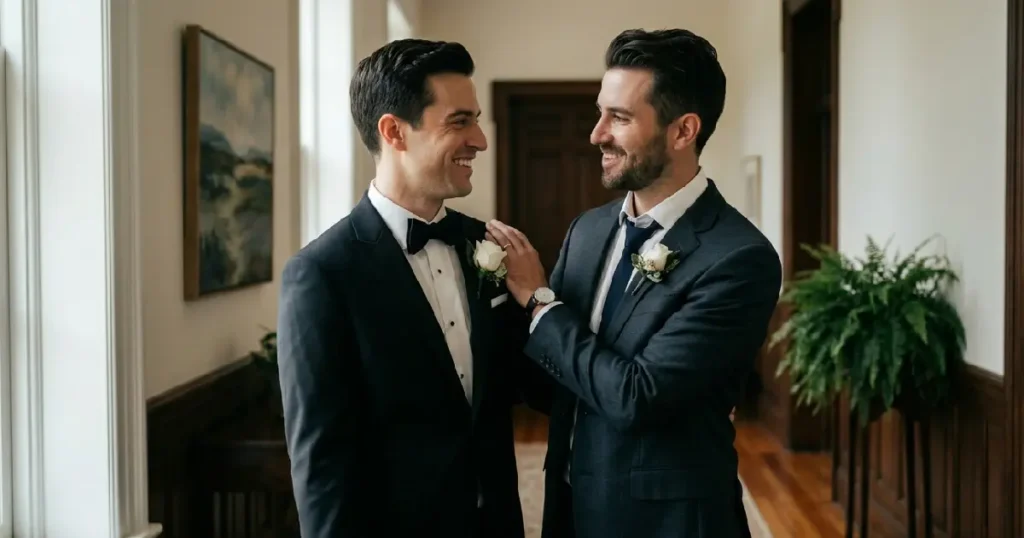
Stop reading random “best man speech examples” that sound like they were written by a committee. Here is the system for building something that works specifically for you.
Step 1: Define Your Role Before You Write a Word
This is where most guides collapse. They assume everyone reading is the Best Man delivering a 10-minute keynote at the United Nations. You might be a groomsman who was told, “Hey, just say a few nice things.”
- Are you the best man? You have the floor. The expectation is usually 4 to 6 minutes. That is roughly 500 to 750 words on paper, but it will feel like an eternity when you are up there.
- Are you a groomsman? You are likely part of a rotation. The room expects 2 to 3 minutes. That is 260 to 450 words. If you go longer than that, you are not being generous; you are holding the salad course hostage.
- Open mic surprise? Keep it under 90 seconds.
Do This: Choose a hard time limit first. Write to fill that container.
Not That: Write a 2,000-word novella and then try to read it in fast-forward while everyone checks their watch.
| Which speech are you actually giving? | Ideal Length | Word Count (Approx.) | Biggest Risk |
|---|---|---|---|
| Regular Groomsman Toast | 2–3 minutes | 260–450 | Going too long for your role; rambling. |
| Best Man Speech | 4–6 minutes | 500–750 | Trying to do stand-up; roasting the couple. |
| Open Mic / Surprise Toast | 60–90 seconds | 120–200 | Rambling without structure; no clear toast. |
Step 2: Pick One Story That Proves Something About the Groom
You have a list in your head right now. It contains about twelve memories involving road trips, bad haircuts, and maybe a canoe that tipped over. Most of these are useless for a Best Groomsmen Speech. They are “inside jokes” that only three people in the room will understand. You do not need a list of memories; you need evidence.
Apply the “What Does This Story Prove?” Filter.
A great personal anecdote reveals a character trait. It is not just “this happened.” It is “this happened, and because of it, we see that he is the kind of person who…“
- Reveals loyalty? Use it.
- Shows generosity when no one was looking? Use it.
- Illustrates steadiness in a crisis? That is gold.
- Shows that he gets funny under pressure? That is better than a forced joke.
Do This: Choose one story with a clear, definable point about his character.
Not That: Stack five weak stories about that time in Vegas.
Step 3: Run Every Line Through the Mixed-Audience Filter (The Grandparent-Bride-Video Test)
This is where we separate the good groomsmen from the ones who make the videographer delete the footage. We call this The Grandparent-Bride-Video Test. Ask these three questions about every single line you write, especially if it is meant to be funny:
- Would the groom’s grandmother laugh comfortably, or would she grip her napkin?
- Does this make the bride or partner feel like the luckiest person in the world, or like they just married an idiot?
- If someone plays this video back in five years, will you want to crawl under the couch or will you smile?
Cut immediately: Ex-girlfriend references, anything involving illegal behavior, jokes about the wedding night, stories where the groom is the victim of humiliation rather than a bit of gentle teasing.
Do This: Use light teasing combined with obvious affection. “He is the worst parallel parker I have ever seen, but somehow he navigated his way to a woman who actually likes him—and that is the kind of miracle I’m here to toast.”
Not That: “Remember that time he woke up in a ditch in Tijuana?”
Bold Takeaway: If the joke needs context to be safe, it is not safe enough for a wedding reception.
Step 4: Use the H.O.N.O.R. Speech Framework
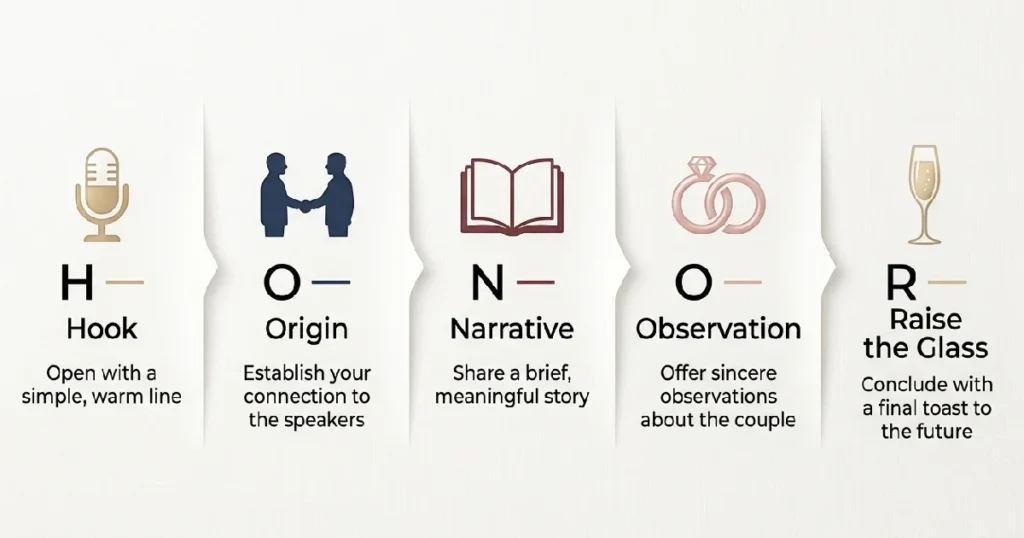
This is your roadmap. When you are standing there and your mind is a void, this structure will pull you back. We call it H.O.N.O.R.
- H — Hook: Your opening line. A simple, warm sentence or one clean laugh. “I’m [Name], and I’ve known [Groom] since he thought cargo shorts were a personality trait.”
- O — Origin: Explain how you know the groom. Short and sweet. Keep it under 30 seconds.
- N — Narrative: That single story you picked in Step 2. Tell it with narrative transportation—paint the scene vividly. Don’t just say “he helped me move”; say “It was 104 degrees, the U-Haul was stuck in reverse, and he just laughed and handed me a Gatorade.”
- O — Observation: Say what you admire about the bride and groom together. This is the pivot from “my friend” to “their union.” This is the heartfelt payload.
- R — Raise the Glass: End cleanly. No trailing off. “Please join me in raising a glass to the happy couple.”
This speech structure creates a natural arc and prevents the dreaded “and… yeah… that’s it…” ending.
Step 5: Use the 70/30 Rule for Tone
The human brain at a wedding is not looking for a Netflix comedy special. It is looking for emotional generosity. You should aim for a ratio of 70% warmth and sincerity to 30% humor. That one funny opening line is the 30%. The rest of the speech needs to land on the side of genuine human feeling. One well-placed laugh beats a string of five weak attempts. The room would rather feel something real than be forced to laugh at something hollow.
Do This: Use humor to reveal affection.
Not That: Use humor to prove you are the funniest person in the room.
Step 6: Edit for Spoken Delivery, Not Written Reading
Your brain reads differently than it hears. A 5-minute speech is roughly 650 to 750 words spoken at a pace of about 130 to 150 words per minute. But you are not typing an essay; you are scripting a conversation.
Edit for the ear:
- Short sentences.
- One idea per line.
- Mark where you will breathe with a slash (/).
- Bold the names on your notecard so you do not accidentally call the bride “Sarah” when her name is “Jessica.”
Do This: Write like you talk. “He’s the guy you call when you don’t know what else to do.”
Not That: “He has consistently demonstrated a proclivity for reliability in tumultuous circumstances.”
Step 7: Rehearse for Presence, Not Perfection
You are not a robot. You are a human being trying to honor a friend. You will not be perfect, and that is actually better. Rehearse out loud while standing up. Practice eye contact with three imaginary anchors in the room (left table, center couple, right table). Use diaphragmatic breathing before you stand up—inhale for four seconds, hold for four, exhale for four. This is a physiological hack proven to reduce public speaking anxiety.
Most importantly, we need to address the moment the bottom drops out: The Blank Mind. It happens. When it does, you will use a strategic pause. Do not panic. Look at the groom. Smile. And say:
“What I really want to say is this…”
That single sentence buys you five seconds of oxygen and resets your brain. It is your escape hatch. Practice it. Love it. Memorize it.
The Frustration Gap: Why You Still Feel Stuck
You have been told to “keep it short, be funny, and tell a story.” And yet, here you are, still sweating through your shirt. Why? Because that advice is the equivalent of telling someone to “just play the notes” on a piano they have never touched.
What articles say online:
- Keep it short.
- Be funny.
- Tell a story.
- Don’t embarrass the groom.
- Practice beforehand.
Why that frustrates you: It is maddeningly vague. It does not account for the specific, soul-crushing variables of a live wedding. It does not explain the difference between a 2-minute groomsman toast and a 5-minute best man speech. It does not tell you how to look at the groom’s new mother-in-law while telling a story about that time he got a parking ticket for parking in a handicapped spot. It does not tell you what to do with your hands, or how to handle the fact that your mouth has suddenly turned into the Sahara Desert.
The real problem is not that you are a bad speaker. It is that most advice gives you generic platitudes instead of a decision system. You need a filter for jokes. You need a rescue line for when you blank. You need a structure that works even when your brain has turned to static.
The “Simplified True Story”: The Turnaround
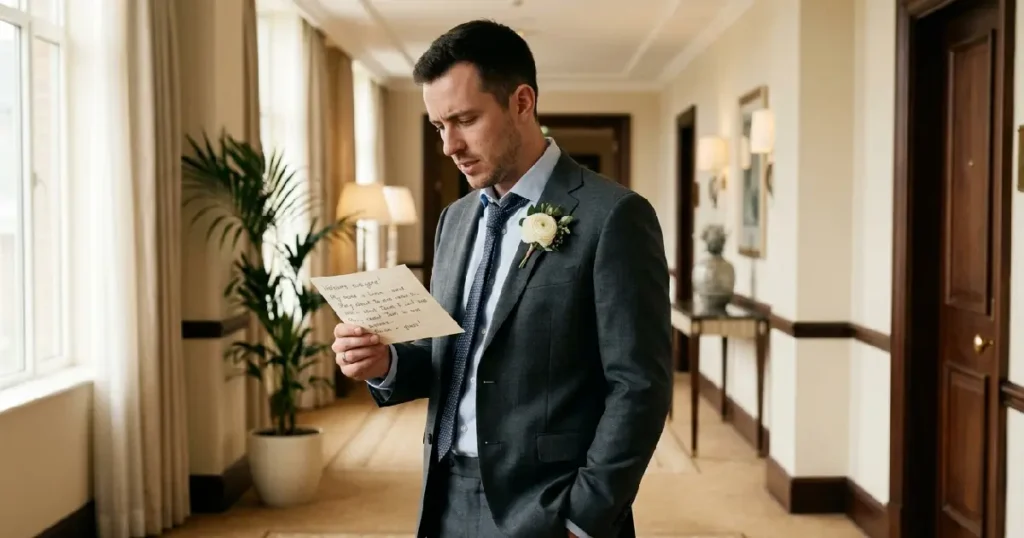
Names have been changed for privacy, but the anxiety was absolutely real.
The Profile: Meet Leo. Leo is funny in a group text. In front of a crowd, he is a statue with a pulse.
The Struggle: Leo was asked to be a groomsman for his childhood friend. He started writing his speech by dumping every memory he had into a Google Doc. It was a 900-word stream of consciousness about a camping trip involving a stolen canoe, a broken tent pole, and a lot of swearing. He thought he had to be the “funny one” to survive. He read it out loud to his girlfriend, and she said, “Leo, that story makes him sound like a criminal, and I don’t think his grandmother knows what ‘Skoal’ is.”
The Application: Leo used just one tip from this article: Step 2: Pick one story that proves something. He cut the canoe incident. He cut the tent pole. He kept a single, small moment: a time when Leo’s car broke down an hour outside of town, and the groom drove out at midnight with a tow rope and a thermos of coffee without a single complaint.
The Result: His speech dropped from 900 words to 340 words. He got one early laugh with self deprecating humor about his own terrible car. He landed a sincere line about how the groom’s new wife was just as patient as the groom was that night on the side of the road. He finished with a clear toast. The older relatives smiled. The bride hugged him and whispered, “That was perfect.” Leo later texted me: “It finally sounded like me instead of a bad movie speech.”
Comparative Analysis: Funny Groomsmen Speech vs. Heartfelt Groomsmen Speech
You might still be wrestling with the balance. Let’s put these two forces side by side so you can see the path clearly.
| Factor | Funny-First Speech | Heartfelt-First Speech | Best Choice for Most Weddings |
|---|---|---|---|
| Main Strength | Quick laughs, immediate energy in the room. | Emotional sincerity, genuine warmth. | Balanced Speech. |
| Biggest Risk | Forced jokes; offending a family member you didn’t know existed. | Sounding flat, rehearsed, or like a funeral eulogy. | Fewer extremes. |
| Audience Reaction | Immediate laughter if you nail it; cringing silence if you miss. | Deeper, quieter connection; maybe a few tears. | Laugh first, feel more later. |
| Ending Power | Weaker if it stays jokey. You lose the emotional landing. | Stronger if it builds to a heartfelt toast. | Strongest when humor supports sincerity. |
Verdict: For almost everyone reading this, the balanced option is not just the safest, it is the most effective. Open lightly to defuse the tension, move into a real story to build trust, and end with a heartfelt observation about the couple. Do not let a bad joke eclipse the reason you are all in that room.
Bold Takeaway: The safest winning formula is not funny or heartfelt. It is funny enough, then heartfelt on purpose.
Frequently Asked Questions (FAQs)
How long should a groomsmen speech be?
For a regular groomsman, aim for a sharp two to three minutes. If you are the best man giving the main speech, five minutes is the sweet spot, with seven minutes as the absolute outer limit. Guests remember warmth and clarity, not a long-winded history lesson. Shorter speeches always feel more respectful to the reception timeline and the couple’s patience.
Does a groomsmen speech need to be funny?
No. A great groomsmen speech does not require a comedy routine. What it requires is emotional accuracy: one genuine story, one kind observation about the couple, and one confident toast. Light humor helps ease nerves, but forced comedy makes the room tense and uncomfortable. Aim to be warm and specific before you reach for bigger laughs that might not land.
Can I include embarrassing stories about the groom?
Yes, but only if the story is safe for the room and ends with affection, not humiliation. Always apply the Grandparent-Bride-Video test we discussed earlier. If the story makes the bride, parents, or future children cringe, cut it without hesitation. Teasing works only when it is brief, true, and clearly loving. Stories about exes or illegal activity are completely off limits.
Should I read from my phone or memorize it?
Never read from a glowing phone. It creates a physical barrier, tempts you to scroll, and looks terrible in every single photo the photographer is taking. Use a small index card or a folded piece of paper with bullet points written in large font. Full memorization often sounds stiff when nerves hit. The best approach is a rehearsed delivery with bullet prompts, so you sound natural while still holding a safety net in your hand.
What should I do if I blank out mid-speech?
If you blank out, pause, breathe out slowly, look directly at the groom, and use your reset line: “What I really want to say is this.” That one sentence buys you time and brings you back to your central point. Most guests will see composure, not failure. A calm, silent pause looks confident; frantic filler words like “um” and “uh” make your nerves visible to everyone in the room.
Final Takeaway
You came here with a knot in your stomach and a blinking cursor on a blank screen. Now you have a structure that works even when your brain does not. The Best Groomsmen Speech is not about being the most eloquent person in the room; it is about being the most present. It is about showing the couple that you see them, not just as a party, but as a permanent team.
Here is your only task for tonight. Do not try to write the whole speech. Just write one sentence that starts with this:
“The groom has always been the kind of person who…”
Finish that sentence with absolute honesty. That single line reveals your theme, your tone, and the soul of your toast. If that sentence feels true, the rest of the words will follow. Stand up, breathe, and give them the gift of your genuine voice. That is more than enough.
My Closing Remarks
I have sat through so many weddings where the speeches felt like a hostage negotiation—everyone was just waiting for it to be over. And then there are those rare moments where a groomsman stands up and says something so simple, so specific, that the whole room exhales. I want you to be that guy. Not the one who tells the perfect joke, but the one who tells the truth. That is the real magic trick. And frankly, if you have read this far, you already care more than 90% of the people who just wing it. You are going to be just fine.
More Related Stories For You
- If the idea of standing up in front of a crowd makes your palms sweat just reading this, you might want to dig deeper into how to manage public speaking fear. This article breaks down the physiological reasons behind the anxiety and gives you a clear path to calm.
- Oddly enough, the breath control we talked about for speeches is the exact same mechanism that helps people cure their fear of flying. The mind-body connection is a powerful thing; learning to control your breath is a cheat code for managing panic in any high-stakes situation.
- And if the source of your jitters isn’t just the microphone but the weight of the commitment itself, you are not alone. Many groomsmen feel a secondary layer of anxiety about getting married as they watch a close friend take the leap. This piece offers a grounded perspective on navigating those complex feelings.
About The Author