
 David Wall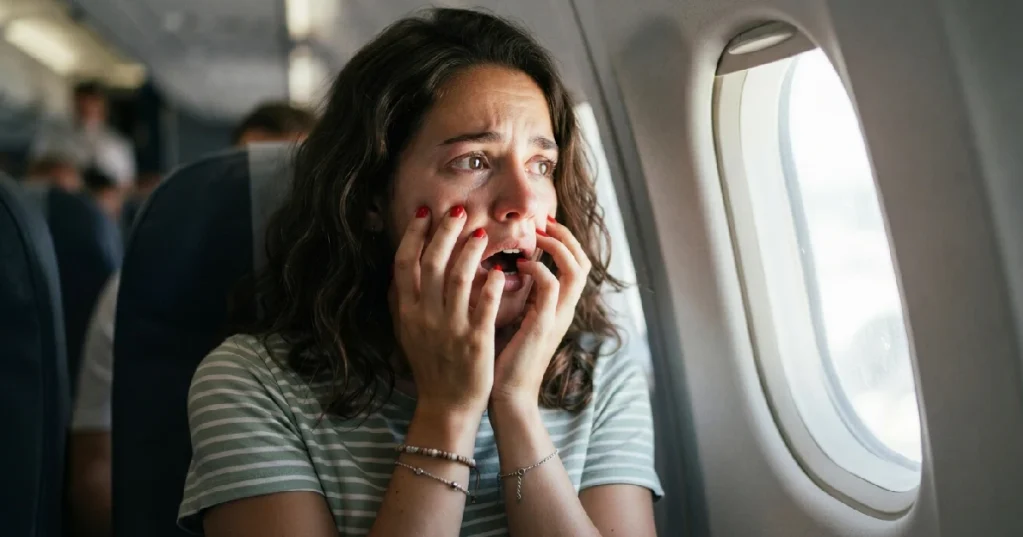
Five real, doable techniques that quiet the panic before takeoff and keep you steady at 35,000 feet, no pills required.
Key Points
- You can cure fear of flying using five specific mental and physical shifts, no prescription required.
- Turbulence feels dangerous, but the physics behind it prove your plane is built to bend, not break.
- One small habit, like switching your pen to your non-dominant hand, can quiet an anxious brain in under sixty seconds.
Contents
Table of Contents
Most people assume a fear of flying is really a fear of crashing. We picture the shaking hands and the racing heart and think something logical must be wrong. But for most anxious flyers, the real terror isn’t the plane going down. It’s the total loss of control the moment that cabin door seals shut.
You know this feeling from the inside. Your palms sweat before you even reach the gate. You scan every flight attendant’s face for a flicker of concern. You grip the armrest during a stretch of normal turbulence, even though some part of your brain knows the plane isn’t going anywhere.
This isn’t a character flaw. It’s a nervous system doing exactly what it was built to do, just in the wrong context.
Someone might think you’re overreacting to a little bumpy air. What they don’t see is the hour of dread that started three days before the flight, the mental rehearsal of every worst-case scenario, the exhausting vigilance of tracking every noise the aircraft makes.
Someone might think a glass of wine or a sedative will fix it. What they don’t see is that heavy medication dulls your ability to think clearly, and clear thinking is exactly what breaks this cycle.
According to clinical estimates from the Goldsworth Medical Practice, a UK-based NHS provider, roughly 10 percent of the population meets the criteria for aviophobia, the clinical term for fear of flying. You are not the odd one on the plane. You’re one of millions.
Here’s the part almost nobody tells you: this fear can be treated without a single pill, using tools you can practice in your seat, with your own hands, starting on your very next flight.
Why Your Brain Treats a Bumpy Flight Like a Life-or-Death Event
Your fear of flying isn’t really about statistics. You already know flying is safer than driving. That fact has never once calmed you down mid-flight, and there’s a real reason why.
Fear of flying lives in the amygdala, the almond-shaped cluster of neurons deep in your brain that scans for threat before your conscious mind even catches up. The amygdala doesn’t read safety reports. It reads sensation. A drop in cabin pressure, an unfamiliar sound, a jolt of turbulence, all of it gets flagged as danger before your rational brain gets a vote.
This is why logic alone rarely fixes flight anxiety. You can’t out-argue a part of your brain that isn’t listening.
Researchers who study flying phobia, including long-running clinical programs in the Netherlands built around exposure therapy, report recovery rates above 90 percent among participants who complete structured behavioral treatment. That number matters. It tells you this fear responds to skill, not just willpower.
The five techniques below work because they interrupt the amygdala directly, using your body and your attention instead of trying to reason your way out of panic. Each one is small enough to try on your very next flight.
The Psychological Hacks: Disrupting the Amygdala Mid-Air
Trick 1: The Non-Dominant Hand Writing Exercise
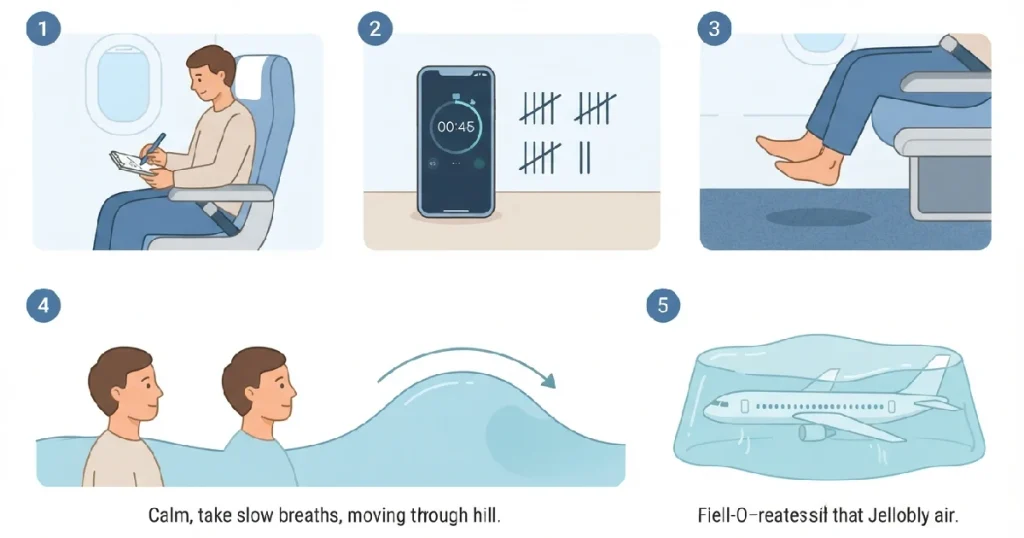
The moment the seatbelt sign turns on, pick up a pen and start writing with your non-dominant hand.
Here’s the mechanism behind it. Your dominant hand is wired into automatic, emotional processing, the same pathways that fuel a spiraling panic loop. Your non-dominant hand forces activity into the analytical left hemisphere of your brain, the region responsible for slow, deliberate, step-by-step thinking.
You’re not writing anything meaningful. You’re recruiting a part of your brain that simply cannot multitask with panic.
Try writing your full name five times. Then try the alphabet backward. Then trace the outline of your palm on a napkin. The content doesn’t matter. The clumsy, deliberate effort does.
Passengers who use this trick often describe the same thing: within two or three minutes, the racing heartbeat softens, not because the turbulence stopped, but because their brain got busy with something it had to concentrate on.
Trick 2: The Countdown and Ground Timer Method
Anxiety thrives on infinity. Your brain, left unchecked, will stretch a bumpy ten minutes into what feels like an unending threat with no clear end point.
Pull out your phone or watch and set a visible countdown timer for 15 or 20 minutes. Tell yourself one simple thing: you only have to get through this block.
When the timer ends, set another one. Each completed block becomes proof, not a promise, that this specific stretch of discomfort has a hard edge.
This works because it gives your brain something concrete to track instead of an open-ended fear loop. A racing mind wants certainty. A visible timer hands it exactly that, in small, believable doses.
Most people in this situation don’t realize their anxiety isn’t actually about the whole flight. It’s about the next few minutes. Once you shrink the target, the fear gets smaller too.
The Kinetic Solutions: Changing How Your Body Feels Flight
Trick 3: The Feet-Off-The-Floor Mechanical Trick
During rough air, lift your feet slightly off the cabin floor and hold them there, using your core muscles to stay stable.
This isn’t a distraction technique. It’s biomechanics. Your feet on the floor act like a direct transmission line, feeding every vibration and shudder of the fuselage straight into your nervous system. Lift them, even an inch, and you cut that connection.
Engage your abdominal muscles gently while you do this, almost like a light plank in your seat. This anchors your body against the ambient sway instead of letting the aircraft’s movement dictate your own.
Combine it with slow, controlled breathing, four seconds in, six seconds out, and you’re telling your body through two different channels that it is safe and stable, even while the cabin rocks around you.
Here’s the differentiator most flying anxiety guides never mention: your inner ear, not your eyes or your logic, is the real author of your fear during turbulence. The vestibular system, the balance mechanism housed in your inner ear, cannot tell the difference between a plane dropping and a plane simply hitting a pocket of denser air. It reports both as falling. Isolating your feet from the floor changes the sensory input your vestibular system receives, which changes what your brain believes is happening to your body in real time.
Trick 4: The “Pass-Through” Mindfulness Protocol
Fighting a panic attack is like pushing back against a wave. The harder you resist, the more force builds against you.
Instead of resisting the adrenaline surge, let it move through you. Notice the tight chest, the shaking hands, the lightheadedness, and mentally label each one without trying to stop it. “This is adrenaline. It peaks, and then it passes.”
But here’s what no one tells you.
A panic attack, biologically, cannot sustain itself indefinitely. Adrenaline has a hard ceiling. Left alone, without you fueling it with more fear, it peaks and starts declining within about 10 to 20 minutes, every single time.
Anxiety support communities online consistently report the same discovery: the flight where they stopped fighting the fear was the flight where the fear finally lost its grip. Not because the turbulence stopped. Because they stopped adding fuel to it.
The Aviation Logic: Rewiring the Analytical Brain
Trick 5: The Jell-O Principle and Fluid Dynamics
Here’s a reframe that changes how turbulence feels for good: at cruising speed, air behaves less like empty space and more like a thick, viscous fluid, closer to Jell-O than to nothing at all.
A plane moving through that dense, high-speed air can’t simply fall through it the way you’d fall through open sky. The wings are generating constant lift, and the aircraft is, quite literally, riding on a cushion of resistant air the entire time. Turbulence is that cushion shifting, not disappearing.
This matters because it separates two things your brain keeps confusing: comfort and safety. Turbulence is almost always a comfort issue, a bumpy ride, not a structural threat to a machine engineered with massive safety margins built in.
The Boeing Statistical Summary of Commercial Jet Airplane Accidents shows commercial accident rates declining roughly 40 percent over the past two decades, even as global air traffic has grown enormously. Modern airframes are stress-tested at forces far beyond anything turbulence has ever produced on a commercial flight.
Gradual Exposure: Moving From Screens to Runways
Fear of flying rarely gets cured by insight alone. It gets cured by proof, collected in small, repeated doses.
Start by tracking flights on a live flight-tracking app, watching thousands of aircraft cross the globe at any given moment, almost all of them landing without incident. Then move to watching real takeoff and landing footage online. Then book a short flight, 45 minutes or less, purely as practice.
This step-ladder approach is called systematic desensitization, a behavioral technique where you gradually face a feared situation in manageable stages instead of all at once. Each step builds evidence your brain actually trusts, because it came from direct experience, not just a fact someone told you.
Next Steps: Moving Past Flight Anxiety Without Medication
Learning to tolerate the sensations of flight builds something a sedative never can: lasting trust in your own ability to handle discomfort. Numbing the moment gets you through one flight. Building this skill gets you through every flight after it.
One place to start is choosing just one trick from this list, maybe the non-dominant hand exercise or the feet-off-the-floor method, and practicing it at home this week, before you’re anywhere near an airport.
A useful question to ask yourself: which part of flying scares you more, the turbulence itself, or the feeling of having no control over your own body’s response to it? Your answer points you toward the trick that will help you most.
The next time boarding announcements start, try naming your anxiety out loud in your head, plainly, without judgment. “My amygdala thinks this is dangerous. My body is safe.” That single sentence does more work than it seems like it should.
Consider this too: the same calm, grounded presence you’re building here, the ability to stay regulated when your body wants to spiral, tends to spill over into how you show up for the people you love, including in your closest relationships.
You didn’t board this article looking for a lecture on statistics. You wanted something that actually works in your seat, at your altitude, on your worst turbulence day. Now you have it.
The fear that once felt like it owned you is really just a misfiring alarm system, loud but not accurate. Turbulence isn’t your plane failing. It’s Jell-O wobbling, exactly as it’s designed to.
You don’t need to eliminate every ounce of nervousness before your next flight. You just need one tool, tried once, proving to your own nervous system that you can get through this. That’s not a small thing. That’s the whole shift.
You now know something most anxious flyers never learn: your fear responds to skill, not sedation.
My Closing Remarks
I’ve watched clients go from white-knuckling every takeoff to reading a book during landing, and it never came from convincing them flying was safe. It came from them proving it to themselves, one small trick, one flight at a time. If you take nothing else from this, take this: your body already knows how to calm down. It just needs you to give it the right instructions, and a little patience while it learns them.
More Related Stories for You
- The same steadiness you build in the sky can shape how you show up in your closest relationships, especially when you understand the qualities of a good partner that calm, regulated people tend to bring into their connections.
About The Author