
 Sara Carmen
How to spot commitment phobia red flags before you invest months into someone who’s already planning their exit.
Key Points
- Fear of commitment signs rarely announce themselves outright. They hide inside small, protective habits weeks before any real conversation about the future ever happens.
- Understanding commitment phobia red flags means knowing the difference between gamophobia and an avoidant attachment style, because each one calls for a different response.
- Five simple scripts inside this piece show you how to talk about commitment without sending your partner into a shutdown.
Contents
Table of Contents
We’ve all watched a relationship go from warm to strangely distant, and we’ve all tried to explain it away. Maybe they’re stressed at work. Maybe it’s just a slow week. You’ve had this conversation with yourself too, replaying the same texts and looking for a clue you must have missed.
Here’s the part nobody tells you. The shift didn’t start last week. It’s been happening the whole time, in ways too small to name until you finally have the language for them.
Someone might think their partner just needs “space” after an intense, connected weekend together. But what they don’t see is a nervous system quietly registering closeness as danger and pulling the emotional plug before things go further.
Someone might think their partner is simply a private person who doesn’t post relationship photos or bring them around friends. But what they don’t see is a decision, mostly unconscious, to keep the relationship easy to walk away from.
Someone might think a partner who avoids the word “girlfriend” or “boyfriend” just isn’t into labels. But what they don’t see is that the label is standing in for something scarier: a named, real commitment they can’t yet promise to keep.
That confusion has a name. And it’s not your imagination.
What Fear of Commitment Signs Really Look Like Behind Closed Doors
Fear of commitment signs are the small, repeated behaviors someone uses to protect themselves from the vulnerability of depending on another person. They rarely look like a dramatic refusal at the altar. Most of the time, they look like a Tuesday night text that never comes, or a weekend trip that somehow never gets planned past “we’ll see.”
In my practice, clients almost never say, “I’m afraid of commitment.” They say, “I just don’t want to lose myself,” or “I don’t want to jinx it by planning too far ahead.” That language is the real tell.
Research on attachment and relationship dynamics, including work by personality researcher Wiebke Bleidorn and colleagues, points to a specific pattern: people high in attachment avoidance tend to read normal relational interdependence, things like shared plans or emotional reliance, as a threat rather than as safety. That’s the engine running underneath most fear of commitment signs. Closeness gets coded as risk instead of comfort.
Once you can name that pattern, you stop mistaking it for something you did wrong.
7 Fear of Commitment Signs Hiding in Plain Sight
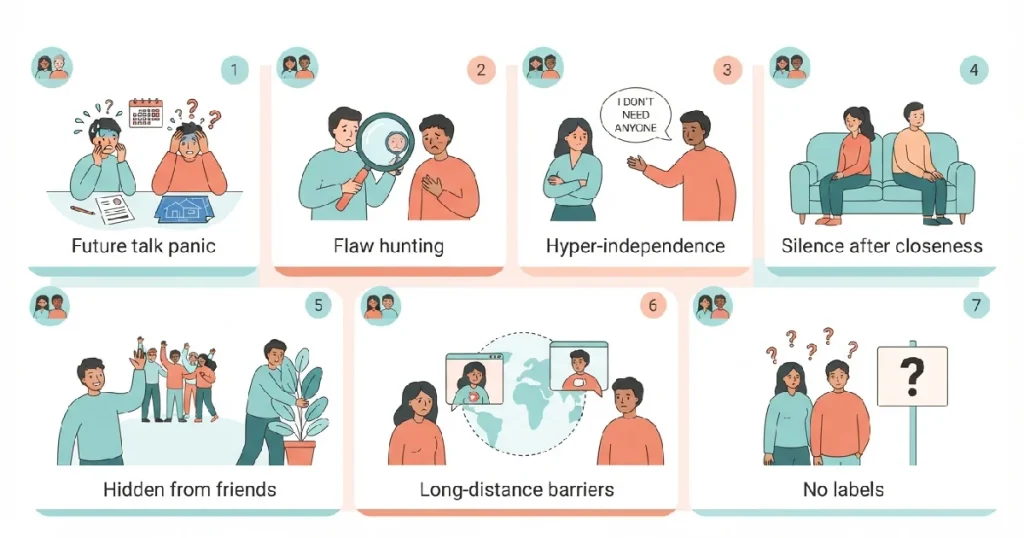
Real commitment phobia rarely shows up as refusing a marriage proposal. It lives inside daily, protective micro-behaviors long before any big talk about the future. Here are the seven fear of commitment signs worth watching for.
1. The Future Gets Vague the Moment It Extends Past Two Weeks
They’ll happily map out a five-year solo career plan, but any mention of a shared future gets met with a shrug or a subject change. Ask about a solo trip next year and they’ll talk in detail. Ask about a couples trip next summer and the sentence trails off into “let’s see how things go.” This isn’t spontaneity. It’s a built-in ceiling on how far the relationship is allowed to go in their mind.
2. Sudden Flaw Hunting Once Things Get Comfortable
Once the honeymoon phase settles into something steady, they start fixating on small, previously ignored habits, the way you chew, how you load a dishwasher, as proof the relationship “won’t work.” Therapists call this a self-sabotage strategy, manufacturing a reason to leave before things get deep enough to genuinely hurt if it ends. If the complaints started right when things got stable rather than building slowly over time, the timing is the real information here, not the complaint itself.
3. Everyday Sharing Feels Like a Threat
A toothbrush left at their place, a shared streaming password, coordinating a Saturday two weeks out. These normal parts of dating get treated like a loss of freedom. This is a hallmark of avoidant attachment style traits: minor interdependence triggers outsized discomfort because the nervous system reads “we” as a threat to “I.” Notice whether their resistance is about you specifically or about closeness as a category. That distinction tells you a lot.
4. Pulling Away Right After Getting Close
A weekend of deep conversation, meeting a close friend, real emotional sharing, gets followed by days of silence or sudden distance. This approach-then-retreat cycle is one of the clearest signs of emotional unavailability, and it happens because intimacy activates old protective wiring rather than a genuine loss of interest. The silence isn’t a punishment. It’s a nervous system recalibrating after feeling more exposed than it’s used to.
5. You Stay Compartmentalized
Months in, and you still haven’t met their friends. Their family doesn’t know your name. Your presence in their life feels contained to one small, closed-off space. Keeping a partner compartmentalized keeps the relationship easy to end without social consequence, which protects against the vulnerability of being known as a couple. Ask yourself honestly whether you exist anywhere in their life outside of the two of you.
6. They Keep Choosing Situations With a Built-In Ceiling
Long distance. Someone freshly out of a messy divorce. A partner who lives across the country for work. These setups keep appearing in their dating history. Choosing circumstances with a natural expiration date lets someone experience romantic connection without ever facing the deeper vulnerability of full, unobstructed intimacy. If this shows up across several relationships and not just yours, you’re looking at a blueprint, not bad luck.
7. They Act Devoted but Refuse the Label
They show up. They care. They act like a real, protective partner in private. But the moment you use the word “boyfriend,” “girlfriend,” or “relationship,” they flinch or redirect. This is one of the clearest commitment phobia red flags, because the actions say yes while the language insists an exit is still available. Pay closer attention to what they’re willing to call the relationship than to how well they treat you inside it. Both matter, but the label reveals what they actually believe is happening.
Is It Gamophobia or an Avoidant Attachment Style?
Most pieces on fear of commitment signs treat this as one single problem. It isn’t.
There are two very different fears hiding under the same set of behaviors, and knowing which one you’re dealing with changes how you respond.
What is gamophobia, exactly? It’s a specific, structured phobia centered on the institution of marriage or formal commitment itself, the paperwork, the permanence, the social finality of it. Someone with gamophobia might be a fully devoted, emotionally available partner for a decade and still panic at the word “wedding.” Wikipedia’s entry on fear of commitment describes this fear as centered on the structure of commitment rather than the emotional experience of closeness.
An avoidant attachment style is something different, and honestly, more common. It’s not a fear of the contract. It’s a fear of the day-to-day emotional reliance that comes with real intimacy, whether a label or ring ever enters the picture. According to John Bowlby’s adult attachment theory, this pattern usually traces back to early caregiving relationships where a child learned that needing someone too much led to disappointment. So the nervous system built a lifelong habit of self-reliance as protection.
Here’s the simplest way to hold the difference. A person with gamophobia fears the cage. A person with an avoidant attachment style fears the heat of the person standing inside it with them.
That distinction matters because gamophobia centers on the label and the structure, while avoidant attachment shows up whether or not marriage is ever mentioned. You can date an avoidant partner for years, never bring up marriage once, and still watch every one of the seven signs above play out in full.
How to Talk About Commitment Without Triggering a Shutdown

The instinct when you notice fear of commitment signs is to ask directly, “Where is this going?” That question, fair as it is, often lands as a demand and triggers exactly the shutdown you’re trying to avoid.
A better approach centers the conversation on your own needs and thresholds rather than forcing a promise out of someone who isn’t ready to make one. Here are five scripts that keep the conversation open instead of shutting it down.
When you’re moving from casual to exclusive:
“I’m really happy with how we’re growing, and I don’t need us to map out the next five years today. But for my own peace of mind, I want to know if we’re focusing our energy exclusively on each other right now. How does that feel to you?”
When they go quiet after a close weekend:
“I loved our time together, and I know that kind of closeness can feel like a lot sometimes. I want to give you space to recharge, but when you go completely silent, I feel disconnected. Can we agree on a quick check-in text if you need a day to yourself?”
When you want to test future plans without cornering them:
“I know your independence matters to you, and I respect that. When I picture things like a trip together or meeting family, I see it as something fun to share, not something that takes away your freedom. What’s your comfort level with being looped into that side of my life?”
When they panic over labels but act devoted anyway:
“Let’s set the label aside for a second. For me, feeling secure means consistent communication and honesty. What does a good, steady day-to-day look like from where you sit?”
When you need to know if it’s fear or a lack of real interest:
“I want to support you if the pace of this feels like a lot. I also need us to be moving in the same direction. Are we slowing down because you need a gentler pace, or because you’re realizing long-term isn’t what you want here? Either answer is okay. I just need the truth.”
Each script does the same quiet work. It removes the ultimatum and replaces it with a boundary framed around your own needs, which is far easier for most people to sit with than a demand.
Your Next Move: The Two-Question Pattern Check
Once you can name what you’re seeing, the next step isn’t confrontation. It’s information gathering, done gently, over time.
One place to start is what I call the Two-Question Pattern Check. Ask yourself: is this behavior new, or has it shown up with every partner they’ve had? And second, does it get better with reassurance, or does reassurance seem to make it worse?
If the pattern is new and softens with warmth and consistency, you may be looking at a temporary adjustment in pace, something a responsive partner can work through with you. If the pattern is old and reassurance seems to make them pull away harder, you’re likely looking at a chronic pattern of emotional unavailability that predates you entirely and isn’t really about you.
A useful question to sit with: are you trying to fix a moment, or a lifelong pattern that was never yours to repair? The answer changes what a healthy next step looks like.
You Deserve Clarity, Not a Slow Fade
Go back to that phone that isn’t lighting up the way it used to. You now know that the silence isn’t a mystery. It’s information.
Recognizing fear of commitment signs was never about diagnosing someone else so you can fix them. It’s about giving yourself enough clarity to make an informed choice about your own life.
Most people in this situation don’t realize how much of their confusion comes from waiting for a label instead of watching a pattern. Real security in a relationship needs two people willing to look at their own patterns, not just one person doing all the decoding. You can offer patience, scripts, space, and grace. What you can’t offer someone is a fear response they haven’t decided to work on yet.
The clearest sign someone is ready for you isn’t what they promise. It’s what they’re willing to look at.
My Closing Remarks
I’ve sat across from a lot of people who spent months trying to love someone into readiness, and I understand the pull completely. Hope is a hard thing to put down. But I’ve also watched what happens when someone finally trusts the pattern over the promise. They stop shrinking themselves to fit into someone else’s fear, and they start dating people who actually meet them where they are. That shift is available to you too, starting with your very next conversation.
More Related Stories for You
- Wondering if your relationship is heading somewhere solid instead of fading out? This piece on signs he’s going to propose walks through the opposite end of the spectrum.
About The Author