


You read the apology text at 2 AM. Your chest tightens. Every logical part of you knows exactly what this is — and still, your thumb hovers over “reply.” You hate yourself for wanting to believe them again.
That moment. That specific, exhausting, humiliating moment is why you’re here. And I want you to know something important before we go any further: narcissism in relationships doesn’t just hurt. It rewires you. The reason “just leave” has never worked for you isn’t a character flaw. It’s neurochemistry. Your brain has been conditioned through a mechanism nearly identical to substance addiction, and no standard list of “red flags” comes close to addressing that.
Narcissism in relationships is a destructive pattern where one partner exploits the other’s empathy through cycles of idealization and devaluation, creating a neurochemical trauma bond. A 2026 study of nearly 6,000 couples confirms this damage is embedded from the relationship’s very start — not a gradual decline that happens over time.
In this article, you’ll get the science behind why these relationships feel impossible to leave, the 2026 research that rewrites what we thought we knew, seven actionable steps with real scripts you can use today, and a neuroscience-backed path to genuine recovery. Let’s get into it.
Narcissism in Relationships Redefined: What the Science Actually Says
Beyond the Buzzword: What Narcissism in Relationships Really Means
Table of Contents
Here’s the truth: “narcissist” gets thrown around so loosely online that it’s starting to lose its weight. Someone cancels plans twice and suddenly they’re a narcissist. Someone forgets your birthday and boom, NPD. But for people living inside a genuinely narcissistic dynamic, the experience is anything but a buzzword.
Narcissistic Personality Disorder (NPD) involves a persistent pattern of excessive self-importance, a profound lack of empathy, and an intense need for admiration that causes real harm in relationships. And here’s what most articles miss: it exists on a spectrum. Not every person with narcissistic traits meets the full clinical criteria for NPD — but that doesn’t mean their behavior isn’t damaging you.
What’s even more important, and what almost no one is talking about yet, is the Narcissistic Admiration and Rivalry Concept (NARC) — a 2026 framework that breaks narcissism into two distinct mechanisms:
- Narcissistic Admiration: Being charming, impressive, magnetic. The partner who sweeps you off your feet and makes you feel chosen.
- Narcissistic Rivalry: Putting others down to feel superior. The subtle jabs, the comparisons, the contempt dressed up as humor.
Why does this distinction matter for you personally? Because narcissistic rivalry traits are consistently linked to lower relationship satisfaction for both partners, while admiration-only narcissism shows a more complex picture. If your partner mostly puffs themselves up without actively tearing you down, the dynamic — while still unhealthy — is different from living with someone who uses criticism as a weapon. Same diagnosis, completely different experience. Knowing which you’re dealing with shapes every decision that comes next.
The Science That Changes Everything
In 2026, researchers Gwendolyn Seidman and William Chopik published a landmark longitudinal study in the Journal of Personality, tracking nearly 6,000 couples for up to six years. What they found shattered one of the most common myths about narcissistic relationships.
We’ve all heard the story: at first it’s magical, then slowly the mask slips. The “honeymoon phase” fades and the real person emerges. Right?
Wrong. Or at least, much more complicated than that.
“The damage appears to be baked in from the start. Rather than early bliss followed by a nosedive, partners of highly narcissistic people were less happy in their relationships from the outset.” — Seidman & Chopik, 2026
This is significant. It means that what you remember as “the good times” at the beginning may not have been as good as the trauma bond is now making them feel. The nervous system in survival mode is capable of extraordinary selective memory. The idealization phase felt intoxicating because it was designed to — not because it was real. This research gives you permission to stop romanticizing the beginning.
7 Actionable Steps to Protect Yourself and Reclaim Your Life
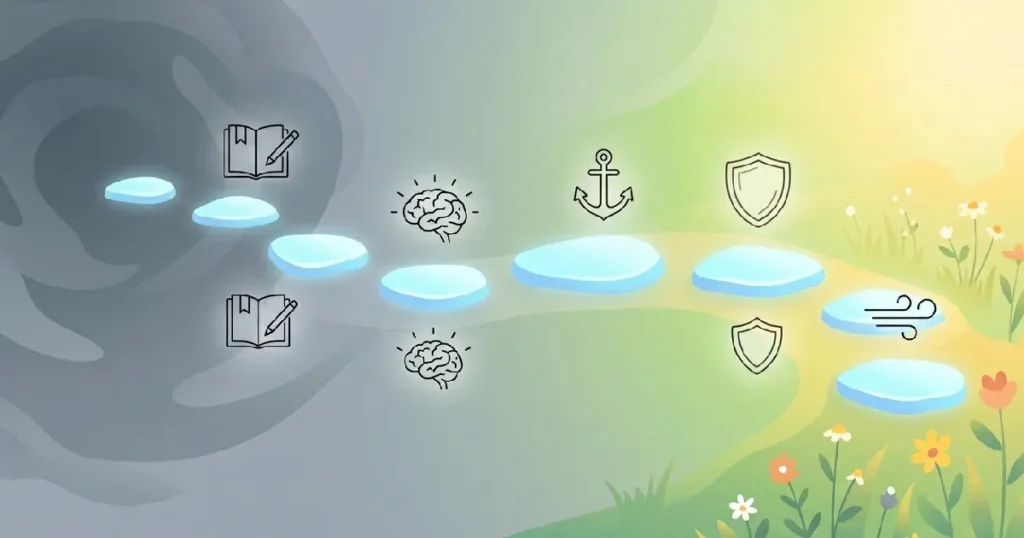
These aren’t abstract suggestions. These are steps, in order, that you can actually use. Think of this as your field guide.
Step 1: Name the Cycle — Don’t Just List the Signs
There’s a big difference between recognizing signs of narcissism intellectually and being able to name what’s happening to you in real time. The full four-stage cycle is:
- Idealization (Love Bombing): Overwhelming affection, gifts, “you’re my soulmate” language — fast and intense.
- Devaluation: The pedestal disappears. Subtle jabs become overt criticism. You start walking on eggshells.
- Discard: When you’re no longer “useful,” they leave — abruptly, coldly, sometimes publicly.
- Hoover: Named after the vacuum brand. They suck you back in with apologies, emergencies, or declarations of change.
Do this today: Open a notes app and map your last three months onto this cycle. Which stage are you in right now? Pattern recognition doesn’t just feel validating — it literally interrupts the dopamine loop your brain is running.
Step 2: Understand Why You Can’t “Just Leave” — It’s Wiring, Not Weakness
This is the step that changes everything for most people. Your brain, under the influence of intermittent reinforcement, behaves almost identically to the brain of someone withdrawing from a substance. The unpredictable alternation between warmth and cruelty floods your reward system with dopamine during “good” phases and stress hormones during “bad” ones — conditioning your nervous system to seek relief from the very person causing the pain.
You are not weak. You are not stupid. You are neurologically conditioned.
Stop telling yourself “I’m an idiot for staying.” That self-blame is part of the conditioning — it keeps you focused inward instead of on the pattern.
Step 3: Implement the 48-Hour Clarity Rule Before Responding
When a hoovering text arrives — “I miss you,” “I’ve changed,” a crying voice memo at midnight — your dopamine spike is highest in the first two to four hours. That is the exact worst moment to respond.
The rule: Write your response in your notes app. Don’t send it. Wait 48 hours. Re-read it. You’ll often find the emotional charge has dropped significantly, and what felt urgent now feels manageable.
Script you can copy right now: “I’ve received your message. I need time to process before responding. I’ll reach out if and when I’m ready.”
That’s it. That one sentence is complete. You don’t owe more than that.
Step 4: Build Your Reality Anchor System
Gaslighting doesn’t just make you doubt specific events — it makes you distrust your own mind. The repair for that is external witnesses.
Designate two or three people as your reality anchors. These are people who will listen without judgment and reflect observable reality back to you. The key: share specific incidents, not just feelings. “He told me I imagined the argument we had on Tuesday” lands differently than “I just feel crazy.”
Do not isolate. Narcissistic partners often, subtly or not-so-subtly, create distance between you and your support network. Recognizing that as a tactic — not as evidence that those friendships “weren’t working” — is part of reclaiming your perception.
Step 5: Assess the Change Question With the 4-Condition Test
So they say they’ve changed. Again. Here’s how you evaluate that claim without getting lost in hope or cynicism. Genuine transformation in someone with narcissistic patterns requires all four of these, not just one or two:
- They acknowledge specific harm they caused — not just “I’m sorry you felt hurt.”
- They are in long-term specialized therapy, consistently, for at least six months.
- Their motivation is internal growth, not keeping you from leaving.
- They are willing to sit with emotional discomfort without reverting to blame or control.
Script when they say “I’ve changed”: “I appreciate you telling me that. I’ll need to see consistent action over the next several months before I can reassess. That’s non-negotiable.”
Not harsh. Just honest.
Step 6: Implement Structured Disengagement — Not Just “No Contact”
If you share children, a home, or finances, a hard no-contact rule may not be immediately possible. And that’s okay. The Grey Rock Method is your bridge strategy. The idea is simple: become as interesting as a grey rock. Short answers. No emotional content. No personal updates.
- “Okay.”
- “I see.”
- “I’ll look into that.”
Co-parenting script: “I’m available to discuss logistics related to [child’s name] via text or email only. I’ll respond within 24 hours on business days.”
One more thing — do not announce you’re going no-contact. That announcement triggers what’s called narcissistic rage, and escalation follows. You just go quiet. Strategically, quietly, safely.
Step 7: Begin Nervous System Recalibration — Not Just “Self-Care”
Bubble baths are lovely. They are not nervous system medicine.
Vagal toning practices — things like box breathing, cold water face immersion, and bilateral (left-right alternating) walking — directly regulate your autonomic nervous system. This isn’t soft advice. It is physiological intervention.
Do five minutes of box breathing every morning: Inhale for four counts, hold for four, exhale for four, hold for four. Repeat. This activates the parasympathetic nervous system and reduces the baseline anxiety that keeps you tethered to hypervigilance.
The beautiful truth about neuroplasticity is this: the same brain mechanisms that allowed narcissistic abuse to rewire you are the exact mechanisms that support your recovery. Your brain changed under duress. It can change again — with intention.
| Step | Do This | Not That | Key Tool |
|---|---|---|---|
| 1 | Map the 4-stage cycle | Just Google signs | Notes journal |
| 2 | Learn the neuroscience | Blame yourself | Psychoeducation |
| 3 | 48-Hour Clarity Rule | Respond immediately | Notes-app draft |
| 4 | Reality Anchor system | Isolate yourself | Trusted contacts |
| 5 | 4-Condition Change Test | Accept words alone | Observable checklist |
| 6 | Grey Rock Method | Announce no-contact | Co-parenting script |
| 7 | Vagal toning daily | Bubble bath “self-care” | Box breathing |
When Everything Finally Clicked: Layla’s Story

Layla was 34, a marketing director, and a mother of one when I first learned her story. She’d been married for six years to a man she described as “both the best person I’d ever met and the person who made me feel the most invisible.”
Every morning, she’d make coffee before he woke up — partly out of habit, partly because those twenty quiet minutes were the only time she felt like herself. By the time he came downstairs, she was already calibrating. Watching his face. Reading the room. Was today going to be the warm version of him, or the cold one?
She’d read every article about narcissistic relationships. She could recite the signs from memory. She’d even brought one to a couples therapy session — a decision that backfired spectacularly when her husband used the session to position her as the “unstable” one. The therapist, not trained in personality disorder dynamics, suggested she work on her “emotional reactivity.”
The turning point came when Layla stopped framing her inability to leave as a personal failing and started understanding it as neurological conditioning. She applied the Grey Rock Method not as a tactic of coldness, but as a way of protecting what little nervous system regulation she had left.
Within three months, she had filed for legal separation. Within six months, she had a co-parenting communication structure and had begun EMDR therapy.
“Once I stopped fighting myself and started working with my brain,” she told me, “the fog lifted almost immediately. Not painlessly. But clearly.”
Narcissism vs. Other Toxic Patterns: Getting the Assessment Right
Narcissism vs. Avoidant Attachment: A Critical Difference
With attachment theory exploding on social media in 2025 and 2026, I’m seeing a lot of people misdiagnose their situation — and that misdiagnosis has real consequences.
An avoidant partner withdraws from emotional closeness out of fear. They go quiet during conflict. They need space. It’s frustrating and it can be deeply painful — but it’s not the same as narcissistic abuse.
A narcissistic partner doesn’t withdraw from conflict. They weaponize it. There’s a meaningful difference between someone who shuts down because intimacy is scary and someone who uses your vulnerability as leverage. Avoidants pull away from connection. Narcissists exploit it.
Getting this distinction wrong leads to the wrong strategy. Pursuing an avoidant partner with ultimatums makes things worse. Using those same strategies with a narcissistic partner can escalate to danger. Know which dynamic you’re actually in.
Common Mistakes That Keep You Trapped

Mistake #1: Crowdsourcing Your Diagnosis on Social Media
TikTok and Instagram are genuinely full of helpful narcissism content. They’re also full of oversimplification, and in 2026, the algorithm serves you more of whatever keeps you scrolling — which means if you’re watching one narcissism video, you’re about to watch forty.
The risk is real: false positives (labeling normal conflict as abuse) and dangerous false negatives (minimizing actual abuse because “it doesn’t look exactly like the video”).
How to avoid it: Use social media content as a starting point, not a verdict. Tell yourself: “I can learn from this, but I’ll validate my experience with a licensed professional before making life-altering decisions.”
Mistake #2: Believing the “Soft Launch” of Change
In 2026, narcissistic partners are increasingly sophisticated. They may attend one therapy session. They may send a carefully worded “accountability” text that sounds like something from a personal development course. They may post something vulnerable on Instagram.
This is what I call the soft launch of change: just enough visible effort to reset your hope cycle. No sustained behavioral shift follows.
The standard to hold: Six months of observable, unsolicited behavioral change minimum. Genuine transformation in NPD — when it occurs at all — takes years of intensive, specialized therapy.
What to say: “I appreciate you telling me that. I’ll need to see consistent action over the next several months before I can reassess. That’s non-negotiable.”
Mistake #3: Using Standard Couples Therapy as the Primary Fix
This one genuinely worries me. Most general couples therapists — good, well-meaning people — are not trained in narcissistic dynamics. In session, the narcissistic partner often performs as the calm, reasonable one. The affected partner, carrying years of accumulated stress and hypervigilance, appears “reactive” or “emotional.” The untrained therapist may inadvertently validate the narcissist’s framing.
What to ask a potential therapist: “Do you have specific experience working with clients in relationships involving personality disorder dynamics or coercive control? Not general relationship counseling — specifically that.”
Individual therapy for the affected partner always comes first. Always.
Mistake #4: Breaking No-Contact During Emotional Anniversaries
Your phone’s algorithm knows your patterns. “On This Day” features surface old memories. Narcissistic partners often time their hoovering attempts strategically around birthdays, the anniversary of when you met, or holidays. It feels like sentimentality. It’s a tactic.
Create an Anniversary Protocol: On every vulnerable date, schedule a call with a reality anchor in advance. Disable “memories” notifications across platforms. Archive old photos from your camera roll so they don’t surface automatically.
Script for the urge to reach out: “This feeling will pass in 72 hours. This is withdrawal, not love. I’m going to call [Reality Anchor Name] instead.”
Frequently Asked Questions
Can a Narcissist Truly Change for Love?
Change driven solely by fear of losing a partner is rarely sustainable. For genuine transformation, a narcissist’s motivation must come from internal growth, not from regaining approval or avoiding consequences. This requires long-term specialized therapy, willingness to face deep emotional discomfort, and years of consistent behavioral evidence — not promises made during a crisis or a hoovering episode.
What Are the First Signs of Narcissism in a Relationship?
The most overlooked early sign is the speed and intensity of initial attachment. Love bombing floods you with affection, gifts, and a “soulmate” narrative within weeks. If someone mirrors your values perfectly, declares deep love unusually fast, and creates an intense sense of being chosen, those are warning signs — not romance. The intensity is the red flag.
Why Is It So Hard to Leave a Narcissistic Relationship?
Because your brain has been neurochemically conditioned through intermittent reinforcement. The unpredictable alternation between warmth and cruelty trains your brain’s reward system the same way substance dependence does. The person who caused your pain has also been your intermittent source of relief from it. This is a trauma bond, and it requires neurological reconditioning — not willpower alone — to break.
What Is the Difference Between a Narcissist and Someone With Avoidant Attachment?
An avoidant partner fears intimacy and withdraws under emotional pressure but generally does not exploit, gaslight, or seek to dominate. A narcissist uses emotional closeness as a tool for control and supply. The key differentiator is intent: avoidants pull away from connection because it frightens them; narcissists weaponize connection to maintain power over you.
Does Narcissism Get Worse With Age or Better?
Research shows that narcissistic traits tend to decline with age — but that doesn’t mean a person becomes safer or easier to be in a relationship with. People can score highly on narcissism as a trait without meeting full NPD criteria. In practical terms: do not make your safety or healing contingent on waiting for age to resolve what therapy and consistent work cannot guarantee.
How Long Does Recovery From Narcissistic Abuse Take?
There is no universal timeline. Significant stabilization often occurs within the first six months of engaged recovery work — especially with specialized therapy like EMDR or trauma-focused CBT. Full integration, where the experience no longer dominates your daily life, takes longer and depends on abuse duration, prior trauma history, and whether contact with the narcissist continues.
Final Takeaway
Here’s your one task. Not a list. One thing.
Open your phone’s notes app. Write down the three most recent incidents that made you question your own reality. Beside each one, write which stage of the narcissistic cycle it represents: Idealization, Devaluation, Discard, or Hoover. Then send a screenshot to one person you trust completely. You are not asking for advice. You are creating a reality anchor — the first act of reclaiming the perception that narcissistic abuse took from you, and the most essential thing to rebuild.
If what you’ve read here describes your experience, you don’t have to figure this out alone. Finding a therapist trained in narcissistic abuse recovery, whether through Psychology Today’s directory or a trauma-informed specialist in coercive control, is the most important next step you can take. You’ve already done something brave by reading this far. Keep going.
My Closing Remarks
I’m going to be honest with you in a way that most articles won’t be: some of the people reading this will go back. And I’m not saying that to shame anyone — I’m saying it because I want you to go back informed, not hopeful. Hope without information is how these relationships survive. In my work, the most heartbreaking cases aren’t the people who stayed too long. They’re the people who left and went back without the tools to protect themselves. You now have those tools. Use them.
More Related Stories for You
- Wondering if your deep capacity for love is actually working against you? Read what personality type is the empath — it might explain more about this dynamic than you expect.
- And if the patterns in this article feel familiar in a specific way, these 10 signs of a narcissistic husband give you even more concrete clarity on what you may be living with.