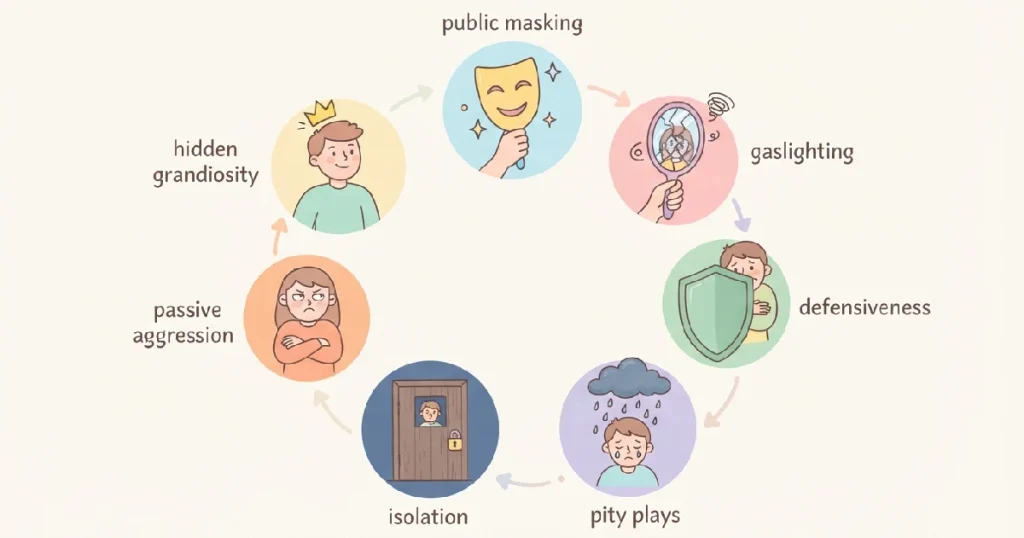
It’s 11 PM. You’re staring at the ceiling, replaying a conversation that should have taken five minutes. You brought up something that genuinely hurt you. They didn’t yell. They didn’t call you names. Instead, they got very quiet, their eyes went soft with pain, and they said: “I guess I just can’t do anything right.” And somehow, within minutes, you were the one apologizing. You were comforting them about the hurt YOU brought to them.
Covert narcissist traits are subtle, carefully hidden, and — this is the part that really stings — specifically designed to make you question your own reality.
Here’s the thing most articles won’t tell you. The loud, chest-puffing narcissist is easy to spot. This person? Not so much. And that invisibility is precisely what makes them more damaging than any obvious abuser you could point to.
Covert narcissist traits include chronic victimhood, passive-aggressive punishment, weaponized sensitivity, backhanded empathy, quiet superiority disguised as humility, hypersensitivity to criticism, and emotional withdrawal used as control. Unlike overt narcissists, covert narcissists manipulate through vulnerability, making them significantly harder to identify and more psychologically damaging to those closest to them.
By the time you finish reading this, you’ll have seven clinically-backed traits mapped to real behaviors (including exact phrases and digital patterns), a comparison table that no one else has built, specific scripts you can use, and one concrete action you can take in the next 24 hours.
What “Covert Narcissist” Really Means — Beyond the Buzzword
Table of Contents
The Clinical Reality Most Articles Get Wrong
Let’s clear something up first, because the internet has gotten pretty loose with this term.
A covert narcissist falls into a narcissistic personality disorder subtype that combines core traits like self-centeredness and manipulative behavior with an introverted, self-effacing demeanor. Interestingly, the term “covert narcissism” doesn’t actually appear in the DSM-5. Clinicians use related terms like “vulnerable narcissism” to describe the same pattern, and this distinction matters, because it tells us this isn’t a new personality type. It’s a different expression of the same core disorder.
The word “covert” refers to how the narcissism is expressed, not whether the person is deliberately hiding manipulative behavior. A person with covert narcissism isn’t necessarily more calculating or scheming. They simply experience and display their narcissism in a more internalized, vulnerable way. That’s a critical distinction. We’re not talking about a Bond villain plotting your downfall. We’re talking about someone whose psychological wounds manifest as behaviors that quietly erode your sense of self.
The core operating mechanism — and this is what nobody explains clearly — is weaponized vulnerability. The covert narcissist doesn’t present as arrogant. They present as wounded. They don’t demand admiration overtly; they extract it through self-pity, carefully timed fragility, and a victim narrative that always, always centers them.
The Science: Why This Subtype Causes Deeper Damage
Research shows that covert narcissism correlates with lower self-esteem and significantly more variability in emotional dysregulation than its grandiose counterpart. That emotional volatility — the sulking, the withdrawal, the sudden fragility — keeps partners in a constant state of hypervigilance.
“Covert narcissists are the most difficult to identify because their narcissism hides behind a mask of sensitivity, victimhood, and false humility.” — Dr. Ramani Durvasula, clinical psychologist and author.
This matters enormously. When the abuse is invisible, when there’s no yelling, no name-calling, no moment you can point to and say “there, THAT was wrong,” you’re left without external validation. And without that, the confusion itself becomes the abuse. You start wondering if you’re the problem. That wondering? That’s not a flaw in your perception. That’s a predictable response to a deliberately ambiguous relational dynamic.
7 Covert Narcissist Traits That Reveal the Quiet Manipulator

Trait 1: Chronic Victimhood as a Control Strategy
Every conversation circles back to their suffering. They never caused a problem — they only endured one. The car broke down because the universe is against them. The work conflict happened because their coworkers are jealous. Your hurt feelings are actually evidence of how misunderstood they are.
This isn’t just complaining. Covert narcissists present as victims of circumstances, other people, and a world that consistently fails them. Their suffering is always someone else’s fault. This narrative serves two functions: it generates sympathy (a form of narcissistic supply), and it insulates them from accountability. The key distinction from genuine victimhood is that the covert narcissist’s victim narrative is pervasive, chronic, and always centers them as the uniquely suffering one.
Do this: Respond with, “I hear that you’re hurting. I also need space to share what I’m feeling.”
Not that: Don’t abandon your point to comfort them. The moment you do, you’ve confirmed that their pain outranks yours, and that lesson will be repeated.
Trait 2: Passive-Aggressive Punishment — The Silent Treatment Reframe
They don’t rage. They disappear. No eye contact, no words, no acknowledgment. The house goes cold. Texts go unanswered for hours. And you feel it like a physical thing — that radiating quiet designed to communicate: you have done something wrong.
In 2026, this shows up digitally in ways that are genuinely hard to confront. They leave you on “read” for six hours after a difficult conversation. They post a vague caption about being “surrounded by people who don’t appreciate depth” while simultaneously ignoring your three messages. They weaponize the ambiguity of digital communication beautifully, because you can never quite prove the intent.
Do this: Name the pattern calmly: “I notice that when I bring up my needs, the conversation shuts down. I’d like to talk about that pattern.”
Not that: Do not chase, over-text, or apologize for having needs. Chasing confirms that their silence controls you.
Trait 3: Weaponized Sensitivity and Hypersensitivity to Criticism
All narcissists are sensitive to criticism. But here’s the difference. Overt narcissists respond with rage or contempt. Covert narcissists respond with dramatic wounding, sulking, withdrawal, or elaborate resentment that can simmer for years over minor perceived slights.
You offer a gentle piece of feedback about the dinner being a bit salty, and three days later you realize they haven’t quite met your eyes since. You mention you’d like more quality time, and they spend the next week performing a quiet, heavy sadness that somehow becomes entirely about how they’re “not enough.” You end up managing their emotional response to your need instead of getting your need met.
Do this: Hold your ground. “My feedback isn’t an attack on your character. Can we talk about the specific issue?”
Not that: Stop emotionally bubble-wrapping every honest observation with lengthy reassurances before you say it. If you have to do that, you’re already being conditioned into silence.
Trait 4: Backhanded Empathy — “I’m Just Worried About You”
This one is sneaky. Really sneaky. A covert narcissist may outwardly show what looks like genuine care and empathy. They’ll ask questions about your life. They’ll express concern. But research on narcissistic empathy consistently shows their underlying purpose is engagement that serves their own emotional needs, not yours.
It sounds like: “I just think you take on too much” (translation: stop outshining me). Or “I’m worried you’re not being realistic about this job offer” (translation: your success makes me feel inadequate). The concern is real enough to feel genuine. The function is control.
Do this: Run the Good News Test. Share something you’re genuinely proud of and watch what happens. Authentic empathy celebrates your wins. Covert narcissism deflects, minimizes, or subtly redirects to their own story.
Not that: Don’t mistake their concern for care without observing the pattern over time. One kind gesture doesn’t define a dynamic. Six months of data does.
Trait 5: Quiet Superiority Disguised as Humility
The covert narcissist carries a deep, unwavering conviction that they deserve more than they’re getting. But they’d never say that directly. Instead, you hear it as chronic complaints about being overlooked, undervalued, or “too much for most people to understand.”
They might say things like, “I’ve just always been more sensitive than other people,” or “I don’t think my boss has the capacity to see what I bring,” or “most people don’t really get me the way you do” — that last one is said to you specifically so you feel specially chosen, not so they feel inflated.
“They experience ongoing resentment that the world has failed to notice their exceptional qualities, disguised as humility and quiet resignation.” — Dr. Craig Malkin, Harvard Medical School lecturer and author of Rethinking Narcissism.
This matters because humility invites connection. But this isn’t humility. It’s an extraction mechanism, designed to pull reassurance from you in an endless loop.
Do this: Listen for the pattern of “no one sees my value” dressed up as modesty.
Not that: Don’t constantly reassure them. That feeds the supply loop and ensures the behavior continues.
Trait 6: Emotional Bookkeeping — Giving to Get

Gifts with strings attached. Favors with invisible invoices. They help you move apartments, and six months later during an argument, that favor resurfaces as evidence that you owe them. The giving-with-expectation-of-something-in-return behavior is a hallmark of covert narcissism, and it’s particularly confusing because the initial generosity feels real and warm.
It’s not. Or rather, it might feel real to them in the moment, but it functions as an investment, not a gift. When you don’t “pay back” in the exact form they expected (compliance, gratitude, loyalty), the debt is recalled.
Do this: When they invoke past favors during a conflict, say calmly: “I appreciate what you did. That doesn’t obligate me to agree with you on an unrelated issue.”
Not that: Don’t accept guilt as payment for past kindness. Generosity with a ledger is a transaction, not love.
Trait 7: Pseudo-Introspection Without Change — The “I Know I’m Broken” Trap
This is the most dangerous trait and the least discussed one. I want you to sit with this one.
Covert narcissists are often surprisingly self-aware — at least on the surface. They’ll tell you, “I know I have attachment issues.” They’ll say, “I’m aware that I shut down emotionally sometimes.” They’ll cry in therapy and reference childhood wounds with real articulateness. And every time they do this, something in you softens. They see it. They’re working on it. Maybe this time will be different.
Here’s the hard truth: narcissistic personality disorder involves the very traits that block authentic change. Accountability is a fundamental requirement for genuine behavioral change. Narcissists lack the emotional depth to move from awareness into action because genuine change threatens the ego structure they’ve built their entire psychological survival on.
What some call “change” is shallow self-awareness — an ability to recognize patterns — without the tools or the actual desire to heal those patterns. Knowing they’re a narcissist doesn’t make them change, any more than knowing you’re out of shape makes you run a marathon. The insight has to be paired with motivation and sustained effort. And that motivation is almost never there.
Do this: Judge by sustained behavioral change across 12 or more months, not by their self-aware monologues.
Not that: Do not let “I know I have issues” substitute for actual behavioral change. This is the final and most effective trap, because it keeps you hoping.
The Comparison Table: Covert Narcissist vs. Overt Narcissist vs. Genuinely Insecure Person
No other article has built this table. And it’s the question every person in your position is actually asking.
| Behavior | Covert Narcissist | Overt Narcissist | Genuinely Insecure Person |
|---|---|---|---|
| Response to your success | Deflects, minimizes, or subtly competes | Dismisses or one-ups you directly | Celebrates, even if quietly awkward about it |
| Response to criticism | Wounded silence, sulking, resentment | Rage, contempt, counterattack | Defensiveness at first, then usually openness |
| Empathy test (Good News Test) | Redirects to their own story | Ignores your news entirely | Engages, even imperfectly |
| Accountability | “I guess I’m just terrible” (deflection) | “You’re too sensitive” (blame) | “I didn’t realize. I’m sorry.” (ownership) |
| Pattern over time | Cyclic crisis, charm, crisis | Consistently dominant and entitled | Gradual growth with genuine effort |
| Your body’s signal | Chronic tension, walking on eggshells | Fear, visible threat response | Safe enough to be imperfect |
When the Traits Finally Clicked: Lena’s Story

Lena was 38, a project manager at a mid-sized marketing firm, and the kind of person her friends described as “the one who always has it together.” She met Daniel at a mutual friend’s dinner party on a rainy Thursday in October. He was quiet, thoughtful, and cried at the end of a documentary they watched on their third date. Her friends told her she was lucky to find someone “so emotionally available.”
Five years later, Lena hadn’t slept well in three. She’d lost 15 pounds without trying, started second-guessing decisions at work that she’d previously made with confidence, and had developed a habit of rehearsing conversations in her head before she had them — trying to pre-emptively smooth anything that might upset Daniel. There was no abuse she could name. No yelling. No cruelty she could point to in a text screenshot and show someone. Just a slow, quiet erosion.
The turning point came from Trait 7. Lena started keeping notes. Every time Daniel gave one of his “I know I have issues” speeches, she logged it. Date, what triggered it, what he said, what changed afterward. Over eight weeks, she documented 11 of these moments. Behavioral change after each one: zero.
“The moment I stopped measuring his words and started measuring his patterns,” she told her therapist, “I got my clarity back.”
Lena built an exit plan over the following four months. She didn’t confront him with a diagnosis. She didn’t wait for a breakthrough. She just stopped measuring his promises and started measuring his actions. That distinction saved her.
Common Mistakes People Make When Dealing with a Covert Narcissist

Mistake 1: Saying “You’re a Narcissist” Out Loud
This feels satisfying in the moment. It is almost always a mistake. The moment you label them, you hand them their next victim narrative. Suddenly, you’re the one who’s “attacking” them with psychological labels. In 2026’s therapy-language-saturated culture, clinical terms get weaponized back at you faster than you’d believe.
Instead, do this: Describe the pattern, not the person. Say: “When I share how I’m feeling, I’ve noticed the conversation shifts to your pain. I need that to change.” You’re describing behavior, not diagnosing a disorder, and that keeps you out of the “abuser” narrative they’ll otherwise construct.
Mistake 2: Taking Their Social Media “Healing Journey” as Evidence of Real Change
In 2026, covert narcissists have found a perfect ecosystem online. They post about therapy breakthroughs, shadow work, “becoming a better version of themselves,” and vulnerability with a capital V. Their followers leave supportive comments. They screenshot the comments and feel validated. None of it requires them to actually change how they treat you on a Wednesday afternoon when you say “no.”
Instead, do this: Measure change by how they treat you in private, under stress, and specifically when you set a limit they don’t like. Instagram captions are performances. Their behavior at 9 PM after a hard day is data.
Mistake 3: Over-Explaining Your Limits
Empathetic people — and most people dealing with covert narcissists are deeply empathetic — instinctively justify why they need a limit. We’ve been culturally conditioned to believe that explaining fosters understanding. With a covert narcissist, every reason you provide becomes a debate point they can argue against.
Instead, do this: State it once, simply. “I’m not available for this conversation right now.” No paragraph of explanation via text. No follow-up justification. You don’t need to earn the right to a limit. Silence after your statement is your ally.
Mistake 4: Waiting for the Therapy Breakthrough That Will “Fix” Them
This might be the most painful truth in this article, so I’m going to say it directly. We cannot love a narcissist into healing. The traits that define narcissistic personality disorder — externalization of blame, resistance to genuine shame, entitlement, and projection — are the exact same traits that block authentic therapeutic change. Trying to rescue them reinforces their victimhood. Tolerating their behavior reinforces their entitlement.
Instead, do this: Set a private, concrete timeline with observable behavioral benchmarks. Not “did they go to therapy this month,” but “have I seen a genuine, sustained shift in how they respond when I express a need?” If six to twelve months of actual professional treatment produces no observable behavioral change in how they treat you, that is information. Use it.
Frequently Asked Questions
What Is the Most Telling Trait of a Covert Narcissist?
The most revealing trait is chronic victimhood combined with a consistent inability to take accountability. A covert narcissist reliably positions themselves as the one who was wronged, while subtly deflecting responsibility for the impact of their behavior. Unlike someone who is genuinely hurt, a covert narcissist’s victim narrative is pervasive, repetitive, and always functions to redirect attention away from their own actions.
How Is a Covert Narcissist Different from an Overt Narcissist?
Both types share core traits — grandiosity, reduced capacity for empathy, and entitlement — but express them differently. Overt narcissists demand admiration through dominance and direct bragging. Covert narcissists extract validation through self-pity, passive aggression, and emotional withdrawal. The overt type is loud and identifiable; the covert type operates through quiet manipulation that causes victims to blame themselves instead of recognizing the dynamic.
Can a Covert Narcissist Change with Therapy?
Change is theoretically possible but statistically rare. Narcissistic personality disorder involves the very traits — avoidance of shame, externalization of blame, deep resistance to vulnerability — that block authentic therapeutic progress. Meaningful change requires years of consistent effort with a specialized therapist and genuine internal motivation. External pressure from a partner threatening to leave almost never produces lasting structural change in the personality.
Are Covert Narcissists Aware of What They’re Doing?
Awareness varies along a spectrum. Some covert narcissists have surface-level insight into their patterns but lack the emotional depth to translate that awareness into behavioral change. Others operate largely unconsciously. In either case, awareness alone doesn’t equal accountability or genuine motivation to change — which is why “but they know they have a problem” is often a trap that keeps partners waiting indefinitely.
What Does a Covert Narcissist Look Like on Social Media?
On social media, covert narcissists post in patterns that emphasize unique suffering, moral superiority, or self-deprecation designed to generate reassurance from followers. Watch for frequent vague posts about being “misunderstood,” curated vulnerability that always centers them emotionally, and public gratitude posts that subtly highlight their sacrifice. These are designed to harvest sympathy-based narcissistic supply from a wider audience than their immediate relationships can provide.
How Does Covert Narcissism Affect Children of a Covert Narcissist Parent?
Children of covert narcissist parents frequently develop hypervigilance, chronic people-pleasing, and deep self-doubt. Because the manipulation is subtle — guilt trips, emotional withdrawal, martyrdom — the child internalizes the belief that their needs are a burden. Covert narcissist parents often experienced emotional neglect themselves, and that unresolved wound makes it genuinely difficult for them to empathize with their own children’s emotional needs.
Final Takeaway
Don’t summarize the list in your head tonight. Don’t try to diagnose anyone right now. Here’s the one thing I want you to do:
Open your phone’s notes app and create a three-column log:
- Date
- What happened (just the facts)
- How my body felt before, during, and after
Do this for 14 days. Don’t analyze it. Don’t judge yourself for what you write. Just document.
At the end of two weeks, read it back from the beginning. The patterns your confused, hopeful, exhausted mind cannot see in real-time will be undeniable in written form. The body data especially — that chronic stomach knot, that tightness across your shoulders every time their name shows up on your phone — that’s not drama. That’s your nervous system giving you accurate, consistent information.
You are not here because you’re judgmental or unfair. You’re here because your instincts are working. The confusion you’ve been living in is not a flaw in your perception. It is a predictable, documented response to a relational dynamic built on deliberate ambiguity.
If this article felt like someone finally described your life out loud, please consider working with a therapist who specializes in narcissistic abuse recovery. Not couples therapy with the person you’re questioning — individual therapy, for you. You deserve someone who won’t send you home with advice to “just communicate more clearly.”
My Closing Remarks
I’m going to be blunt with you, the way I’d want a friend to be blunt with me. The most heartbreaking thing I see in my practice isn’t the abuse itself — it’s the years people lose waiting for someone to become who their self-awareness promised. Your gut knew something was off long before you Googled this. That instinct isn’t paranoia. It’s wisdom. Stop waiting for the moment they finally “get it.” Start building the life your clarity is pointing you toward, because you deserve that.
— Nicole Adkins, LMFT
More Related Stories for You
- How a Narcissistic Man Acts in a Relationship — because covert traits often look completely different from what you’d expect from the “classic” narcissist profile.
- 10 Signs of a Narcissistic Husband — if you’re specifically navigating this dynamic in a marriage, this one will give you concrete, relationship-specific patterns to watch for.