
 Nicole Adkins
The traits that keep love steady have almost nothing to do with chemistry, and almost everything to do with how someone treats you on an ordinary Tuesday.
Key Points
- The real qualities of a good partner show up on ordinary Tuesdays, not just during the honeymoon phase.
- Secure love is built on emotional safety, accountability, and consistency, not intensity or drama.
- You can learn to spot these green flags within the first few months, before you hand over your heart.
Contents
Table of Contents
Beyond the Spark: Navigating Modern Dating Fatigue
We have been trained to treat intensity like proof. The late reply that spikes your pulse. The fight that ends in a dramatic reunion. The person who feels like a cliff edge. Then someone kind sits across from you, texts back when they said they would, and a quiet alarm goes off in your chest that this cannot be the real thing.
Someone might think a good partner is the one who keeps them guessing. But what they don’t see is that unpredictability is often just anxiety wearing perfume.
Someone might think a calm relationship means the spark is gone. But what they don’t see is that their body is finally not bracing for impact.
Someone might think they are settling because they are not head over heels every hour. But what they don’t see is that secure love was never supposed to feel like a crisis.
The qualities of a good partner live in behavior, not in spark. Psychologists call this a secure base: the felt sense that someone is both available and safe. You stop performing. You stop scanning the room. That is what a healthy relationship actually feels like on an average day.
This mix-up exists for a reason. Your brain learned to equate love with activation. Stress hormones and reward chemicals can feel a lot like chemistry. A steady partner does not flood you with that cocktail. So the absence of panic gets misread as the absence of feeling. Most people coming out of messy dating or a toxic relationship do not realize their boredom detector is actually a danger detector with the wires crossed.
Left unexamined, this pattern does not just make dating exhausting. It is how you walk out of the first healthy relationship you have ever had and call it a lack of spark.
A good partner is not a fireworks show. They are a well-built hearth. Fireworks are spectacular for ninety seconds. A hearth keeps you warm through winter. What follows are the ten qualities of a good partner that build that hearth, one ordinary day at a time.
Emotional Safety and Accountability in a Healthy Relationship
1. Unwavering Emotional Safety
A good partner is a calm, predictable haven. You can tell them the unflattering truth (the jealousy, the old shame, the ugly thought you hate admitting) and they do not store it for later.
Contrast that with a partner who files your vulnerabilities like ammunition. The moment a fight starts, they bring up the thing you cried about last month. That is not passion. That is a breach of trust. Emotional safety means your inner world is not a weapon in their hands.
If you notice yourself editing your sentences before you speak, pay attention. Self-censorship is data. A healthy relationship should feel like you can put the armor down, not like you have to keep it polished.
2. Active Accountability and Low Defensiveness
When a good partner gets it wrong, they own it. Fully. No courtroom defense. No “I’m sorry you feel that way,” which is an apology that quietly hands the problem back to you.
Defensiveness is the reflex that turns a small repair into a second fight. A securely grounded person can hear “that hurt me” without treating it as an attack on their character. As experts at Psychology Today have noted, a partner who can accept feedback without collapsing is a green flag you should never ignore.
Watch what happens after the apology. Do they change the next time, or do they only perform remorse? Accountability is not a speech. It is a pattern.
Connection, Conflict, and the Qualities of a Good Partner Under Stress
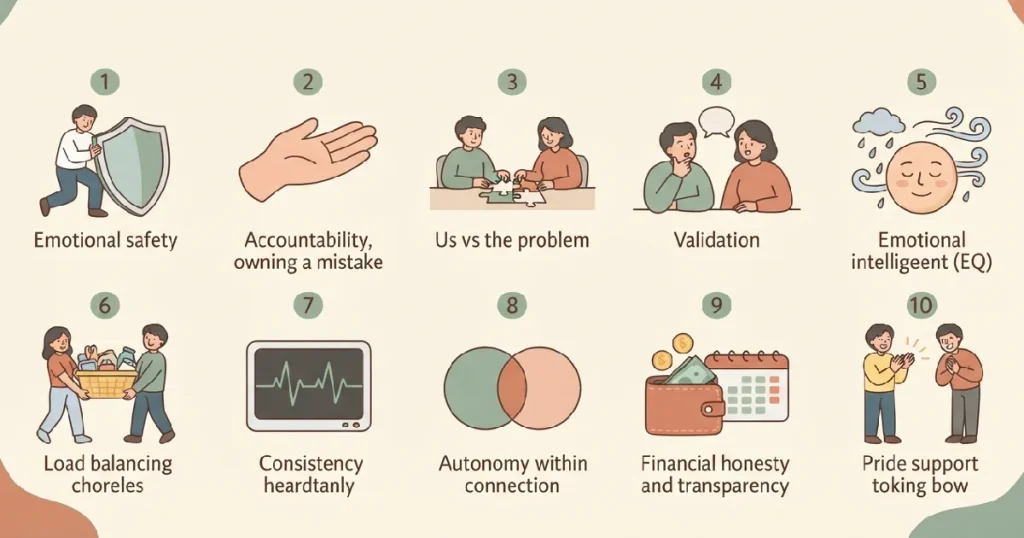
3. Productive Conflict Alignment
You will fight. The question is whether you fight as teammates or as opponents.
A good partner treats conflict as “us against the problem,” not “me against you.” They refuse name-calling, yelling, and stonewalling (the shutdown that leaves you talking to a wall). They can take a break and come back. They do not vanish for three days to punish you with silence.
According to researchers at The Gottman Institute, how a couple handles disagreement is one of the strongest predictors of whether the relationship lasts. Fighting well beats never fighting. Never fighting often means someone is swallowing themselves to keep the peace.
Listen for the difference. “How do we fix this?” is a green flag. “What’s wrong with you?” is not.
4. Generous Listening and Emotional Validation
A good partner listens to understand, not to reload.
Validation does not mean they agree with you. It means they treat your inner experience as real. “I can see why that landed that way” is validation. “You’re overreacting” is a dismissal dressed as logic. When your feelings are consistently named and respected, daily anxiety drops. Intimacy has room to grow because you are not busy proving that you make sense.
If you leave most conversations feeling crazier than when you started, that is not chemistry. That is erosion.
5. High Emotional Intelligence in Daily Life
Emotional intelligence (EQ) is the ability to notice feelings in yourself and others, then respond without making the room worse. It is not a buzzword. It is a set of small behaviors.
A high-EQ partner self-soothes when stressed instead of handing you their storm. They read the room when you have had a brutal day and do not demand cheerfulness on cue. They can say “I need twenty minutes” instead of snapping. Empathy here is practical: they adjust, they check in, they do not make your bad day about their ego.
You do not need a partner who has been to years of therapy. You need a partner who is willing to grow and who can regulate themselves enough not to take you down with them.
Maya Thought Safety Meant the Spark Was Gone
Maya, 34, had left a relationship where every disagreement ended in a three-day freeze-out. She started seeing Daniel, who apologized the same night, asked what she needed, and remembered it the next week. Within a month she felt restless. No adrenaline. No scanning his tone for danger. She told a friend she was “just not feeling it” and nearly ended things. What she was feeling was the absence of threat, and her body had never been taught that peace could be love. She stayed long enough to notice she was sleeping through the night. The restlessness was not a verdict. It was withdrawal from chaos.
That unease you feel is not always boredom. Sometimes it is a nervous system coming off a diet of drama.
Practical Interdependence: What a Good Partner Does Without Being Asked
6. Proactive Load Balancing
A good partner shares the work of life, including the work you cannot see.
The mental load is the invisible tracking: who needs a gift, when the bill is due, what is left in the fridge, which friend is going through a hard week. In a healthy relationship, that load is not yours by default. He handles chores, plans, and logistics without a manager. You should not have to nag someone into being an adult in the home you both live in.
If you are the project manager of the relationship, you do not have a partner. You have a dependent with a nicer title.
7. Reliable Continuity and Consistent Communication
Consistency is not boring. Consistency is how trust gets built in the body.
A good partner’s actions match their words. You do not decode mixed signals. You do not wonder why they went cold after a good weekend. Hot-and-cold cycles train you to chase. Predictable communication (even the ordinary “running late, see you at 7”) removes that anxious guessing. Reliable continuity means their presence has a shape you can count on.
If you need a translator for their behavior, something is off. Clarity is a quality of a good partner, not a luxury.
8. Active Support for Your Personal Autonomy
Interdependence is the sweet spot: close without being fused. Codependency is the trap where one person’s mood runs the whole house.
A great partner protects your separate friendships, your solo hobbies, and your distinct goals. They do not sulk when you have a Saturday with friends. They do not treat your growth as a threat. Differentiation (the capacity to stay connected without losing yourself) is one of the quietest green flags in long-term love.
If someone needs you small in order to feel close, that is not devotion. That is control with better lighting.
Long-Term Alignment: Qualities of a Good Partner Who Can Build a Life
9. Transparent Financial Responsibility
Money is not unromantic. Money is how values become a calendar.
A good partner talks about money without shame or secrecy. They know where their income goes. They can align with you on saving, spending, and the kind of life you both want, whether that is kids, a quiet apartment, or a shared future you have actually named. You do not need identical salaries. You need honesty, adult habits, and a shared direction.
Hidden debt, secret spending, or contempt for your financial style will not stay hidden. It will show up in the relationship as stress with a different name.
10. Genuine Pride in Your Success
A good partner believes they are with someone they admire. Your promotions, your intelligence, your wins do not shrink them.
This is the cherishing mindset: they light up when you do well. They tell other people about you with warmth, not a punchline. Professional jealousy is a slow poison. If your growth makes them colder, you will eventually start dimming yourself to keep the peace. That is too high a price.
You deserve someone who is proud to stand next to you, not someone who needs you a half-step behind.
The Green Flag Reality Check: Normalizing “Boring” Love

Here is the least advertised truth about the qualities of a good partner. Stable love can feel bland at first if you were raised on high-drama attachment.
Most mainstream romances sell you the spike. Online discussions tell a different story. People recovering from narcissistic abuse or years of relationships keep asking the same thing: Is it normal not to feel swept away when things are finally kind? Yes. Peace is not the absence of chemistry. Peace is chemistry that no longer has to shout over fear.
Give yourself a longer sample size than your anxiety wants. A useful timeline many daters now use is a simple 3-6-9 window. In the first three months, hold back the fantasy and watch behavior. By month six, patterns are visible. By month nine, values (money, family, conflict, effort) are hard to fake. Idealization is loud early. Character is quiet and repetitive.
You are not looking for a perfect human. You are looking for a willing one.
How to Evaluate a Good Partner Without Turning Love Into a Trial
One place to start is the Us vs. The Problem script. The next time tension rises, try: “Okay. This is us and the issue. What would help?” You are testing whether they can join you on the same side of the table.
Consider a Shared Values List. Sit down, even early on, and write a short, honest document: money, chores, family, how you repair after a fight, how much alone time you each need. It sounds unsexy. It is one of the kindest things two adults can do. Ambiguity is where resentment grows.
A third tool is the Calm-Down Boundary. You do not have to finish a fight while someone is flooded. A simple line works: “I want to keep talking. I’ll come back when we’re both calm.” Then actually come back. Boundaries that vanish are not boundaries.
A useful question to ask yourself after a date or a hard week: Did I feel more like myself, or more like a version of myself managing their mood? Your answer is already pointing.
Co-Creating Your Safe Haven
You came here tired of the performance. Tired of reading people. Tired of calling anxiety a spark. The person who felt like a movie may still cross your mind. Let them. Then look at the person who texts when they said they would, who owns the mess they made, who is proud of you in rooms you are not in.
You now have a clearer map than chemistry ever gave you. The ten qualities of a good partner are not a museum of virtues. They are daily evidence that your nervous system can rest and your life can be shared.
Look for the hearth, not the fireworks.
My Closing Remarks
In my practice I have sat with people who left the kindest partner they ever had because the silence felt like a warning. Their body was waiting for the other shoe. If that is you, you are not broken and you are not failing at love. You are meeting safety with a nervous system trained on chaos. Give the quiet a few more weeks than your fear wants. Notice whether you can breathe around them. That is data. That is choosing differently.
More Related Stories for You
- If you want practical, grounded good advice for a relationship you can use this week, start there and keep building the hearth on purpose.
About The Author



It’s an awesome article in support of all the web visitors;
they will get benefit from it I am sure.
Everything is very open with a clear clarification of the issues.
It was definitely informative. Your website is very helpful.
Thanks for sharing!