
 Sara Carmen
The fight isn’t about the dishes. It’s about whether you feel heard, and these five exercises can change that starting tonight.
Key Points
- Healthy communication in relationships is a trainable skill, not a personality trait you either have or lack.
- Five daily exercises can interrupt the exact nervous system reaction that turns small disagreements into full-blown standoffs.
- You don’t need a total relationship overhaul, just one new habit practiced consistently this week.
Contents
Table of Contents
We all know that particular kind of silence. The one that follows a fight neither of you planned to have. You started talking about something small, maybe dishes, maybe a missed text, and within minutes you were both saying things you didn’t quite mean. Nobody won. Nobody even remembers exactly who started it. You just know it happened again.
Someone watching from the outside might think you two just don’t get along anymore. But what they don’t see is the couple who still leaves each other notes, who still reaches for each other’s hand in the car, who genuinely love each other and still end up shouting over a dishwasher loaded the wrong way.
Someone might think your partner just doesn’t listen. But what you don’t see in the moment is that their brain has already stopped processing your words. Not because they don’t care, but because their body has quietly slipped into a state where listening is no longer physically possible.
Someone might think you’re “bad at communicating.” But what’s actually happening is far more common, and far more fixable, than either of you realizes.
Here’s the short version: healthy communication in relationships isn’t a personality trait you either have or don’t. It’s a mechanical skill, built through small daily repetitions, the same way you’d train a muscle. The good news is that muscle responds fast.
Why Healthy Communication in Relationships Breaks Down Under Stress
The Anatomy of Physiological Flooding
When an argument escalates fast, your body is doing something specific. Your heart rate climbs past 100 beats per minute. Your muscles tense. Blood flow shifts away from the prefrontal cortex, the part of your brain responsible for reasoning and perspective-taking, and toward the amygdala, the part wired for threat detection.
Psychologists call this flooding. It isn’t a character flaw. It’s biology doing exactly what it’s built to do.
Think of your nervous system like a phone running at 3 percent battery. It still works, technically, but every extra demand drains it faster until it shuts down mid-task. Flooding is what happens when your emotional battery hits zero in the middle of a conversation. You’re not choosing to stop listening. Your body is doing it for you.
Most couples don’t realize this is happening in real time. They experience it as their partner “shutting down” or “blowing up,” and they take it personally.
Reactive Listening vs. Active Listening Tips That Actually Work
Once flooding starts, most people switch from listening to understand into listening to defend. Psychologists call this reactive listening: your brain stops processing your partner’s words and starts scanning for the fastest way to prove them wrong.
Active listening is the deliberate alternative. It means holding off on your rebuttal long enough to accurately reflect what your partner said before you respond to it at all.
According to relational communication studies, the way couples communicate directly predicts long-term relationship satisfaction and even protects against emotional burnout in high-stress partnerships. Communication isn’t a soft skill here. It’s a structural one, the load-bearing wall of the whole relationship.
In my own practice, I’ve watched this pattern play out again and again: couples who love each other deeply, stuck in a loop that has nothing to do with love and everything to do with timing.
But here’s what no one tells you.
The fix isn’t a longer conversation. It’s a shorter, more structured one.
5 Healthy Communication Exercises for Couples to Practice Daily
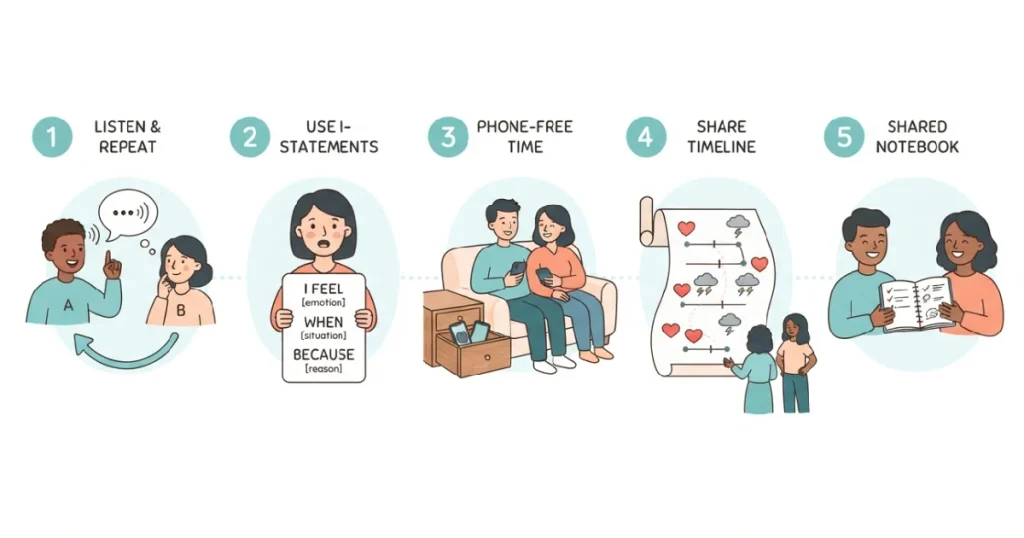
1. The Speaker-Listener Technique (Hear-Reflect-Verify)
Never reply directly to a complaint. Reflect it back first.
Here’s how it works: Partner A speaks for 60 seconds using only feeling-based language, no blame. Partner B’s only job is to repeat back what they heard, starting with “What I hear you saying is…” then asking, “Did I get that right?” Nobody switches roles until the speaker feels fully understood.
This sounds slow on purpose. Couples therapists have leaned on versions of this speaker-listener structure for decades because it physically interrupts the rebuttal reflex before it fires.
Try it tonight with something low stakes, like how your day went, before you attempt it with something charged.
2. Action-Focused “I” Statements
Replace accusatory phrases like “you always ignore me” with your own internal experience. Accusations trigger defensiveness, and defensiveness ends conversations before they really start.
Use this exact script out loud: “I feel [emotion] when [specific behavior happened], and what I need moving forward is [concrete request].” For example: “I feel dismissed when I’m mid-sentence and you check your phone, and what I need is for us to put phones away during dinner.”
The formula does two things at once. It names a feeling instead of a verdict, and it ends with a request instead of a complaint. Complaints ask your partner to defend themselves. Requests ask them to participate.
3. The 15-Minute Tech-Free Check-In
Sit face to face every evening, phones out of the room entirely. Share one small appreciation from your day and one hidden stressor, something you haven’t said out loud yet.
Fifteen minutes doesn’t sound like much. But couples who protect a consistent, undistracted window each day report feeling far more emotionally connected than those who only talk during downtime between screens.
This exercise works because it lowers your baseline stress before conflict ever starts, so you have more emotional bandwidth left over for when something hard actually comes up.
Here’s something most guides on this topic miss. These exercises don’t work mainly because they teach you better words. They work because they retrain your nervous system to recognize your partner as safe again, one repetition at a time. Communication skill is the byproduct. Safety is the actual target.
4. Trigger Source Mapping
Draw a horizontal line on a piece of paper. Mark the emotional peaks and pain points of your life, individually, from before the relationship even began.
Then explain to each other how those older experiences might be driving your current fears. A partner who grew up with unpredictable parents may react strongly to raised voices, even mild ones. A partner who was constantly interrupted as a child may bristle the moment they feel unheard.
This isn’t about assigning blame to the past. It’s about recognizing that most explosive reactions in the present are really old alarms going off at the wrong time.
5. The Shared Communication Notebook
When a topic feels too urgent to discuss safely out loud, write it down instead. One partner writes their thoughts in a shared notebook and leaves it for the other to read.
The receiving partner gets 24 hours to sit with it, regulate, and write a response before handing it back.
This is one of the more underrated relationship trust exercises available, mainly because it removes the physiological trigger of face-to-face confrontation while still keeping the conversation moving forward.
5 Conflict Resolution Techniques to Stop Relationship Arguments From Escalating

1. The Structural Timeout Word
Agree on one neutral word, like “mango,” that either of you can say to pause an argument before flooding takes over completely. The rule: whoever calls it must name a return time. “I’m flooded, give me 30 minutes” keeps a pause from turning into stonewalling, where a partner disengages and never actually comes back to finish it.
2. Separate the Action From the Person
Ban absolute labels like “you’re lazy” or “you’re selfish.” They attack identity instead of behavior, and identity attacks are almost impossible to walk back. Name the specific moment instead: “When the sink was full last night, I felt overwhelmed.” One version invites change. The other builds a wall.
3. Sit on the Same Side of the Problem
Sit next to each other, not across a table, during a hard conversation. Say it out loud: “It’s not me versus you, it’s you and me versus the problem.” Position changes psychology. Facing each other can unconsciously prime a competitive stance, while facing the same direction primes cooperation instead.
4. The One Past Vault Rule
Keep the conversation confined to what happened in the last 24 to 48 hours. If old grievances start getting pulled in to win the current argument, use this boundary phrase: “Let’s lock that in the vault for now and stay with today’s issue.” Old wounds deserve their own conversation, not a supporting role in this one.
5. The Micro-Repair Pause
Mid-conflict, pause on purpose to insert one small human moment: a hand on theirs, or a soft line like “I’m mad about this right now, and I still love you, and we’re going to figure it out.” Small repair attempts like this, even clumsy ones, are among the strongest predictors of whether a couple recovers from conflict or spirals further into it, a finding at the heart of several Gottman Method relationship concepts developed from decades of couples research.
Healthy Communication in Relationships Starts With One Small Habit
You don’t need to run all ten of these tonight. Pick one.
One place to start is the 15-minute tech-free check-in. It needs no script, no timeout word, no deep vulnerability about your childhood. Just fifteen minutes, a chair facing your partner, and phones in another room.
A useful question to ask yourself this week: which conversation keeps repeating itself in your relationship, and which exercise above would interrupt it fastest?
If flooding is your main issue, start with the timeout word. If the same complaint keeps looping, start with the I-statement script. If you feel more distant than angry lately, start with the check-in.
The next time a small disagreement starts creeping toward a big one, consider naming it out loud: “I think I’m getting flooded, can we use our word.” One sentence like that can stop more damage than an hour of trying to push through it.
The New Version of the Same Fight
Picture that same Sunday argument. The dishes still aren’t loaded the way you’d do it. But this time, you catch the flooding before it takes over. You say the word. You come back in 30 minutes instead of three hours of silence. You reflect what your partner said before you defend yourself.
The fight isn’t gone. Conflict is a normal cost of two people building a life together. What’s gone is the spiral. What’s gone is waking up the next day still not sure what actually happened the night before.
That’s the real shift. Not a relationship with zero arguments. A relationship where an argument no longer has the power to take down the whole night.
Healthy communication in relationships isn’t about never running low. It’s about knowing how to recharge before you hit zero.
My Closing Remarks
In my own work with couples, the ones who make the fastest progress aren’t the ones with the fewest problems. They’re the ones willing to try something small and slightly awkward, like reading a script out loud, until it stops feeling awkward. Nobody tells you that part going in. Stick with it anyway. The couples who keep showing up for fifteen clumsy minutes a night are usually the ones who, a year later, can’t remember the last time a fight actually scared them.
More Related Stories for You
- If flooding shows up often in your relationship, building a broader mindfulness practice can help you regulate faster, not just mid-argument, but in daily life overall.
About The Author