
 Sara Carmen
Science-backed relationship trust exercises that calm hypervigilance and teach two nervous systems how to feel safe together again.
Key Points
- These five relationship trust exercises replace vague promises with small, provable acts of reliability that your nervous system can actually believe.
- You’ll get exact scripts for starting each exercise tonight, without the usual awkwardness or forced silence.
- Discover the golden rules that stop hard conversations from turning into your next blowout fight.
Contents
Table of Contents
We tend to imagine trust breaking in one loud moment. A caught lie. A confession. A phone that lights up at the wrong time. But for most couples, it did not break that way at all. It wore down slowly, one small withdrawal at a time, until you found yourself checking a location app at midnight and hating that you needed to.
You are exhausted. Not from one big fight, but from the hundred small ones that keep circling back to the same accusation and the same denial.
Here is what nobody tells you in the middle of it: trust falls and grand romantic gestures were never going to fix this. What actually rewires a wary nervous system is much smaller, far more repeatable, and considerably less dramatic than you’ve been led to believe. Below are five relationship trust exercises grounded in real psychological research, plus the conversation boundaries that keep them from turning into your next argument.
Why Rebuilding Trust Requires Structured Emotional Safety
When trust breaks, most couples try to talk it out on their own. It usually goes the same way. One partner brings up a worry, gently at first. The other hears an accusation, gets defensive, and within four minutes you’re relitigating something from eight months ago.
This is not a communication failure. It’s a nervous system doing exactly what it evolved to do.
Psychologists sometimes call this a threat response loop. Once someone has been hurt by a partner’s dishonesty or emotional distance, the brain starts treating that partner as a possible danger, not just a romantic partner. Any ambiguous behavior, a slow text reply, a private conversation, gets flagged by the amygdala (your brain’s built-in alarm system) before the more rational part of your brain gets a vote. That’s why unstructured conversations about trust so often end in tears or shouting. You are not weak. You are wired for self-protection.
This is where attunement matters. Dr. John Gottman’s research on emotional attunement found that couples who stay connected long-term are not the ones who never hurt each other. They’re the ones who consistently turn toward small bids for connection instead of dismissing them. Attunement simply means noticing your partner’s emotional state and responding to it before defensiveness takes over.
Trust rebuilding doesn’t happen through one grand promise. It behaves more like physical therapy after an injury. You don’t get a single surgery that fixes everything. You get small, deliberate reps, repeated often enough, until the relationship’s tissue slowly learns it’s safe to bear weight again.
5 Powerful Relationship Trust Exercises to Try at Home
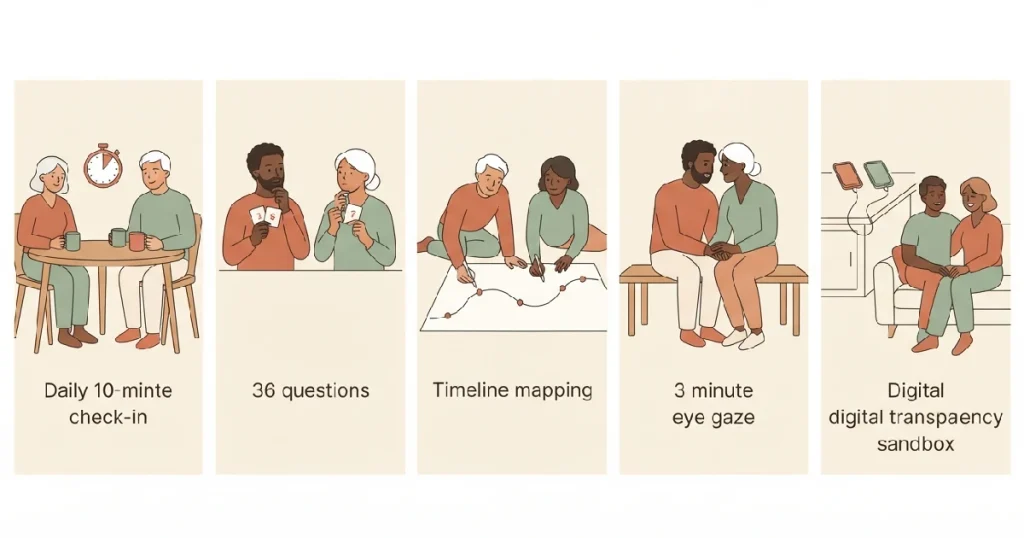
1. The 10-Minute Daily Emotional Check-In
The Framework: Set a timer for ten minutes each evening. Ask two questions, no more. “What made you feel disconnected from me today?” Then, “How can I support you tomorrow?” No rebuttals. Just listening.
Start simply: “Can we do our ten minutes tonight?” That’s the entire invitation.
It works because it schedules a slot for vulnerability before anxiety gets a full day to build its case file. Couples who wait for the “right moment” usually end up having the conversation sideways, at 11 p.m., in the middle of something unrelated. A standing appointment removes that guesswork. This is one of the simplest couple vulnerability activities available, no equipment required, just a timer and two honest questions.
2. The 36 Questions Vulnerability Deep Dive
The Framework: Work through a progressive list of questions that starts light (“Would you like to be famous?”) and gradually deepens (“What is your most terrible memory?”). Take turns. Don’t skip ahead.
Psychologist Arthur Aron and his colleagues designed this exact question set for a 1997 study, finding that structured, reciprocal self-disclosure could generate measurable closeness between complete strangers in under an hour. If it works between strangers, it works faster between two people who already share history, once they’re given permission to be honest again.
Start with: “Want to try one question tonight before bed, no pressure to finish the list?” Small doses beat marathon sessions here.
3. Shared Timeline Mapping for Rebuilding Trust After Betrayal
The Framework: Draw a long line across a sheet of paper representing your relationship, day one to today. Together, mark the high points, moments you felt closest, alongside the low points, moments you now realize you were drifting.
This works because it moves the conversation out of the present tense, where defensiveness lives, and into shared history, where you’re both looking at the same picture instead of across a table. Say: “I want us to see the whole story together, not just the worst chapter.” Couples rebuilding trust after betrayal often discover the rupture had quiet warning signs on both sides, months before the moment either partner points to as “when everything broke.”
4. The 3-Minute Eye-Gazing Challenge
The Framework: Sit facing each other, knees almost touching, and hold eye contact in silence for a full three minutes. No talking. No looking away.
It sounds almost too simple to matter, but sustained eye contact activates the parasympathetic nervous system, the part of your body responsible for calming down after a threat. That’s the exact system your relationship needs online again. Start with: “This is going to feel awkward for about ninety seconds. Stay with me anyway.” Most couples report the discomfort peaks around minute one, then softens into something closer to relief.
5. The Digital Transparency Sandbox
The Framework: Agree out loud on one small, temporary transparency habit. Leaving a phone face-up on the counter. Sharing a location app for thirty days. Reading a text aloud if asked. This is not surveillance. It’s exposure therapy for the part of the brain still expecting to find something.
Say it plainly: “I’m not doing this because I have something to hide. I’m doing it so your brain gets to practice finding nothing.” Over time, repeated exposure to “nothing bad happened” retrains an anxious brain to stop predicting catastrophe. This exercise works best with a clear end date, reviewed and renegotiated together, not left open-ended indefinitely.
5 Golden Rules for Conflict-Free Communication Exercises for Couples

Every exercise above works better inside a few non-negotiable boundaries. These come from couples who actually survived a trust breach, not from a textbook.
1. Sit on the same side. Move physically to the same side of the couch or table before discussing anything hard. Facing each other like opponents primes your brain for debate. Sitting side by side primes it for teamwork.
2. Ban eternity language. Cut “always” and “never” completely. “You always do this” isn’t a fact, it’s an accusation dressed as one, and it forces an instant defensive posture. Replace it with the specific instance instead: “Last Tuesday, when…”
3. Install a safe-word pause button. Pick one neutral word, unrelated to the conflict, like “yellow” or “timeout.” Either partner can say it once, and both of you stop talking for twenty minutes, no exceptions. Come back to the same room after the cooldown, every single time.
4. Mirror before you respond. Before making your own point, repeat back what your partner just said, in your own words, and ask, “Did I get that right?” This one habit slows the conversation down enough to short-circuit the threat response loop.
5. Separate impact from intent. Start hard sentences by naming what you believe your partner meant, then what actually happened to you: “I don’t think you meant to hurt me when you didn’t call. But when you didn’t, I spiraled.”
These five rules won’t make hard conversations painless. But here’s what no one tells you: painless was never the goal. Survivable, structured, and repeatable was always the goal.
Moving Forward: Overcoming Insecurity in Relationships Takes Consistency
Some days these exercises will feel like they’re working. Other days an old wave of doubt will hit you out of nowhere, seemingly for no reason. That’s not a sign of failure. It’s a normal marker of a nervous system still relearning what safe feels like.
Recovery from a trust rupture rarely moves in a straight line. Expect setbacks. Expect a random Tuesday where the old fear shows up uninvited. What matters isn’t a perfect week. It’s whether you keep showing up for the small, repeatable moments that slowly outnumber the doubt.
One place to start: pick a single exercise from this list, just one, and commit to it for the next fourteen days before adding anything else. Consistency in a ten-minute check-in will do more for your relationship than one dramatic apology ever could.
You did not lose the ability to trust. You lost the evidence that made trust feel automatic. Every rep you complete from this list rebuilds a small piece of that evidence, the same way physical therapy rebuilds a joint nobody thought would hold weight again. Give it reps, not perfection. That’s how safety comes back.
If old fears from a betrayal keep surfacing despite consistent effort, consider speaking with a licensed couples therapist trained in trauma-informed approaches.
My Closing Remarks
In my practice, the couples who heal fastest are rarely the ones with the most dramatic breakthrough sessions. They’re the ones who do the unglamorous ten-minute check-in on a Tuesday when they’d rather watch television instead. Trust was never going to be repaired by one perfect conversation. It gets repaired by two people choosing each other in small, boring, repeated moments, until the nervous system quietly decides it’s finally safe to exhale.
More Related Stories for You
- If constant hypervigilance still feels overwhelming between exercises, learning simple ways of grounding your nervous system can help you show up calmer for these conversations.
About The Author