


Standard parenting advice is lying to you. If your kid throws a massive, screaming tantrum in the middle of a busy grocery store, well-meaning relatives will probably tell you to ignore them or immediately use a time-out. That is dead wrong. If you want to see genuine Preschoolers Social and Emotional Development, you have to completely throw out the old, outdated playbook.
Isolating a child when their brain is actively panicking does not teach them a valuable lesson. It just teaches them to hide their big feelings from you.
As a clinical social worker, I sit across from exhausted parents every single day. You are tired. You are constantly second-guessing your reactions. You just want your child to be kind, confident, and able to handle frustration without throwing a toy at someone’s head. I get it. I have been there, both as a professional and in my own living room. We are going to fix this.
You do not need another dense, academic lecture about child psychology. You need actual tools you can use right now. You need scripts. You need to know what to say when your kid absolutely loses their mind over the wrong color cup.
In this guide, we are going to break down the exact steps to build unbreakable emotional resilience in your child. We will cover the psychological shifts you need to make, the common mistakes that are secretly making tantrums worse, and the specific phrases that will bring peace back to your home. Let’s get to work.
The Core Concept: Redefining Preschoolers Social And Emotional Development
Before we jump into the scripts, we need to completely reframe how we view early childhood behavior. Most adults think that good behavior means a quiet, compliant child. But compliance is not emotional intelligence.
Table of Contents
If a child only behaves well because they are terrified of being punished, they have not learned anything about processing their feelings. They are simply masking their distress. True emotional literacy means a child can feel blazing anger, recognize that anger, and choose to use their words instead of their fists. That is a massive neurological leap.
Social and emotional development in preschoolers is the specific process where children aged three to five learn to accurately understand their feelings, build deep empathy, and form lasting relationships. The most proven method to support this is emotion coaching, where parents actively co-regulate, clearly label feelings, and model healthy conflict resolution in real time during highly stressful moments.
To achieve this, we have to look closely at understanding typical early childhood developmental milestones. Young children are not miniature adults. Their brains are literally under construction. They do not have access to logic when they are upset. When you understand that their meltdowns are neurological traffic jams rather than personal attacks against you, everything changes.
5 Actionable Steps To Build Unshakable Emotional Literacy
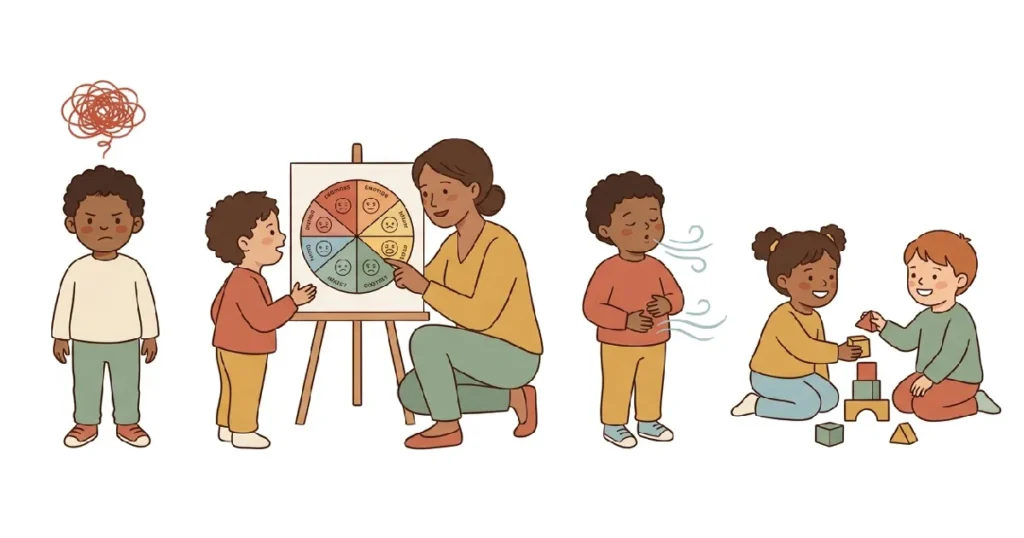
You do not need a degree in psychology to be an excellent parent. You just need a few reliable tools. Here is your step-by-step guidance for building strong executive function skills and emotional control at home.
1. Shift From Emotion Dismissal To Emotion Coaching
When your child is crying over something that seems ridiculous to you (like a broken cracker), your instinct is probably to fix it or dismiss it. You might say, “It is just a cracker, stop crying.” This is emotion dismissal. It tells the child their feelings are wrong. You need to switch to emotion coaching immediately.
- Do this: Say, “You are so sad your cracker broke. You wanted it to be whole. I understand.”
- Not that: “Stop whining, I will just get you another one.”
When you validate the emotion, the child stops fighting to be heard. Their nervous system instantly begins to settle.
2. Implement Affect Labeling Daily
Young kids do not have the vocabulary to say, “Mother, I am feeling quite overwhelmed by the sensory input in this room.” They just scream. You have to lend them the words. This is called affect labeling.
Dr. Dan Siegel, a leading clinical psychiatrist, explains this perfectly.
“Name it to tame it, as we say in interpersonal neurobiology, helps calm the emotional centers of the brain.”
By assigning a word to the wild feeling inside their body, you make the feeling manageable. Here is a list of phrases you can start using today:
- “I see your hands are balled into fists. You seem really mad.”
- “Your shoulders are tight. Are you feeling nervous about this new place?”
- “You are jumping up and down! You must be so excited.”
3. Practice Active Co-Regulation During Meltdowns
If you have ever dealt with this, you know it is maddening. Your kid is screaming, and suddenly you feel like screaming, too. But a dysregulated adult can never regulate a dysregulated child. You have to practice co-regulation techniques for parents to bring them back to baseline.
Dr. Laura Markham summarizes the science beautifully.
“Your child’s brain is still developing, and they rely on your calm nervous system to help them regulate their own.”
If your child is completely melting down, do not send them away. Sit near them. Take deep, audible breaths. Say out loud, “I am going to take a deep breath to calm my body down.” They will subconsciously absorb your calm energy.
4. Role-Play Peer Interactions At Home
You cannot wait until you are at a crowded playground to teach social skills. The stakes are too high, and the environment is too distracting. You have to practice at home when everyone is relaxed. Use their toys to act out scenarios.
Here is a list of games you can play to practice these skills safely:
- The Puppet Conflict: Have two puppets “fight” over a block. Ask your child, “Oh no, they both want it! What should they do?”
- The Freeze Game: Play music and dance. When the music stops, they have to freeze. This builds massive impulse control.
- The Emotion Guessing Game: Make silly or angry faces and have your child guess what you are feeling.
5. Embrace The Teachable Moment After The Storm
You cannot teach a drowning person how to swim. Likewise, you cannot teach a screaming preschooler a lesson about sharing. During a tantrum, their logic center is offline. You must wait for the storm to pass.
Once they are fully calm, maybe 30 minutes later, you bring it up gently. Say, “Wow, we had a really hard time earlier. You were so mad that your brother took your toy, and you hit him. Next time you are that mad, what can you say with your words?” This is where the actual learning happens.
The Simplified True Story: From Hiding To Thriving
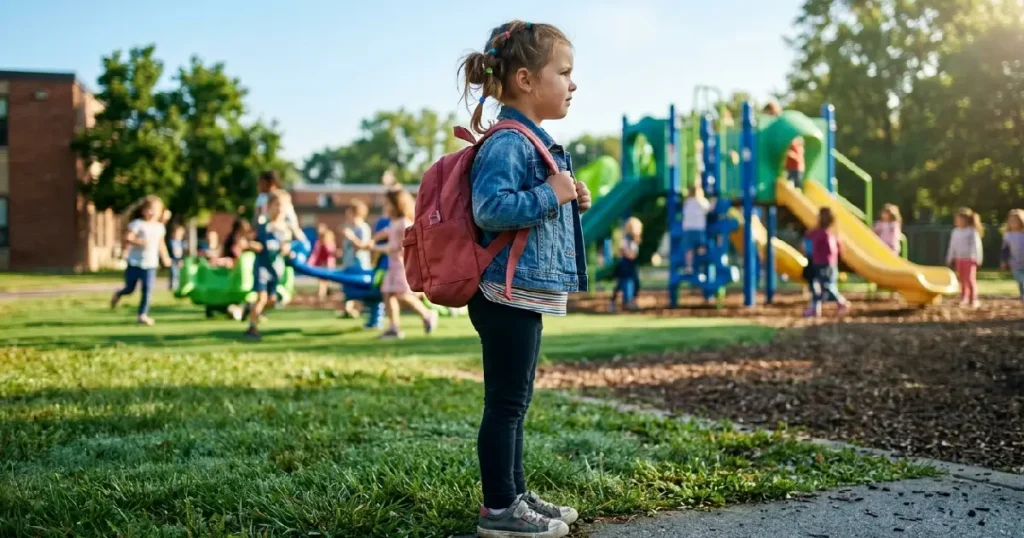
Meet Sarah and her four-year-old son, Leo. It was a typical Tuesday morning at 7:30 AM, and the house was already vibrating with tension. Leo had a very specific habit. Whenever he felt anxious, he would aggressively tug on his left earlobe. On this particular morning, Sarah was rushing to get out the door for preschool drop-off.
Leo, however, was frozen by the front door. His tiny fingers were pulling on his earlobe, and thick tears were silently streaming down his face. When Sarah tried to gently guide him toward the car, Leo immediately dropped to the floor, wrapped his arms tightly around her right leg, and buried his face in her knee. He was absolutely terrified of joining the group of loud, chaotic children at his school.
In the past, Sarah would have peeled him off, told him to be brave, and promised him a sweet treat after school. But she knew that was not working anymore. Instead, Sarah dropped her heavy bags. She sat directly on the cold tile floor next to him. She did not rush him at all.
She looked at his tear-stained face and said, “Your body is telling me you feel very scared right now. The school is loud, and it is okay to feel nervous.”
Leo stopped tugging his ear. He looked up at her, took a shaky breath, and simply nodded. That one moment of pure validation did more for his confidence than a hundred lectures ever could. By naming his fear, Sarah gave him the courage to finally walk to the car.
Common Mistakes And How To Avoid Them
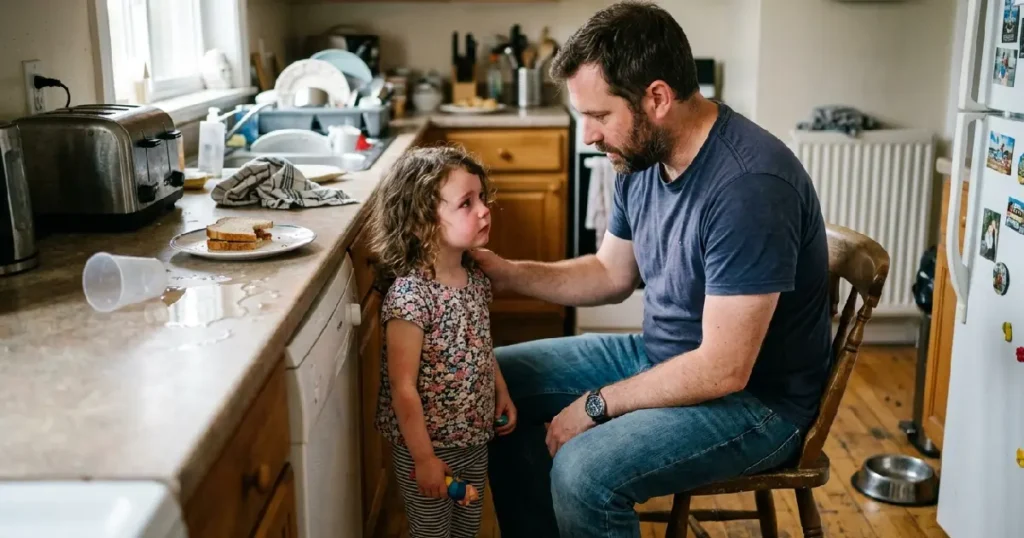
Even the most dedicated parents fall into these traps. Standard society pushes us toward these reactions, but they actively harm the relationship you are trying to build. Let’s fix them.
Mistake 1: Forcing Empty Apologies Too Quickly
When your child snatches a toy from another kid at the park, it is embarrassing. To save face with the other parents, you probably grab your kid and hiss, “Say you are sorry right now.”
Actually, let me back up. What does a forced apology actually achieve? It teaches your kid to tell a lie to get out of trouble. They are not sorry; they are just mad they got caught.
How to fix it: Instead of forcing the words “I am sorry,” focus on repair. Try using these exact phrases from this list instead:
- “Check on your friend. Is he okay? What can we do to help him feel better?”
- “I will not let you take toys. When you are ready, you can offer him a turn.”
- “Let’s go get an ice pack for her arm.”
Mistake 2: Punishing The Behavior Instead Of Reading The Emotion
Behavior is just communication. It is the tip of the iceberg. If you only punish the visible behavior (the hitting, the biting, the yelling), you completely ignore the massive chunk of ice underwater (the fear, the exhaustion, the overstimulation).
If you are struggling with why kids have aggressive tantrums, you have to look deeper. If a child bites when they are crowded, punishing the bite will not stop the sensory overload.
How to fix it: Become a detective. Ask yourself, “What is driving this?” Are they hungry? Are they tired? Are they seeking connection? Address the root cause, and the bad behavior will naturally fade away.
Mistake 3: Treating Meltdowns Like A Manipulation Tactic
I hear this all the time: “He is just crying to manipulate me into giving him candy.” I might be wrong about this, but I strongly believe that four-year-olds are not criminal masterminds. They do not possess the cognitive foresight to map out a manipulative scheme.
A meltdown happens because they have exceeded their capacity to cope with their current environment. It is a genuine distress signal.
How to fix it: Change your internal monologue. Instead of thinking, “He is giving me a hard time,” you must repeat the phrase, “He is having a hard time.” This simple mental switch shifts you from an angry adversary to a helpful coach.
Mistake 4: Expecting Four-Year-Olds To Share Perfectly
Adults hate sharing. If someone walked up to you and demanded to drive your car because they liked it, you would call the police. Yet, we expect toddlers to hand over their most prized possessions simply because another child wants them.
At this age, children are moving from parallel play (playing next to each other) to cooperative play (playing together). Sharing is an incredibly complex skill.
How to fix it: Stop forcing them to share immediately. Teach them about “turns.” Here is a reliable list of scripts you can use for sharing conflicts:
- “You can have a turn as soon as she is all done.”
- “He is still working with that truck. Let’s find something else to do while we wait.”
- “Are you finished with this, or are you still using it?”
Allowing a child to finish their turn builds a deep sense of security. When they feel secure, they will naturally hand the toy over.
Frequently Asked Questions
What is a proven way to help young kids with their emotional needs?
The most proven method is emotion coaching. Instead of dismissing a child’s big feelings, you must validate the emotion, label it clearly, and help the child physically regulate their body. Combining this approach with daily cooperative play and establishing a safe calming corner rapidly builds a young child’s emotional literacy, confidence, and internal impulse control.
How do you handle a child who hits when they are angry?
Hitting is a sign of an underdeveloped impulse control system, not a bad kid. Immediately block the hit safely. Say firmly, “I will not let you hit, because hitting hurts.” Once the child is completely calm, validate the underlying emotion, and practice using words instead of hands for the next time they feel frustrated.
Why is my four-year-old suddenly struggling to share toys with others?
Sharing requires advanced executive functioning and perspective-taking, which kids are still actively building at this age. Instead of forcing them to share immediately, teach them simple turn-taking. Allowing the child to finish their turn with a toy builds a sense of deep security, making them much more willing to hand it over afterward.
Is it normal for young kids to have extreme public meltdowns?
Yes, it is completely normal. Young kids experience intense emotions but lack the neurological wiring in their prefrontal cortex to process them logically. Meltdowns occur when their nervous system is overwhelmed by frustration, hunger, or heavy fatigue. Consistent co-regulation from a very calm adult is the key to helping them process these overwhelming moments safely.
What daily activities promote better social skills in early childhood stages?
Play-based learning is the absolute most effective activity you can use. Engaging in pretend play, using puppets to resolve imaginary conflicts, playing cooperative board games that require turn-taking, and reading books that explicitly discuss feelings are all proven ways to rapidly develop your child’s empathy, emotional vocabulary, and overall social awareness in group settings.
Can parental stress directly impact a child’s early emotional development?
Yes, significantly. Children are highly observant and often absorb the emotional temperature of their home environment. If you are constantly overwhelmed, your child may mirror that anxiety. Prioritizing your own mental health and finding healthy ways of managing stress in your marriage directly benefits your child’s ability to remain emotionally balanced.
Final Takeaway
Raising a socially confident and emotionally stable child is not about achieving perfect behavior every single day. It is about creating an environment where feelings are safe to express, boundaries are consistently held, and repair is always guaranteed after a rupture.
You are laying the foundation for the adult they will become. The scripts, the deep breathing, and the endless patience might feel exhausting right now. But every time you sit on the floor and validate their anger instead of shouting at them, you are physically rewiring their brain for resilience. Give yourself some grace. You are learning this new language right alongside them. Keep showing up, keep taking deep breaths, and trust the process.
My Closing Remarks
I have sat in my car and cried after a massive toddler meltdown in public. It feels humiliating. But listen to me carefully. Your child is not giving you a hard time; they are having a hard time. The day I stopped caring about the judgmental stares of strangers and started sitting on the floor to breathe with my screaming son, everything changed. You have the power to break generational cycles of anger right now. It takes guts, but you are absolutely brave enough to do it.
More Related Stories For You
- If you are struggling with technology boundaries, read our guide on setting healthy screen time limits for preschoolers to bring peace back to your living room.
- Curious about the future of education? Find out the truth about AI tutors and child cognitive development before you introduce new devices.
- If you have younger kids at home, do not miss our actionable tips for building social emotional learning for toddlers from the ground up.