
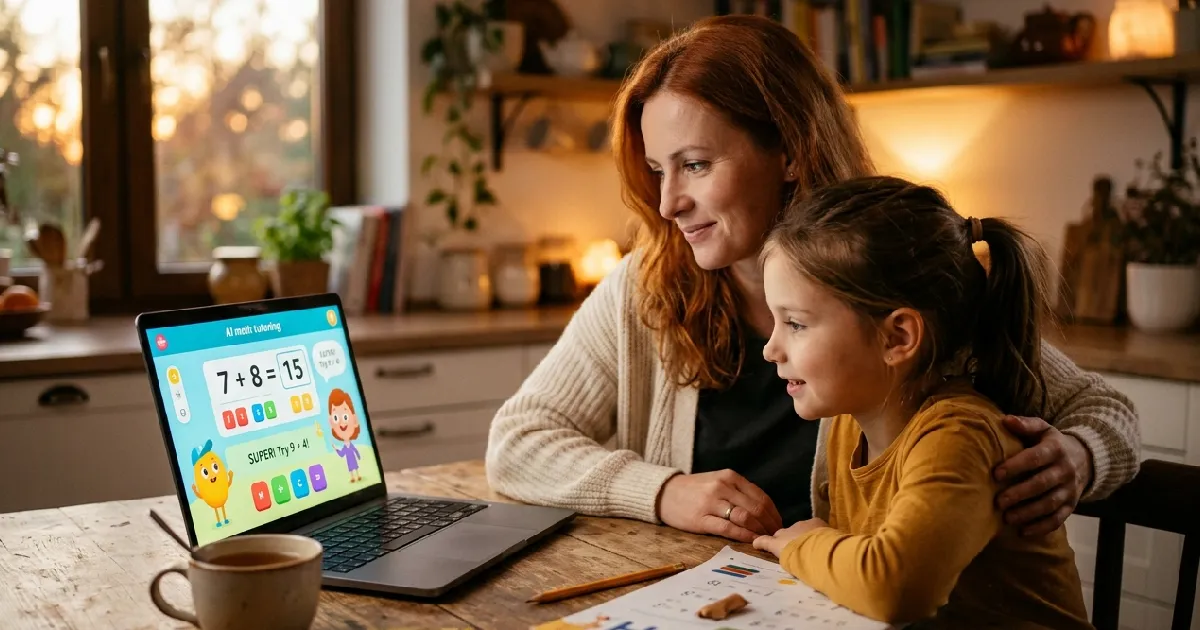

You have watched your child sit at the kitchen table, stuck on the same math problem for forty minutes. Textbook open. Frustrated tears forming. You, Googling the answer yourself, wondering why the school system seems allergic to teaching the way your kid actually learns.
You are not a bad parent. The system was never built for your child’s brain.
Let me say something most articles will not: the debate about AI tutors and child cognitive development has been hijacked by two loud, wrong camps. One camp screams that AI is the savior of education. The other insists it is a dangerous shortcut that will turn our kids into lazy thinkers who cannot tie their own shoes without asking ChatGPT.
Both camps are missing what the 2025 research actually shows.
It is not about AI or human teachers. It is about what happens when they work together. And the cognitive wins showing up in randomized controlled trials are unlike anything we have seen before.
AI tutors accelerate child cognitive development by delivering personalized, adaptive instruction matched to each child’s exact learning pace. Harvard’s 2025 randomized controlled trial found students using AI tutors learned significantly more in less time than those in traditional active-learning classrooms. Nature’s systematic review of 4,597 K-12 students confirms these systems produce generally positive effects on learning and performance.
Here is what you are getting in the next few minutes: what the science actually says, stripped of jargon. An age-by-age guide no other article has built for you. Five proven steps you can use at your kitchen table this week. The hidden risk most parents never hear about (and exactly how to avoid it). And the real story of a mother who turned homework battles into breakthroughs.
What “AI Tutors and Child Cognitive Development” Really Means (And Why It Is Bigger Than You Think)
Beyond the App: The Real Science of AI Tutoring
Most people think an AI tutor is just a chatbot that quizzes kids on multiplication tables. That misses the entire point.
Table of Contents
The most sophisticated AI tutoring systems are built around something called the Zone of Proximal Development, a concept psychologist Lev Vygotsky developed decades ago. Think of it as the sweet spot between what your child already knows and what they are ready to learn next. Not too easy. Not too hard. Just enough stretch to grow.
A classroom teacher managing twenty-eight students cannot possibly keep every child in that sweet spot all period long. She is pitching to the median. Your advanced child is bored. Your struggling child is lost. Both are disengaging.
An AI tutor, by contrast, operates entirely within your individual child’s ZPD, every single session. It builds what researchers call an adaptive student model (a real-time cognitive profile) by tracking not just right and wrong answers, but how your child thinks: where they hesitate, what misconceptions they hold, when they are ready to surge ahead.
This is why students can finally be saved from classes pitched to the median. The kind of personalized syllabus and bespoke learning that was once available only to the privileged few is now accessible through pedagogically designed AI platforms.
There is another layer here, and it is the one that matters most for long-term brain development. The best AI tutors do not just teach your child math. They incorporate metacognitive self-regulation features that encourage students to assess their own progress and take ownership of their learning. In plain terms: your child learns how to think about how they learn. That skill, once built, transfers to every subject for the rest of their life.
And here is where things get fascinating. A Psychology Today analysis framed AI tutors as Vygotsky’s “more knowledgeable other,” stepping in with support, then stepping back so the learner builds independence. When the AI pays attention and adjusts in real time, it mirrors the kind of teaching that builds confidence rather than dependence.
The Data That Silenced the Skeptics: 2025 Research Roundup
Let me give you the numbers parents and educators actually need.
Study 1: Harvard’s 2025 Randomized Controlled Trial
Gregory Kestin and his team at Harvard ran a crossover design with 194 undergraduate physics students, comparing AI-tutored sessions against traditional active-learning classrooms taught by experienced instructors. The results stopped people in their tracks. Students using the AI tutor achieved median post-test scores of 4.5 compared to 3.5 for classroom learners, representing learning gains more than double those of the control group. The effect size reached between 0.73 and 1.3 standard deviations. In education research, anything above 0.4 is considered significant. This was remarkable. And students accomplished these superior outcomes in less time, with 70 percent finishing in under an hour.
But here is the quote that should make every parent lean in. Kestin said: “AI tutors shouldn’t ‘think’ for students, but rather help them build critical thinking skills.” This is not a man selling a product. This is a Harvard physicist warning us about the right way to use the tool. His study also found students felt more engaged and more motivated when learning with the AI tutor, which challenges the assumption that screens automatically equal disconnection.
Study 2: Nature’s K-12 Systematic Review (4,597 students)
Published in npj Science of Learning, this review analyzed 28 studies encompassing 4,597 K-12 students. The conclusion: intelligent tutoring systems produce generally positive effects on learning and performance, particularly when compared to traditional teacher-led instruction, with most studies reporting medium to large effects. Middle school students frequently demonstrated more pronounced learning gains than their high school counterparts, suggesting the deployment window matters enormously.
Study 3: The VanLehn Meta-Analysis
Kurt VanLehn’s widely cited 2011 meta-analysis compared intelligent tutoring systems against human tutors and no-tutoring conditions. The effect size for intelligent tutoring systems? 0.76. The effect size for human tutoring? 0.79. Statistically, these are nearly identical. AI tutors are now approaching the effectiveness of one-on-one human instruction, at a fraction of the cost and available any hour of the day.
Here is the headline: the best AI tutoring systems are no longer a sci-fi fantasy. They are producing measurable cognitive gains in real classrooms and real kitchen tables across the country.
The Age-by-Stage Roadmap: When AI Tutoring Truly Shines
No other article on page one of Google gives parents this. But you cannot make a smart decision without knowing what works at your child’s specific developmental stage.
Ages 3–6: The Foundation Window
Early childhood, from birth to age six, is a critically sensitive developmental window of rapid cognitive, social, and emotional growth. Whatever your child experiences during this period, including interactions with AI technologies, can have long-lasting implications for how their brain wires itself.
At this age, the rule is simple: AI should be a co-play tool, never a digital babysitter.
Best tools for this stage are storytelling-based AI platforms and tangible learning toys that blend physical manipulation with digital feedback. Think Osmo Little Genius or interactive story apps where the child moves real pieces and the screen responds. The goal is not academic acceleration. It is exposure to cause-and-effect reasoning and language-rich interaction.
Parent action: sit beside your child during every AI session. Keep sessions to fifteen to twenty minutes maximum. And balance every minute of screen-based learning with at least equal time of physical, hands-on play. If you are wrestling with how to strike that balance, this guide on digital play versus physical play will give you a practical framework.
Ages 7–12: The Cognitive Acceleration Window
This is the prime window where AI tutoring delivers its strongest documented impact. Middle school students often show more pronounced learning gains than high school students, partly because their brains are still building foundational reasoning structures and partly because AI tutors are exceptionally good at catching gaps before they compound.
At this age, emotional intelligence development through AI becomes a real and underexplored possibility. Emotionally responsive chatbots and AI-enabled systems can simulate social scenarios that help children practice recognizing feelings, navigating conflict, and building empathy. Harvard researcher Ying Xu put it this way: “AI is actually capable of providing very high-quality emotional support, but young people prefer human connections.” The takeaway is not to replace human interaction. It is to use AI as a low-stakes practice field where kids can rehearse social skills before taking them into the real world.
Best tools: Khan Academy’s Khanmigo for Socratic math and science tutoring, adaptive problem-solving platforms, and AI reading coaches that ask comprehension questions rather than just reading aloud.
Parent action: set three weekly AI tutoring sessions of twenty-five to thirty minutes. After each session, spend five minutes in a “teach-back” conversation where your child explains one concept they learned to you. This single habit activates deep memory consolidation and prevents cognitive offloading.
Ages 13–18: The Critical Thinking and Independence Window
Here is where things get serious, because the greatest risk and the greatest opportunity both peak simultaneously during the teenage years.
The risk is cognitive offloading, where teenagers habitually delegate thinking to AI instead of building their own reasoning muscles. The opportunity is self-directed mastery, where a motivated teen uses AI as a thought partner to explore subjects far beyond the school curriculum.
Best use at this stage: Socratic dialogue AI that asks questions rather than giving answers, essay feedback tools that highlight structural weaknesses without rewriting, and STEM problem-solving platforms that require the student to submit an independent attempt before revealing guidance.
Parent action: require an “AI-free” first draft on every major assignment. Let your teen struggle for at least twenty minutes before opening any AI tool. That struggle is not wasted time. It is the neurological equivalent of resistance training.
Table 1: AI Tutoring Readiness by Age Group
| Age Range | Cognitive Stage | Best AI Tool Types | Session Length | Parent Role | Key Risk |
|---|---|---|---|---|---|
| 3–6 | Sensorimotor to preoperational | Storytelling AI, tangible AI toys | 15–20 minutes | Co-player, sit beside | Passive screen dependency |
| 7–12 | Concrete operational | Socratic math/science AI, reading coaches | 25–30 minutes | Post-session teach-back partner | Over-reliance without reflection |
| 13–18 | Formal operational | Essay feedback AI, STEM problem-solving ITS | 30–45 minutes | AI-free draft enforcer | Cognitive offloading |
5 Proven Steps to Use AI Tutors for Your Child’s Cognitive Development
Step 1: Choose a Pedagogically Designed AI Tutor (Not Just Any Chatbot)
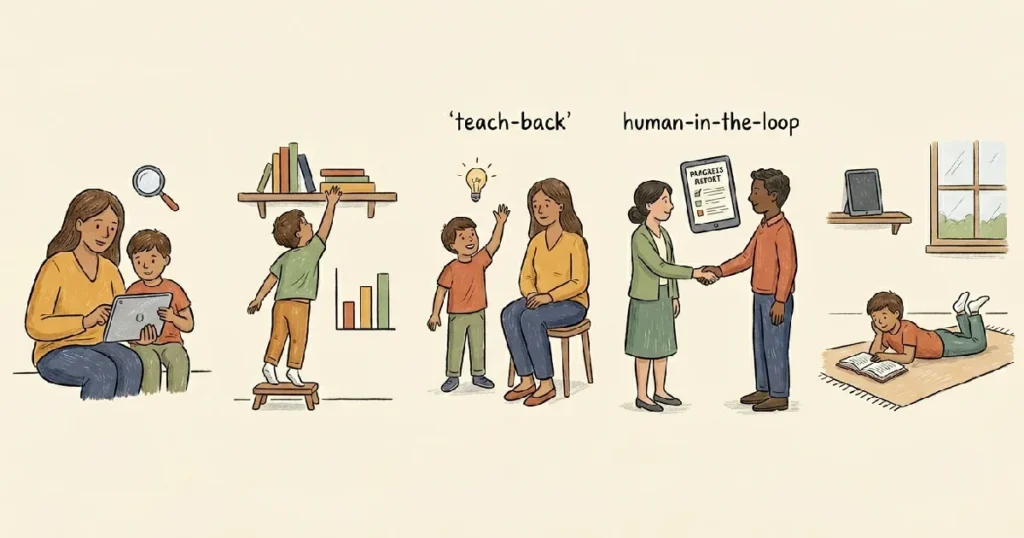
Do this: select AI tutoring platforms specifically built around cognitive science and learning principles. Khan Academy’s Khanmigo, Synthesis, IXL Learning, and Socratic by Google are all designed with pedagogical guardrails. They ask follow-up questions. They refuse to simply hand over answers.
Not that: do not give your child unrestricted access to a general-purpose chatbot like ChatGPT or Gemini without structure. These models are engineered to be helpful, not to promote learning. Without guidance, students complete assignments without engaging in critical thinking at all.
Step 2: Establish a “ZPD Session” — Start at the Right Level
Do this: use the AI tutor’s diagnostic assessment to establish your child’s exact knowledge baseline. A true intelligent tutoring system will find the Zone of Proximal Development automatically. Let it. The content should feel slightly challenging, never comfortable.
Not that: do not set the difficulty level to easy just to keep your child happy. Comfortable means no growth is happening. The ZPD is deliberately calibrated to be just beyond current ability, where real cognitive stretching occurs.
Step 3: Build in the “Teach-Back” Protocol After Every Session
Do this: after every twenty-five to thirty-minute AI tutoring session, spend five minutes asking your child one question: “Teach me one thing you learned today.” This simple act forces the brain to retrieve, organize, and articulate knowledge, which is the neurological foundation of long-term memory consolidation.
Not that: do not let the AI session end with your child closing the laptop and walking away. Research shows that students using generative AI without specific guidance demonstrate very limited reflection on learning material. Without the teach-back step, the cognitive gains evaporate.
Step 4: Keep the Human Teacher in the Loop
Do this: share AI session progress reports with your child’s classroom teacher. Teachers continue to play an essential role in monitoring and guiding students’ use of AI tools, ensuring they are used appropriately and productively. The hybrid model is not a compromise. It is the evidence-backed winner.
Not that: do not treat AI tutoring as a replacement for the teacher-child relationship. Every major study in this space reaches the same conclusion: AI plus human instruction outperforms either one alone.
Step 5: Schedule “AI-Free” Thinking Days
Do this: build in two to three days per week where your child solves problems independently before checking any AI tool. This protects neural pathway development and builds genuine cognitive resilience. According to Cognitive Load Theory, AI must decrease cognitive overload while sustaining active cognitive engagement, and that only works with intentional pacing.
Not that: do not allow daily, multi-hour AI tutor sessions without breaks. Cognitive research has raised a clear warning: persistent reliance on AI tutors may foster cognitive offloading, thereby impeding the development of self-regulated learning and analytical reasoning. The risk is real, and it is preventable with this single scheduling habit.
Real Story: How One Family Turned Homework Battles Into Breakthroughs

Maya was nine years old, bright and curious about everything except math. By third grade, she was two grade levels behind. Her mother, Danielle, had hired a traditional tutor. Twice a week, forty-five dollars per session. The other five evenings each week, Maya sat at the kitchen table at 6:30 PM and fell apart.
Danielle told me: “She would cry. I would panic. We would both give up and watch TV. I felt like I was failing her.”
Here is what nobody had explained to Danielle: Maya’s tutor was teaching to her average performance. Some days Maya needed to slow down and rebuild a foundation. Other days she was ready to accelerate. The tutor had no way to know which day it was, because she only saw Maya twice a week and had no real-time data between sessions.
Danielle made one specific change after reading about structured AI tutoring. She signed Maya up for an adaptive AI math platform set at her Zone of Proximal Development. Every evening at 6:30 PM, same kitchen table, Maya spent twenty minutes with the AI tutor. Then came the non-negotiable: five minutes of teach-back. Maya had to explain one concept to her mother, in her own words.
Eight weeks later, Maya’s math assessment scores moved from the 31st percentile to the 58th. But Danielle told me the number was never the real story. “She stopped saying ‘I’m bad at math.’ She started saying ‘I haven’t learned that part yet.’”
That is the cognitive shift that matters. The teach-back protocol, a five-minute habit any parent can implement tonight, rewired Maya’s relationship with her own mind.
Common Mistakes and How to Avoid Them
Mistake 1: Using AI as a Digital Babysitter
Many exhausted parents hand their child a tablet with an educational app and walk away. This is understandable. It is also the fastest path to passive screen dependency and zero cognitive gain.
What to do instead: for children under eight, sit beside them during every AI session. Your presence signals that the activity matters. Ask one question during the session: “Why did you choose that answer?” Your voice, your attention, your follow-up question, those are the elements that transform screen time into brain-building time. If you are struggling to be present because work demands are bleeding into family hours, this piece on how remote work affects children may help you set the boundaries you need.
Mistake 2: Skipping the Reflection Step
The most common pattern I see: child finishes AI session, closes laptop, moves on to something else. Without reflection, the neural pathways formed during the session begin to weaken within hours.
What to do instead: implement the teach-back protocol described in Step 3. It takes five minutes and requires zero preparation. You can also try a quick mindfulness reset before the teach-back, something as simple as three deep breaths together, which primes the brain for memory retrieval.
Mistake 3: Choosing Convenience Over Pedagogy
Giving your child unrestricted access to a general chatbot because it is free and easy is like handing a ten-year-old a university library and expecting them to self-educate. AI chatbots are designed to be helpful, not to promote learning.
What to do instead: use platforms specifically built for education. Khan Academy’s Khanmigo uses Socratic questioning instead of answer-giving. IXL adapts in real time to student performance. Duolingo’s AI adjusts language difficulty based on error patterns. These tools are built with learning science baked in. The free chatbot is a research tool for adults, not a tutor for developing brains.
Mistake 4: Treating AI Tutoring as a Replacement for Human Connection
I hear this fear constantly: “Will my child stop needing me? Will they stop needing teachers?” The research is unanimous on this point. AI should complement and not replace human instruction.
What to do instead: think of AI tutoring as the daily practice and the human teacher as the coach who designs the game plan. Your child’s teacher can look at AI session data and identify exactly where to focus classroom instruction. You can use the teach-back conversation as a daily bonding ritual. AI handles the repetitive skill-building. You handle the relationship, the encouragement, the larger meaning. Neither replaces the other.
AI Tutor vs. Human Tutor vs. Traditional Classroom: The Definitive Comparison

VanLehn’s meta-analysis found that intelligent tutoring systems produced an effect size of 0.76, nearly identical to human tutoring at 0.79. In plain English: the best AI tutoring systems are now statistically as effective as one-on-one human instruction, available 24/7, and accessible for the cost of a monthly subscription rather than a second mortgage.
Table 2: AI Tutor vs. Human Tutor vs. Traditional Classroom
| Factor | AI Tutor | Human Tutor | Traditional Classroom |
|---|---|---|---|
| Personalization | Fully adaptive, real-time | High, but session-limited | Pitched to the median |
| Availability | 24/7, on-demand | Scheduled only | School hours only |
| Cost | Free to $30/month | $50 to $150/hour | Free (public) |
| Emotional Connection | Simulated, developing | Genuine human bond | Teacher relationships |
| Cognitive Offloading Risk | High if unmanaged | Low | Low |
| Learning Gains (Evidence) | Effect size ~0.76 | Effect size ~0.79 | Effect size ~0.42 |
| Best For | Daily practice, skill drilling | Complex conceptual breakthroughs | Social learning, collaboration |
The verdict? Hybrid wins. Always. AI handles the daily, personalized repetition that builds fluency. Human teachers and parents handle the mentorship, the emotional support, and the complex reasoning that requires relationship. This is not AI versus humans. It is AI plus humans, which is now the most powerful learning combination available to ordinary families.
Frequently Asked Questions
At What Age Should a Child Start Using an AI Tutor?
Most child development experts suggest AI tutoring tools can be introduced as early as age three or four through guided, play-based platforms. However, the strongest documented cognitive gains appear in children aged seven to twelve. Parental co-use is essential for any child under six. The tool matters less than the presence of an engaged adult sitting beside them.
Can AI Tutoring Replace a Real Teacher or Human Tutor?
No, and the best research confirms this. AI tutoring excels at personalized practice and immediate feedback. Human educators provide irreplaceable relationship-based learning, emotional support, and complex synthesis instruction. The evidence-backed approach is a hybrid model: AI for daily personalized skill-building, humans for deeper mentorship and social-emotional development.
Does AI Tutoring Actually Improve Cognitive Development in Children?
Yes, with strong scientific support. Harvard’s 2025 randomized controlled trial found students learned significantly more in less time using AI tutors compared to traditional classroom instruction, with higher reported engagement and motivation. Nature’s systematic review of 4,597 K-12 students confirms intelligent tutoring systems produce generally positive effects on learning and performance
What Is the Biggest Risk of AI Tutoring for Children?
The greatest risk is cognitive offloading, when children outsource their thinking to AI instead of building independent reasoning skills. This risk is real but entirely preventable. Implementing structured AI-free practice days, using the teach-back protocol after every session, and selecting pedagogically designed platforms that promote reflection rather than answer-giving effectively counteract this risk.
Is AI Tutoring Effective for Children Who Struggle in Traditional School Settings?
Particularly yes. Research consistently finds that lower-performing students benefit most from AI tutoring because intelligent tutoring systems provide tailored scaffolding that classroom instruction cannot offer. AI tutors operate within each child’s Zone of Proximal Development, meeting struggling learners exactly where they are, adjusting difficulty in real time, and eliminating the anxiety of classroom comparison.
How Does an AI Tutor Personalize Learning Differently Than a Regular Educational App?
Standard educational apps follow a fixed curriculum path. AI tutors use adaptive student modeling, building a real-time cognitive profile by tracking response patterns, hesitation times, and underlying misconceptions. The system then continuously adjusts content type, difficulty, and pacing to match each child’s evolving brain state, session by session, rather than moving lockstep through a predetermined sequence.
Final Takeaway
You now know something most parents do not: AI tutoring is neither a silver bullet nor a threat to your child’s mind. It is a tool. And like any powerful tool, its value is entirely determined by how intentionally you use it.
Your one task this week: visit Khan Academy and activate Khanmigo for your child. Spend ten minutes doing the diagnostic assessment together. Then, after their first twenty-minute session, sit with them for five minutes and ask: “Teach me one thing you learned today.”
That is it. That is where the cognitive magic begins. The science is clear. The tools are ready. The missing ingredient is you, showing up, asking the question, and refusing to let the machine replace the relationship.
My Closing Remarks
I have sat across from parents who cried in my office because they felt their child was slipping away into a system too big to care. I have also watched those same parents, weeks later, walk in with something I can only describe as cautious hope after they finally found a rhythm that worked. AI tutoring will not save your child. But you, armed with the right information and willing to show up for a five-minute conversation at the end of a screen session, absolutely can. That is not a research finding. That is what I have seen with my own eyes.