
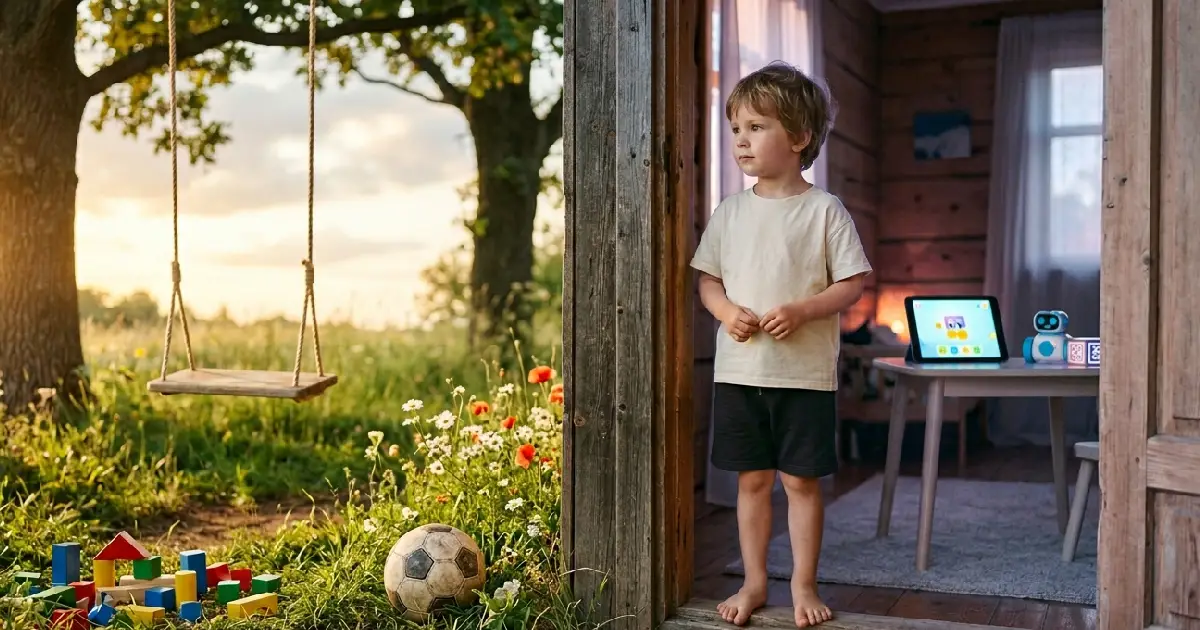

You know that knot in your stomach when you hand over the tablet, even for ten minutes, because you need to cook dinner or just breathe? That split-second guilt that whispers you’re somehow failing? If you’ve been down the rabbit hole searching “digital play vs physical play children” at 11 p.m., torturing yourself with conflicting advice, I want you to stop. Right here. Because what I’m about to tell you will flip that guilt on its head, and it might ruffle a few feathers. The real problem isn’t your child’s tablet. It’s that you’ve been tricked into managing screen time like a prison warden instead of designing your child’s play life like a thoughtful architect.
By the end of this read, you’ll know exactly what each type of play does to a developing brain, have a clear, age-by-age plan you can start tomorrow, and pick up a clever middle ground most parents never hear about. You’ll also walk away with one tiny, shockingly simple action that will reframe everything you thought about this so-called battle.
Digital play builds problem-solving, cognitive flexibility, and early digital literacy. Physical play constructs sensorimotor integration, gross and fine motor skills, and the executive function foundation for self-regulation. Children under twelve need both, with physical exploration serving as the non-negotiable developmental anchor and intentional, high-quality digital play acting as a structured cognitive boost.
What “Digital Play vs Physical Play Children” Really Means — and Why You Need a Reframe
Beyond Screens and Sandboxes
Most articles will tell you that digital play is “playing on screens” and physical play is “playing outside.” That’s dangerously incomplete. Let’s clean up the definitions.
Table of Contents
Digital play, when it’s actually play, is active, purposeful engagement with an app, game, or interactive tool where the child is making decisions, experimenting, and shaping the outcome. Think a child building a world in Minecraft Creative mode or figuring out a puzzle in an Osmo kit. This is a universe apart from passive digital consumption — that glazed-eye YouTube loop where the child is just absorbing, not doing. I’ll say it bluntly: passive consumption is the enemy, not the device.
Physical play is whole-body, sensorimotor exploration of the tactile world. It’s block towers crashing down, mud squishing between fingers, swinging until they’re dizzy, and chasing the dog barefoot. It activates the proprioceptive (body awareness), vestibular (balance), and tactile systems in ways no touchscreen can replicate. In fact, sensorimotor integration — the brain’s ability to take in, organize, and respond to physical sensations — is built almost exclusively through messy, movement-rich, real-world play.
Here’s a phrase I want you to hold onto: play affordances. Every play type offers something unique that the other cannot. Digital play offers infinite adaptability and immediate feedback loops that build cognitive flexibility. Physical play offers the irreplaceable weight of a real block, the scent of grass, the social negotiation of a live game of tag. The goal isn’t to crown a winner. It’s to understand what each brings to the table so you can serve the right meal at the right time.
What the Research Actually Says
If you’ve ever felt like you’re drowning in scary headlines, take a breath. The data is nuanced, and I’m going to give you the real picture.
A 2024 longitudinal study out of the University of Michigan, published in Developmental Psychology, tracked 380 children ages 3 to 8 and found something fascinating: children who engaged in high-quality, interactive digital play — not passive video watching — showed a measurable boost in problem-solving and early computational thinking, without any corresponding dip in social skills, as long as they also had at least double the time in hands-on physical play. The risk appeared when the ratio flipped. Read the full study summary here (American Psychological Association).
“The quality of screen time matters far more than the quantity,” explains Dr. Dimitri Christakis, pediatrician and screen-time researcher at Seattle Children’s Hospital. That means a 7-year-old co-creating a digital story with a sibling on an app is having a fundamentally different experience than a 7-year-old zoned out to algorithm-fed videos. Knowing the difference is half the battle.
On the other side, physical play consistently proves to be the heavyweight champion for executive function scaffolding. Unstructured, child-led physical play — think fort-building, not adult-led drills — directly strengthens the three pillars of executive function: inhibitory control (stopping an impulse), working memory (holding and using information), and cognitive flexibility (shifting between ideas). These are the exact mental muscles that predict academic success and emotional regulation far more reliably than early reading or math drills. “Play is not a luxury; it’s a biological necessity,” says Dr. Stuart Brown, founder of the National Institute for Play. If that doesn’t make you rethink your afternoon schedule, nothing will.
The Age-Specific Play Diet: Stop Guessing and Start Designing
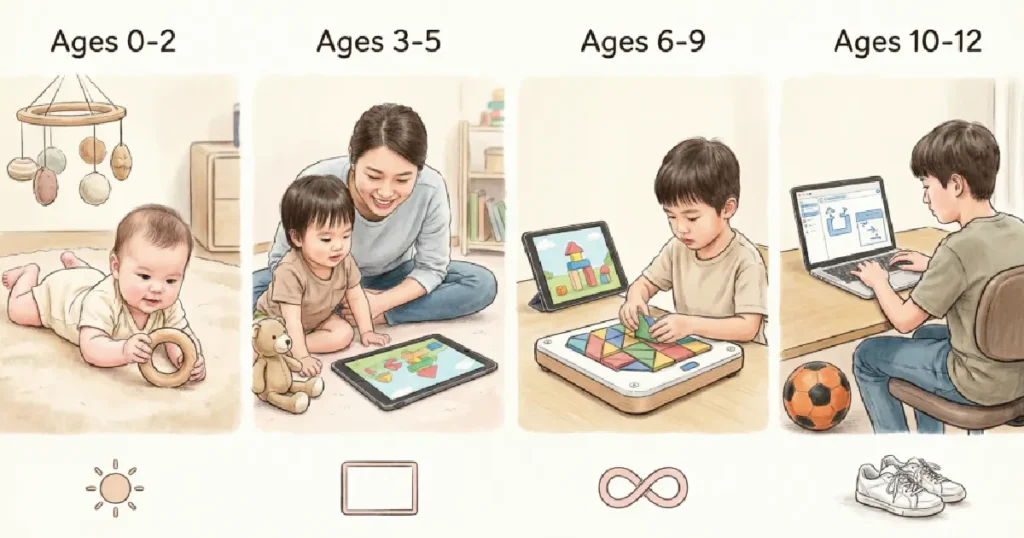
Here’s where every other article loses you. They say “find balance” like it’s a fortune cookie mantra. I’m going to give you actual ratios and real-life action steps broken down by age, because what works for your 2-year-old is developmentally irrelevant for your 10-year-old.
Ages 0–2: Physical Play Is Non-Negotiable
These first two years are a massive neurological construction project. The brain is mapping the body and the physical world almost exclusively through sensory input and movement. Tummy time, reaching for a wooden ring, banging pots, crawling over cushions — every wobble, every texture, every taste is wiring the brain for later learning. A touchscreen, no matter how colorful, provides zero proprioceptive feedback. It can’t teach cause and effect the way dropping a spoon from a high chair does.
Do this: Flood the day with floor play, water play, supervised sensory bins (dry rice, large pom-poms), and you on the floor being a human jungle gym. Narrate what you do.
Not that: Do not substitute an app for the critical sensory input of real objects. The one high-value screen exception? Live video calls with family, where social reciprocity cues are still present. The American Academy of Pediatrics stands firm: avoid digital media for children under 18 months, except for video chatting, and for 18–24 months, choose only high-quality programming and watch it with them.
You’ll know it’s working when: Your baby repeatedly reaches for, shakes, and mouths different objects. That’s active scientific inquiry, and it’s exactly right.
Ages 3–5: Introduce Digital Play With a Co-Pilot
Your preschooler’s developmental thrust is symbolic play, explosive language, and early social navigation. Physical play still needs to dominate — think dress-up, playdough, trips to the playground, and unstructured building with Duplo. But now you can open the door to high-quality digital tools, with one non-negotiable: you need to be there.
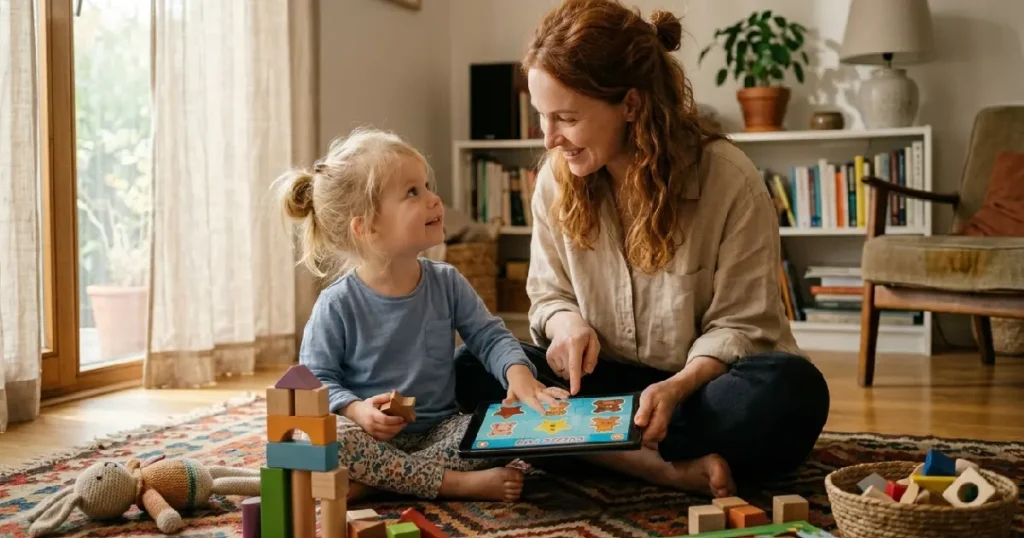
The magic ingredient is Joint Media Engagement (JME) — essentially, you and your child engaging with digital content together, talking about what’s happening, and connecting it to the real world. Research shows that the presence of a caring adult during screen-based play matters far more for developmental outcomes than the app’s production value. When you say, “Look, that bunny is sorting by color — just like you did with your blocks this morning!” you create a semantic bridge that cements learning.
Do this: Limit to 20–30 minutes of a top-rated educational app like PBS KIDS Games or Khan Academy Kids, and make that time a together activity. Then, follow up the digital session with related physical play.
Not that: Don’t hand over the tablet as a solo babysitter. That path leads to a child who zones out rather than engages. Also, avoid apps with constant rewards, pop-ups, and algorithms that rob the child of agency. Check app quality on Common Sense Media before downloading anything.
You’ll know it’s working when: Your child starts narrating their app play, or spontaneously transfers a concept into physical play (“Look, I’m making a tower like in the game!”).
Ages 6–9: The Phygital Bridge Is Your Best Friend
This is the danger zone — independent device use skyrockets, and passive consumption can easily crowd out physical activity. Your mission, should you choose to accept it, is to introduce phygital play: activities that deliberately combine physical manipulation with digital feedback, effectively ending the either-or war.
Think LEGO sets with companion AR apps, Osmo learning kits that blend tangible pieces with on-screen puzzles, or a Sphero robot your child programs to navigate a living room obstacle course. In these experiences, the child is moving, building, and manipulating real objects while the digital layer adds a dynamic problem or narrative. It forces simultaneous activation of motor and cognitive systems. I’ve seen dozens of families use this as a “re-entry” strategy for kids who resisted outdoor play after logging too many passive screen hours.
Do this: Aim for a starting point of roughly 60% physical, active, or social free play, and up to 40% intentional, high-quality digital or phygital play. Try a challenge like “build a physical bridge that can hold a certain weight, then test it with a digital simulation app.”
Not that: Do not lump all digital play into one category. Minecraft in Creative mode (spatial planning, resource management) is lightyears ahead of watching a streamer play Minecraft. Be picky. Research on phygital play highlights its power to boost collaboration and self-monitoring; a recent open-access study from Computers & Education confirms this read the findings.
You’ll know it’s working when: Your child transitions from a digital session to physical play without a meltdown, and occasionally even initiates building something in real life that they designed on-screen.
Ages 10–12: Digital Literacy as a 21st-Century Skill
Your pre-teen is navigating online identity, multiplayer gaming, and the early edges of social media. This isn’t just “screen time” anymore — it’s a developmental competency. Age-appropriate digital engagement, whether it’s coding simple games in Scratch, collaborating in a creative Minecraft server with friends, or making digital art, is increasingly a core literacy, much like learning to read was for their grandparents.
Physical play may now shift to organized sports, dance, martial arts, or hiking. That’s not a loss; that’s a form change. The function — sensory integration, social negotiation, physical exertion — stays the same.
Do this: Have explicit, non-judgmental conversations about what they do online. Allow collaborative digital play that requires strategy, communication, and teamwork, and frame it as a legitimate skill-building activity alongside their soccer practice.
Not that: Don’t villainize all social gaming. A cooperative challenge with peers builds the same executive function and social muscles as a team sport, albeit in a different arena. Keep an eye on sleep disruption — if late-night chatting starts, enforce a device curfew in a common room.
One Parent’s Real-Life Shift (And Why It Worked)
Maya, a 36-year-old mom of two boys (ages 4 and 8), texted me in February feeling like she was losing her younger son to a screen. “Every time I say ‘tablet off,’ it’s a World War III scream session,” she wrote. She lived in a small apartment where outdoor space required a fifteen-minute walk, and by 5 p.m., with dinner prep looming, the tablet had become her survival tool. She felt the weight of every pediatrician’s warning, convinced she was harming her kids.
I asked Maya to try one thing: replace the post-homework tablet hour with a phygital bridge that both boys could touch. She bought a used Osmo kit for twenty dollars online and set it up on the living room floor. With the physical letter tiles and the on-screen monster game, the 4-year-old practiced phonics while physically moving pieces, and the 8-year-old, who considered himself “too cool” for such things, ended up sitting beside him, offering hints. Instead of 60 minutes of passive device time, they got 35 minutes of active, physical-digital play with spontaneous sibling collaboration. The first evening without a screen-disconnect tantrum felt, Maya said, “like a tiny miracle.”
Within three weeks, her younger son’s kindergarten teacher mentioned he was persisting longer on drawing tasks. The real win wasn’t less screen time. It was that the screens became a tool they touched together, not an isolating default.
Digital Play vs Physical Play: The Side-by-Side That Finally Makes Sense
The Head-to-Head Comparison
Here is the clearest breakdown I can offer. Bookmark this table.
| Dimension | Digital Play (Active/Quality) | Physical Play |
|---|---|---|
| Sensory Input | Mainly visual and auditory | Full multisensory — tactile, proprioceptive, vestibular |
| Motor Development | Fine motor via touchscreen gestures | Gross and fine motor — running, climbing, manipulating objects |
| Cognitive Gains | Problem-solving, logical sequencing, digital literacy | Spatial reasoning, executive function, creative innovation |
| Social Growth | Collaborative multiplayer; emerging digital social cues | Face-to-face negotiation, reading body language, turn-taking |
| Emotional Regulation | Varies widely; quality content with co-play supports regulation | Consistently supports self-regulation and stress reduction |
| Required Resources | Device and internet connection | Little to no equipment; a cardboard box can work wonders |
| Adult Role | Co-play is critical for under-7s, high-value at all ages | Natural and intuitive co-play |
The Phygital Middle Ground
We’ve touched on it, but let’s cement it. Phygital play is the deliberate combination of a physical object and a digital experience that requires you to manipulate the real world to affect the digital one — or vice versa. Examples: Osmo kits, LEGO Hidden Side AR, coding robots like Botley, or even nature apps that send kids on an outdoor scavenger hunt with a phone camera as their guide.
This isn’t a weak compromise. It’s a strategic bridge. It engages sensorimotor systems and digital problem-solving simultaneously, which means a child who previously could not unglue from a screen without a fight can smoothly re-enter the physical world. I consider it a lifeline for parents whose kids resist outdoor play.
Pro-Tips for the Play Architect
- Rotate types, don’t just restrict. Instead of cutting screen time, change the flavor: puzzle app Monday, drawing app Tuesday, coding game Wednesday. Variety prevents the compulsive loop.
- Adopt the “Physical First” rule. Before any digital play session, do ten minutes of gross motor play (dance party, hallway obstacle course, quick game of Simon Says). It primes the nervous system and reduces post-screen dysregulation.
- Learn to read behavioral red flags. Persistent irritability when devices are turned off, inability to self-initiate play without a screen, loss of interest in previously loved physical activities, and new sleep difficulties are clear signals the balance has tilted too far.
- Use evidence-based tools. For app quality, Common Sense Media is your best friend. For movement breaks, GoNoodle.com blends physical and digital seamlessly.
Common Mistakes Parents Make When Balancing Play (And How To Fix Them)

Mistake 1: Treating All Screen Minutes as Equally Toxic
A minute of passively watching unboxing videos is not the same as a minute of solving puzzles in a math app with a parent. When you treat them as identical, you rob yourself of the nuance needed to make smart choices. Instead, categorize digital activities into “active creation/problem-solving,” “active learning,” “social connection,” and “passive consumption.” Limit only that last category ruthlessly, and you’ll find much less to feel guilty about.
Mistake 2: “No Screens” as a Punishment, Not a Choice
“No more iPad because you didn’t clean your room” sets up the device as a forbidden fruit, making it even more desirable. Try a script like, “We’ve had our digital time for the day, and now our bodies need a different kind of fuel. Let’s go build that fort you talked about.” This frames the shift as intentional design, not deprivation. If a tantrum still comes, you stay calm: “I know it’s hard to stop. Let’s shake our bodies out for a minute together.”
Mistake 3: Expecting Children to Self-Regulate Screen Time (Without Coaching)
Young children have virtually no impulse control around algorithmically designed reward systems. Expecting them to turn off the tablet because “time’s up” without warning is a setup for failure. Give a five-minute countdown, then a two-minute one, and finally, a transition action: “When the timer goes off, we’re going to zoom like rockets to the kitchen for a snack.” Build the off-ramp.
Mistake 4: Forgetting That Parental Co-Play Changes Everything
If you sit next to your child and ask, “What are you building? Show me how this works,” you transform the experience from solitary consumption to shared exploration. This single habit, based on Joint Media Engagement research, takes less-than-ideal passive content and turns it into a conversation starter. Try it exactly once and watch the difference.
Frequently Asked Questions
Is digital play as good as physical play for child development?
No single form of play is “better.” Physical play uniquely builds sensory integration, motor skills, and executive function. Digital play, when interactive and age-appropriate, enhances problem-solving, digital literacy, and cognitive flexibility. They complement each other; they do not substitute. A child needs a steady diet of physical experiences with digital play used intentionally as a supplementary cognitive tool, never the main course.
How much screen time is healthy for children aged 3 to 5?
The American Academy of Pediatrics recommends no more than one hour per day of high-quality programming for children ages 2 to 5, with a caregiver watching alongside. But raw minutes matter less than the quality and the co-engagement factor. Twenty minutes of an interactive puzzle app solved with a parent is developmentally richer than sixty minutes of passive video alone.
What are the signs my child has too much digital play?
Watch for these behavioral signals: extreme irritability after devices are removed, an inability to self-initiate play without a screen, neglecting previously beloved physical toys or outdoor activities, new or worsening sleep problems, and shortened attention span during non-digital tasks. These are your child’s way of saying the play diet needs rebalancing urgently.
What is “phygital play” and how can I start?
Phygital play merges physical objects with digital feedback. Think LEGO AR sets, coding robots like Sphero, or outdoor exploration apps paired with a real scavenger hunt. Start with a single low-cost kit, like Osmo, and set it up in a shared space. This approach helps bridge the gap for kids who struggle to leave screens, making the shift back to physical engagement smoother and more natural.
Does physical play actually make children smarter?
“Smarter” is too narrow. Physical play builds executive function skills (inhibitory control, working memory, cognitive flexibility) that are among the strongest predictors of academic achievement and lifelong mental health. Digital play builds domain-specific problem-solving and tech literacy. A child who thrives has robust experience with both. Neither alone can optimize whole-child development.
Can too much physical play ever be harmful?
In a world of increasing sedentary behavior, physical play is rarely the concern. However, overly intense, unsupervised physical risk-taking can lead to injury, and children with sensory processing differences may find certain environments overwhelming. The goal is developmentally appropriate, safe physical exploration. Follow your child’s cues, offer variety, and ensure basic safety without hovering.
Your Monday Morning Move
You don’t need another lecture about balance. What you need is one deliberate, tiny shift that proves to your brain that you’re the architect here, not the warden. Tonight, or tomorrow morning before the day’s first activity, take sixty seconds to decide whether the next play block is physical, digital, or phygital — and write your reason on a sticky note. Stick it on the fridge or the TV. That single intentional act reshapes your family’s play culture infinitely more powerfully than any screen-time chart ever could. Stop fighting digital play vs physical play children. Start designing it.
My Closing Remarks
I will never forget the summer my own son was six and I had let his tablet time bleed into three-hour stretches because I was overwhelmed and working from home. One evening, he looked up and said, “Mom, will you just play blocks with me instead?” I could have cried — not from guilt, but because I realized physical play had never stopped calling him. Our children don’t need perfect parents. They need us to be awake enough to answer when they invite us back to the real world. The only true mistake is thinking the screen has permanently stolen them.