
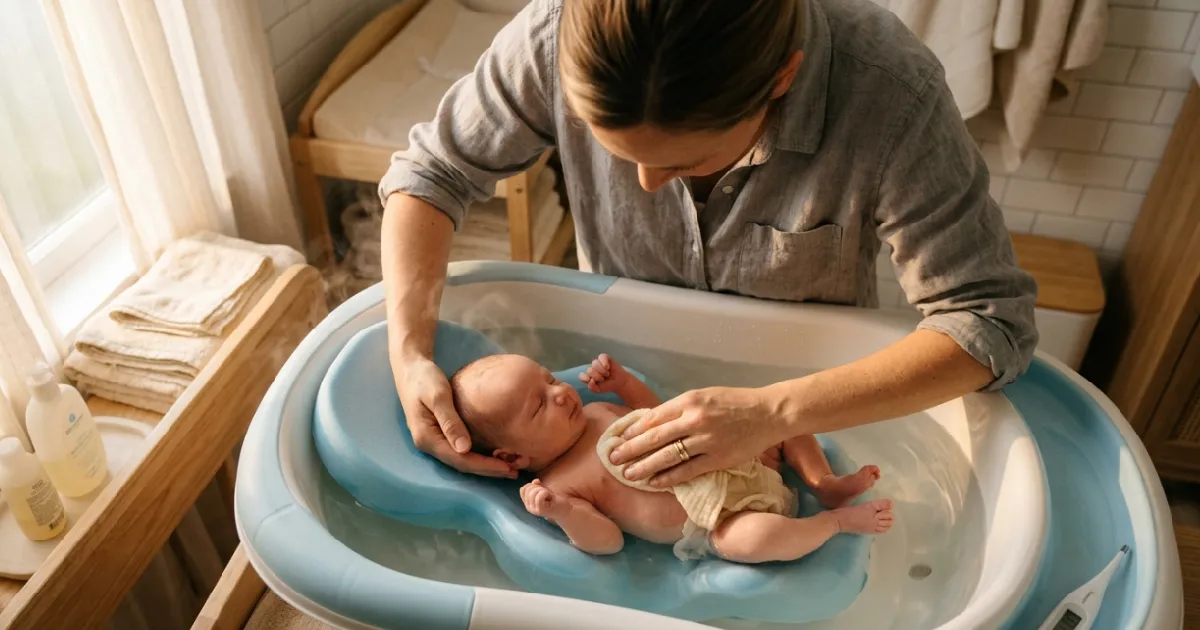

Here’s something nobody tells you at the hospital: your baby probably doesn’t need a bath tonight.
Actually, let me back up. If you’ve been giving your newborn a nightly bath because your mom insisted, because it feels like responsible parenting, or because the hospital cleaned baby within hours of delivery, you are not alone. Almost every new parent does exactly the same thing. But that routine, however well-intentioned, may be quietly working against your baby’s skin health in ways that don’t show up until week three or four — when the dryness appears and you have no idea why.
Knowing how often to bathe newborns isn’t just a scheduling question. It’s a biology question.
Your newborn’s skin is not a miniature version of yours. It’s thinner, more permeable, and still actively building the protective barrier it will need for the rest of their life. Every unnecessary bath is a small erosion of that process. Here’s a quick look at what’s really going on:
- Your newborn’s skin loses moisture up to five times faster than adult skin
- The first weeks of life are when beneficial bacteria colonize the skin surface
- The natural waxy coating at birth is protection, not something to scrub off
- Daily bathing disrupts all three of these systems at once
Here’s the short, pediatrician-backed answer before we go any deeper:
Quick Answer (Pediatrician-Backed): Newborns should be bathed 2 to 3 times per week, not daily. The American Academy of Pediatrics and the American Academy of Dermatology both confirm that more frequent bathing strips natural skin oils, disrupts the developing skin microbiome, and raises the risk of eczema and dryness. Until the umbilical cord stump falls off, sponge baths only.
In this guide, you’ll get the science behind why that number matters, the official schedule from three major health organizations, and the five specific bathing mistakes parents make every single week without realizing the damage they’re causing. By the end of this, you won’t second-guess bath time again.
Here’s what we’re covering:
- Why your newborn’s skin is a biological system, not just a surface to clean
- The full story on vernix caseosa, nature’s original skincare product
- Five dangerous bathing mistakes, each with a clear, step-by-step fix
- A real case study from a mom who unknowingly triggered eczema with nightly baths
- The “top and tail” method as a safe daily alternative
- A complete FAQ block with answers sized for quick reading
Let’s get into it.
What Your Newborn’s Skin Is Actually Doing (And Why It Changes Everything)
Most parenting content skips this section entirely. That’s the problem.
Table of Contents
Your Newborn’s Skin Is a Biological System, Not Just a Surface
A newborn’s skin is dramatically different from adult skin in almost every measurable way. It’s thinner. It’s far more permeable. And it loses moisture at a rate up to five times faster than yours. That rate has a clinical name: Transepidermal Water Loss, or TEWL. Elevated TEWL is a key reason why over-bathing causes real, visible harm in the first weeks of life.
There’s also the neonatal skin microbiome to consider. In the days and weeks after birth, beneficial bacteria are colonizing the skin surface and forming the first layer of immune protection your baby will ever have. Think of it like a freshly seeded lawn. Washing with soap every day is like power-washing that lawn before the roots can take hold. You’re not doing it on purpose. But the outcome is the same regardless.
Over-bathing strips protective lipids from the skin surface, disrupts bacterial colonization, raises the skin’s pH above its natural acidic baseline, and leaves the barrier temporarily defenseless. The result you’ll see is dryness, irritation, and, in babies with any genetic predisposition, early-onset atopic dermatitis.
The Vernix Caseosa: Nature’s Original Baby Skincare Product
This is the part your pediatrician mentions in passing, and most articles reduce to one sentence. It deserves much more than that.
Vernix caseosa is the white, waxy coating covering your newborn’s skin at birth. It forms during the final trimester of pregnancy and is composed of water, lipids, and proteins. It does three things simultaneously: it keeps the baby’s skin hydrated in the womb, it provides antimicrobial protection against bacteria and fungi, and it supports thermoregulation in the critical hours after birth.
“Vernix caseosa is a biofilm with broad-spectrum antimicrobial activity. It elaborates compounds that confer protection against bacteria and fungi from the moment of birth.”
That finding, drawn from a 2024 prospective comparative study on vernix retention in neonates, matters because it directly challenges what most parents are told or, more often, not told at all. The study confirmed that retaining vernix after birth produces significantly higher skin hydration levels compared to babies who were bathed early. The compounds vernix releases include LL-37, cystatin, and alpha-defensins. Those are measurable, documented antimicrobial agents. Your baby arrives already wearing them.
When you rush to wash the vernix off, you are not cleaning your newborn. You are removing the most sophisticated skincare product ever made.
What the AAP, WHO, and AAD Actually Say
Three separate medical organizations. Same answer. Here’s the table so you can have it ready the next time someone in your family pushes back:
| Organization | Official Recommendation |
|---|---|
| American Academy of Pediatrics (AAP) | 2 to 3 baths per week; sponge baths only until the umbilical cord stump falls off (1 to 3 weeks) |
| World Health Organization (WHO) | Delay first bath at least 24 hours after birth; 6 hours minimum if cultural practices require earlier |
| American Academy of Dermatology (AAD) | Bathing 2 to 3 times per week is sufficient, as long as the diaper area is cleaned thoroughly at each diaper change |
Three organizations. Three continents of research behind them. One consistent number.
How Often to Bathe Newborns: 5 Dangerous Mistakes You Need to Stop Making
Each mistake below follows the same structure: what the problem is, what it does biologically, and a step-by-step fix you can apply starting today. Read all five, even if you think you’re already doing it right.
Mistake #1: Bathing Your Newborn Every Single Day
The problem isn’t that daily baths feel wrong. The problem is that they feel right, which is exactly what makes them dangerous.
Daily bathing of a newborn is a cultural habit, not a medical recommendation. Newborns don’t sweat. They don’t crawl through dirt. The only areas that genuinely need daily attention are the diaper zone and the face. Everything else? Plain warm water handles it fine, and even then, only two to three times a week.
The biological damage is measurable. Daily washing removes the protective lipids from the skin barrier, disrupts the neonatal microbiome, and for babies with any eczema predisposition, frequent bathing can trigger active flare-ups. According to the American Academy of Dermatology, bathing a baby with sensitive or eczema-prone skin too frequently is one of the most common, and most overlooked, triggers families bring into the home.
How to Fix It (Step by Step):
- Pick three consistent days per week for full baths. Monday, Wednesday, and Friday works well for most families.
- On all other days, switch to the top and tail method (detailed below).
- After each bath, apply a fragrance-free, hypoallergenic moisturizer within three minutes of patting baby dry. That window is when skin absorption is highest.
- If you notice dry or flaking patches forming, reduce frequency first before adding any new product.
Do This: Three bath days per week. Done.
Not That: Don’t assume frequency equals cleanliness. A baby bathed three times a week and one bathed daily are equally hygienic. One of them has a healthier skin barrier.
Mistake #2: Bathing Your Newborn Too Soon After Birth
Most parents assume that because the hospital bathed their baby within hours of delivery, that’s the timeline to replicate at home. It isn’t.
The World Health Organization recommends delaying a baby’s first bath by at least 24 hours after birth. If cultural or family practices require an earlier bath, the minimum delay is 6 hours. This recommendation isn’t arbitrary. Early bathing removes vernix, drops the baby’s core body temperature, and can destabilize blood sugar, making an already sleepy newborn too drowsy to feed effectively.
Here is the statistic that stops parents completely: one study found a 166% increase in breastfeeding success among babies whose first bath was delayed by 12 hours compared to those bathed within the first couple of hours after birth. That’s not a rounding error. That’s a headline-level outcome that almost no competitor article bothers to surface.
How to Fix It (Step by Step):
- If you’re still in the hospital, ask the nursing staff to delay the bath. Most hospitals now support this upon request.
- If you’re already home, skip the bath for the first 24 hours unless there’s a specific medical reason not to.
- Allow any remaining vernix to absorb naturally into the skin. It will.
- When you do start baths at home, begin with the 2 to 3 times per week schedule immediately.
Do This: Delay the first bath. Protect the vernix. Let the biology do its job.
Not That: Don’t treat the vernix coating as “mess.” It is performing active, documented antimicrobial and thermoregulatory work on your newborn’s skin.
Mistake #3: Using Soap on Your Newborn’s Entire Body
Even soap labeled “gentle” or “natural” disrupts newborn skin chemistry. That’s not a fringe opinion. It’s how skin pH biology works.
Your newborn’s skin maintains a naturally acidic pH, typically between 4.5 and 5.5. That acidity is a deliberate defense feature. It prevents pathogens from establishing themselves on the skin surface. Soap, regardless of how mild the marketing claims, raises the skin’s pH temporarily. While the pH is elevated, the skin’s antimicrobial defense system is offline.
“Cleansing products for neonatal skin should be selected with great care. The acid mantle is fragile in the first weeks of life and soap-based cleansers disrupt it in measurable ways.” — American Academy of Dermatology, official guidance on infant skincare.
Beyond the pH issue, soap applied routinely to the scalp, torso, and limbs destroys the developing neonatal microbiome. A study published via PubMed found that the neonatal skin microbiome begins establishing within hours of birth and is directly influenced by early washing practices. Research has also linked microbiome disruption in infancy with higher lifetime rates of atopic dermatitis and allergic disease.
How to Fix It (Step by Step):
- Use plain warm water for the baby’s body from head to toe during a standard bath.
- Reserve a mild, fragrance-free soap for the diaper area only, and for any visibly soiled area.
- Skip soap on the scalp, arms, torso, and legs unless there’s a specific reason to use it.
- If you want to use something on the body, look for products labeled pH-balanced for newborns, free of fragrance, dyes, and preservatives.
Do This: Plain water for the body. Gentle, fragrance-free soap for the diaper area only.
Not That: Don’t lather soap across every surface out of habit. There is nothing on your newborn’s clean torso that water alone cannot handle.
Mistake #4: Using Water That Is Too Hot
This is the mistake with the highest immediate injury potential on this list.
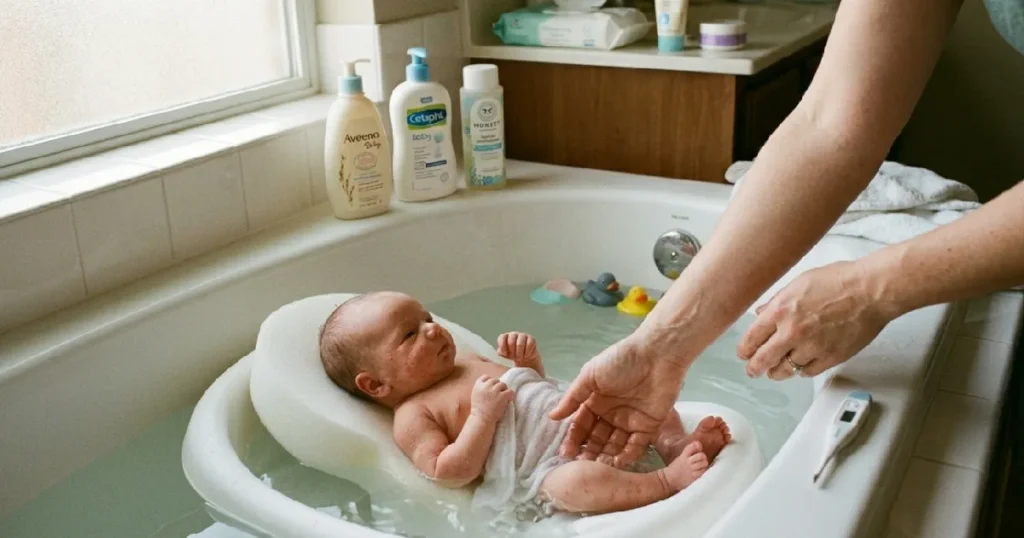
Hot water scalds are the leading cause of burn injuries in babies and young children. Tap water at an unsafe temperature can cause burns severe enough to require surgery, and the injury happens within seconds of skin contact. The AAP recommends that newborn bath water be between 90 and 100 degrees Fahrenheit, with the home water heater set no higher than 120 degrees Fahrenheit.
Here’s the trap most parents fall into: testing water with their palm. Palms are significantly less heat-sensitive than most other areas of your skin. A temperature that feels comfortable on your hand can be genuinely dangerous on newborn skin.
How to Fix It (Step by Step):
- Set your home water heater to a maximum of 120 degrees Fahrenheit. This is a one-time safety adjustment with permanent benefits.
- Always test the bath water with your inner wrist or elbow before placing baby in the tub. Both are far more sensitive to heat than your palm.
- Purchase a dedicated bath thermometer and use it for at least the first three months. It removes all guesswork.
- Never run additional water into the tub while baby is in it. Temperature can shift as water moves through household pipes.
Do This: Inner wrist or elbow test. Bath thermometer. Water heater capped at 120 degrees.
Not That: Don’t test with your palm alone, and don’t add warm water mid-bath with baby present.
Mistake #5: Letting the Bath Run Too Long
A calm newborn in warm water feels like a victory. A 20-minute bath feels like bonding. The reality is that extended baths are working against you in three simultaneous ways.
Research supports keeping newborn baths to 5 to 10 minutes maximum. Beyond that window, prolonged water exposure paradoxically draws moisture out of the skin rather than adding it. Newborns also lose body heat from wet skin at a dramatically faster rate than adults do, which makes extended baths a real neonatal hypothermia risk. And the longer soap stays in contact with the skin surface, the greater the disruption to the acid mantle.
How to Fix It (Step by Step):
- Set a five-minute timer when you lower baby into the tub.
- Prepare your hooded towel before the bath starts, open and ready on a flat surface nearby.
- Wrap baby immediately after lifting them out of the water, head first, before drying.
- Apply fragrance-free moisturizer within three minutes of patting dry, while skin is still slightly damp.
Do This: Five minutes. Hooded towel waiting. Moisturizer within three minutes.
Not That: Don’t gather supplies mid-bath. Don’t let baby sit in cooling, soapy water while you look for the towel.
At a Glance: The 5 Mistakes and Their Fixes
| Mistake | The Risk | The Fix |
|---|---|---|
| Daily bathing | Strips skin lipids, worsens eczema | Bathe 2 to 3 times per week |
| Bathing too soon after birth | Removes vernix, disrupts breastfeeding and blood sugar | Delay first bath 24 hours |
| Full-body soap use | Disrupts skin pH and neonatal microbiome | Plain water for body; soap for diaper area only |
| Water too hot | Scald burns (leading cause of infant burns) | 90 to 100 degrees Fahrenheit; test with wrist or elbow |
| Bath lasting too long | Skin dryness, neonatal hypothermia | 5 to 10 minutes maximum; hooded towel immediately after |
A Real Story: When Daily Baths Were Causing the Problem All Along
Let me tell you about Priya.
Priya was a first-time mom from suburban New Jersey, three weeks postpartum, running on about four hours of sleep when I heard her story. She’d built a nightly bath ritual for her daughter, Naia, because her own mother had been very clear: “Babies need to be bathed every day. That’s just how it’s done.”
Priya followed the advice. She found lavender-scented baby wash at the store, got a little floating thermometer for the tub, and turned bath time into a whole event. Warm towels on the radiator, soft music on the speaker, the nightlight on in the corner. It felt like good parenting. It felt like love made visible.
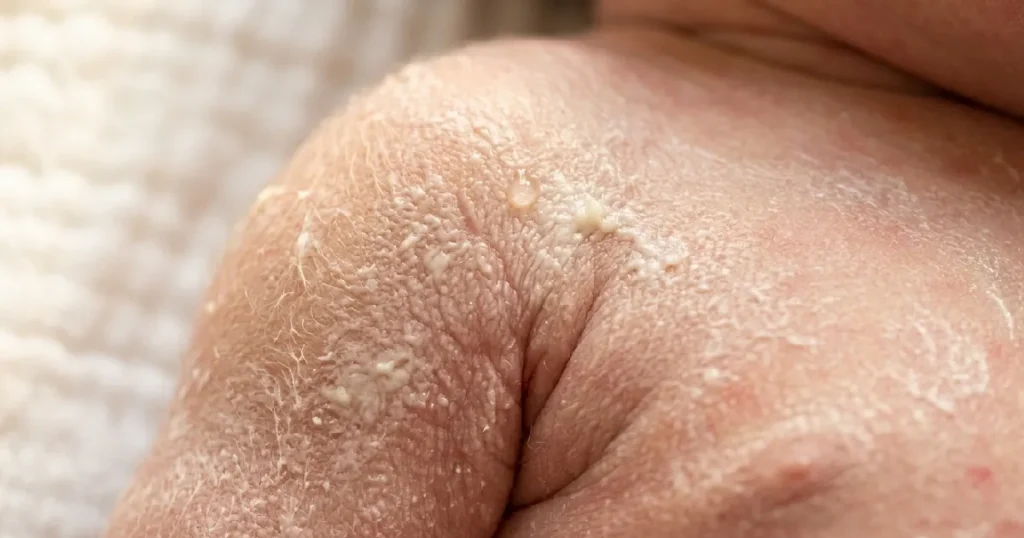
By week four, Naia’s skin started to change. Dry, flaking patches on her cheeks. A red, rough strip along both wrists. Priya assumed it was a product reaction and switched brands immediately. No change. She switched again. Still nothing.
At Naia’s four-week checkup, the pediatrician looked at her skin for about ten seconds and asked one question: “How often are you bathing her?”
When Priya answered “every night,” the doctor didn’t lecture her. She just said, “Let’s try three times a week, plain warm water, and a fragrance-free moisturizer within three minutes of patting her dry.”
Priya made the change that night. It was a Tuesday, somewhere around 11 PM, while Naia was asleep on her chest. She lay there scrolling through articles, quietly rethinking everything she thought she knew about being a good mother.
Two weeks later, the eczema patches had nearly cleared. No prescription. No special treatment. Just less bathing.
The lavender wash moved to the back of the cabinet. And Priya now cites AAP guidelines from memory when her mother brings up the daily bath question.
Full Bath vs. “Top and Tail” Cleaning: Which One Does Your Baby Actually Need?
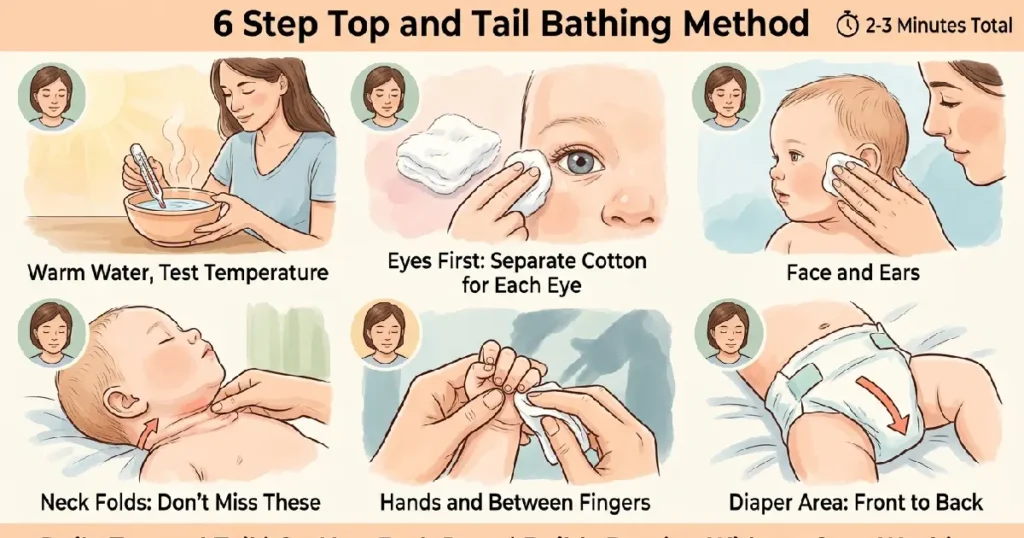
On the four or five days per week when you’re not doing a full bath, the top and tail method keeps your baby clean without any of the skin disruption.
| Factor | Full Tub or Sponge Bath | Top and Tail Clean |
|---|---|---|
| Frequency | 2 to 3 times per week | Daily, on non-bath days |
| Time required | 10 to 15 minutes | 2 to 3 minutes |
| Skin disruption risk | Moderate (if done correctly) | Minimal |
| Umbilical cord safe? | Sponge bath only until cord falls off | Yes |
| Best for | Weekly routine, post-blowout cleanup | Between-bath hygiene maintenance |
How to Do a Top and Tail Clean in 6 Steps
- Warm a small bowl of water to body temperature. Test with your wrist before starting.
- Begin with the eyes. Use a separate piece of cotton wool for each eye. Wipe from the inner corner outward, never back toward the nose.
- Move to the face. Gently wipe both cheeks, the forehead, around the mouth, and behind each ear.
- Clean the neck folds. Lift the chin and wipe all skin creases thoroughly. Milk residue and lint accumulate in neck folds and can cause a rash within a day or two if skipped.
- Open the baby’s fists and clean between the fingers. You’ll be surprised how much gets in there.
- Finish with the diaper area, always wiping front to back. This is the one area that genuinely needs attention every single day.
Two to three minutes. No undressing fully. No temperature risk. No disruption to the skin barrier.
Essential Tools Worth Having

- A bath thermometer — Non-negotiable for the first three months. Removes all temperature guesswork.
- A hooded baby towel — Wraps baby’s head immediately post-bath and slows heat loss significantly.
- Fragrance-free moisturizer — Apply within three minutes of patting dry, every single bath.
- Six soft cotton washcloths — Rotate them across top and tail sessions throughout the week.
- A baby bathtub with sling support — For when tub baths begin after the umbilical cord falls off.
Frequently Asked Questions
Is it okay to bathe a newborn every day?
No. The American Academy of Pediatrics states clearly that newborns do not need a bath every day. Until a baby is crawling and getting genuinely dirty, bathing more than three times a week strips protective skin oils, disrupts the developing microbiome, and raises the risk of dryness and eczema. The diaper area and face are the only zones needing daily attention. Stick to 2 to 3 baths per week.
What actually happens if you bathe a newborn too often?
Over-bathing strips natural lipids from the skin barrier, elevates trans epidermal water loss (TEWL), and disrupts the neonatal skin microbiome, the colony of beneficial bacteria that defends against pathogens. In practical terms, this leads to dry and flaking skin, accelerates eczema onset, and temporarily disables the skin’s antimicrobial protection while the microbiome attempts to re-establish. Most parents see visible dryness within 2 to 3 weeks.
When should I give my newborn their first bath at home?
The World Health Organization recommends delaying the first bath at least 24 hours after birth. This preserves vernix caseosa, stabilizes blood sugar, supports thermoregulation, and significantly improves breastfeeding success rates. If your hospital bathed baby early, simply delay subsequent baths at home and move directly to a 2 to 3 times per week schedule. There’s no need to “catch up” with extra baths.
How long should a newborn bath actually last?
Keep it to 5 to 10 minutes maximum. Longer baths paradoxically dry out the skin, because prolonged water exposure draws moisture out rather than adding it. Newborns also lose body heat from wet skin far faster than adults, making extended baths a real hypothermia risk. Have your hooded towel open and waiting before bath starts, and wrap baby head-first the moment they come out of the water.
What is the safest water temperature for a newborn bath?
The AAP recommends 90 to 100 degrees Fahrenheit for newborn bath water. Your home water heater should be set no higher than 120 degrees Fahrenheit as a permanent safety adjustment. Always test with your inner wrist or elbow, not your palm, which is far less sensitive to heat. A bath thermometer is the simplest way to remove all guesswork for the first several months.
Should I moisturize my newborn after every bath?
Yes, and timing is the variable most parents miss. Apply a fragrance-free, hypoallergenic moisturizer within three minutes of patting baby dry. That window is when skin is still slightly damp and absorption is highest. Avoid anything with added fragrance, dyes, or preservatives, as these commonly trigger reactions in sensitive newborn skin. If patches of dryness appear, reduce bath frequency before adding any new product.
Final Takeaway
You came here wondering about a number. You’re leaving with something bigger.
Your newborn’s skin is an active biological system. It is building immunity, regulating temperature, and defending against pathogens using tools that nature spent nine months constructing. Every unnecessary bath, every lather of soap across a clean torso, every extended soak in water that’s slightly too warm — these are not neutral choices. They carry real biological consequences that show up as dry skin, eczema, and feeding disruptions that most parents never trace back to the bath.
Here is your one action for today. Open your calendar right now and block three bath days for this week. On every other day, do a three-minute top and tail clean instead. That single change, starting tonight, is the difference between a skin barrier that struggles and one that builds the way it’s supposed to.
If your baby already has dry or red patches, don’t spiral. Switch the frequency. Apply moisturizer within three minutes of patting dry. Bring it up at your next pediatric visit. Most mild dryness resolves within one to two weeks of reducing bath frequency, without any prescription.
You are not behind. You just had information that nobody bothered to give you.
My Closing Remarks:
I’ve sat with parents who were doing everything “right” and still watching their baby’s skin break down week by week. Here’s the honest truth: a lot of the advice passed down from our parents isn’t wrong because they were careless. It’s wrong because the science moved, and nobody updated the conversation. You are not a bad parent for not knowing this before today. But now that you do know, you have a real responsibility to act on it. Your baby’s skin cannot speak for itself. You have to do that.