


It is 3:14 a.m. and you are staring at the ceiling again. Your eyes feel like they are filled with sand. You just sat down after the third wake-up since midnight. Your heart is full of love, but your body is running on absolute empty. Somewhere in the heavy fog of sleep deprivation, a small, terrifying voice asks: “Is something wrong with my baby? Or am I failing as a parent?”
Let me be blunt. Most of the advice you have read so far is probably garbage. People tell you to “sleep when the baby sleeps” or “just stick to a routine,” but those phrases do not help when you are dealing with a Newborn Waking Up Every Hour. The truth is that most articles treat every baby the same, whether they are three weeks or five months old. That is a mistake. What works for a 20-week-old will often backfire on a newborn. You are not failing. You are just fighting biology without the right map.
A Newborn Waking Up Every Hour is usually biologically normal in the first 0–3 months due to short sleep cycles, immature circadian rhythms, and frequent feeding needs. After 3–4 months, causes shift toward sleep associations and overtiredness. Solutions depend entirely on the baby’s age and specific cause.
In this guide, we are going to move past the generic fluff. I am going to show you the science of why this happens in plain English. We will use a triage tool to find your baby’s specific trigger and give you a protocol for what to do right now, tonight. We will also cover the medical red flags that other sites ignore so you know exactly when to call the doctor.
What’s Really Happening When Your Newborn Waking Up Every Hour
Before we can fix the night, we have to understand the brain. Your baby is not waking up to spite you. They are waking up because their brain is currently “under construction.” Unlike adult sleep, which is deep and long, infant sleep is designed for survival and rapid development.
Table of Contents
The Newborn Sleep Cycle: Why It Is Designed This Way
Newborns enter sleep through REM (Rapid Eye Movement), which is a light, active state. Adults spend about 20% of their night in REM, but newborns spend nearly 50% of their sleep there. This is known as REM-Dominant Sleep Architecture. Because they stay in this light phase longer, they are much easier to startle or wake.
Furthermore, while you have a 90-minute sleep cycle, your baby has an Ultradian Sleep Architecture. Their cycles only last about 30 to 50 minutes. When one cycle ends, they surface to a state of partial arousal. If they do not know how to “bridge” to the next cycle, they wake up fully. This is why you see so many babies waking at the 45-minute mark. According to the National Institutes of Health, infants sleep about 16 to 18 hours a day, but it is rarely in one long stretch because their arousal systems are still maturing.
Sleep Is Not A Luxury; It Is A Biological Necessity For Both Parent And Child.
This quote reminds us that fixing sleep is not about being “perfect.” It is about health. When you are rested, you are a safer, more present parent.
The Circadian Clock Your Baby Does Not Have Yet
Your baby was born without an internal clock. They do not produce melatonin, the hormone that tells the body it is night. This internal rhythm, known as circadian rhythm entrainment, usually does not start to develop until about 12 to 14 weeks. Until then, your baby does not know the difference between 2:00 p.m. and 2:00 a.m. This is why their sleep is distributed evenly across 24 hours. A 2025 Frontiers in Neuroscience review highlighted that night waking frequency is a standard part of the developmental trajectory for the first half-year of life.
In Plain English:
Your baby isn’t waking up because something is wrong. Their brain is literally not built yet to link sleep cycles together the way adult brains do. It’s not a failure. It’s physiology.
The Triage Framework: Which Cause Is YOUR Baby’s Cause?

You cannot fix a problem if you do not know what it is. Use this table to narrow down why your nights are so fragmented.
| If Your Baby Is… | Most Likely Cause | Action Needed |
| Under 8 weeks, waking every hour | Hunger or Biology | Optimization |
| 8–12 weeks, waking but not hungry | Day/Night Confusion | Light Exposure |
| Waking exactly every 45 minutes | Overtiredness | Shorter Wake Windows |
| 4+ months, needs rocking to sleep | Sleep Association | Habit Shift |
| Gassy, arching, or spitting up | Reflux or Gas | Medical Check |
| Poor weight gain, clicking sounds | Feeding Issues | Consult Lactation/MD |
The 5 Specific Causes Explained
Cause 1: Hunger and Feeding Needs.
Breastfed babies usually need to eat every two to three hours, while formula-fed babies might go three to four. However, newborns have tiny stomachs. Sometimes they “snack” instead of taking a full meal. This leads to more frequent wakes. If you are struggling with the transition, advice for new moms often emphasizes that feeding frequency is the biggest hurdle in the early weeks.
Cause 2: Day and Night Confusion.
This happens when the baby sleeps all day and stays awake all night. It is a lack of circadian entrainment. To fix this, you need to use light as a tool. Bright light during the day and total darkness at night help “set” their internal clock.
Cause 3: Adenosine Buildup (Sleep Pressure).
This is counterintuitive. When a baby stays awake too long, their brain produces cortisol and adrenaline to keep them going. This makes it harder for them to stay asleep. An overtired baby wakes up more often than a well-rested one.
Cause 4: Sleep Onset Association Dependency.
By 4 months, babies begin to realize how they fall asleep. If they fall asleep while nursing or rocking, and then wake up in a still crib, they feel “tricked.” They need that same rocking to get back to sleep. This is not a “bad habit” for a newborn, but for an older baby, it becomes the main reason for hourly wakes.
Cause 5: Environmental and Medical Factors.
Babies are sensitive to temperature. If the room is too hot or cold, they will wake. More importantly, issues like reflux or tongue-tie can cause pain that prevents deep sleep.
The Way We Respond To Our Children’s Needs At Night Builds The Foundation Of Their Security.
Meeting a baby’s needs builds trust. However, meeting those needs does not mean you have to be awake every 60 minutes for six months straight.
5 Proven Steps To Reduce Hourly Night Waking
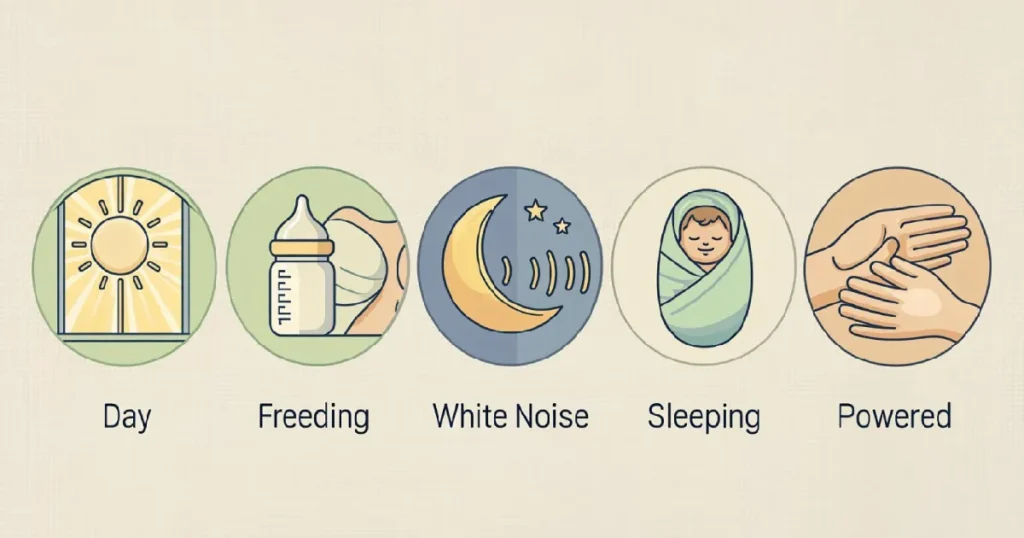
We are splitting these by age. If your baby is a newborn, do not try to “train” them. Focus on optimization.
For Babies 0–3 Months: The Optimization Approach
- The Tank-Up Strategy: Feed your baby every 1.5 to 2 hours during the day. Do not let them sleep more than 3 hours for any single nap. This ensures they get their calories while the sun is up, which can help stretch the first period of sleep at night.
- The Dream Feed: Offer a feeding around 10:00 p.m. or 11:00 p.m. while the baby is still mostly asleep. This can sometimes buy you a longer stretch until 2:00 a.m.
- The 3-Sense Protocol: Optimize the room. Use blackout curtains for total darkness. Use white noise at 65 decibels (about the volume of a running shower). Keep the temperature between 68 and 72 degrees Fahrenheit.
- Sequential 5 S’s: Use Dr. Harvey Karp’s method: Swaddle, Side, Shush, Swing, Suck. Do not just try one. Use them together to trigger the calming reflex.
- The Relay System: This is for you. Divide the night into shifts with your partner. One person is “on” from 9 p.m. to 2 a.m., and the other takes over. This ensures each parent gets at least 5 hours of sleep. Even in the chaos, you can find room for funny parenting advice to keep your spirits high during these shifts.
For Babies 3–6 Months: The Association Reset Approach
- Audit Wake Windows: At 4 months, babies can usually only handle 90 minutes to 2 hours of awake time. If you miss this window, you hit the “overtired” zone.
- Eat-Play-Sleep: Move the feeding to the beginning of the awake period. This breaks the link between eating and falling asleep.
- The 90-Second Pause: When your baby stirs, do not rush in immediately. Give them 90 seconds. Many babies “power down” by grunting or fussing for a minute before falling back into a new sleep cycle.
- Consistent Rituals: A 15-minute routine (bath, book, song) tells the brain it is time to produce melatonin. Consistency is more important than the actual activities.
The “Right Now Tonight” Protocol
If you are reading this at 3:00 a.m., do these things in order:
- Check the basics: Is the diaper wet? Is the baby too hot? Is the swaddle loose?
- Reset the environment: Turn on the white noise if it is off. Turn off any nightlights.
- The “Pause”: If the baby is grunting but not screaming, wait 2 minutes. They might be in “active sleep” and not actually awake.
- The Boring Feed: If you must feed, keep the lights off. Do not talk. Do not make eye contact. Keep it as boring as possible.
- The Handoff: If you are feeling angry or overwhelmed, wake your partner. It is safer to wake them than to reach your breaking point alone.
When Is It More Than Just Normal Waking? The Medical Red Flags Ladder
Use this ladder to decide if you need professional help.
Tier 1: Normal. Waking every 2 hours in a baby under 3 months who is gaining weight and settling easily after a feed. This is just the “fourth trimester” at work.
Tier 2: Monitor. Waking every hour in a baby over 4 months. Signs of heavy reflux, like arching the back or crying in pain after eating. Talk to your pediatrician at the next visit.
Tier 3: Call the Doctor Now. If your baby is waking every hour and also has poor weight gain, trouble breathing, or is inconsolable for hours. Also, watch for signs of low iron, which can cause extreme restlessness. According to the Mayo Clinic, these symptoms require a medical evaluation to rule out underlying issues.
Real Parent Story: The Daylight Breakthrough

Mara was a first-time mom to a 7-week-old named Leo. Every night was a battle. Leo would wake up at 12, 1, 2, and 3. Mara was surviving on cold coffee and the blue light of her nursery monitor. She was convinced she was doing something wrong. She had tried every swaddle on the market.
One Tuesday, we looked at her daytime routine. Because she was so tired, she kept the house dark and quiet all day so Leo would nap. She was inadvertently keeping Leo in a state of permanent day/night confusion. We decided to try the Daylight Reset.
The next morning, despite her exhaustion, Mara opened every curtain in the house at 7:00 a.m. She took Leo for a 15-minute walk in the morning sun. During his naps, she kept the blinds open and the household noise at a normal level. In the evening, she dimmed every light starting at 6:00 p.m.
By the third night, Leo’s first sleep stretch went from 60 minutes to 3 hours. By the end of the week, he was giving her a 5-hour stretch. Mara didn’t need a new “method” or a fancy gadget. She just needed to help Leo’s brain understand when the day ended and the night began. It was a simple shift that changed everything for her mental health.
Swaddle vs. Sleep Sack: Making The Right Call
Choosing the right gear can feel like a high-stakes gamble.
- The Swaddle (0-4 Months): This is vital for suppressing the Moro reflex, which is the “startle” that wakes babies up. Always keep the hips loose to avoid hip dysplasia.
- The Transition: Once your baby shows signs of rolling, the swaddle must go. This is a safety rule from the American Academy of Pediatrics (AAP).
- The Sleep Sack: This is a wearable blanket. It keeps the baby warm without the SIDS risk of loose blankets.
Common Mistakes And How To Avoid Them
- Mistake 1: Mistaking Active Sleep for Waking. Babies are loud sleepers. They grunt, whimpering, and even open their eyes while still asleep.
- The Fix: Use the “Pause Before Response” model. Wait 60 seconds before picking them up to see if they are actually awake.
- Mistake 2: Keeping the House Too Quiet. If your baby only sleeps in total silence, they will wake up at every floorboard creak.
- The Fix: Introduce a high-quality white noise machine. It creates a “sound cocoon” that masks household noises.
- Mistake 3: Over-stimulating During Night Changes. Turning on the big overhead light for a diaper change tells the baby’s brain to wake up.
- The Fix: Use a very dim, red-toned nightlight. Red light does not interfere with melatonin production like blue or white light does.
Frequently Asked Questions (FAQs)
Is it normal for a newborn to wake up every hour?
Yes, it is common for infants under 12 weeks to wake frequently. Their sleep cycles are short, often only 30 to 50 minutes long. Between these cycles, they surface to light sleep and may wake up fully if they are hungry, cold, or overstimulated. This is a physiological stage of development rather than a behavioral problem that needs “fixing.”
Why does my newborn wake up every hour even when not hungry?
Many non-hunger wakes are caused by the Moro reflex, which is a startle response that can jar a baby awake. Other causes include environmental discomfort, such as being too warm, or “active sleep” where the baby appears awake but is actually still dreaming. If your baby is over three months, these wakes might also be related to a developing sleep association dependency.
When do newborns start sleeping longer stretches?
Most babies begin to consolidate sleep between 3 and 4 months of age as their circadian rhythms mature. By 6 months, many infants can sleep for a continuous 6-hour stretch, though this varies greatly by child. Factors like weight gain, feeding efficiency, and the development of the internal biological clock all play a role in when those longer stretches finally arrive.
Can overtiredness cause a baby to wake every hour?
Actually, yes. When a baby stays awake past their natural window, their body produces cortisol and adrenaline to stay alert. This “second wind” makes it very difficult for them to fall into deep sleep and stay there. This leads to frequent arousals throughout the night. Shorter wake windows during the day are often the key to better sleep during the night.
Should I let my newborn cry it out when they wake every hour?
No, formal sleep training methods are not appropriate for newborns under 4 to 6 months old. Young infants have genuine biological needs for food and comfort that must be met. They also lack the neurological ability to self-soothe effectively. Responsive parenting during the first few months helps build a secure attachment and does not create long-term “bad habits” or negative sleep cycles.
What medical issues can cause a newborn to wake every hour?
Common medical triggers include acid reflux, which causes pain when the baby lies flat, or a tongue-tie that makes feeding inefficient and leaves the baby hungry. Less common issues include ear infections or low iron levels. If your baby is waking every hour and showing signs of physical distress or poor weight gain, you should consult your pediatrician immediately for an evaluation.
Final Takeaway
Sleep deprivation is a form of torture. There is a reason it has been used that way throughout history. If you are feeling like you are losing your mind, it is because your brain is literally struggling to function without NREM3 deep sleep. You are allowed to feel frustrated. You are allowed to wish for the morning. But remember: this is a season, not a permanent state. By identifying your baby’s specific cause and adjusting their environment, you can start to reclaim your nights.
Fixing a Newborn Waking Up Every Hour is about small, consistent changes. It is not about a single magic product. It is about understanding the human brain under construction. You have got this.
My Closing Remarks:
I am going to be honest with you. I have seen parents at their absolute breaking point because of hourly wakes. I have seen marriages strained and mental health crater. It is okay to admit that you sometimes feel resentment toward this tiny human who won’t let you sleep. That does not make you a bad person; it makes you a human with a nervous system. This is a survival phase. Do not aim for “perfect” parenting right now. Aim for “safe and rested” parenting.
More Related Stories For You
- If you are feeling overwhelmed by the digital world, consider how social media effects on relationships can add pressure to your already stressed life.
- Remember to seek out advice for new moms from those who have been in the trenches before you.
- And when things feel truly impossible, sometimes a bit of funny parenting advice is the only thing that can break the tension.