


Let us get straight to the part no one admits out loud. It is not that you lack love for your baby. It is that you look in the mirror and do not know who you are looking at anymore, and nobody warned you that reality was coming. You are doing everything “right” by every standard checklist out there. Yet, you feel more lost than capable. If you are searching for advice for new moms, you have probably read a hundred articles telling you to take a nap or ask for help.
Actually, let me back up. The reason most guidance fails you is not because you are not trying hard enough. It is because society treats a biological and identity transformation as a simple productivity problem. You are not a broken machine that needs optimization. Every article you have read tells you to sleep, accept help, and lower expectations. But nobody has told you that your brain has undergone changes comparable to a period of massive hormonal and physiological restructuring studied in Nature Neuroscience (2024), and that what you are experiencing has an actual name, a science, and a solution.
“The most effective advice for new moms goes beyond survival tips: it validates the neurological and identity transformation of motherhood (called matrescence), then offers science-backed, body-centered strategies that rebuild confidence, regulate the nervous system, and restore a sense of self.”
In this article, you will discover what is actually happening in your brain right now, and why that is not weakness, but adaptation. We will walk through seven actionable steps that move from biology to behavior, a real mother’s turning point story, and a comparative framework to help you filter the ocean of opinions and act on what truly matters.
What Advice For New Moms Really Means And Why Most Of It Falls Short
Real guidance is not a list of hacks to trick your baby into sleeping. It is a structural framework for understanding that you are literally not the same person you were before giving birth, and that this is not a crisis to fix, but a developmental stage to navigate. The most effective support combines neurological literacy with practical, tiered strategies that honor the whole person: body, mind, and identity. Let us look at what is truly going on beneath the surface.
Table of Contents
What Is Matrescence And Why No One Tells You About It?
The concept of matrescence, akin to adolescence but for mothers, has gained massive attention in perinatal psychiatry, marking a paradigm shift toward understanding the complete development of mothers. It covers the myriad psychological, social, cultural, and existential changes which occur as women transition into motherhood.
“Motherhood Is Not A Destination But A Constant State Of Becoming And Rebuilding.”
This quote captures the biological truth perfectly. You are physically building new neural pathways and letting go of old ones, which takes an immense toll on your daily energy reserves.
Frame it this way for yourself: Just as no one expects a teenager to have it all together during puberty, no new mom should expect seamless functioning during her equivalent developmental upheaval. Consistent with research from institutions like the National Institutes of Health, new mothers report a range of challenges including physical changes, shifts in identity, emotional exhaustion, relational dynamics, social adjustments, isolation, and mood instability. All of these are normal features of matrescence, not signs of failure.
Matrescence offers a strengths-based framework that acknowledges both the hurdles and opportunities of motherhood, emphasizing the normative aspects of a mother’s self-development. The delayed validation of this concept simply reflects a historic lack of language for describing new motherhood as a life transition without framing it entirely in negative terms.
“If no one has told you this yet: You haven’t lost yourself. You are becoming someone new. That process has a name, matrescence, and it is one of the most massive neurological events in a human lifetime.”
The Science: What Is Actually Happening In Your Brain Right Now?
A landmark 2024 study published in Nature Neuroscience performed precision MRI scans on a woman from preconception through two years postpartum and found that pronounced decreases in gray matter volume and cortical thickness were evident across the brain, with few regions untouched by the transition to motherhood.
This is not cognitive decline; it is synaptic pruning. Think of your brain like a highly trafficked city grid. Pregnancy comes in and permanently shuts down the scenic routes so the emergency vehicles, your caregiving instincts, can travel faster. This process helps streamline neural pathways that aid mothers in recognizing and responding to their baby’s needs, and is thought to improve emotional regulation, social interactions, and attachment. These are essential skills for nurturing a newborn.
Pregnancy and the postpartum period are marked by an increased perinatal neuroplasticity in the maternal brain. Meaning your brain is not broken; it is in a state of extraordinary, purposeful reorganization. According to neurobehavioral studies published in the Journal of Neuroscience, this rewiring is required for long-term parental success.
Among birthing parents, cognitive functioning often declines during the first postpartum year, though recovery and improvement are typically observed over time. Let me be clear: the “mom fog” has an end date. Furthermore, pregnancy triggers a massive surge in hormones including estrogen, progesterone, oxytocin, and prolactin, which drive neurological changes. Oxytocin, often called the “love hormone,” plays a critical role in bonding, reducing stress, and promoting feelings of calmness to balance out the chaos.
7 Actionable Steps To Truly Save Your Sanity As A New Mom
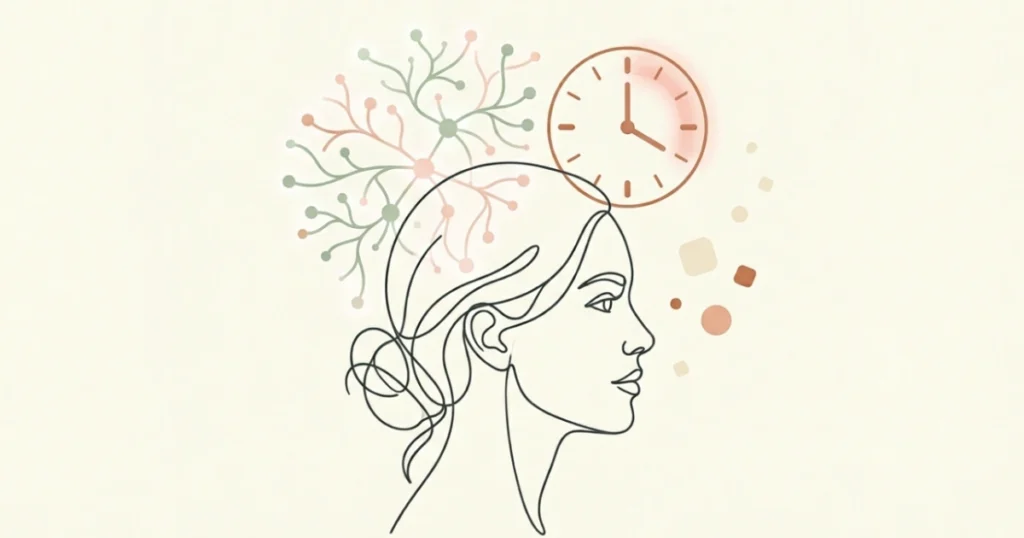
These are not generic affirmations or recycled wisdom. Each step is sequenced intentionally, starting with your biology, moving to your boundaries, and ending with your identity. Work through them in order if you can. If not, start wherever today’s need is greatest.
1. Name What Is Happening In Your Body Before You Fix Anything
- Do This: Spend 60 seconds naming your current physical state out loud or in a journal. Say, “I am exhausted, my shoulders are tight, I feel foggy.” This activates the prefrontal cortex and interrupts the stress loop. It is a somatic regulation technique heavily utilized in trauma-informed postpartum therapy, supported by guidelines from the American Psychological Association.
- Not That: Do not immediately reach for your phone to scroll for solutions. Digital input when dysregulated spikes cortisol, destroying any chance of calm.
2. Replace Sleep When The Baby Sleeps With Rest Your Nervous System
- Do This: If sleep is impossible, lie flat with no screens. Close your eyes for even 10 minutes. This activates your parasympathetic nervous system and reduces cortisol levels, what researchers call restorative rest, distinct from sleep.
- Not That: Do not use the baby’s nap time to immediately catch up on chores or scroll social media. Both actions prevent nervous system recovery.
3. Perform A Daily Cognitive Load Audit
- Do This: Each morning, write down everything currently living in your head: feeding schedules, pediatrician appointments, who needs to bring what where. Then outsource or defer at least two items to your partner or support network. This is cognitive load redistribution in practice.
- Not That: Do not attempt to hold every logistical detail in your working memory. The mental demands of parenting are extreme, and cognitive functioning drops biologically during the first postpartum year. This is biology, not incompetence.
4. Set A Sacred Window Instead Of Vague Boundaries
- Do This: Choose one 20-minute daily window that is non-negotiable for you alone. Take a walk, take a shower, or drink a cup of coffee in absolute silence. Name it to your household and put it on the calendar. Specificity creates accountability.
- Not That: Do not say “I need more me-time” without scheduling it. Vague self-care requests are routinely ignored in the chaos of newborn life.
5. Filter Advice Using The 3-Tier Sanity Filter Model
- Do This: When you receive advice from family, social media, or friends, mentally assign it a tier using this model:
- Tier 1: Your pediatrician, a certified postpartum therapist, or evidence-based resources.
- Tier 2: Experienced mothers in your immediate trusted circle.
- Tier 3: Social media, anonymous forums, well-meaning but uninformed relatives.
- Act on Tier 1 first. Consider Tier 2. Deprioritize Tier 3 without guilt.
- Not That: Do not apply every piece of advice equally. The tsunami of conflicting input is one of the primary drivers of new mom overwhelm that nobody talks about.
6. Practice Micro-Connection With Your Partner Daily
- Do This: Ask your partner one non-baby-related question each evening. Try, “What made you smile today?” or “What are you thinking about right now?” This preserves your couple identity alongside your parental identity, a clinical recommendation from maternal mental health specialists to prevent relational drift.
- Not That: Do not let every conversation default to logistics and baby updates. This slowly erodes the partnership foundation that is one of your most critical support structures.
7. Reframe Good Enough As A Neuroscience-Backed Strategy
- Do This: Consciously lower the bar on non-essential tasks like housekeeping, meal aesthetics, and appearance, and resist the urge to apologize for it. This preserves executive function for the cognitive demands that actually matter: responding to your baby’s cues, regulating your own emotions, and making health decisions.
- Not That: Do not chase the Instagram version of new motherhood. Despite advances in maternal mental health, a bias toward pathologizing maternal experiences persists, and social media amplifies this bias daily. You are not failing; you are allocating.
“Perfection In Motherhood Is An Illusion Created By Those Selling You A Cure.”
This reminder is vital because an entire industry profits from your insecurity. Letting go of perfection is a biological requirement for your brain to heal.
Comparison Table: Common New Mom Advice What Works Vs. What Backfires
| Advice You Have Heard | Why It Often Backfires | The Better Alternative |
| “Sleep when the baby sleeps” | Impossible for most; creates guilt when it fails | “Rest your nervous system” with eyes closed and no screen |
| “Lower your expectations” | Too vague; offers no action | Conduct a daily cognitive load audit and delegate 2 items |
| “Accept all help offered” | Does not address HOW to ask when help is not offered | Create a specific “Help Menu” list you share with your village |
| “Enjoy every moment” | Toxic positivity that invalidates real struggle | Name both the joy AND the hardship, both are true simultaneously |
| “You will figure it out” | Dismisses the real learning curve | Seek Tier 1 sources proactively; do not wait for a crisis |
| “Trust your instincts” | Useful, but instincts need information to function | Combine maternal intuition WITH evidence-based pediatric guidance |
| “This phase will pass” | True but completely unhelpful in the moment | Use somatic regulation grounding techniques to survive right now |
The Simplified True Story: The Night Sara Stopped Trying To Be Fine

Meet Sara. She is a 26-year-old first-time mom from Ohio who, six weeks after the birth of her daughter, appeared by every external measure to be doing absolutely great.
The Struggle: Sara had read every article. She had a freezer full of meals, a well-meaning mother-in-law on call, and a partner who tried to help. But at 2:14 AM on a Tuesday, sitting in the creaky gray nursing chair for the fourth time that night, she broke. Not from the physical exhaustion, she had expected that part. She broke from the quiet, persistent terror that she had lost the person she used to be, and that no one, not a single blog post she had read, had ever mentioned this might happen. The streetlights hit the floorboards, and she just sobbed.
The Application: A week later, a postpartum therapist introduced Sara to the clinical concept of matrescence. She learned that what she was experiencing, the heavy grief for her former self, the intense disorientation, the feeling of inhabiting a stranger’s body, was a named, documented, normal developmental process. She began Step 1 from this article: naming her physical state before reacting to any trigger. When the 2 AM wake-ups came, instead of spiraling into panic, she would whisper quietly into the dark room. “I am tired. My nervous system is activated. This is biology. It will pass.” Three words of naming. Sixty seconds of total stillness.
The Result: Sara does not describe herself as “cured” or “thriving” today. She uses a much more honest word: grounded. Four months postpartum, she still has brutally hard nights. But she no longer feels like a stranger in her own life. The structured framework, not the internet hacks, gave her back her footing. “I didn’t need one more tip,” Sara told me. “I needed someone to tell me that what I was feeling had a medical name.”
Comparative Analysis: Survival Mode Vs. Sustainable Motherhood
Many new mom resources are written entirely for survival mode, the first days and weeks of pure biological triage. But advice that saves sanity across the first year requires a completely different framework: moving from reactive crisis management to a sustainable, identity-informed approach.
| Dimension | Survival Mode Approach | Sustainable Motherhood Approach |
| Focus | Get through the next hour | Build adaptive rhythms that flex with the baby’s stage |
| Identity | Put yourself entirely on hold | Actively tend to self alongside the baby |
| Support | Accept whatever is casually offered | Curate a specific, tiered support system |
| Mental Health | Manage symptoms when they finally appear | Proactively build resilience through matrescence education |
| Partner Relationship | Coexist in robotic logistics mode | Protect micro-moments of non-parental connection daily |
| Advice Intake | Absorb everything desperately | Filter by source tier; act only on Tier 1 guidance |
| Self-Compassion | “I should be doing much better” | “My brain is reorganizing. I am doing extraordinary work.” |
| Timeline Expectation | “When does this finally get easier?” | “I am in a developmental stage. Growth is non-linear.” |
The Bottom Line: Survival mode is absolutely necessary in the early days, but it becomes actively harmful when it extends for months without a transition toward sustainable practices. The entire goal of this article is to give you the bridge between the two.
Common Mistakes And How To Avoid Them

If you have ever dealt with this, you know how maddening it is to repeat the same errors when you are already running on fumes. Let us fix the top three missteps.
1. Trying To Logic Away The Grief Of Your Old Life
You might tell yourself, “I wanted this baby so badly, so I have no right to be sad right now.” That is entirely false. You are mourning the loss of your independence, which is a required part of matrescence.
Step-by-step fix: Write down three specific things you miss about your pre-baby life. Acknowledge them without an ounce of guilt. Tell your partner, “I deeply love our baby, but today I am mourning how easy it used to be to just walk out the front door.” Giving it a voice removes its hidden power.
2. Refusing To Delegate The Mental Load
You assume it is just faster to do it yourself because explaining the task takes too much time. This path leads straight to severe burnout, a reality documented repeatedly by the Center for Women’s Mental Health at MGH. Which, if you have ever dealt with this, you know is maddening. You think it saves time. It does not.
Step-by-step fix: Pick one recurring task, like ordering formula or tracking pediatrician visits. Hand it over entirely. Text your partner: “I need you to own the diaper inventory from now on. Check it every Sunday and order as needed.” Then, let them fail or succeed. Do not step in to save them.
3. Waiting For The Perfect Time To Connect With Your Partner
You think you will schedule a proper date night when things finally calm down. Spoiler alert: things do not calm down for years.
Step-by-step fix: Implement a five-minute check-in while literally doing the dishes. Ask, “What is one thing that stressed you out at work today?” It does not need candles or a babysitter. It just requires eye contact and a conversation that does not revolve around infant digestion.
Frequently Asked Questions (FAQs)
Q1: What is the most important advice for a first-time mom in the newborn stage?
The single most important advice is this: understand that you are in a neurological and identity transition called matrescence, not just a logistical adjustment. Before optimizing routines or chasing milestones, prioritize somatic regulation by calming your nervous system. Give yourself the exact same developmental grace you would give your baby. Survival is the goal, not perfection, in week one.
Q2: How do new moms cope with feeling overwhelmed and losing their sense of self?
Start by naming what is happening: this is matrescence, not a breakdown. Your brain is literally reorganizing itself. Practical steps include conducting a daily cognitive load audit to externalize mental tasks, building one 20-minute non-negotiable daily window for yourself, and seeking a postpartum therapist if identity loss feels persistent. You are not disappearing; you are becoming someone entirely new.
Q3: Is it normal to feel like a different person after having a baby?
Yes, and there is hard neuroscience to explain it. A 2024 Nature Neuroscience study found that few brain regions are untouched by the transition to motherhood. This physical brain reorganization is called matrescence, and it mirrors the developmental upheaval of adolescence. Feeling different is not a sign that something is wrong; it is evidence of profound biological adaptation.
Q4: How can new moms get more sleep with a newborn?
Replace the goal of sleeping when the baby sleeps, which is often impossible, with nervous system rest. Lying flat in a dark room with no screen, even for 10 minutes, activates the parasympathetic system and reduces cortisol. When actual sleep is possible, prioritize it over all non-essential tasks. Sleep deprivation is biological; managing it strategically matters more than maximizing total hours.
Q5: When should a new mom seek professional help for her mental health?
Seek professional support immediately through organizations like Postpartum Support International if you experience persistent sadness, intense anxiety, or rage lasting more than two weeks. Intrusive thoughts about harm, an inability to bond with your baby, or a sense of unreality are clear signals. Postpartum mood and anxiety disorders affect one in five mothers. Early intervention consistently leads to faster recovery.
Final Takeaway
You have just read things that most “advice for new moms” articles will never tell you: that your heavy disorientation actually has a clinical name, your brain has a measurable reason for feeling reorganized, and the internet tips that never stuck were not your failure. They were simply the wrong level of intervention for a physical transformation this massive.
I know how incredibly isolating it feels to scroll through perfectly curated social media feeds while you are sitting in the dark, wondering if you are doing everything wrong. I see that exhaustion in you. But knowledge without action is just temporary comfort. So here is your one required task:
Tonight, before you go to sleep, open your phone’s notes app and write three words that describe your physical state right now. Not how you should feel. Not what the baby needs. How you feel. In your body. Right now.
That act of naming, that simple 60-second practice, is exactly how somatic regulation begins. It is how Sara started. It is how every sustainable season of motherhood has to begin: with radical, clear-eyed honesty about where you actually are.
Are you ready to stop fighting your own biology and start working with it? You are not behind schedule. You are becoming. And that is enough for today.
The transition into motherhood demands a massive rewiring of your brain, your body, and your entire identity. By understanding the biology of matrescence, practicing daily somatic regulation, and actively delegating your cognitive load, you stop merely surviving and start adapting. Motherhood is not about desperately bouncing back to who you were; it is about confidently moving forward into exactly who you are becoming.
My Closing Remarks:
Look, I am going to be brutally honest with you. Society profits off your mom-guilt. Every time you feel like you are failing, someone is right there to sell you a sleep program, a diet pill, or a parenting course. I was so angry when I realized no one told me about the actual brain changes happening during postpartum. Stop apologizing for needing twenty minutes of silence. Stop acting like your basic biological needs are an unreasonable burden. You grew a human being from scratch. Stop playing small just to make other people comfortable.
More Related Stories For You
If you want to dive deeper into building a genuinely supportive home life, you need a partner who steps up to the plate.
- Understanding the core qualities of a good partner can completely shift how you share the suffocating mental load.
- Sometimes, a tiny shift in communication works absolute wonders; even sending simple good morning messages for him can break the ice when you both feel like exhausted roommates.
- Ultimately, surviving the brutal first year requires you to actively maintain healthy relationship habits so you do not lose your marriage in the chaos of newborn life.