
 Sara Carmen
Your marriage isn’t broken. It’s running on autopilot. Here’s the science-backed reset that brings it back to life.
Key Points
- Healthy relationship habits aren’t grand gestures. They’re small, repeatable behaviors that decades of marriage research say actually work.
- The 5:1 ratio, the soft startup, and the “covert contract” sound clinical, but they quietly decide which marriages thrive and which ones slowly starve.
- One small shift, tested over the next 48 hours, can start reversing years of emotional distance.
Contents
Table of Contents
Most marriages don’t end with a slammed door. They end with two people sitting on the same couch, each scrolling a separate phone, in a silence neither one of them chose.
We tend to assume it’s the big blowups that wear a marriage down. The truth is quieter than that. It’s the thousand small moments of disconnection that pile up until two people who once talked for hours start negotiating logistics like coworkers.
You’ve noticed it. Maybe you’ve even said it out loud. “We feel like roommates.”
You’ve tried talking about it. You’ve tried date nights, maybe a few articles, maybe a book someone recommended. And yet the same patterns keep showing up. You start to wonder if something is fundamentally wrong with the two of you.
There isn’t.
Someone on the outside might think your marriage is simply going through “a rough patch.” But what they don’t see is the 11 p.m. argument about nothing that was really about everything. A friend might assume you two just need more romance. But what’s actually missing isn’t romance. It’s a set of behavioral habits that never got built in the first place.
This is where the research gets genuinely useful, because marital stability isn’t a matter of luck or chemistry. According to decades of observational research from the Gottman Institute, the difference between couples who stay connected and couples who drift apart comes down to specific, measurable behaviors happening in the smallest moments of daily interaction, long before anyone raises their voice.
That’s the shift this article is asking you to make. Not “try harder to love each other.” Try these seven specific things instead.
The 7 Healthy Relationship Habits That Actually Change a Marriage
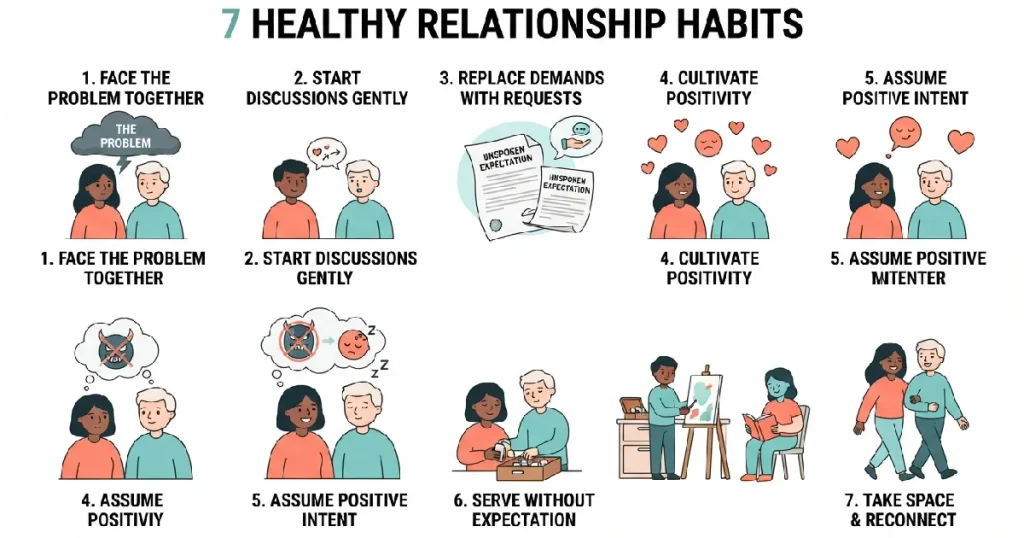
Habit 1: Reframe Conflict as “Us vs. The Problem”
Picture two people sitting across a table, arms crossed, each building a case against the other. Now picture the same two people sitting side by side, looking at the same problem laid out in front of them.
That physical and psychological shift is the entire habit. In psychology, this is sometimes called moving from an adversarial frame to a collaborative frame. Instead of protecting your ego from your partner, you and your partner protect the relationship from the problem.
Couples who do this stop asking “who’s right” and start asking “what does this situation need.” One question builds walls. The other builds a team.
The next time money, in-laws, or scheduling turns into a fight, try physically sitting next to your partner instead of across from them. It sounds small. It changes the entire tone of the conversation.
Habit 2: Use a Soft Startup to Lower Defensive Barriers
Research on married couples has found something almost too simple to believe: the way a conversation begins predicts, with startling accuracy, how it will end. This is called a “startup,” and it sets the emotional temperature for everything that follows.
A harsh startup sounds like this: “You never help around here. I’m so sick of doing everything myself.” A soft startup addresses the same frustration differently: “I’m feeling overwhelmed with the house right now and I need us to figure out a plan together.”
Notice the difference. The first one attacks character. The second one names a feeling and invites a solution.
Your partner’s nervous system reacts to your tone before it ever processes your words. A soft startup keeps their defenses down long enough for them to actually hear you.
Habit 3: Explicitly Deconstruct Covert Contracts
A covert contract is an unspoken rule you’ve created in your own head about what your partner “should” do, without ever telling them. You expect them to remember the anniversary of your first date without a reminder. You expect them to know you’re stressed just by the way you’re loading the dishwasher.
Most people in long marriages don’t realize they’re operating this way until the resentment has already built for years.
The APA’s guidance on healthy relationships points to clear, direct communication as one of the strongest predictors of relationship satisfaction, because mind reading simply isn’t a skill either of you actually has.
Try this tonight: name one unstated rule you’ve been quietly holding against your partner. Say it out loud. You’ll likely find they had no idea it existed.
Habit 4: Master the 5:1 Ratio During Disagreements
Here’s the part almost every article on this topic gets wrong. The famous “Magic Relationship Ratio” from Gottman’s research isn’t about being nice on ordinary days. It’s about what happens during the fight itself.
The finding, drawn from years of observing married couples in conflict, is this: for every one negative interaction during a disagreement, stable couples produce roughly five positive ones. That’s a small laugh mid-argument. A hand on the arm. A quiet “I hear you” before you disagree.
Couples who divorce, by contrast, often show a ratio closer to 1:1, meaning negativity and repair happen in roughly equal measure, and repair simply can’t keep pace.
The math matters because it means you don’t need to eliminate conflict. You need to season it with enough warmth that it never turns corrosive.
Habit 5: Assume Positive Intent to Counter Hyper-Vigilance
When a marriage has taken a few hits, the brain starts scanning for threats the way it would in any unsafe situation. A short text reply feels like rejection. A forgotten errand feels like disrespect. This is hyper-vigilance, and it keeps a nervous system stuck in a low-grade fight-or-flight state even when nothing dangerous is actually happening.
But here’s what no one tells you.
Most of what feels like malice in a long marriage is actually just fatigue, distraction, or a bad day that has nothing to do with you. Choosing to assume positive intent isn’t naive. It’s a deliberate mental habit that interrupts the threat-scanning loop before it hijacks the whole evening.
The next time your partner’s text feels short or their tone feels off, ask yourself one question: what’s the most generous explanation for this? Nine times out of ten, it’s also the accurate one.
Habit 6: Run Background Diagnostics for Mundane Comfort
This is the habit almost nobody talks about, and it might be the most important one on this list.
Think about it like a piece of software quietly running maintenance checks in the background while you sleep. You never see it working. You only notice when something breaks. That’s exactly what emotional security in a marriage looks like when it’s done right.
Habit 7: Protect Secure Solitude and Separate Lifelines
Somewhere along the way, a myth took hold that a happy marriage means doing everything together, sharing every friend group, wanting the same hobbies. Research on long-term relationship satisfaction tells a different story.
Couples who maintain their own friendships, their own interests, and even some financial independence report higher relationship satisfaction over time, not lower. Autonomy isn’t the opposite of connection. It’s the fuel that keeps connection interesting.
Left unexamined, the opposite pattern, two people slowly merging into one identity, doesn’t just feel suffocating. It quietly erodes the curiosity that attraction depends on.
If you can’t remember the last time you did something alone that had nothing to do with your marriage, that’s worth paying attention to.
The 3-Step Structural Framework for Daily Life

Knowing the habits is one thing. Building them into a routine you’ll actually keep is another. Here’s a simple weekly structure.
The Weekly Diagnostic Check-In
Set aside 20 uninterrupted minutes once a week. Ask three questions: What went well? What missed the mark? What do I need explicit support with this week?
The Echo Technique
Before responding to a complaint, summarize your partner’s point back to them accurately, out loud, before you defend yourself. This single habit prevents most conflict resolution failures before they even start.
The Calming Time-Out
When your heart rate spikes past a certain point, roughly 100 beats per minute, your ability to reason and listen drops sharply. This is called flooding. The APA’s guide to strengthening couples’ relationships recommends a genuine pause, twenty minutes or more, before returning to a hard conversation. Not silence as punishment. Silence as regulation.
Deepening the Emotional Bond: 4 Supporting Strategies
Co-owning domestic labor. Chores stop feeling like resentment fuel when both partners treat them as a shared investment rather than a favor one person does for the other.
Prioritizing the slow-cooked friendship. Before you’re spouses managing a household, you were two people who liked talking to each other. Protect that.
Establishing routine escapism. One evening a week, phones away, outside stress banned from conversation, eye contact restored. It doesn’t need to be expensive. It needs to be consistent.
Active de-escalation. Agree in advance, outside of conflict, that yelling and stonewalling are both off the table. Replace them with a shared signal for “I need space to cool down.”
Your Next Step: Pick One and Test It
You don’t need to overhaul your marriage this weekend. One place to start is choosing a single habit from this list, the soft startup or the background diagnostic, and testing it for 48 hours.
A useful question to ask yourself tonight: which one of these seven habits is my marriage most starving for right now?
The next time tension rises, try the echo technique before you defend yourself. Notice what shifts.
In my practice, the couples who make the most lasting change rarely try to fix everything at once. They pick one small, repeatable behavior and practice it until it becomes automatic.
The Quiet Comeback
Remember that couch, those two separate phones, that silence neither of you chose? That scene doesn’t have to be your ending.
Saving a marriage from routine was never going to require a grand gesture. It requires small, deliberate choices, repeated daily, until they become who you both are again.
That silence on the couch can become a conversation again. It starts with one habit, practiced on purpose, tonight.
My Closing Remarks
I’ve sat across from couples who came in convinced they’d simply fallen out of love, only to discover they’d just stopped practicing the small behaviors that built that love in the first place. Marriages don’t usually die from a lack of love. They die from a lack of maintenance. You still have time to run the diagnostics, restock the small things, and choose each other again tonight.
More Related Stories for You
- Wondering what it actually means when your partner still notices you after all these years? Here’s what it means when a guy calls you beautiful.
About The Author