
 Sara Carmen
Before you split the rent, find out what psychology says about whether cohabitation sharpens your relationship or quietly stalls it.
Key Points:
- Living Together Before Marriage can either sharpen your compatibility radar or slowly erode your timeline toward commitment, depending entirely on why you moved in.
- The “cohabitation effect” shows that sliding into a shared address without a clear plan is linked to lower relationship satisfaction years later.
- A handful of honest conversations before you sign a lease can turn cohabitation from a trap into the smartest test your relationship ever takes.
Contents
Table of Contents
We’ve all watched it happen to a friend, or maybe to ourselves. A toothbrush moves over first. Then a drawer. Then most weekends. Eventually someone points out that you’re basically already living together, so you might as well make it official and split the rent.
You nod along. It sounds practical.
But underneath the math of two incomes and one lease, a quieter question sits there, unanswered. Are you choosing this future together, or just drifting into it.
Here’s a number worth sitting with. According to the Pew Research Center, a majority of adults under 44 in the United States have lived with a romantic partner outside of marriage at some point in their lives. Cohabitation isn’t the exception to the rule anymore. For most couples in their twenties and thirties, it is the rule.
Someone might think moving in together is purely a financial upgrade, two paychecks covering one set of bills instead of two. But what they don’t see is the quiet anxiety underneath it, the worry that shared square footage will end up answering the marriage question for them, whether they meant it to or not.
Someone might think a partner’s messy bathroom counter is a small, forgivable thing. But what they don’t see is that three days of dishes in the sink is often a preview of how that person handles responsibility when nobody is watching.
Someone might think refusing to move in without a clear plan is old fashioned. But what they don’t see is a growing body of research connecting how a couple enters cohabitation to how satisfied they end up years later, married or not.
The Psychology Behind Moving In Together Before Marriage
You’ve watched rent prices climb again this year. You’ve run the numbers on your own place versus a shared one, and it isn’t close. But you’ve also felt a flicker of hesitation, a small voice wondering if moving in will finally push your relationship toward marriage, or quietly let both of you off the hook of ever deciding anything at all.
That flicker has a name.
Psychologists call it relationship inertia. It describes the tendency for a shared living situation to keep two people together through convenience rather than genuine commitment, which makes it harder to walk away later even when the relationship stops working. The lease, the furniture, the shared dog. All of it raises the cost of leaving, whether or not the relationship deserves to be kept.
Family researchers Scott Stanley and Galena Rhoades gave this pattern a memorable name of its own: sliding versus deciding. Couples who slide into cohabitation, meaning they move in without ever having a real conversation about what it means, tend to report lower relationship quality years later compared to couples who made a deliberate, spoken decision to share an address.
A widely cited study on the cohabitation effect found that timing and intent mattered more than cohabitation itself. Moving in because your lease was ending is not the same decision as moving in because you had already committed to a future together. Your relationship tends to know the difference even if you don’t say it out loud.
Most people don’t realize they’ve slid into anything until years later, when they’re standing at a crossroads wondering how they got there.
The Smart Test: Five Real Reasons Living Together Before Marriage Works
1. Domestic Compatibility Check: The Guest Phase Finally Ends
Weekend visits show you a curated version of your partner. Daily life shows you the real one. Living together reveals cleaning habits, sleep schedules, and personal discipline that never surface during a dinner date.
On forums like Reddit’s r/Marriage, people describe the same realization over and over. The person who seemed effortlessly put together on dates turns out to leave laundry on the floor for a week straight. How someone treats a shared space often mirrors how they’ll treat shared responsibility later, including finances and follow-through on promises.
2. Financial Synergy: Real Relief in a High-Rent Market
In cities where rent has outpaced wage growth for years, combining households can be the difference between saving money and barely breaking even. Splitting rent, utilities, and groceries frees up income that can go toward debt, savings, or eventually a wedding.
For many couples in their late twenties, this is the honest, unglamorous reason cohabitation happens in the first place. The key question isn’t whether the math works. It’s whether the math is the only reason you’re moving in.
3. Early Red Flag Detection: The Mask Drops Early
Living together forces conflict into the open faster than dating ever does. You can’t avoid a disagreement about money or chores when you share a kitchen every single day.
This early pressure test can be a genuine gift. It surfaces controlling behavior, financial secrecy, or emotional withdrawal while you still have an easy way out, instead of discovering it after a wedding.
4. The Low-Stakes Exit: Cheaper Than Divorce
If real incompatibilities surface, breaking a lease is inconvenient. Divorce is a legal process that can take months, cost thousands of dollars, and involve courts dividing shared property. Cohabitation gives you a way to discover deal-breakers while the exit door is still relatively affordable to use.
5. Deepening Intimacy: From Dates to Daily Life
Shared chores, shared groceries, and shared mornings build a different kind of closeness than romantic dinners ever could. Couples who divide domestic labor in a way that feels fair to both people often describe feeling more like a team, not just a couple. That sense of partnership, built through ordinary Tuesday nights, tends to carry real weight later in marriage.
Why Living Together Before Marriage Tests the Wrong Kind of Compatibility
Here’s something most guides on this topic miss entirely.
Living together tests whether two people can function well as roommates. It tests whether you can agree on a cleaning schedule, split a grocery bill fairly, and tolerate each other’s sleep habits. Call this logistics compatibility.
But logistics compatibility is not the same thing as commitment compatibility, meaning whether you both actually want the same future and are willing to fight for it during hard seasons.
A couple can run a household beautifully and still have wildly different levels of investment in the relationship’s future. You can split chores perfectly with someone who has no intention of proposing anytime soon. Cohabitation is genuinely useful for testing the first kind of compatibility. It is a poor substitute for an honest conversation about the second.
Maya and Daniel’s Lease
Maya moved in with Daniel after eighteen months of dating, mostly because her roommate was moving out and the timing worked. Two years later, she was still waiting for him to bring up marriage, assuming the shared address had already answered that question for both of them.
Daniel, meanwhile, saw the arrangement as a comfortable, practical setup that never needed a formal next step. Neither one had actually decided anything together. They had simply slid into a life that looked like commitment from the outside without either person choosing it out loud.
When Maya finally asked directly where he saw things going, Daniel admitted he’d never really thought past convenience. They weren’t incompatible. They had just never had the conversation that mattered.
The Relationship Trap: Five Realistic Cons of Living Together Before Marriage

1. The Sliding Versus Deciding Stagnation
Moving in without a real conversation about your future creates comfort, and comfort can quietly replace intention. Years pass. The relationship continues not because both people are choosing it, but because ending it would mean untangling a shared life.
Moving in together without a real decision is a bit like walking through a sliding door instead of knocking on one. You end up in the room, but nobody actually chose for you to be there.
2. Asymmetrical Commitments: The Invisible Support Trap
Sometimes one partner takes on the bulk of the emotional labor, cleaning, and financial planning, while the other simply enjoys the benefits without matching the investment. Community forums are full of stories from partners, often women, who describe functioning as a spouse in every practical way while waiting years for a formal commitment that never arrives.
3. The Legal Vacuum: No Court to Protect You
Marriage comes with a legal framework for dividing assets if things end. Cohabitation does not. If you break up after five years of shared purchases, joint furniture, and a shared pet, there is no automatic legal process to sort out who keeps what.
4. Diminished Anticipation: The Wedding Blur
Part of what makes a wedding night feel significant is the contrast it represents, a clear before and after. When a couple has already shared a home, a bed, and a life for years beforehand, that milestone can feel more like paperwork than transformation.
5. The Illusion of Security: Easy to Leave, Harder to Fix
Without the legal and social weight of marriage, it can be easier for one partner to walk away during a rough patch instead of doing the harder work of repair. Some couples keep separate finances and an unspoken exit plan, which can quietly prevent either person from fully investing in fixing what’s broken.
Living Together Before Marriage: The Legal Realities in the US and UK
Here’s a myth worth killing right now.
Living together for ten years does not create a common law marriage in most of the United States or in the United Kingdom. This belief is one of the most persistent misconceptions couples carry into cohabitation, and it can cost people dearly if a long relationship ends without legal protection.
In the UK, unmarried partners have no automatic right to a partner’s property, pension, or savings, regardless of how long they’ve lived together. In most US states, the same is true. Without a legal agreement, asset division after a breakup depends entirely on whose name is on the paperwork, not on how long you shared a home.
The fix isn’t complicated, even if couples avoid it out of discomfort. A cohabitation agreement, similar in spirit to a prenup, can outline how property, debt, and shared purchases would be divided if the relationship ends. A simple will, along with a declaration of trust for jointly owned property, can prevent years of disagreement and heartbreak later.
Most couples don’t realize they need this kind of protection until they’re already in a dispute, which is exactly the moment it’s hardest to negotiate calmly.
Are You Ready to Live Together Before Marriage? A Quick Framework
Before you start comparing apartment listings, sit with a few honest questions.
Ask yourselves why you’re really moving in. Is this decision about saving money, or about building a shared future together? Both reasons can coexist, but only one of them should be doing the heavy lifting.
Ask what timeline, if any, you’re both imagining. You don’t need a wedding date. You do need to know if you’re both picturing the same general direction for the relationship.
Ask how you’d handle a breakup before you need to. Talking through how you’d split furniture, the lease, or a shared pet before moving in isn’t pessimistic. It’s the same reasoning behind wearing a seatbelt.
A recent analysis of cohabitation motives found that couples who moved in primarily for convenience, rather than as a deliberate step toward a shared future, reported lower relationship functioning over time. The reason for moving in mattered more than the moving in itself.
What to Do Before You Move In Together
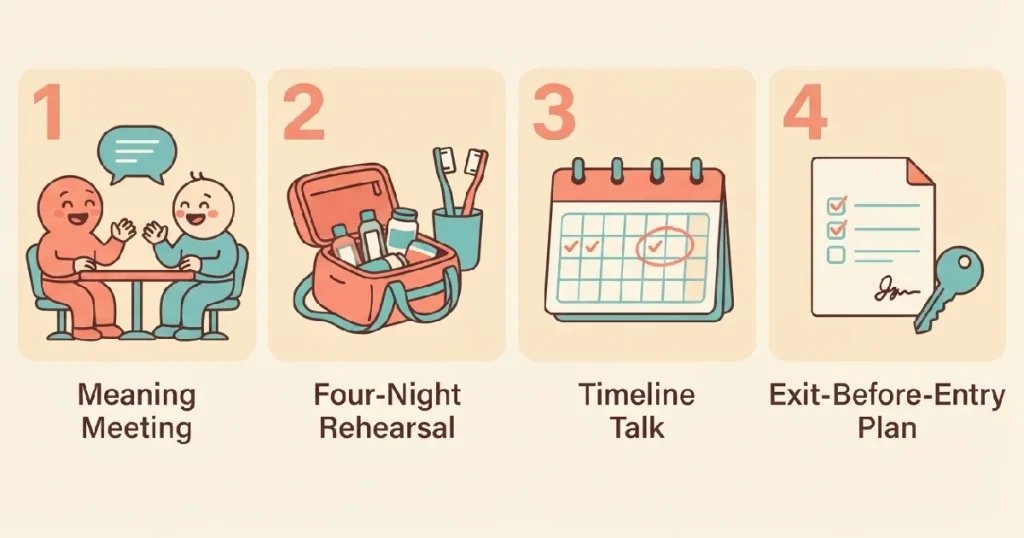
One place to start is naming your reason out loud, together, before you start packing boxes. Try finishing this sentence honestly: “We are moving in because ___.” If neither of you can complete it with something beyond convenience, that’s information worth sitting with.
Consider trying what some couples call the four day split, spending several nights a week together at each other’s places for a few months before committing to a joint lease. It offers a lower stakes preview of daily friction without the financial entanglement of a shared apartment gone wrong.
A useful question to ask yourselves is whether you’d still choose each other if the rent math didn’t work out at all. If the honest answer is yes, cohabitation is likely to function as a genuine test of your future together. If the honest answer is uncertain, that uncertainty deserves a conversation before it becomes a shared address.
The next time a friend, or your own inner voice, frames this as purely a financial decision, try naming what’s actually being decided underneath it.
Living Together Before Marriage Isn’t the Real Question
The real question was never whether you move in together. It’s whether you decide to, out loud, with your eyes open, instead of sliding through the door because it happened to be unlocked.
You can knock first. You can ask the questions before the boxes arrive instead of after. That single shift, from sliding to deciding, is what separates couples who use cohabitation as a genuine test from couples who quietly get stuck living out someone else’s momentum.
You now know the difference between a test and a trap. What you do with that knowledge is the only part that was ever really up to you.
My Closing Remarks
In my practice, the couples who struggle most after moving in aren’t the ones who disagree about dishes. They’re the ones who never actually talked about why they were moving in at all. I’ve watched partners assume a shared address settled a question neither of them had actually asked out loud. You deserve better than assumption. Have the conversation before the lease, not after the resentment.
If you’re struggling with the decision to move in together or feel stuck in relationship limbo, consider speaking with a licensed therapist or couples counselor who specializes in premarital work.
More Related Stories for You
- For more on building the kind of open, honest communication that makes cohabitation actually work, check out this good advice for a relationship.
About The Author