
 Nicole Adkins

You’re not imagining it, and you’re not bad at your job. Here’s how to protect your peace and your paycheck.
Key Takeaways
- Learning how to deal with a narcissist boss starts with controlling the channel of communication, not the person.
- You can’t fix a narcissist boss, but you can build a system that makes their usual tricks stop working on you.
- Dealing with a narcissist boss isn’t about winning the argument, its about protecting your paper trail and your sanity.
Quick Answer: To deal with a narcissist boss, build an asynchronous communication moat, practice low emotional reactivity, and tie your updates to measurable data instead of ego battles. Document directives in writing, quietly build allies across departments, and keep emotional distance to protect your mental health and your career standing.
Contents
Table of Contents
The Corporate Reality of Pathological Leadership
We’ve all sat in that meeting where the ground shifted for no reason. One minute your boss loves the deck you built. The next minute they’re telling the VP it was a mess, and somehow that lands on you.
You replay the conversation that night. Did I say something wrong. Did I misread the brief.
You didn’t, by the way. But that doubt is kind of the point.
If you work for a narcissist boss, this isn’t a one off bad day. Its a pattern, and your body already knows it even while your brain hunts for a logical explanation.
Here’s the thing nobody tells you at orientation. A boss with narcissistic traits isn’t confused or having an off week. They’re running a setup where their self image gets protected no matter what the real outcome was.
You are up against a calculated system of self preservation. Your response has to be just as calculated, not emotional, not defensive, and definately not personal.
This guide isn’t about fixing your boss or hoping one honest 1-on-1 changes everything. It’s tactical. It’s about protecting your job, your reputation, and your own grip on reality, starting today.
Decoding the Playbook: How to Deal with a Narcissist as a Boss
Before you can respond well, you have to see the pattern clearly. Most advice treats narcissistic bosses like a personality quiz result instead of a set of actual workplace behaviors you can spot in real time.
Spotting Covert Sabotage vs Overt Aggression
Some narcissist bosses are loud. Yelling in meetings, belittling people in front of clients, throwing tantrums over small mistakes.
Others are quiet about it. They sigh instead of yelling. They “forget” to loop you into the meeting where credit got handed out. They play helpless so someone else fixes their mess, then take the win anyway.
Both types share a root cause that research on narcissistic leadership dynamics describes well: their decisions are driven by ego defense, not business outcomes. A tough manager pushes for results. A narcissistic one pushes to stay admired, and punishes anything that threatens that image.
Unmasking DARVO in Performance Reviews
DARVO stands for Deny, Attack, Reverse Victim and Offender. It’s a concept from psychologist Jennifer Freyd’s research on institutional betrayal, and it shows up constantly in review season.
You raise a fair concern about a shifting scope. Suddenly you’re the one being called “defensive” or “difficult” in the room. The conversation that started about a missed deadline ends with you apologizing for your tone.
Take Priya, a project lead at a mid size agency. She flagged that her boss changed the deliverable three times without updating the brief. In the review, her boss called her “resistant to feedback” and never addressed the scope change at all.
This pattern matches what the clinical symptoms of narcissistic personality disorder describe as an inability to tolerate perceived criticism without reacting defensively.
Quick diagnostic for your next tense meeting:
- Did my original concern ever get addressed, or did the topic change to my “attitude.”
- Am I apologizing for something that was never actually my mistake.
- Does the story they’re telling match the timeline I can prove in writing.
If you answered yes twice, you’re looking at a pattern, not a bad mood.
How to Deal with a Narcissist Boss: 9 Proven Behavioral Methods
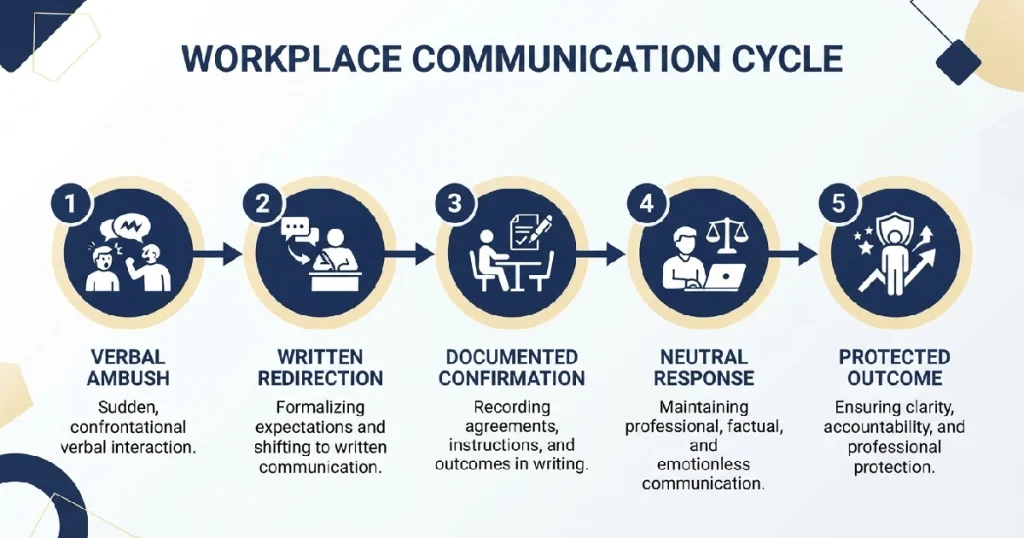
Once you can name what’s happening, the panic turns into something closer to chess. Here’s the actual tradecraft, not the “just set a boundary” advice that gets people fired.
1. Build the Asynchronous Moat. Move verbal ambush conversations into written channels. When your boss drops by with vague demands, try this script: “I am knee-deep in finishing the client deliverable right now. Please drop the specific bullet points into Slack so I can address them in order without losing momentum.” This creates a timestamp and removes the pressure of a live, unprepared answer.
2. Deploy the BIFF Protocol. If you’re wondering how do I deal with a narcissist boss in writing, use BIFF: Brief, Informative, Friendly, Firm. Skip apologies and defensive explanations entirely. Try: “Understood. The revised financial projections have been adjusted to reflect the 8% target and are saved in the shared drive for your 2 PM review.” No drama, no bait taken. For more on this, check out mastering workplace communication under pressure.
3. Use Ego-Syntonic Framing. Pitch your ideas so they visibly feed your boss’s standing with leadership. Instead of “I think we should change the process,” try “This would make your team look great in front of the VPs next quarter.” Same idea, far less resistance.
4. Practice Supply Starvation. This is the narcissist boss how to deal essential: stop reacting. These bosses often bait people into anger or tears, then use that reaction against them later. Keep your face neutral, your voice flat, and redirect to the next operational step.
5. Use Policy Shields. Decline unreasonable requests by citing systems, not yourself. “I would like to take this on, but security compliance requires all data exports to go through IT verification first. I will initiate that ticket so we stay fully aligned with governance.”
6. Lock Down Objective Milestones. Send a quick recap email after every call defining what “done” looks like. This stops the classic goalpost shift where success gets redefined after the fact.
7. Use Strategic Praise Buffers. If you’re asking how do you deal with a narcissist boss during a disagreement, sandwich your correction between two genuine compliments about their broader vision. This prevents what psychoanalyst Heinz Kohut called narcissistic injury, the outsized reaction to feeling criticized.
8. Build a Parallel Visibility Network. Build real relationships with other directors and skip-level leaders. If a smear campaign starts, you want people in the room who already know your work firsthand.
9. Maintain an Off-Grid Evidence Dossier. Keep a personal, non-company log of dates, times, and specific statements. Use a personal device, not a work laptop. This protects you if a bad faith performance plan ever shows up.
Daily Survival: How to Deal with a Boss Who’s a Narcissist
Breaking the Hoovering Cycle
Narcissistic bosses often follow mistreatment with sudden warmth. A surprise compliment, a bonus, an invite to the leadership lunch. This is sometimes called hoovering, and it works the same way as the variable reward schedules B.F. Skinner studied in behavioral psychology. Unpredictable rewards are more addictive than consistent ones, which is exactly why you keep hoping this time is different.
Stay emotionally level whether they’re praising you or ignoring you. The goal isn’t coldness, it’s consistency they can’t manipulate.
Setting Quiet Micro-Boundaries
Loud boundary speeches tend to backfire with this personality type. Quiet consistency works better.
For weekend messages, try something like: “Got it, I’ll have a full answer for you first thing Monday morning.” No lecture about work life balance needed, just a calm, confirmed delay.
The Departure Strategy: Long-Term Exit Planning
At some point, staying stops being worth it. Watch for physical signs like disrupted sleep or constant dread, which overlap heavily with signs of executive burnout and career fatigue.
Run your job search off company devices, during personal hours, full stop. Before giving notice, quietly gather three things: saved performance data proving your results, personal copies of your own work samples, and two or three references outside your direct chain of command who already know what you can do.
What To Do Next

One place to begin is The 3-Minute Pause. Before responding to any accusation, wait three full minutes before typing or speaking. This breaks the fight or flight loop long enough for your logical brain to take back the wheel.
Consider testing The Paper Trail Habit. After every verbal instruction, send one line back: “Confirming what we just discussed so I can prioritize correctly.” This single habit alone closes most of the ambiguity trap.
Another option is The One Ally Rule. You don’t need a whole network overnight. Just one person outside your reporting line who sees your actual work is enough to start breaking the isolation this dynamic depends on.
Frequently Asked Questions
Can a narcissist boss actually change if I confront them directly?
Rarely, and confrontation often triggers retaliation instead of reflection. Most workplace progress comes from changing your own systems and boundaries, not from the boss gaining sudden insight.
Should I tell HR my boss is a narcissist?
Avoid the clinical label and stick to documented behaviors, dates, and business impact. HR responds to evidence of policy violations, not personality diagnoses.
How do I know if it’s really narcissism or just a tough manager?
Tough managers push for results and stay consistent even when corrected. Narcissistic managers punish correction itself, shift blame after failures, and take credit after wins regardless of the actual outcome.
Taking Back Control of Your Career Equity
That meeting where the ground shifted under you? It still happens sometimes. But now you have a map for it.
Working under a disordered boss is a tactical problem, not proof that you’re bad at your job. Your skill, your standing, and your next move still belong to you.
You don’t need your boss to change in order for you to get your power back.
My Closing Remarks
I’ve sat across from alot of smart, capable people who genuinely thought they were the problem. They weren’t. If any of this sounds familiar, please know the exhaustion you’re feeling is a rational response to an irrational system, not a personal failing you need to fix alone.
More Related Stories for You
If this resonates, you might also want to read how to handle a narcissistic manager without losing your sense of self for a deeper look at long term recovery after you leave.
About The Author