
 Sara Carmen

Why do five-minute kitchen misunderstandings turn into midnight standoffs, and what actually stops the spiral?
Key Takeaways
- Learning how to de-escalate an argument starts with calming your physical nervous system before you ever try to sort out the facts.
- Well-meaning phrases like “calm down” or “let’s be logical” accidentally trigger your partner’s threat response and speed up the fight.
- Using brief repair scripts and timed pauses helps couples lower their heart rates and solve problems on the same side of the net.
Learning how to de-escalate an argument requires calming the nervous system before debating the facts. Lower your voice below your partner’s volume, relax your physical posture, validate their immediate frustration without surrendering your boundaries, and call a 20-minute break with a promised return time once heart rates pass 100 beats per minute.
Contents
Table of Contents
We have all stood in a kitchen at 9:00 PM, staring at an unloaded dishwasher while a disagreement over forks morphs into a trial on who cares more about the marriage. Within ninety seconds, your chest tightens, your voice climbs half an octave, and you find yourself bringing up something your partner said three summers ago. You hate how exhausting these blowups feel. Still, backing down in the heat of the moment can feel like admitting defeat or letting yourself get walked over.
In clinical work with hundreds of couples, this tug-of-war between wanting peace and wanting justice is the exact trap that keeps fights burning. Psychologists call the underlying biological mechanism diffuse physiological arousal, a state where your brain’s threat center mistakes your partner’s sharp tone for a physical emergency. Once adrenaline floods your bloodstream, your prefrontal cortex goes offline, taking your empathy and problem-solving skills with it.
Figuring out how to de-escalate an argument gives you a practical off-ramp before temporary frustration hardens into lasting distance. You will see why common calming tactics backfire, how to spot the physical warning signs of a blowup sixty seconds early, and which phrases lower the temperature in the room right away.
Why Standard Advice Fails: How to Escalate an Argument by Accident
Before you can cool a heated room, it helps to look closely at how to escalate an argument without realizing you are doing it. Most people do not wake up hoping to pick a fight with the person they love. In our observation of high-conflict couples, the worst blowups accelerate when one partner tries to end the tension using the wrong tool.
Take the classic phrase, “You need to calm down.” On paper, it sounds like a gentle invitation to peace. In practice, telling an upset person to calm down registers as dismissal, signaling that their emotional pain is inconvenient or irrational.
Another hidden accelerant is what practitioners call premature logic. When your partner says they feel overwhelmed and lonely this week, pulling out a mental receipt of all the chores you completed since Tuesday pours gasoline on the fire. You are answering an emotional bid for closeness with a courtroom cross-examination.
Tone policing creates a similar trap. When you interrupt your partner’s complaint to critique their volume or facial expression, they feel unheard and double down on their intensity just to break through your wall.
Unexplained silence can be just as flammable. Walking out of the room without a word or staring at your phone while your spouse talks triggers primal panic in the human nervous system. Instead of cooling the room, cold withdrawal makes an anxious partner talk louder and follow you down the hall to force a response.
How to Stop an Argument from Escalating? Read the 100-BPM Warning Signs
Many couples ask, “How to stop an argument from escalating?” when they only notice the danger after plates are already verbally flying. The secret lies in catching the shift from a passionate disagreement to biological flooding before either person crosses the line.
Landmark research by psychologists John Gottman and Robert Levenson (1992) identified a clear physiological threshold during relationship conflict: 100 beats per minute. When your resting heart rate climbs past that mark (or around 85 beats per minute for endurance athletes), your body dumps cortisol and adrenaline into your veins.
At this stage, your body prepares to fight a predator. You experience auditory exclusion and visual tunnel vision, meaning you literally cannot hear the softer nuances in your partner’s voice. Your brain filters out affection and scans exclusively for threat and blame.
Since most of us do not check a smartwatch in the middle of a dispute over holiday travel, you can track three observable behavioral metrics that appear roughly sixty seconds before full flooding takes over:
- The Three-Second Interruption Rule: Both partners stop waiting for the other to finish a thought and begin cutting in within three seconds of the other person speaking.
- Vocal Pitch and Posture Locking: Your voice shifts higher into your throat, your jaw clenches, or your breathing moves up into your upper chest.
- Kitchen-Sinking and Global Labels: The topic expands from one specific event (“You forgot to call the roofer”) into sweeping character verdicts (“You never care about our house, just like with the car last month”).
Spotting even one of these three signals tells you that productive problem-solving is biologically impossible for the next twenty minutes. Pushing forward to “finish the conversation” while flooded guarantees you will trade insults you have to clean up tomorrow.
How to De-Escalate an Argument with Your Spouse: The 7 Core Secrets

When people search for how to de escalate arguments at home, they often worry they will have to swallow their dignity and agree with unfair blame. Real de-escalation techniques for couples protect your boundaries while calming both nervous systems. If you are asking yourself, “How to de escalate an argument with your spouse when tempers are already hot?”, these seven behavioral shifts change the emotional climate fast.
1. Drop Your Vocal Volume by 30 Percent
Human nervous systems mirror one another through an automatic process called co-regulation. When your partner raises their voice, your reflex is to match or beat their volume so your point does not get drowned out. Try doing the exact opposite. Drop your voice 30 percent lower and slow your speaking pace, which subtly pulls the other person’s volume down so they can hear you.
2. Validate the Emotion While Parking the Facts
You can acknowledge that your spouse is hurting without signing off on their version of history. When evaluating defensive couples against resilient ones in daily life, resilient partners separate the feeling from the storyline. Instead of arguing over whether you were ten minutes late or twenty, say, “I can see how stressful it felt waiting by yourself at the restaurant.” Validation disarms anger because people stop shouting once they feel understood.
3. Shift From Eye-to-Eye to Side-by-Side
Standing directly across from an angry partner with crossed arms and locked eye contact mimics a physical standoff. Change the physical geometry of the room right away. Sit down on the sofa, uncross your legs, or suggest stepping onto the back porch where you are both looking out at the trees rather than staring each other down.
4. Own Your 10 Percent Immediately
Even when you feel 90 percent right about the facts, you likely contributed at least 10 percent to the friction through a sharp sigh, bad timing, or a defensive tone. Own your 10 percent at the start of your sentence. Research by Overall and McNulty (2017) shows that softening hostile reactions and offering cooperative responsiveness during heated moments reduces partner defensiveness and preserves relationship trust. Saying, “My tone a minute ago was super snippy, and I am sorry for that,” takes the wind right out of a fight.
5. Trade “Why” Questions for “What” Questions
In the middle of tension, almost every “Why” question lands like an accusation. Asking “Why did you buy that?” or “Why didn’t you text me?” puts your partner straight into the witness box. Swap “Why” for collaborative “What” questions, such as, “What can we put in place so tomorrow morning feels less chaotic for both of us?”
6. Name Your Own Defensive Reflex Out Loud
One of the fastest ways to melt tension is to call out your own bad habit before your partner points it out. When you feel yourself getting sarcastic or shutting down, report your internal state like a weather forecast. Saying, “I can feel myself getting defensive and wanting to score points right now, and I want to actually listen to you,” shifts your brain back into rational awareness.
7. Call a Timed Pause With a Guaranteed Return
Walking out of the kitchen without a plan feels like abandonment, which spikes panic in an already upset spouse. Always attach a specific clock time to your break so your partner knows you are not running away from the issue. Let them know you need twenty-five minutes to settle down and promise you will meet them back on the couch at 8:00 PM to finish talking.
What to Say Next: 4 Field-Tested Scripts for Heated Moments
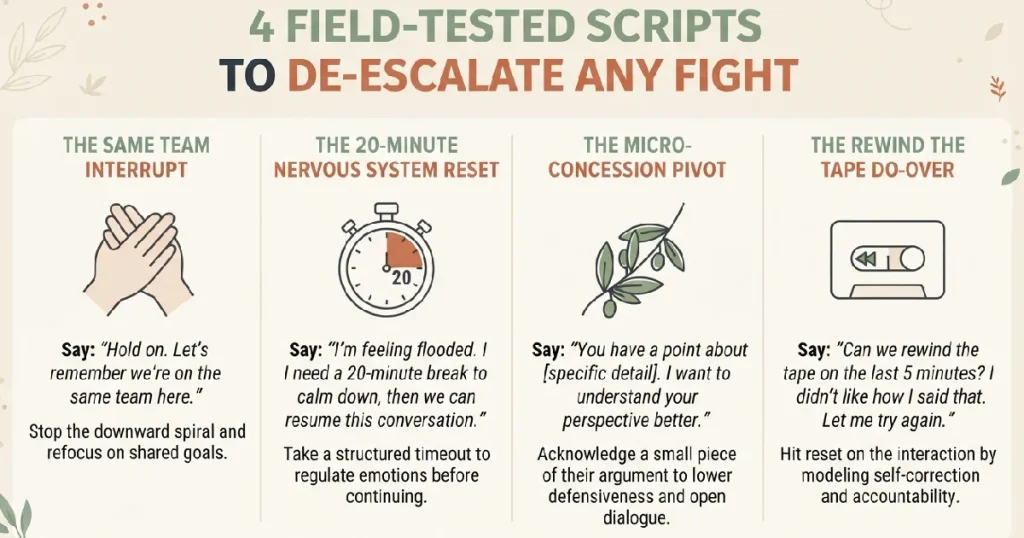
Knowing the psychology of conflict is helpful, yet finding the right phrases to calm an angry partner when your palms are sweating is much harder. Below are four practical strategies you can test the next time tension spikes in your hallway.
1. The “Same Team” Interrupt
A common pitfall we frequently see is couples treating the partner as the adversary rather than treating the disagreement as a shared puzzle. One place to begin is verbally reminding both of your nervous systems that you are allies who care about each other.
- Word-for-Word Script: “Hold on a second. I love you, and I hate how sharp we are getting with each other right now. We are on the same team, so let’s slow this down.”
- Self-Reflection Prompt: Notice what shifts in your jaw and shoulders when you say the words “I love you” out loud in the middle of an irritation.
2. The 20-Minute Nervous System Reset
Because stress hormones take at least twenty minutes to clear your bloodstream, five-minute breathers rarely work. Consider testing a full twenty-to-thirty-minute pause where you soothe your body with a brisk walk, music, or cold water rather than mentally rehearsing your closing argument.
- Word-for-Word Script: “My heart is pounding and I am about to say things I do not mean. I need twenty-five minutes to cool off so I can hear you properly. I will come back into the living room at 7:45 so we can figure this out.”
- The Pursuer Edge Case: What if your spouse hates pauses and follows you from room to room demanding to settle the score right now? Stay grounded, keep your voice soft, and repeat a calm boundary: “I promise I am not brushing you off. You matter to me, and I can give you my real attention in twenty minutes. Please give me that window so I do not make this worse.”
3. The Micro-Concession Pivot
When a disagreement stalls in a stubborn deadlock, offering a small piece of honest agreement breaks the stalemate immediately. Look for the single grain of truth inside your partner’s frustration and shine a spotlight on it.
- Word-for-Word Script: “You have a fair point about how distracted I have been on my phone after dinner this week. Help me understand what would feel most supportive to you tonight.”
- Self-Reflection Prompt: Ask yourself what specific piece of your partner’s complaint makes sense if you view the past forty-eight hours through their eyes.
4. The “Rewind the Tape” Do-Over
You never have to ride a bad conversation all the way to the bottom of the hill. When a talk starts with a tired snap at the front door, consider testing an immediate mulligan within the first ninety seconds.
- Word-for-Word Script: “Wait, I walked in hot and dumped my workday stress straight onto you. Can we rewind the tape two minutes and let me try walking through that front door again?”
- Self-Reflection Prompt: Pay attention to how quickly warmth or a shared laugh returns to the room when you ask for a clean start without blaming anyone else.
Frequently Asked Questions
How do you de-escalate an argument with someone who wants to fight?
Drop the rope by keeping your voice low and using brief, neutral phrases like, “I hear that you are upset.” Skip defending yourself against baiting comments. If hostility continues, calmly state that you will gladly talk once the tone feels respectful, then leave the room.
Why do I freeze or cry when an argument gets loud?
Freezing or crying is an automatic nervous system reflex when conflict feels overwhelming or unsafe. Your brain hits the emergency brakes once adrenaline spikes. Tell your partner during a calm moment that tears signal physical overload, meaning you need a twenty-minute breather before continuing.
How long should you wait to talk after a big fight?
Wait at least twenty minutes for stress hormones to clear your bloodstream, and no longer than twenty-four hours so distance does not harden. Before restarting the conversation, ask a simple check-in question: “Are we both ready to talk this through as teammates?”
Choosing Connection Over Winning the Point
The next time you find yourself standing by the kitchen sink at 9:00 PM and feel that familiar heat rising in your throat, you do not have to let adrenaline write the script. You now have a clear mental map to spot the 100-beat-per-minute warning signs, soften your posture, and offer a grounded repair phrase before the walls go up. Catching a spiral early takes practice, and even the healthiest couples miss the off-ramp on exhausted weeknights. Lasting peace in a marriage grows from how quickly you choose each other over winning the argument.
My Closing Remarks
If you grew up in a home where arguments meant slamming doors or days of icy silence, staying steady during conflict feels like learning a second language. Give yourself grace when you slip back into old habits on exhausting Tuesdays. Even catching yourself halfway through a sharp sentence and saying, “Hold on, let me try that softer,” changes the entire emotional climate of your home. You are building safety one pause at a time.
More Related Stories for You
- Curious why one of you wants to talk things out immediately while the other needs space to breathe? Explore how different attachment styles shape conflict and closeness in relationships to understand your partner’s hidden triggers.
About The Author