
 Sara Carmen

Why does your best help sometimes land wrong, and what do wives who get it right do differently?
Key Takeaways
- How to Be a Supportive Wife starts with a question most couples never say out loud: “Do you want me to fix it, sit with you, or give you space?”
- Research on “invisible support” suggests the most helpful things you do may be the ones he barely notices.
- The first three minutes of a tough conversation can predict how the whole talk ends.
How to be a supportive wife means learning what kind of help your husband actually wants, responding to his small daily bids for connection, backing his goals without managing them, keeping your own identity strong, and repairing arguments quickly. Support works best when it is specific, mutual, and matched to his stress.
Contents
Table of Contents
You hear his keys hit the counter and you already know. His shoulders are up, his jaw is tight, and his phone is back in his hand. You ask about his day, he says “fine,” and ten minutes later you are both annoyed without knowing why.
Most of us have stood in that kitchen. You want to help, but asking too much sounds like nagging and asking too little looks like you don’t care. So you guess, and guessing is where the friction starts.
Here is the mechanism underneath. People handle stress differently: some want solutions, some want company, and some need quiet before they can speak. When a wife offers the wrong kind of help, even with loving intent, it can land as pressure or as distance.
This guide shows how to be a supportive wife in ways that fit the man you actually married. You will find five practices, four scripts to try this week, and a few honest limits on what support should cost you.
How Can a Wife Support Her Husband When He Is Stressed?
The wives who seem to get this right share one habit: they stop guessing. A common pitfall we see is a loving woman who becomes a brilliant problem solver for a man who only wanted a listener.
Secret 1: Ask Which Kind of Help He Wants
Support comes in at least three forms. Fixing means advice and practical help. Company means listening or simply sitting nearby. Space means leaving him alone for a set amount of time.
Picture a composite couple, Dana and Marcus. After a brutal work week, Dana laid out a five-step plan over dinner. Marcus went quiet, Dana felt shut out, and the chill lasted two days. Once they started asking “fix, sit, or space?” the same kind of bad Tuesday settled in about ten minutes.
Offer the choice once, then wait. If he picks space, attach a time to it, like “Can we check in at eight?” A time limit keeps space from feeling like distance.
Secret 2: Answer His Small Bids for Connection
Psychologist John Gottman calls tiny attempts at attention “bids.” A sigh, a joke, or a “look at this” about a bird on the fence all count. In his research, couples who stayed married turned toward each other’s bids about 86% of the time, while couples who later divorced did so only 33% of the time (Gottman & Silver, 1999).
Each answered bid tells him he matters. Gottman describes these small moments as deposits in an emotional bank account that a marriage draws on when times get hard.
You don’t need a stopwatch. Try catching three bids a day. In our experience, a quick “Give me two minutes, then tell me everything” still counts as turning toward.
How Does a Wife Support Her Husband Without Becoming His Manager?

Support has a tricky cousin called over-functioning. It looks like reminding, researching, scheduling, and rescuing, and it usually grows out of love. It also tends to leave one spouse tired and the other quietly resentful.
Secret 3: Make Some of Your Help Invisible
A well-known study of couples where one partner was preparing for the bar exam found something surprising. When the stressed partner noticed the help, it sometimes came with an emotional cost. When the helper gave support the partner did not register, anxiety and low mood dropped (Bolger et al., 2000).
Invisible help looks like making the dentist call, guarding his Saturday morning, or setting a plate by his desk during deadline week without a speech about it.
There is a trade-off. If he never learns what you did, resentment can build on your side. Mention it once, lightly, and keep no scorecard.
Secret 4: Back His Goals and Keep Your Own Life Full
When he names a goal, ask what would make it easier, then wait for his answer. He owns the project. You are the person in his corner.
A pattern we often see is a wife who slowly becomes the family’s only emotional support, drops her friendships, and then burns out. Keeping your own friends, work, and interests protects the marriage from that slow squeeze. It also gives him a wife with stories to tell.
One firm limit matters here. If he is controlling, belittles you, or makes you afraid, being supportive does not mean absorbing it. A licensed counselor can help, and the National Domestic Violence Hotline (1-800-799-7233) is open around the clock.
How Can a Wife Help Her Husband During Arguments?
Secret 5: Start Soft and Repair Fast
Gottman found that the first three minutes of a 15-minute disagreement predicted how it would end about 96% of the time (Gottman & Silver, 1999). A harsh opening, like “You never help around here,” puts him on defense before he even hears the request.
A soft start names the situation, your feeling, and one clear need. It sounds like “I felt overwhelmed by the dishes tonight. Could we split them after dinner?”
When voices rise, call a pause. Gottman’s research on “flooding” suggests at least 20 minutes for the body to settle, so say when you will come back. Keeping that promise matters as much as the break.
A clumsy repair attempt helps too, like “Can I start that over?” Gottman ranks the success of these attempts among the strongest signs of a lasting marriage.
How to Be a Supportive Wife This Week: Four Strategies to Try
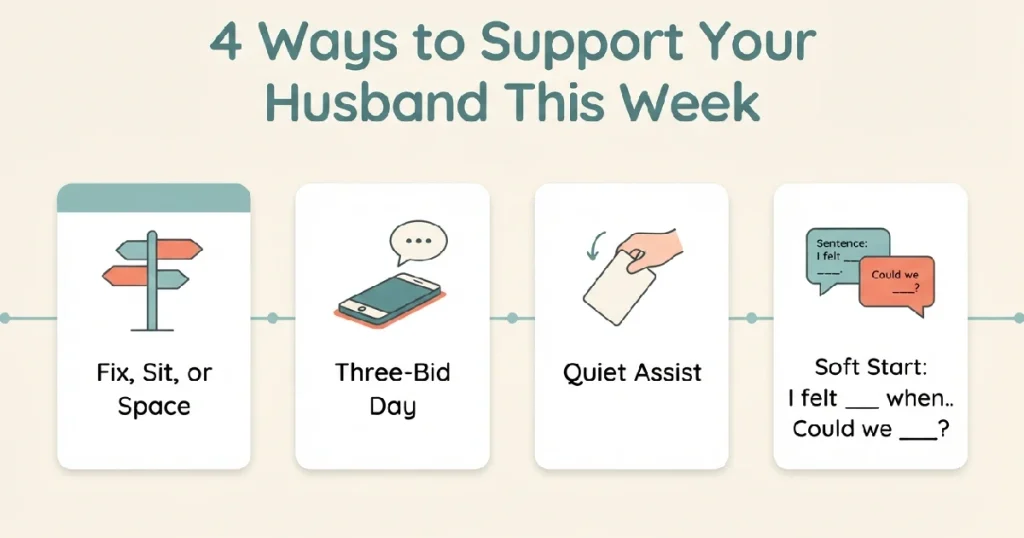
One place to begin is a single script. Pick the one that feels least awkward and give it a week.
1. The Fix, Sit, or Space Check-In
Say: “I can tell today was heavy. Do you want me to help fix something, sit with you, or give you space?” Then ask yourself: “Which of the three do I offer by default, and is it the one he wants?” Invite him to ask you the same question.
2. The Three-Bid Day
Consider testing this: when he says “Look at this,” set your phone face down and try, “Show me. What caught your eye?” Notice what shifts in his mood by Friday.
3. The Quiet Assist
Choose one task each week to lift off his plate without announcing it. A prompt to try: “What is draining him right now that I could handle by Friday?” If you later want a fair trade, you might say, “I took care of the insurance call. Could you cover Thursday’s pickup?”
4. The Soft Start Sentence
Write your next complaint in this shape first: “I felt ___ when ___. Could we ___?” For example, “I felt lonely when we ate dinner on our phones. Could we try twenty screen-free minutes tonight?” Reading it aloud once before you speak takes about ten seconds.
Frequently Asked Questions
What does a supportive wife do every day?
She answers small bids, asks what kind of help he wants, and handles a few things quietly. Daily support is mostly tiny moments of attention, like a real hello at the door.
How can I support my husband if he will not open up?
Offer company without questions, like a walk or a drive. Some people open up more side by side than face to face, so give it a few weeks before judging the results.
Is it okay to feel unsupported myself?
Yes. Support works best when it runs both ways, so use a soft start to name what you need. If asking repeatedly changes nothing, a couples counselor can help.
Go back to that kitchen. Keys on the counter, shoulders up, phone in hand. This time you do not guess. You ask, “Fix, sit, or space?” and he says, “Sit.”
You pour two glasses of water and say nothing clever. Ten minutes later, his shoulders drop. That is how to be a supportive wife on a real Tuesday in a real kitchen.
You do not have to be perfect to be the person he is glad to come home to.
My Closing Remarks
I have sat with many wives who believed being supportive meant giving until nothing was left. It never did. Pick the smallest script above and try it this week, knowing it may feel clumsy at first. That is normal. And if you are the one who needs holding right now, say so out loud. A good marriage has room for both of you to be supported.
More Related Stories for You
Want something lighter after all that heart work? Read these funny father wedding speeches that prove love and laughter belong together.
About The Author