


Why “just turn it off” fails, and what brain science says actually works to pull kids back into the real world.
Key Points
- Screen-free family activities fail when they offer less stimulation than the device they replace. The fix is matching the reward intensity, not just removing the screen.
- Your stress level, not your child’s willpower, is the single biggest predictor of unplanned screen time. Protecting your energy is part of the strategy.
- The 25 ideas below are organized by psychological mechanism, from competitive tournament loops to zero-prep survival games, so you can match the activity to your child’s current brain state.
Contents
Table of Contents
The Problem Nobody Names
We’ve all been there. You announce a screen-free afternoon with the confidence of someone who has read one too many parenting books. Within forty minutes, someone is crying. It might be your child. It might be you.
You’ve tried the coloring books. You’ve tried “go play outside.” You’ve tried the board games that felt magical in your own childhood and now sit untouched while your kid watches a stranger open surprise eggs on a tablet. The guilt sits heavy. You know the screens are too much. You also know that every attempt to pull them away turns your home into a negotiation you never signed up for.
Someone might think you just need stricter limits and better follow-through. But what they don’t see is that your child’s brain has been calibrated by algorithms to expect a fresh reward every few seconds. A crayon cannot compete with that. Someone might think screen-free family activities just require more parental effort and creativity. But what they don’t see is that you’re already running on empty, and the energy required to entertain three kids of different ages without a screen is energy you spent hours ago.
But here’s what nobody tells you about screen-free weekends. The failure isn’t your child’s. It’s the activity’s.
Why “Just Turn It Off” Backfires
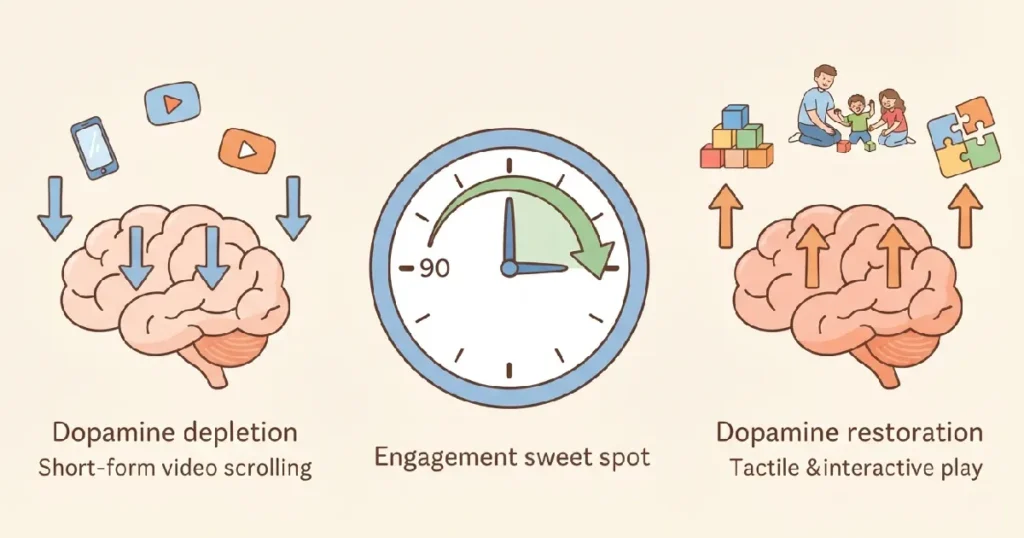
The core issue isn’t willpower, yours or your child’s. It’s neurochemistry. When kids consume short-form video content, their brains receive rapid-fire hits of dopamine, the neurotransmitter that drives motivation and reward-seeking. Research on short-form video consumption and students’ attention spans shows that high-frequency viewing significantly predicts poorer sustained attention and weaker executive control (the brain’s ability to plan, focus, and resist impulses), even after accounting for total screen time. In plain terms, the problem isn’t how long your child stares at a screen. It’s that the rapid-reward format recalibrates their brain to expect constant novelty.
When you hand a dopamine-depleted kid a coloring sheet and say “have fun,” you’re offering a single drop of water to someone stumbling out of a desert. The gesture is kind. The dose is wrong.
Maya, a mother of three I worked with last year, tried what she called a “clean weekend.” No screens from Friday night to Sunday evening. By Saturday at noon, her seven-year-old was lying face-down on the kitchen floor, her eleven-year-old had retreated to his room in protest, and her four-year-old was pulling at Maya’s leg every ninety seconds. Maya told me she felt like a failure. She wasn’t. She was using the right tool at the wrong dosage.
Here’s the short version. You don’t beat screens by banning them. You beat them by offering offline family activities that deliver the same things algorithms do, clear rules, fast feedback, visible progress, competitive stakes, but through physical, tactile, shared play. The screen loses not when it’s forbidden but when it’s outmatched.
The American Academy of Pediatrics built its 5 Cs of Media Use framework around exactly this principle. One of those five Cs is “Crowding Out,” the idea that strong offline experiences naturally displace screen time rather than fighting it head-on. You stop policing minutes and start producing better alternatives.
Beyond the Glare: Why Your Family Activities Need a Reset
The 5 Cs of Media Use: Moving Away from Arbitrary Time Limits
The old playbook was simple. Count minutes and enforce limits. That playbook is broken. The AAP’s current guidance, updated this year, moves away from rigid time caps and toward quality, context, and conversation. The 5 Cs framework (Child, Content, Calm, Crowding Out, Communication) asks you to consider whether media is crowding out sleep, physical play, and family connection rather than obsessing over a stopwatch.
This matters because when you become the minute-counting gatekeeper, your child experiences you as the obstacle between them and something they want. Every restriction becomes a battle. The shift is from gatekeeper to director. You stop policing screen time and start producing offline alternatives that make the screen less appealing by comparison.
Understanding the Link Between Screen Use and Dopamine Depletion
Here’s the mechanism that changes how you plan offline time. Dopamine doesn’t just produce pleasure. It produces anticipation of reward. Short-form video platforms are engineered around variable reinforcement schedules, the same psychological principle that makes slot machines compelling. Each scroll delivers a possible reward, and the unpredictability keeps the brain locked in. As research on how technology affects attention spans across age groups demonstrates, this rapid-reward format operates on the same dopamine-driven feedback loops that underlie addictive behaviors.
When that loop runs for hours, baseline dopamine signaling drops. The brain adjusts downward. Now ordinary activities, the ones that used to captivate kids for an hour, feel flat. Boring. Almost painful. This is why a child who once built Lego cities for two hours now can’t sit with a puzzle for ten minutes. Their attention threshold has been shifted, not by character weakness but by neurochemical adaptation.
Most parents in this situation don’t realize that the boredom and resistance they see isn’t defiance. It’s withdrawal. And like any recalibration, it needs structured, high-intensity input to reset.
Left unexamined, this cycle doesn’t just steal one afternoon. It quietly becomes the default operating mode of your household, where screens are the only thing that works and everything else feels like a fight. That’s where the 25 ideas below come in, organized by the exact psychological mechanism each one activates.
High-Agency Family Activities: Competing with Algorithmic Dopamine Loops
Establishing a Championship Protocol: Leaderboards and Written Rules
The first category of family activities borrows directly from video game design. Games hold attention through clear rules, visible scorekeeping, and progressive difficulty. You can replicate all three offline. The key is structure, not just “go play.” Post a scoreboard on the wall. Write the rules on paper. Time everything. When kids see a leaderboard with their names on it, the competitive urgency kicks in.
- Floor Is Lava: Hardcore Edition. Mark safe zones with painter’s tape on furniture and floor tiles. Add a physical timer and a player-made “resource deck” of index cards that forces kids to trade items to survive cross-room journeys.
- The Household Taskmaster Championship. One parent acts as the whimsical Judge. Kids receive bizarre timed challenges on hidden cards (“Build the most intimidating sculpture from raw vegetables in four minutes”). Points go on a visible wall leaderboard.
- The Indoor Blind Obstacle Course. Arrange cushions, chairs, and boxes across a room. Blindfold one child while a sibling or parent guides them using only code words (“Alpha” for left, “Beta” for right). Swap roles and race the clock.
- Real-Life Mystery Room Escape. Lock a prized item (the weekend dessert or a board game) inside a box with a 3-digit luggage lock. Hide three riddle clues around the house requiring counting, basic math, or backward-written notes to crack the combination.
- The Balloon Volley-Grand Prix. String yarn across a cleared hallway at waist height as a net. Play volleyball with a balloon, but players must stay on their knees or use only their non-dominant hands to score points.
- The Family Board Game Dictator Night. Take a game everyone knows. Hand kids a blank sheet to invent three custom “Chaos Rules” for the session (“If you draw a red card, speak in an accent for two turns”). The novelty resets engagement with a game they’d otherwise dismiss.
Resource Management Games: Immersive Simulations for Tweens and Teens
Older kids who live in Minecraft and Roblox worlds respond to construction, resource allocation, and milestone tracking. These activities scratch the same itch without a screen.
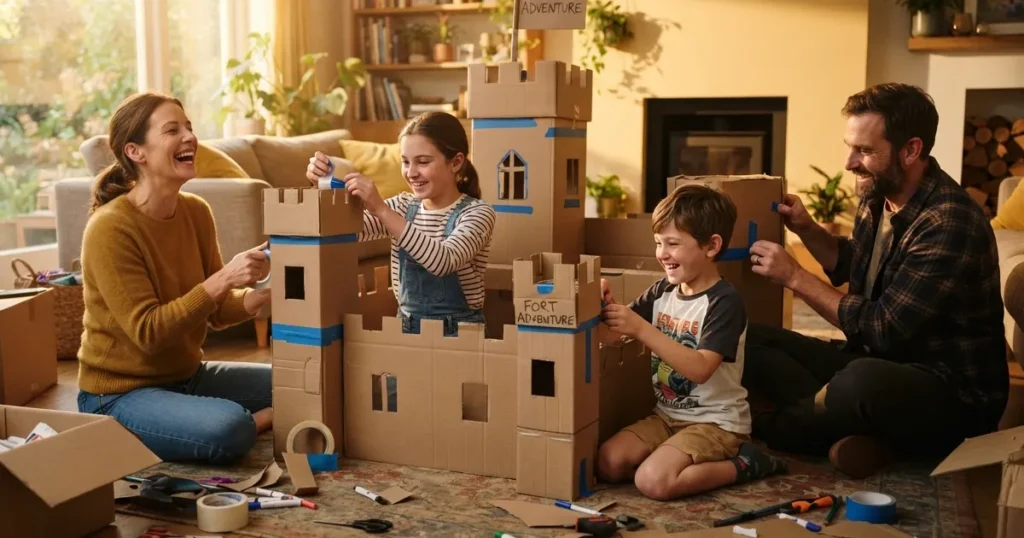
- The 3D Cardboard Architecture Studio. Gather shipping boxes, toilet paper rolls, masking tape, and markers. Give a specific design prompt: “Build a multi-level fortress that safely holds a heavy shoe on top.” The constraint is what makes it absorbing.
- The Living Room Pillow-Fort Ecosystem. Build a fort with blankets, heavy books, chairs, and cushions, but it must have designated rooms (a reading pod, a supply cache, an entry tunnel) and stand independently for at least sixty minutes.
- The Miniature Toy Stop-Motion Layout. Set up an action figure or toy brick scene on a table. Instead of animating with a phone, kids create a physical flipbook or drawn comic panels predicting how the toy battle unfolds frame by frame.
Low-Stress, Zero-Prep Screen Free Family Activities for Exhausted Parents
High-Energy Verbal Showdowns: Reverse Charades and Family Debates
A 2026 study from Florida International University’s Center for Children and Families surveyed 822 caregivers and found that elevated parenting stress directly correlates with unplanned spikes in children’s screen use. The researchers’ message was clear. Supporting caregivers matters as much as setting rules for children. When you’re depleted, you reach for the tablet. That’s not failure. That’s survival.
These six activities require zero supplies, zero preparation, and minimal parental energy. You can launch them from the couch.
- Reverse Physical Charades. Three family members silently act out a complex scene together (“Surviving a shipwreck”) while only one person guesses. The group dynamic makes it louder and funnier than standard charades.
- The Ridiculous Family Debate Court. Arrange chairs like a courtroom. One parent is the Judge with a wooden spoon gavel. Assign absurd topics (“Should cereal be legally classified as soup?”). Each side gets sixty seconds to present evidence.
- The Freeze-Dance DJ Challenge. One child controls the pause button on a music playlist with their back turned. When the music stops, anyone caught moving must do five jumping jacks to re-enter.
- The Alphabetical Scavenger Race. Sit on the couch. Call out random letters. Kids sprint to find an object starting with that letter and bring it back. First one back wins the point.
- The Memory Mirror Duplication. Face your child. Perform a sequence of four rapid movements (clap, spin, touch left ear, jump). They must mirror it perfectly. Add one move each round until someone breaks.
- The Silent “Don’t Laugh” Eye-Contact Showdown. Sit knee-to-knee with your child. Set a two-minute timer. Maintain eye contact with no talking or touching. First to crack a smile loses a point.
The 90-Minute Rule: Structuring Offline Play to Prevent Burnout
Most families who attempt all-day screen-free weekends end up exactly where you do. Exhausted and arguing by mid-afternoon. Engagement tracking shows that family group energy sharply declines after about ninety minutes of continuous offline activity.
The solution is the 90-Minute Rule. Structure your family activities into tight, high-intensity blocks. Start strong, play hard, and stop while everyone is still having fun. Ending at the peak of momentum, rather than dragging on until boredom sets in, makes kids associate offline time with excitement rather than exhaustion. They’ll look forward to the next block instead of dreading an open-ended screen-free marathon. That shift also makes the age-gap problem solvable.
Tactile Family Activities and Multi-Age Play to Rebuild Attention Spans
Research on the benefits of play in cognitive development confirms that play strengthens neural connections, builds executive function, and releases connection-forming chemicals like dopamine and oxytocin. Tactile, open-ended play is the natural antidote to screen fatigue because it rebuilds attention capacity through physical engagement rather than passive consumption.
Giant Collaborative Floor Art and Audio-Build Studios
- The Giant Comic Strip Roll. Roll butcher paper across the hallway floor. Divide it into ten massive panels. The family builds one continuous story, with each person drawing the next panel and passing the narrative along.
- Audio-Book Clay Lab. Lay down a plastic tablecloth and supply air-dry modeling clay. Play a high-production audio drama or adventure audiobook. Everyone sculpts characters or items inspired by what they hear in real time, combining narrative listening with fine-motor work. For reluctant readers, this audio-plus-hands approach removes the pressure of decoding text while still building comprehension and cognitive flexibility.
Memory Makers: Scrapbooking Real-World Textures and Ephemera
- Real-World Texture Scrapbooking. Give each child a small notebook and glue stick. Send them on a “Texture Hunt” to collect non-living artifacts (tree bark, smooth pebbles, fallen petals, unique wrappers). They compile these into a sensory catalog with invented names for each specimen. The tactile variety engages sensory processing pathways that screens never touch.
Multi-Age Magic: How to Handle Toddlers and Teenagers Simultaneously
The hardest part of family activities isn’t the activity itself. It’s the age gap. A four-year-old and a fourteen-year-old want different things, and forcing them into the same game usually ends with the teen sulking and the toddler melting down. The solution is asymmetric role design, where each age gets a role calibrated to their ability and interest. The teenager gets demanding tasks and autonomy. The little one gets movement and sensory input. Nobody feels babied or bored.
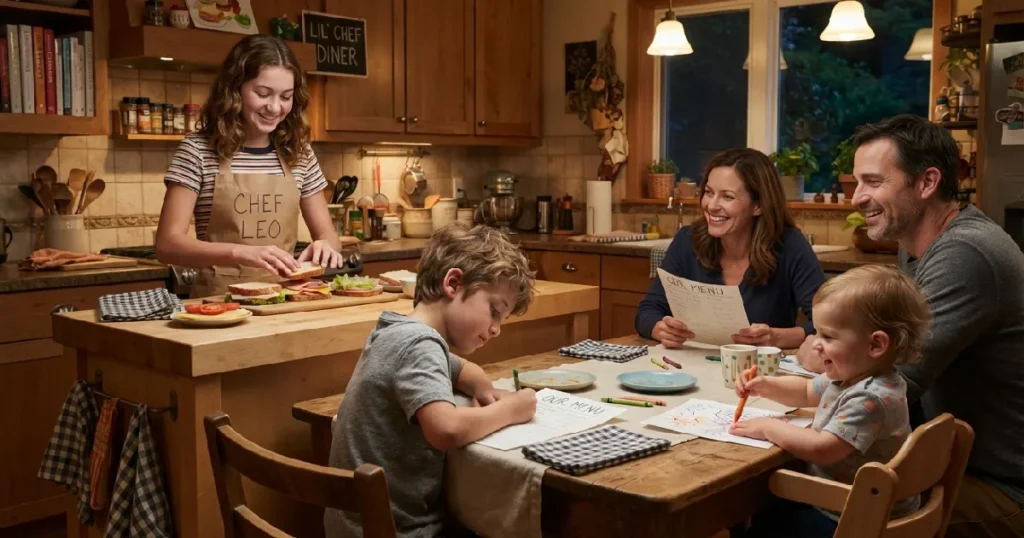
- The Family Restaurant Simulation. Turn your kitchen into a fictional five-star restaurant. The teenager is Head Chef (handling safe cooking or assembly), the school-age kid is Waiter (writing menus, taking orders), and the toddler is Food Critic (tasting ingredients and coloring the menus).
- The Backyard Biosphere Exploration. Head outside with a magnifying glass and notepad. The teenager is “Lead Scientist,” mapping a one-meter grid of grass or dirt. Younger kids are “Field Scouts,” finding unique insects, plants, or rocks to report for cataloging.
- The Living Room Runway Fashion Show. Pull out old coats, funny hats, and scarves. The teenager is the Fashion Designer and DJ, styling younger siblings and picking walk-up music. Younger kids walk the runway while parents score them on creativity.
- The Giant Puzzle Speed Run. Dump a 300-to-500-piece jigsaw on a table. Toddlers hunt for pieces of one bright color. School-age kids sort the edge pieces. Teens and parents collaborate on structural assembly.
- The Radio Play Voice-Acting Studio. Pick a story everyone knows. The teenager is Director and Narrator, reading aloud. Younger siblings get sound-effect roles using household items (crinkling paper for fire, tapping cups for horse hooves).
- The Mega Card-Tower Engineering Project. Open three or four decks of playing cards. Teens build complex triangular structural bases. Younger children act as the “Supply Line,” sorting cards by suit and carefully handing them to the builders.
- The Family Capsule Time-Vault. Find an old jar or shoebox. Every family member contributes one item representing their current life phase (a teen writes favorite song lyrics, a younger child includes a drawing, a toddler adds a handprint). Seal it together and hide it deep in a closet.
Putting It Into Practice: The Now What?
You don’t need to run all twenty-five activities this weekend. That would be its own form of burnout. Here are three ways to start small and build momentum.
The No-Phone Zone Charging Station. Designate a visible spot in your home where all family devices, yours included, go during activity time. Frame it as a charging station rather than a confiscation point. You’re not taking phones away. You’re giving your family a space where phones rest so people don’t have to. The positioning matters. You are the director of an event, not the enforcer of a ban.
The 90-Minute Block Calendar. Pick one block this week. Ninety minutes. Choose two or three activities from the list above and write them on paper your kids can see. Post the start time. When the block ends, stop. Even if they’re begging for more. Especially if they’re begging for more. The desire for “one more round” is the signal that you’ve won.
The Parental Energy Audit. Before choosing activities, check your own battery. If you’re at a three out of ten, pick from the Zero-Prep category. If you’re at an eight, go for the Championship Protocol. Matching the activity to your energy level is not cutting corners. It’s the strategy the research supports. The FIU study found that caregiver stress, not child behavior, is what most reliably predicts screen-time lapses. Protecting your energy isn’t selfish. It’s the mechanics of making this work.
A useful question to ask yourself before each block: “Am I producing an event or policing a rule?” If the answer is policing, switch categories until you find something you genuinely want to join.
The Close
Maya came back the following month with a different report. She hadn’t attempted a full screen-free weekend. Instead, she ran one ninety-minute block on Saturday morning. She posted a leaderboard on the fridge, picked two tournament games, and ended the session while her kids were mid-argument about who had actually won. Her seven-year-old asked when the next one was before lunch was over.
That’s the shift. You stop trying to replace the screen and start building something the screen can’t offer. Physical stakes. Shared laughter. The specific pride of winning a game you made up together. The desert doesn’t end because you took away the water bottle. It ends because you found something worth drinking.
The screen was never the enemy. The emptiness it filled was.
My Closing Remarks
I’ll be honest with you. Writing this hit a nerve because I lived it. My own daughter was seven when I caught myself handing her the phone just to finish a work email, then feeling the guilt crawl up my spine for the rest of the afternoon. The turning point wasn’t a grand parenting overhaul. It was one Saturday, one timer, one ridiculous vegetable-sculpting contest that ended with us laughing so hard we forgot the phone existed. That’s the whole secret. Not perfection. Just one good block at a time.
More Related Stories for You
- Understanding your child’s social and emotional development starts with the kind of play that builds connection, not just distraction.