
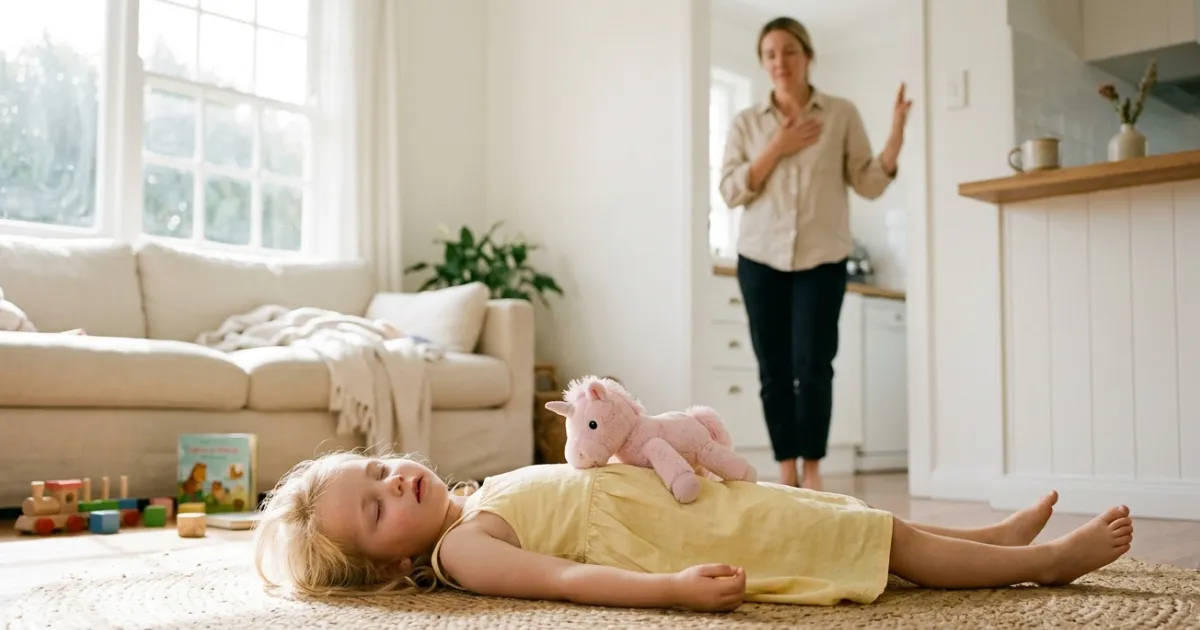

Let me say something that might make you uncomfortable.
If the only time you reach for breathing exercises is when your preschooler is mid-meltdown on the kitchen floor, you are setting yourself up for failure. Not because you are a bad parent. Not because the technique is wrong. But because you have been handed a tool without the instruction manual.
Here is a scene you probably know: Your three-year-old is screaming. Their face is red. Their tiny fists are clenched. You kneel beside them and say, in your calmest voice, “Take a deep breath, sweetie.”
They scream louder.
You try again. “Just breathe with me, okay?”
Now they are thrashing. And you are left wondering why the internet’s favorite calm-down strategy just made everything ten times worse. You feel helpless. Maybe a little embarrassed. Maybe a lot frustrated.
Here is the hard truth almost nobody talks about: mindfulness breathing for preschoolers is not about what technique you choose. It is about when you teach it. When a child is in full fight-or-flight mode, their brain has literally gone offline. The thinking part, the rational part, the part that can hear you and follow instructions. It is not available.
Actually, let me back up. This is not your fault. Every list article online shows you the what: five cute breathing exercises with names like Dragon Breath and Flower Breath. Nobody shows you the crucial when and how that determines whether any technique succeeds or collapses.
In this guide, you will learn the single most important principle that child development research has uncovered about teaching emotional regulation to young children. You will get a specific technique (just one, because you do not need forty-seven options), a five-step plan you can start tomorrow, and the neuroscience behind why it all works. No fluff. No academic jargon. Just what actually helps.
What Mindfulness Breathing for Preschoolers Really Means
It Is Not What You Think
Mindfulness breathing is not simply asking a small child to “take a deep breath.” If you have tried that, you already know it lands somewhere between confusing and infuriating for them.
Table of Contents
For a preschooler, mindfulness breathing means teaching simple, play-based diaphragmatic breathing in a way their developing brain can actually absorb. Diaphragmatic breathing, often called belly breathing, is the physiological opposite of the shallow chest breathing we slip into when stressed. It engages the diaphragm fully, pulling air deep into the lungs, which triggers a cascade of calming signals throughout the body.
The distinction matters because most young children do not know how to breathe deeply on command. They have no anatomical awareness. Telling them to “breathe from your belly” is like telling them to “rotate your scapula.” It means nothing. They need something they can see, touch, and play with.
This is where the bigger picture comes in. Mindfulness-based interventions for young children are part of what educators call social-emotional learning, or SEL. When breathing practices are woven into SEL, children learn to recognize what is happening inside their bodies, name their emotions, and develop the self-regulation skills that predict everything from academic success to healthier relationships later in life.
And there is a developmental reason preschoolers need their own approach. The prefrontal cortex, the part of the brain responsible for reasoning, impulse control, and emotional regulation, is still under heavy construction during ages three to five.
As neuroscientist Dr. Richard Davidson explains, “One of the things that happens in human development is that the prefrontal cortex matures as we get older. But in preschoolers, where the prefrontal cortex is not so developed, they’re not worrying about tomorrow. Their future is maybe three minutes from now.”
What this means for you: abstract instructions like “notice your breath” or “focus on the sensation of air moving through your nostrils” are biologically inappropriate for a four-year-old. Their brain is not wired for that kind of metacognition yet. Imagination, however, is their native language. Play is the doorway.
The Science Behind the Calm
When a child becomes anxious, angry, or overwhelmed, their body enters what scientists call sympathetic arousal. You know it as fight-or-flight. Stress hormones flood their system. Their heart pounds. Their breathing becomes shallow and rapid. Less oxygen reaches their brain. They are not thinking clearly because, biologically, they cannot think clearly. The thinking brain has been temporarily disconnected.
Breathwork flips this switch. Slow, diaphragmatic breathing directly activates the parasympathetic nervous system through the vagus nerve, a major cranial nerve that runs from the brainstem down through the body. Belly breathing stimulates the vagus nerve, which signals the body that it is safe to relax, lowering heart rate, reducing cortisol levels, and restoring the brain’s ability to reason. This is not a metaphor. It is measurable physiology.
Research confirms this repeatedly. Studies have shown that controlled, diaphragmatic breathing lowers cortisol levels, slows heart rate, and stabilizes emotions in children. Breathing practices were the most commonly used formal mindfulness technique among early childhood educators, with 89% reporting they used them with young children. A 2025 study published in JMIR found that post-intervention data suggests breath-focused mindfulness training may indicate cortical plasticity reflecting reduced mind-wandering and enhanced focus over time.
In plain English: teaching a child to belly breathe is not just a nice idea. It physically rewires how their nervous system responds to stress.
The Calm-First Protocol: Your Five-Step Plan
Here is where nearly every article on this topic goes wrong. They hand you a list of breathing exercises and send you on your way. They skip the one variable that decides whether those exercises actually work: timing.
When a child has reached peak emotional elevation, their brain cannot learn anything new. Asking them to breathe, or teaching them a breathing technique during a breakdown, is a losing battle. Instead, you need to build the skill during peaceful moments, when their brain is available for learning, and then, only then, bridge it into stressful moments later.
This is the Calm-First Protocol. It is the framework that changes everything.
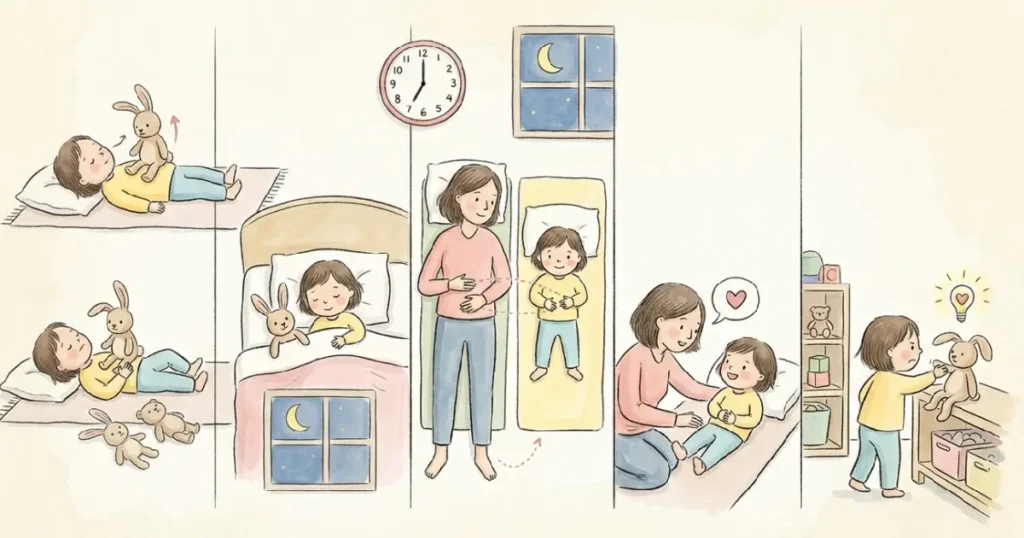
Step 1: Choose Your Hero Technique (The Belly Buddy Method)
Forget the list of ten exercises. You need exactly one, and it needs to work with how a preschooler’s brain actually operates.
Here is the technique: have your child lie on their back and place a small stuffed animal on their belly. That is it. The goal is to make the stuffed animal rise on the inhale and fall on the exhale. You frame it as a game: “Can you give Teddy a ride? Up goes Teddy. Down goes Teddy.”
This method works because it turns an invisible internal action into something concrete and visible. The child does not have to understand “diaphragmatic breathing.” They just need to watch Teddy move. The prop provides proprioceptive feedback, a gentle weight on the belly that helps their body learn the motion. It engages imagination, which, as I said, is the native cognitive language of a three-to-five-year-old.
Do This: Place the Belly Buddy and make it playful. “Can you make Teddy sleep by breathing so slowly he barely moves?” Lie beside them. Make it a shared activity.
Not That: Do not stand over the child and instruct them to “breathe deeply.” Without a physical prop, they have no reference point. The instruction is meaningless.
Step 2: Build the Practice Into a Calm Daily Ritual
Research shows that embedding mindfulness into daily routines strengthens emotional resilience in young children. The best windows for preschooler breathing practice are nap time, bedtime, the morning circle at school, or right after outdoor play, during that natural transition from high energy to stillness. These are the calmest, most predictable moments of the day.
Aim for two to three minutes, once per day, in the same place and at the same time. Consistency builds neural memory. The brain starts to associate that time and place with safety and regulation.
Do This: Pair Belly Buddy breathing with an existing routine. After brushing teeth at bedtime, every single night, you lie down together and do two minutes. It becomes as automatic as the toothbrushing itself.
Not That: Do not introduce the practice randomly, only when you need it. Behavioral learning requires contextual consistency. If the only time they see Teddy is during chaos, Teddy becomes a stress signal, not a safety signal.
Step 3: Model First. Become the Mirror.
Here is something fascinating that almost nobody in this space talks about: preschoolers learn breathing not by being instructed, but by watching and mirroring a calm adult.
This happens through mirror neurons, specialized brain cells that fire both when we perform an action and when we observe someone else performing the same action. Co-regulation develops through the use of mirror neurons, allowing calmness to transmit from person to person. When you lie beside your child and breathe slowly, visibly, audibly, their nervous system begins to match yours. Not because you told them to. Because their biology is designed to synchronize with yours.
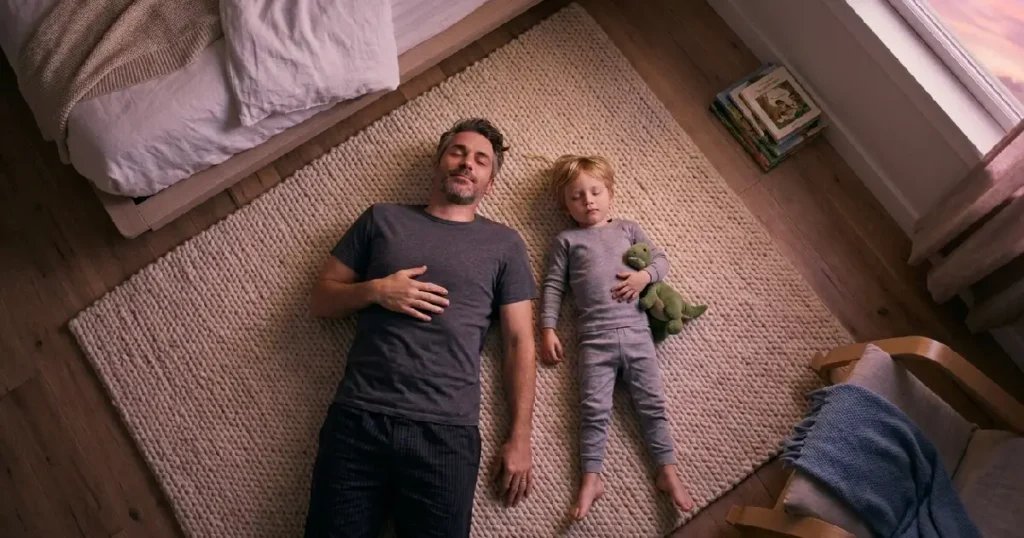
Do This: Lie down beside them. Place your own hand on your belly. Breathe visibly and slowly. Make your exhale audible, a soft “hhhhh” sound. Say nothing for the first thirty seconds. Let their mirror neurons do the work.
Not That: Do not stand over them giving verbal instructions while they are expected to perform. That is not co-regulation. That is a command.
Step 4: Name It, Claim It
Preschoolers are actively building their sense of self. When they learn they are “someone who knows how to calm down,” that identity becomes self-reinforcing. This is not woo-woo psychology. It is how self-concept develops in early childhood.
After each practice session, use identity-affirming language. Not “Good job calming down” (which praises the outcome). Instead: “Wow, you are getting so good at your belly breathing. You are really learning how to feel calm.”
Do This: Use process and identity praise after every single practice. “You are becoming a really good breather.” “Look at you, taking care of your body.”
Not That: Do not save your praise for moments when they successfully calm down from a tantrum. Affirm the practice, not just the performance.
Step 5: Bridge Into Stress Only After Seven to Ten Days
This is the sequencing secret. Only after the Belly Buddy practice has become a familiar, positive, pleasurable experience does it become retrievable under stress. The brain needs calm encoding before it can access the skill during chaos.
During your calm practice sessions, introduce a consistent cue: a simple phrase or gesture. Touching their tummy gently and saying “Belly Buddy time.” This cue becomes the on-ramp. Then, when a low-level frustration arises (not a full meltdown, but the early warning signs), use the exact same cue. Watch recognition light up in their face.
Do This: After a solid week of calm practice, try the cue during a minor frustration moment. “Hey, I think your belly could use a Buddy right now.”
Not That: Do not wait for a crisis to be the first context of use. And do not skip the calm practice phase. That phase is not optional. It is the entire foundation.
| Step | Calm-First Protocol (Do This) | Crisis-First Approach (Not That) |
|---|---|---|
| 1 | Belly Buddy with stuffed animal prop | “Just take a deep breath” with no visual |
| 2 | Daily ritual at a calm, predictable time | Only when the child is already dysregulated |
| 3 | Adult models breathing alongside the child | Adult instructs from above |
| 4 | Identity-affirming process praise | Outcome-only praise after meltdowns |
| 5 | Introduce during stress only after 7-10 days | First use is during a full meltdown |
Meet Lena: One Afternoon That Changed Everything

Lena taught preschool in a busy, under-resourced classroom in Cleveland. By two in the afternoon, the room was loud, the energy jagged, and at least one child was usually in tears. She had tried everything she had been trained to try. Star Breathing. Counting to ten. “Use your words.” Each technique fell apart the moment a child tipped into full dysregulation.
The turning point came on a Tuesday, right after lunch. It was the quietest stretch of her entire day. The kids were full and tired. The lights were dimmed. She had a bin of small stuffed bears intended for a counting activity. On a whim, she handed one to each child and asked them to lie on their mats. She lay down too. She placed her bear on her belly and breathed, slowly and audibly, without saying a single instruction.
For the first thirty seconds, nothing happened. Then one child placed her bear on her own belly. Then another. Within two minutes, seven four-year-olds were breathing in near-silence, eyes fixed on the tiny animals rising and falling on their stomachs.
Lena did this every single day after lunch for three weeks. She never explained it. She never made it a lesson. She just modeled it.
Then, one afternoon, a boy named Marcus got into a shoving match at the water table. His face was red, his jaw clenched. Before Lena could intervene, Marcus walked himself to his mat, picked up his bear, lay down, and began to breathe. He had not been told to. He had not been redirected. He had internalized a tool and used it, at age four, entirely on his own.
The goal was never just to teach breathing. The goal was to give a small child their first experience of being in control of how they feel. That is worth more than any behavioral chart, any sticker system, any lecture. That is freedom.
Mindfulness Breathing vs. Standard Calm-Down Strategies
Mindfulness Breathing vs. Counting to Ten
Counting to ten is a distraction strategy. It asks the child to shift their cognitive attention away from the feeling. Breathing is a physiological regulation strategy. It does not distract from the feeling, it actually changes what is happening inside the body.
For a preschooler, this difference is enormous. Counting to ten requires working memory and number recall, both of which are compromised under stress. Breathing requires only muscle memory, which, once built through practice, remains accessible even when the thinking brain goes offline.
The verdict: breathing is neurobiologically superior for children under five. It works with the body’s own calming mechanisms rather than attempting to override them with cognition.
Pro Tips and Tools for Immediate Implementation
- The Pinwheel Hack: Give your child a pinwheel and ask them to make it spin as slowly as possible. This creates instant visual biofeedback. They can see their breath’s force and duration in real time.
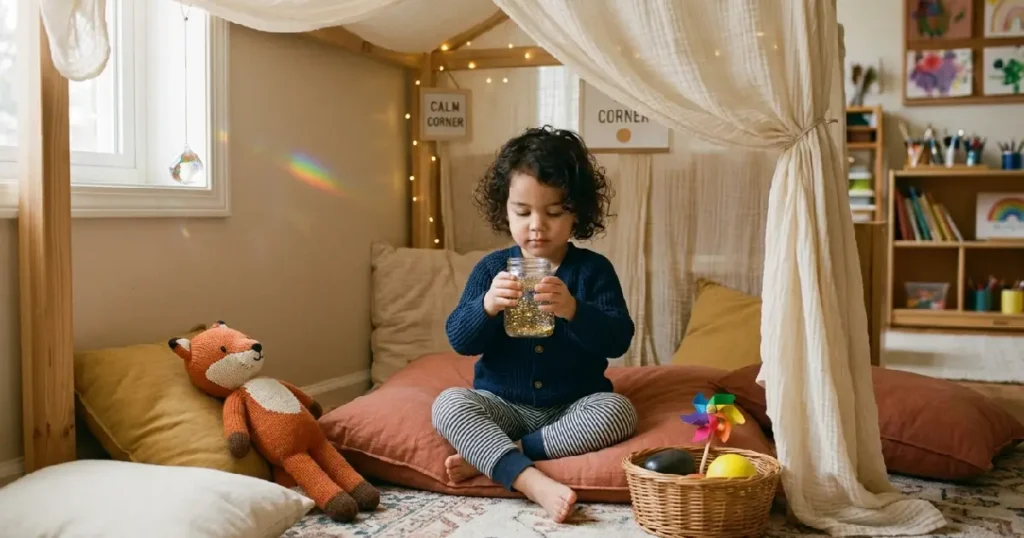
- The Glitter Jar Pairing: Fill a jar with water and glitter. Shake it. Have your child watch the glitter settle while they do their Belly Buddy breathing. The visual settling mirrors what is happening inside their nervous system.
- The Neurodivergent Adaptation: For children with ADHD or sensory processing differences, movement-based mindfulness that combines slow, rhythmic movements with breath awareness can send safety signals directly to the nervous system. Replace the generic stuffed animal with their favorite character, a dinosaur, a superhero, whatever they love. This is not a minor tweak. It is the difference between participation and refusal.
- The Breathing Corner: Whether in a classroom or at home, create a designated space with soft textures, a Belly Buddy, a glitter jar, maybe a pinwheel. This is not a time-out corner. It is a safe haven they choose to visit.
| Tool | Type | Best For |
|---|---|---|
| Small stuffed animal | Physical prop | Belly Buddy breathing |
| Pinwheel | Visual biofeedback | Extended exhale training |
| Glitter jar (DIY) | Sensory anchor | Full calming ritual |
| Calm app (Kids section) | Digital | Guided practice for parents |
Common Mistakes and How to Avoid Them
Mistake 1: Introducing Breathing During a Meltdown
This is the big one. When a child is in full fight-or-flight, their prefrontal cortex has essentially gone offline. You are trying to teach a skill to a brain that is not available for learning. As child psychotherapist Katie Hurley puts it, “You have to practice this when they’re calm. When kids are hot, it’s not the time to start saying, ‘Do deep breathing.’ The brain will say, ‘That’ll never work.’
How to fix it: Commit to at least seven days of calm-only practice before ever attempting the technique during stress. Pick a consistent daily calm window (bedtime is usually the easiest) and protect it.
Mistake 2: Giving Verbal Instructions Instead of Modeling
Standing over a child and saying “breathe deeply” is not co-regulation. It is a command, and preschoolers are developmentally primed to resist commands during emotional moments.
How to fix it: Lie down beside them. Do the breathing yourself, visibly and audibly, without asking them to join. Say nothing instructional. Just breathe. Their mirror neurons will respond. The phrase to use is: “I’m going to take a deep breath to calm my body down.” Then do it. If they join, great. If they do not, great. The modeling is the lesson.
Mistake 3: Trying Too Many Techniques at Once
Parent blogs love to give you ten options. Cute names, different props, various scripts. This creates decision paralysis. You cannot remember the steps in a crisis. Your child never masters any single technique because you keep switching.
How to fix it: Pick exactly one technique. The Belly Buddy method is the most research-aligned choice for preschoolers. Use it exclusively for at least a month. Mastery over variety, every time.
Mistake 4: Quitting After One Failed Attempt
You tried it once during bedtime. Your child wiggled away. You concluded, “This does not work for my kid.”
I might be wrong about this, but I suspect you have tried most things in parenting more than once. Breathing deserves the same patience. Skill-building takes repetition. The first attempt is usually messy. The fifth attempt starts to feel familiar. The twentieth attempt is automatic.
How to fix it: Commit to two minutes daily for two weeks. Set a reminder on your phone. Lower the bar: if they lie down with the stuffed animal for thirty seconds, that is a win. Build from there.
Frequently Asked Questions
At what age can I start teaching mindfulness breathing to my child?
You can begin introducing simple mindfulness breathing as early as age three. Preschoolers ages three to six are in an ideal developmental window because imaginative, sensory, and movement-driven activities align naturally with their cognitive stage. Always use props, keep sessions to two to three minutes, and remember that consistency matters far more than duration at this age.
How long should a preschooler’s breathing session last?
For preschoolers, mindfulness breathing sessions should last between two and four minutes. Their attention spans are genuinely limited, and quality always outweighs quantity. A daily three-minute session practiced consistently during a calm routine (bedtime or post-lunch rest) produces significantly better emotional regulation outcomes than longer, infrequent sessions attempted during moments of stress.
What is the single best breathing technique for a preschooler?
The most effective technique is Belly Buddy Breathing, which involves placing a small stuffed animal on the child’s belly and using it as a visual cue for diaphragmatic breathing. It works because it makes an invisible internal action concrete and playful. Controlled diaphragmatic breathing lowers cortisol levels, slows heart rate, and stabilizes emotions, making this the top research-backed choice for young children.
My preschooler refuses to do breathing exercises. What should I do?
Refusal is normal and usually signals the technique was introduced during dysregulation. Shift your approach completely: never introduce a new breathing technique when the child is already upset. Start during calm playtime as a game. Model the exercise yourself without asking them to participate. Within days, curiosity and mirror neuron mimicry will naturally draw them in without pressure or resistance.
Can mindfulness breathing help a child with ADHD or sensory differences?
Yes, with the right adaptations. Research confirms that structured breathing techniques can reduce ADHD symptoms and improve classroom behavior. The key adaptation is incorporating the child’s specific sensory preferences and special interests into the practice. Replace generic props with their favorite characters or textures. Movement-based mindfulness can be especially helpful for children who struggle with stillness.
How do I know if the breathing practice is actually working?
Progress signs include the child self-initiating the breathing practice without prompting, shorter meltdown recovery times, fewer explosive reactions to transitions, and a growing ability to identify their own emotions verbally. The single most powerful indicator is when the child teaches the technique to a sibling, doll, or peer, demonstrating they have truly internalized the skill as their own tool.
Final Takeaway
You do not need another list of breathing exercises. You do not need a Pinterest-perfect calm-down corner. You do not need to be a perfect parent or a trained therapist.
What you need is ninety seconds of silence. You need a stuffed animal and a quiet floor. You need to lie beside your child, breathe slowly, and say nothing.
The research says the breathing works. The research also says that you are the delivery mechanism. Your calm nervous system, broadcasting safety signals that your child’s body instinctively mirrors. That is co-regulation. That is the missing piece.
Start today, during the calmest moment of your child’s day. Not during the next meltdown. Not when you are both exhausted. Right after a meal, or right before bed. Ninety seconds. That is the entire first step. Everything else builds from there.
My Closing Remarks
I have spent years watching parents and teachers burn out on techniques that “should” work. The techniques are rarely the problem. The timing is almost always the problem. If you take nothing else from this article, take this: you cannot teach a drowning child to swim. Pull them to shore first. Let them breathe. Then, in the stillness, show them how. That is not just a metaphor for parenting. That is the actual neurobiology. Your calm is the shore. Be that first. Everything else follows. And honestly? That is a relief. Because you do not have to be perfect. You just have to be present, and breathe, and trust that their little nervous system knows exactly what to do with yours.