


Let’s get brutally honest. If you are reading this, you are probably exhausted. You sit down with your kid at the kitchen table to finish a simple spelling worksheet, and within ten minutes, the pencil is thrown, tears are falling, and a screaming match erupts. You might be thinking your child is just being stubborn, manipulative, or lazy. I might be wrong about this, but I bet you feel a heavy wave of parent guilt when you finally close their bedroom door at night.
Actually, let me back up. The problem is not their attitude, and it is definitely not your parenting. Your child’s brain has completely run out of working memory.
This is exactly why Cognitive Load Management in Children is the secret to stopping the daily drama.
When kids face too much mental clutter, their logic center shuts down. To stop this cycle, you must recognize the signs of mental exhaustion before the explosion happens. Here is what an overloaded brain actually looks like:
- Staring blankly at a page for twenty minutes.
- Sudden tears over a task they did easily yesterday.
- Picking fights immediately after walking inside.
- Physically retreating or completely shutting down.
In this guide, I will show you exactly how to quiet the noise, strip away the clutter, and get your peaceful evenings back. We are going to stop the daily homework battles right now. You just need a few simple shifts in how you present information to them. Let’s fix this together.
What Is Cognitive Load Management In Children?
Cognitive load management in children is the intentional practice of reducing unnecessary mental strain to prevent working memory exhaustion. By breaking down complex tasks, minimizing sensory distractions, and simplifying verbal instructions, parents can stop emotional meltdowns, reduce daily homework drama, and significantly improve a child’s ability to focus and learn independently without experiencing behavioral shutdowns.
The Real Reason Your Child Melts Down Every Afternoon
If you want to stop the yelling, you have to understand the machinery inside your child’s head. Imagine your child’s brain is a brand new smartphone. When they wake up, the battery is at one hundred percent. But as the day goes on, they open apps. Listening to the teacher is an app. Navigating loud cafeteria noises is an app. Remembering to pack their lunchbox is an app.
By the time they get home at four o’clock, they have twenty-five apps running in the background. Their mental battery is at two percent. When you hand them a math worksheet and say, “Hurry up and finish this before soccer practice,” the phone completely crashes.
“Working memory is the brain’s temporary sticky note, and when it is full, new information simply bounces off.”
This matters because you cannot force a child to process instructions when their mental sticky note is out of space. You have to clear the board before you teach.
When you fail to clear that board, you run into what psychologists call an emotional hijacking. The logical part of the brain shuts off to conserve energy, and the emotional, survival-based part of the brain takes the wheel. This is why you see such intense reactions to very small requests. Building their core executive function skills requires you to protect their limited mental energy at all costs.
A Familiar Tuesday Night

Let me tell you about Sarah and her nine-year-old son, Leo (names changed for privacy). It was 7:15 PM on a Tuesday. The kitchen smelled like cold pizza crust, and the only sound was the aggressive scratching of Leo’s pencil on a math worksheet. Suddenly, the pencil snapped. Leo threw the broken pieces across the room, put his head down on the table, and started sobbing uncontrollably.
Sarah was exhausted. She had asked him politely to finish just five division problems. From her perspective, Leo was being stubborn and wasting the entire evening over something he already knew how to do. She crossed her arms, sighed heavily, and said, “Leo, you are just making this harder on yourself. Stop the drama.”
If you have ever dealt with this, you know it is maddening.
But Leo was not being stubborn. He had spent seven hours at school navigating social dynamics, suppressing his physical energy, and processing new rules. His working memory was tapped out. Looking at a page filled with thirty different math problems pushed him over the edge into a biological shutdown.
Sarah decided to try something different. The next night, instead of handing him the whole worksheet, she folded the paper so only one single math problem was visible. She removed the visual clutter. She sat next to him quietly instead of talking.
The result? Leo finished the five problems in twelve minutes. No tears. No snapping pencils. The problem was never the math. The problem was the presentation.
4 Actionable Steps To Implement Cognitive Load Management In Children Today
I want to give you real, step-by-step guidance you can use the next time your kid starts to spin out. Put the formal psychology textbooks away for a minute. We are talking friend-to-friend here. You need practical strategies to overcome cognitive overload in young students right now.
Step 1: Perform The Extraneous Audit
Every task has an “intrinsic” load (the actual difficulty of the homework) and an “extraneous” load (the background noise, the confusing instructions, the visual mess). You cannot change the difficulty of the math, but you can control the environment. When your child is struggling, audit the room immediately. Turn off the television in the other room. Move the dog outside. Clear the messy kitchen table so only the pencil and the paper are visible.
- Do This: Create a sterile, blank environment for deep focus. Face their desk toward a blank wall instead of a window.
- Not That: Do not let them do homework at the busy kitchen island while you are cooking dinner, listening to a podcast, and talking to their sibling. That is sensory torture for a tired brain.
Step 2: Scaffolding And The Brain Dump
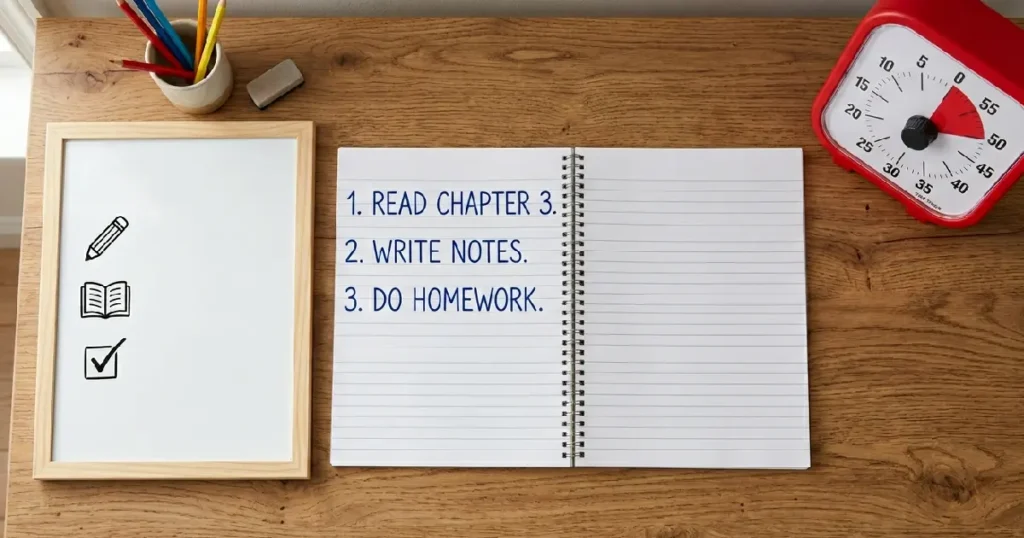
Your child can only hold about three pieces of information in their head at once. If you tell them, “Go upstairs, brush your teeth, put your pajamas on, and bring down your reading book,” they will walk upstairs and forget everything after “brush your teeth.” You have to externalize their memory. Get a small whiteboard. Write down the exact steps with simple checkboxes. If you want to know how working memory functions, you have to realize it requires visual anchors.
- Do This: Give one micro-step at a time. Say, “First, write your name on the top of the paper.” Wait until they finish before giving the next step.
- Not That: Do not give verbal paragraph-long lectures about what they need to accomplish before bedtime. Verbal instructions vanish into thin air.
Step 3: Implement Cognitive Pacing
Children process information slower than adults. Period. When you rush them, their mental strain spikes, and they shut down. You need to use visual timers to create safe boundaries around difficult tasks. The Pomodoro technique works beautifully for kids if you adjust the timeframes. A seven-year-old might only have ten minutes of solid focus in them. Honor that limit.
- Do This: Set a visual sand timer for ten minutes. Tell them, “We are only working until the sand runs out. Then we take a three-minute jumping break.”
- Not That: Do not force them to sit at the table for forty-five uninterrupted minutes just because you want to get the homework out of the way. You will spend thirty of those minutes fighting.
Step 4: Decode The Behavioral Shutdown
When your child gets the “deer in the headlights” look, you have to intervene before the tears start. You must act as a detective and help kids who struggle with executive functions name their feelings. When you name the mental fatigue, you remove the shame. They stop feeling stupid and start feeling understood.
- Do This: Look them in the eye and say, “Your brain looks really full right now. I am going to put this paper away for five minutes while we get a drink of water.”
- Not That: Do not say, “Stop whining, you just did this yesterday, it is not that hard.” That invalidates their biological reality and escalates the fight.
Common Mistakes And How To Avoid Them

We all make mistakes when we are tired parents. I have done every single one of these things. But if we want to change our family dynamic, we have to look closely at our own reactions. Here are the four biggest traps parents fall into when dealing with a child’s mental fatigue.
Mistake 1: Talking Too Much When They Are Dysregulated
When your child is crying under the table, your instinct is to talk them out of it. You explain why the homework is important. You try to reason with them. Stop doing this immediately.
“When the amygdala is activated by stress, the logical prefrontal cortex goes entirely offline.”
This biological fact means that reasoning with a crying, overwhelmed child is physically impossible. You must calm their nervous system before you try to correct their behavior.
When they are in a full amygdala hijack response, your words are just adding more noise to an already overloaded system.
The Fix: Use silence. Sit down next to them. Take deep breaths yourself. Say absolutely nothing for three full minutes. Let their nervous system regulate by being near your calm presence. Once their breathing slows down, offer a hug, not a lecture.
Mistake 2: Confusing A Cluttered Room With A Creative Room
Many parents think a bedroom covered in colorful posters, loose Lego bricks, and scattered books is a sign of a creative, happy child. While play is wonderful, a highly cluttered space demands constant mental processing. Every time your child walks into a messy room to find their shoes, their brain has to subconsciously scan and ignore hundreds of objects. This drains their battery before the day even begins.
The Fix: You do not need to become a minimalist, but you do need visual resting spots. Buy opaque storage bins with solid colored lids. Hide the visual clutter. Make sure the space where they do homework is completely blank. A clean desk facing a blank wall is a gift to an exhausted mind.
Mistake 3: Pushing Through The Pain For The Sake Of Finishing
It is 8:00 PM. They have one paragraph left to write for their history report. They are crying, rubbing their eyes, and complaining that their hand hurts. The parent says, “Just push through, it will take two minutes!”
This is a massive mistake. When you force a child to work past their absolute breaking point, they do not retain the information anyway. Worse, you condition them to associate learning with anxiety and pain.
The Fix: Be the adult who calls it off. Look at their paper, close the book, and say, “You have worked incredibly hard today. Your brain is officially done, and that is okay. We are stopping right now. I will write a quick note to your teacher explaining that we ran out of time.” Teaching them healthy boundaries is far more important than a perfect grade.
Mistake 4: Treating The Meltdown As Defiance
This is the hardest habit to break. When your child yells “No!” and throws their workbook on the floor, it feels deeply disrespectful. Your ego flares up. You want to punish them for the attitude. But if you punish a child for a biological system failure, you build a wall of resentment between you.
The Fix: Shift your perspective. Tell yourself out loud, “They are not giving me a hard time, they are having a hard time.” Address the disrespect only after the storm has completely passed. The next morning, when they are calm and eating breakfast, you can say, “Yesterday was really tough. I know your brain was tired, but we cannot throw things when we are frustrated. What can we do differently today?”
Frequently Asked Questions
What are the primary signs of cognitive overload in children?
The most common signs of cognitive overload in children include sudden irritability, crying over minor inconveniences, and staring blankly at simple assignments. You might also notice them acting out, picking fights with siblings, or complaining of physical symptoms like stomach aches. These behaviors clearly indicate their working memory is entirely full and they can no longer process new instructions.
How does cognitive load affect a child’s daily behavior?
When a child faces excessive mental strain, their brain quickly enters a defensive state. This biological shift forces the emotional center to take control over the logical part of the brain. As a result, children exhibit fight-or-flight behaviors, such as yelling, running away, or completely shutting down, which adults frequently misinterpret as intentional defiance.
How do I reduce my child’s cognitive load at home?
You can reduce mental strain by immediately eliminating environmental distractions like background television or heavily cluttered workspaces. Break all multi-step instructions into single, actionable steps. Instead of giving long verbal lists, write chores on a small whiteboard to externalize their working memory. Always make sure to schedule frequent, screen-free breaks to let their active minds reset.
What is the difference between intrinsic and extraneous cognitive load?
Intrinsic cognitive load is the natural difficulty of a specific task, such as learning how to do long division. Extraneous cognitive load refers to unnecessary outside distractions, like confusing verbal directions, loud noises, or poorly formatted worksheets. Parents should always aim to eliminate the extraneous distractions so kids can focus purely on the intrinsic task.
Can digital devices and screens cause cognitive overload in kids?
Yes, heavy screen time significantly increases unnecessary mental strain. Rapidly switching between colorful apps, dealing with constant pop-up notifications, and absorbing fast-paced graphics will quickly overwhelm a child’s delicate working memory capacity. This intense digital fatigue leads directly to scattered focus and severe emotional dysregulation when they eventually transition back to offline activities like normal homework.
How long does it take to recover from cognitive fatigue?
Recovery time depends entirely on the severity of the mental exhaustion. A minor afternoon slump might require just fifteen minutes of quiet, screen-free rest and a healthy snack. However, chronic mental fatigue from a highly stressful school week might require a full weekend of unstructured, low-demand play to completely reset their overwhelmed nervous system.
Final Takeaway
You have the power to change the atmosphere in your home by changing how you present information to your kids. Implementing Cognitive Load Management in Children is not about lowering your expectations; it is about creating an environment where your child can actually meet those expectations without burning out. When you reduce the visual noise, simplify your words, and respect their mental limits, you stop fighting against their biology. You become their guide instead of their warden. Tomorrow afternoon, when the backpacks hit the floor, try removing just one distraction. Watch how quickly the tension melts away.
My Closing Remarks
I need you to hear this loud and clear: forcing a crying child to finish their homework is practically abusive to their delicate nervous system. Stop worshiping the hustle culture of perfect grades. Your relationship with your child is vastly more important than a Tuesday spelling worksheet. I spent years watching well-meaning parents break their kids’ spirits over math problems, and it never works. Throw the worksheet in the trash if you have to. Protect their peace, protect your bond, and watch how beautifully they thrive tomorrow.