
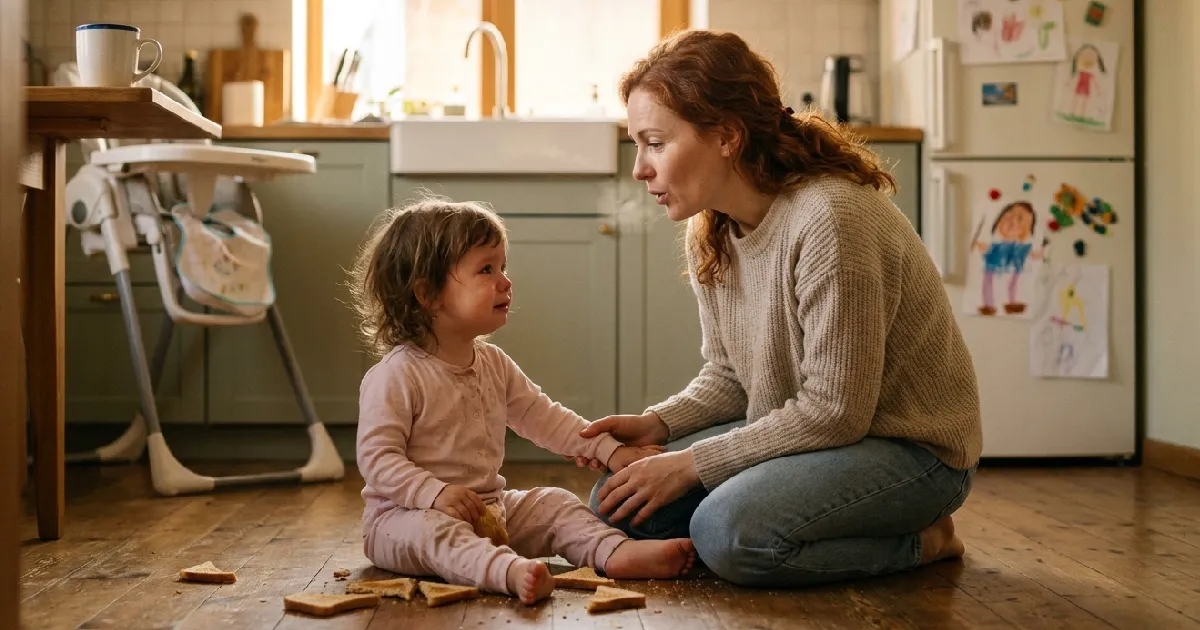

Let me say something that might sting a little. If you have spent weeks (or months) printing feelings charts, building a calm-down corner, and dutifully naming emotions at the dinner table only to watch your toddler still dissolve into a screaming heap because you served milk in the wrong cup, you have not failed. You were handed the wrong instruction manual.
Most advice on social emotional learning for toddlers starts at Step 4. It assumes the child’s brain is online and ready to receive a lesson. It is not. Not during a meltdown. Not when you are gripping the countertop praying you do not yell. I am going to hand you something different today: a single, neuroscience-backed shortcut that works precisely because it meets your toddler’s brain where it actually lives.
What is social emotional learning for toddlers? It is the process of helping children aged 1 to 4 identify emotions, build empathy, and develop self-regulation through daily interactions and play. The most effective approach is co-regulation: using your own calm nervous system to teach your toddler’s developing brain how to handle big feelings. No flashcards needed. No scheduled “emotion time.” Just you, steady and present, in the moments that already exist.
By the end of this article, you will have the exact brain science that explains why your current attempts feel like they are bouncing off a wall, one central hack you can use in the next five minutes, an age-specific roadmap from 18 months through age 4, and a real story from a parent who turned things around without buying a single new product.
What Social Emotional Learning for Toddlers Actually Means
The Definition Most Parents Get Wrong
The Collaborative for Academic, Social, and Emotional Learning (CASEL) defines SEL as the process through which young people and adults learn to manage emotions, set goals, show empathy, build relationships, and make responsible decisions. That framework is solid. It is also written for school-aged kids.
Table of Contents
When you apply it to a 22-month-old, everything shifts. SEL at this age does not look like a structured lesson. It looks like a four-second pause on the kitchen floor. It looks like you crouching down instead of looming over. It looks like a single exhale before you speak. During the toddler years, dramatic transformations happen in social reasoning, emotional understanding, and self-control, but none of them happen because a child sat through a mini-lecture on feelings. They happen in micro-moments repeated hundreds of times a day.
The mistake most advice makes is treating SEL as a scheduled activity you add to an already exhausted schedule. That is backward. The real work of emotional learning is already happening inside every car ride, every bath, every grocery trip. You just need to know what to look for and how to respond.
Co-Regulation: The Brain Science Nobody Taught You
Here is the thing that changes everything. Your toddler’s prefrontal cortex, the part of the brain that handles impulse control and emotional regulation, is not just immature. It is structurally incapable of calming itself down independently. That ability does not fully come online until early adulthood. Let that land for a moment.
What this means is brutally simple: your toddler cannot self-regulate. They borrow your nervous system instead.
Co-regulation is the process of helping a child manage their emotions through supportive, attuned interactions with a calm adult. Babies and toddlers do not yet have the brain development in place to regulate their own emotions. They need adults to soothe them many times before they can do this themselves. This is not a parenting preference. It is developmental biology.
Think of it this way. You are the Wi-Fi router. Your toddler is the device. They can only connect to the internet of calm if your signal is strong. When your signal is crackling with frustration, they lose the connection entirely. This is not metaphor. It is the mechanism of mirror neurons, the invisible bridge between your nervous system and theirs.
A 2025 brief from Zero to Three confirmed that strong co-regulation in early childhood is directly connected to how well a child develops coping strategies, emotional awareness, and resilience over time. This is not theoretical. It is the foundation everything else rests on.
The Research That Backs This Up
Several findings are worth knowing. First, a 2020 longitudinal study published in Biological Psychiatry: Cognitive Neuroscience and Neuroimaging found that children who could identify and label difficult facial emotions in early childhood showed better emotion regulation in adolescence and increased activation in cognitive control regions of the brain. In other words, naming feelings early literally builds the brain circuitry for managing them later.
Second, a 2024 birth cohort study of nearly 10,000 children found that informal home play activities (painting, drawing, games, reading) predicted stronger socioemotional development at 36 months, even after accounting for income and other family factors. The takeaway: ordinary, joyful play is an SEL intervention in disguise.
Third, research on the landmark “affect labeling” study by Lieberman and colleagues at UCLA demonstrated that simply putting feelings into words reduces amygdala reactivity. When you name an emotion, the threat-response center of the brain dials down. That is a biological fact, not a parenting trend.
Your 5-Step Plan to Start Using This Hack Today
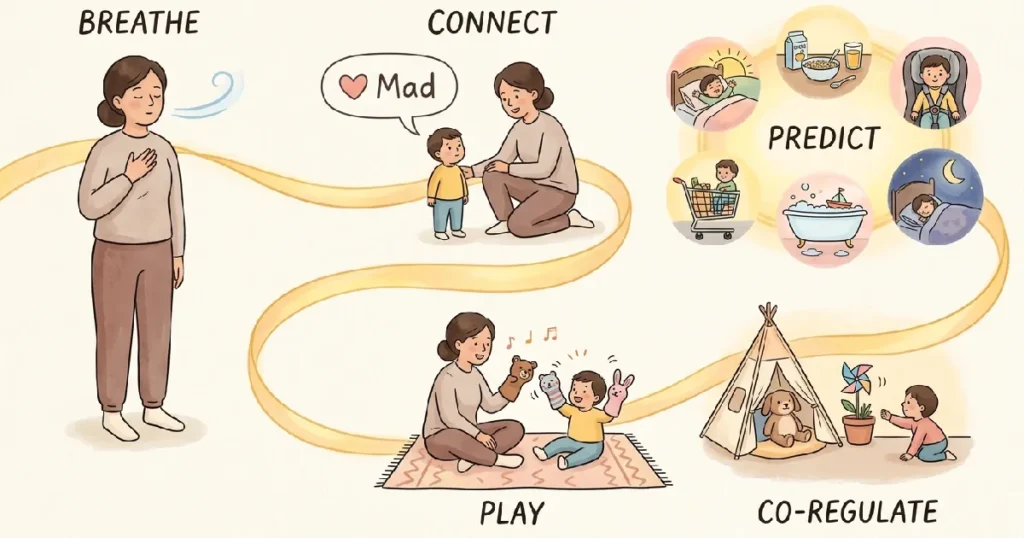
None of these steps require buying anything. None require extra time. Each one leans on a moment you are already living.
Step 1: Regulate Yourself First (The 3-Second Rule)
Before you say a single word to your melting-down child, take one visible, audible, slow breath. Exhale loudly enough that they hear it. Lower your voice by one octave. Get physically lower, crouching or kneeling to their level.
Why this works: your nervous system is contagious. When you regulate, your toddler’s mirror neurons begin to sync with your state. That is co-regulation in real time.
Do this, not that: do one slow breath first (do this), not “Stop crying right now” (not that). Lower your voice (do this), not match their escalating volume (not that). Kneel down (do this), not stand tall giving commands (not that).
Age note: this works from 12 months upward. At 18 months, your physical presence and tone do nearly all the work. At 3 to 4 years, they may eventually imitate the breath with you.
Step 2: Name the Feeling Out Loud
Say what you see, calmly and without judgment. “You are really frustrated right now. You wanted the red cup, not the blue one. That feels huge.” Do not explain. Do not fix. Just name it.
Why this works: affective labeling, the act of naming emotions aloud, has been shown in neuroscience research to reduce amygdala activation, literally calming the brain’s threat-response system. The UCLA study found that when people attach a word like “angry” to an emotional face, the amygdala settles down while the prefrontal cortex activates.
Do this, not that: say “You are feeling really mad right now” (do this), not “Why are you crying? Stop it” (not that). Name the feeling before you offer a solution (do this), not rush to fix the problem first (not that). Use simple words for under-2s: mad, sad, scared (do this), not nuanced vocabulary like “frustrated” or “overwhelmed” (not that).
Step 3: Weave SEL Into the Routines You Already Have
Stop scheduling “SEL time.” Instead, identify the six transitions already built into your day: morning wake-up, mealtime, car ride, errands, bath time, and bedtime. Insert one tiny micro-moment into each.
Why this works: play and everyday routines provide a developmentally meaningful context for emotional skill-building. Ordinary life is the curriculum. You do not need a separate lesson plan.
Here is what this looks like in practice:
| Daily Routine | Micro-Moment Hack | Skill Targeted |
|---|---|---|
| Morning wake-up | “What kind of morning are you feeling?” | Self-awareness |
| Mealtime | Take turns sharing one feeling from yesterday | Social awareness |
| Car ride | Name the feeling behind a song you hear | Self-management |
| Grocery store | “I wonder how that person feels waiting?” | Empathy |
| Bath time | Act out an emotion story with bath toys | Relationship skills |
| Bedtime | One good thing, one hard thing, one hope for tomorrow | Decision-making |
Do this, not that: ask “How did your body feel at the park today?” during bedtime (do this), not schedule a separate 20-minute feelings lesson (not that). Narrate your own emotions during routines (do this), not only address your toddler’s feelings when they explode (not that).
Step 4: Let Play Do the Heavy Lifting
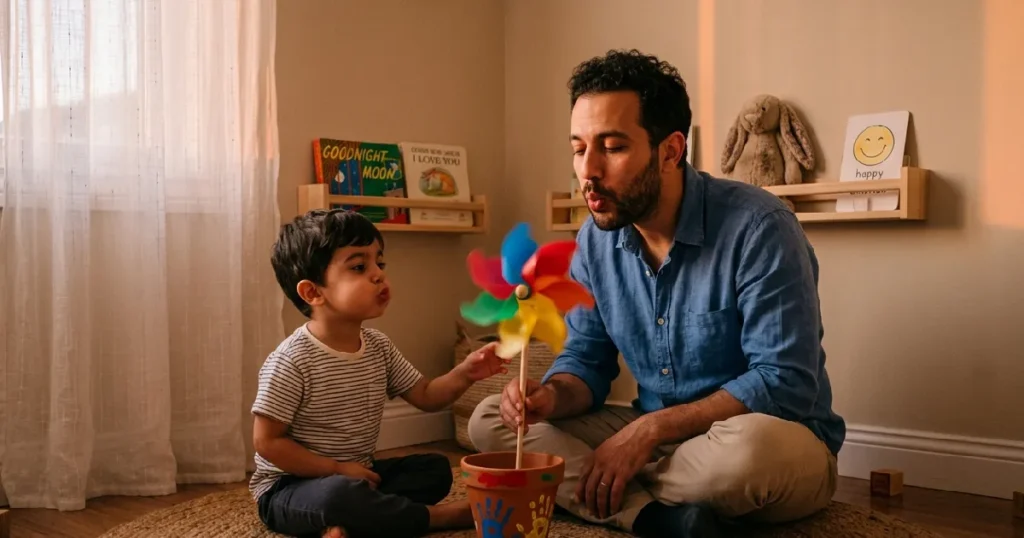
Build one play-based SEL activity into your week, but make it feel like pure play, not a lesson. Emotion puppet shows, feelings bingo, mirror face games, and “feelings detective” picture books all work beautifully.
Why this works: informal play activities such as games, painting, and reading have been shown to predict stronger socioemotional development in large-scale studies, independent of income or other family factors. When children engage in frequent playful experiences, they develop confidence in negotiating new situations and collaborating with others.
Do this, not that: let your toddler lead the play narrative (do this), not direct the play with SEL goals in mind (not that). Pause to reflect softly (“Oh, the bear looks sad, what happened?”) (do this), not interrupt to quiz them on feelings (not that).
Age note: at 18 months, use board books showing simple facial expressions. At 2 to 3 years, introduce puppets. At 3 to 4 years, role-play scenarios together (“What would you do if your friend took your toy?”).
Step 5: Build One Regulation Anchor
Designate one physical object or small space your toddler associates with calm. This could be a cozy corner with a stuffed animal, a pinwheel for practicing deep breaths, or a feelings jar with simple emotion cards. Introduce it during happy, calm play, never during a meltdown.
Why this works: the brain learns through association. By practicing the calm-down tool before it is needed, your toddler’s brain builds a neural shortcut: this object equals safety equals calm. When a meltdown eventually comes, that anchor is waiting.
Do this, not that: introduce the calm corner during joyful play (do this), not send your child there as a punishment (not that). Practice deep breathing with the pinwheel as a game (do this), not only bring out regulation tools during crisis moments (not that). Let the child help choose items for their space (do this), not create it entirely without their input (not that).
Step Summary
| Step | The Hack | Skill Built | Age | Time |
|---|---|---|---|---|
| 1 | Regulate yourself first (3-second breath) | Co-regulation | 12mo+ | 3 seconds |
| 2 | Name the feeling out loud | Emotional literacy | 12mo+ | 10 seconds |
| 3 | Weave SEL into 6 daily routines | All 5 CASEL skills | 18mo+ | Zero extra |
| 4 | Play-based SEL delivery | Empathy and social skills | 18mo to 4yr | 10 min/week |
| 5 | Create a regulation anchor | Self-management | 2yr+ | One-time setup |
The Turnaround: How One Mom Finally Got It Right
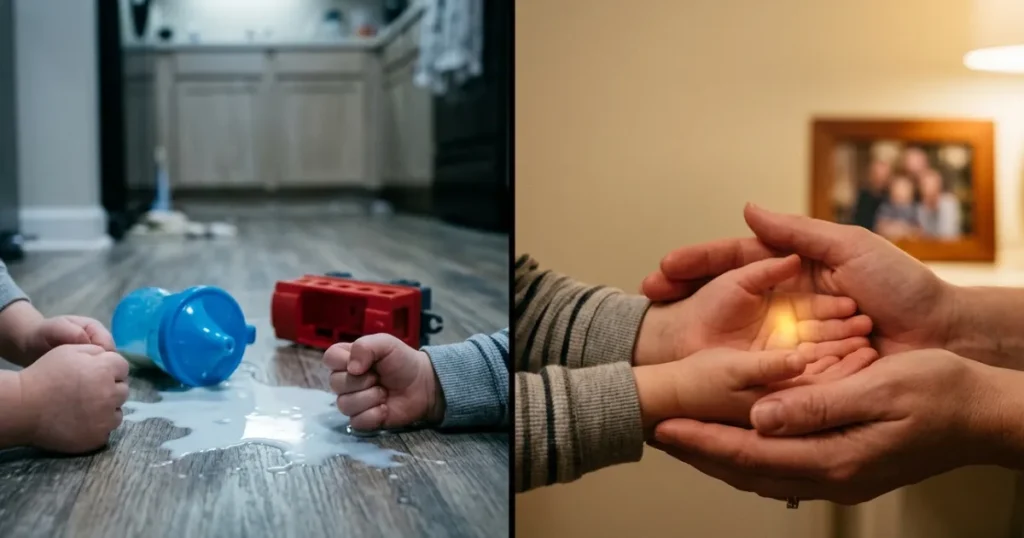
Maya is 31 and lives in a two-bedroom apartment outside Columbus with her husband and their son Leo, who is two and a half. By her count, Leo was having five or six full meltdowns a day. He would scream when she opened the wrong yogurt. He would fling himself backward when it was time to leave the park. Maya had read the books. She had printed the emotion cards. She had laminated them, for goodness’ sake. Nothing stuck.
Her real problem was not the activities. It was that the moment Leo escalated, she escalated right alongside him. She could feel it in her chest, that hot surge before she snapped. She would say things she regretted and then scroll parenting forums at midnight feeling like a fraud.
Then someone told her to try one thing. Not a chart. Not a reward system. Just this: before responding to any meltdown, take one visible deep breath. Exhale so Leo could hear it. That was the entire intervention.
The first few days felt strange and small. But around day 11, something shifted. Leo was starting to exhale when she exhaled. His little shoulders would drop. He was borrowing her calm without either of them naming it. By week three, Leo walked up to her during a frustrating moment and said, unprompted, “I breathe.” Maya cried in the kitchen that night, not from exhaustion but from relief. The meltdowns did not vanish. But their intensity dropped by half, and so did hers. She told me later, “The secret was not a new activity. The secret was that I was the activity.”
Common Mistakes Parents Make and Exactly How to Avoid Them
Mistake 1: Trying to Teach During a Meltdown
When your toddler is in full dysregulation, the thinking part of their brain is offline. Trying to explain, reason, or teach in that moment is like giving swimming lessons during a hurricane.
How to avoid it: Connect first, redirect later. As Dr. Dan Siegel put it, “Instead of command and demand, try to connect and redirect.” That means you get down to their level, you regulate first, you validate the feeling, and you save the lesson for when they are calm, maybe hours later, maybe at bedtime. The window for teaching opens after the storm passes, never during it.
Mistake 2: Skipping Your Own Regulation
Most parents jump straight to managing the child’s behavior before checking their own internal state. Your shoulders are tense. Your breathing is shallow. You are in fight-or-flight, and your toddler’s nervous system is tracking every signal.
How to avoid it: Give yourself a silent script before you speak. Something like: “I am safe. They are safe. This is not an emergency.” Take one breath. Then act. As developmental psychologist Dr. Aliza Pressman said, “Our regulated presence is the single most powerful tool we have for helping our kids feel safe.” That one line has more therapeutic weight than most parenting books I have read. Your calm is literally the intervention. Do not skip it.
Mistake 3: Using Overly Complex Language With Young Toddlers
With an 18-month-old, saying “I can see you are feeling really overwhelmed and frustrated right now” is functionally useless. They do not have the vocabulary to map those words onto their internal state.
How to avoid it: Under age 2, stick to one or two words: “Mad.” “Sad.” “Scared.” At 2 to 3 years, add a simple cause: “You are mad because the blue cup is dirty.” At 3 to 4 years, you can start asking: “What does your body feel like right now? Tight? Hot? Wiggly?” Meet them at their language level, not yours.
Mistake 4: Treating SEL as a Separate Activity
If you are carving out dedicated “feelings time” while ignoring the emotional content of the other 23 hours and 50 minutes of the day, your child is not learning what you think they are learning.
How to avoid it: Use the micro-moment approach from Step 3. Narrate your own regulation aloud: “Mommy is feeling a little tight in her chest right now. I am going to take a breath.” When you burn the toast, let them see you handle disappointment without catastrophizing. Those unscripted moments teach more than any laminated card ever will.
Frequently Asked Questions
What is social emotional learning for toddlers, and when should it start?
Social emotional learning for toddlers is the process of helping children aged 12 months to 4 years build skills in identifying emotions, managing big feelings, and forming positive relationships. It should begin at birth. The earliest SEL lesson is a caregiver responding consistently to a baby’s cries. By 18 months, intentional emotion-naming and co-regulation practices can begin formally through daily interactions and play.
Can a 2-year-old really learn social emotional skills?
Yes. The toddler years are actually the most neurologically receptive window for SEL skill-building. A 2-year-old cannot yet self-regulate independently, but they can learn through co-regulation: borrowing a calm adult’s nervous system. At this age, the most effective strategies are simple emotion naming, consistent caregiver responses, and brief play-based activities like puppet shows or mirror face games that feel like pure play rather than structured lessons.
What is the single most effective hack for toddler meltdowns?
The most research-supported approach is co-regulation. The adult regulates first by taking one visible, slow breath, then names the toddler’s emotion aloud in simple language. This two-step micro-moment activates the child’s mirror neurons, reduces amygdala reactivity (the brain’s threat response), and begins building emotional regulation capacity over time. It takes roughly three seconds and requires zero supplies, preparation, or scheduled time.
How is social emotional learning different from just being kind?
Social emotional learning is a structured developmental framework grounded in five core competencies: self-awareness, self-management, social awareness, relationship skills, and responsible decision-making. Being kind creates a positive environment, but SEL provides the specific language, repeated neural pathway building, and intentional daily practices that wire a toddler’s brain for emotional intelligence across a lifetime. Kindness sets the table; SEL serves the meal.
How long does it take to see results from this approach?
Parents using consistent daily co-regulation techniques typically report a noticeable reduction in meltdown intensity within two to four weeks. Full emotional vocabulary development, where a toddler begins naming their own feelings unprompted, generally emerges between four and eight weeks of consistent practice. Long-term benefits, including improved school readiness and peer relationships, are supported by longitudinal research showing effects lasting into adolescence and beyond.
What are the five core skills of social emotional learning for toddlers?
The five core SEL skills for toddlers, based on the CASEL framework, are: self-awareness (recognizing their own emotions), self-management (beginning to regulate big feelings), social awareness (noticing others’ emotions), relationship skills (sharing, taking turns, communicating), and responsible decision-making (choosing a response to a situation). All five begin developing in the toddler years through co-regulation, play, and daily caregiver interactions rather than formal instruction.
Your Monday Morning Assignment
You do not need to implement all five steps tomorrow morning. You need to do one thing.
When your toddler wakes up and something goes sideways, and it will, take one visible breath before you respond. Just one. Do not announce it. Do not explain it. Just breathe audibly enough that they hear it.
That one breath is social emotional learning for toddlers in its purest form. It is you being the regulation their brain cannot yet generate on its own. And here is what I want you to hold onto: research has shown that for every dollar invested in quality SEL programming, society sees an average return of eleven dollars in reduced behavioral issues, improved academic outcomes, and better long-term mental health. What you are doing in these three-second micro-moments is not small. It is building the architecture of who your child becomes.
My Closing Remarks
I have sat with parents who genuinely believed they were ruining their children because they could not stop yelling during meltdowns. Not a single one of them was a bad parent. They were exhausted, unsupported people trying to teach a skill they had never been taught themselves. If you take nothing else from this article, take this: the parent who pauses to breathe before responding is doing the deepest emotional work there is. You are not behind. You are not broken. You are learning alongside your child, and that is exactly how it is supposed to look.