
 Nicole Adkins
The internet turned masculinity into a leaderboard. Here’s what’s actually true about how men lead, love, and grow.
Key Points
- All four male personality types, Alpha, Beta, Sigma, and Delta, describe real behavior patterns, but none of them are fixed identities you’re stuck with forever.
- Understanding male personality types helps you spot your natural strengths at work and in relationships, along with the blind spots that quietly sabotage both.
- The healthiest men don’t pick a label and defend it. They borrow strengths from all four styles depending on what the moment calls for.
Contents
Table of Contents
We’ve all done it. Scrolled through a late-night Reddit thread breaking down “alpha body language,” or watched a video that promised to reveal which type of man you really are underneath the noise. You are not doing this because you’re shallow. You are doing it because you want a map of who you already are, and modern culture keeps handing you a maze instead.
Someone might scroll past a confident, deep-voiced guy running a meeting and think, that’s what success looks like. What they don’t see is the same man lying awake at 2 a.m., terrified that one bad quarter will strip away the status he’s built his whole identity around.
Someone else might get called “too nice” by a friend, a quiet dig meaning beta, meaning weak. What that friend doesn’t see is the guy’s calendar full of favors he does for people who never ask how he’s doing, or the boundary he still hasn’t learned to set.
And someone might watch a man skip the group chat entirely, seemingly unbothered, and label him a lone-wolf sigma. What they don’t see is a person who genuinely doesn’t know how to let anyone get close without feeling like he’s losing himself.
This guide is going to give you an honest, no-hype breakdown of all four male personality types, how they show up at work, and how they behave once the front door closes and nobody’s performing for anyone.
The Psychological Origin: Archetypes vs. Internet Culture
Historical Roots of Male Personality Types
Humans have always reached for frameworks to explain identity. Long before Reddit, Swiss psychiatrist Carl Jung proposed that certain universal patterns of behavior live in what he called the collective unconscious, a shared psychological inheritance he believed shapes how people across cultures instinctively act out roles like the hero, the caregiver, or the rebel. This idea is often described as Jung’s structural framework of universal unconscious behaviors, and it laid groundwork for the personality typing obsession we still see today.
The alpha-beta-sigma-delta system is a different animal entirely. It didn’t come from a research lab. It came from internet forums, where users borrowed language originally used to describe dominance in wolf packs and reapplied it to men, ranking them by perceived social value. This is now widely known as the socio-sexual hierarchy, where online communities adapted Greek letters to map out social status.
Here’s the honest part most articles skip.
Wolf researchers themselves walked back the “alpha wolf” idea decades ago once they realized pack hierarchy in the wild looks nothing like the aggressive dominance model. Humans don’t organize into rigid biological pecking orders either. But that doesn’t mean these categories are useless. Used correctly, they’re a starting point for self-awareness, not a verdict on your worth.
The 4 Core Male Personality Types Explained Realistically
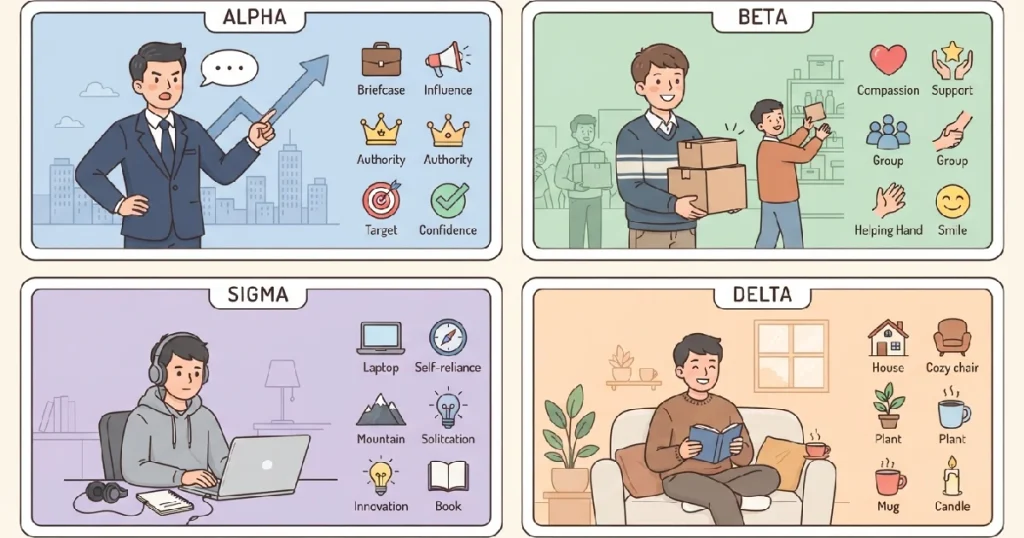
1. The Alpha Male Personality: The Social Leader
Strip away the tough-guy caricature and the Alpha male personality is really about visibility and organization. This is the person who naturally steps into a leadership vacuum, speaks first in a silent room, and stays outwardly steady when everyone else is panicking.
You’ll spot him running the team meeting, coaching the rec league, or making the split-second call during a crisis at work. He tends to take calculated risks rather than reckless ones, and he genuinely enjoys being the person others look to.
In relationships, Alpha men often make protective, decisive partners who love planning the trip or handling the hard phone call. The catch is emotional access. Many Alphas confuse vulnerability with weakness, which can quietly starve a relationship of real intimacy.
The real vulnerability: burnout and a quiet fear of losing status, something forum discussions bring up constantly but glossy “alpha” content almost never mentions.
2. The Beta Male Personality: The Stabilizing Force
The word “beta” got turned into an insult online, which is a shame, because the Beta male personality is arguably the most underrated of the four. Betas are cooperative, emotionally attuned, and genuinely dependable, the kind of person a team or a family quietly runs on.
You’ll recognize him as the coworker who remembers details, the friend who shows up at 6 a.m. to help you move, the guy who reads the room before he speaks.
In dating, this is the personality type most often described as an excellent listener and a deeply supportive partner. His growth edge isn’t becoming more aggressive. It’s learning to say no without guilt and stop mistaking harmony for the same thing as happiness.
In my practice, I’ve seen more relationships strengthen from a Beta-leaning man learning healthy boundaries than from almost any other single shift.
3. The Sigma Male Personality: The Autonomous Operator
The Sigma male personality gets romanticized online as some mysterious lone wolf, but the honest version is simpler. He has the confidence and competence of an Alpha, minus any interest in climbing a social ladder or seeking group approval.
This is the introverted entrepreneur, the remote specialist, the guy who can walk into any room, hold his own, and leave without needing anyone to notice him.
In relationships, Sigmas want low-maintenance, high-autonomy dynamics. They’re deeply loyal to a partner who respects their need for solitude, and they shut down fast around clinginess or constant reassurance-seeking. This isn’t coldness. It’s a nervous system that needs space to function well.
But here’s what no one tells you.
The most independent-seeming men on the outside are often the ones who’ve had the least practice being emotionally dependent on anyone, which can look like strength while quietly limiting how close a relationship can actually get.
4. The Delta Male Personality: The Grounded Everyman
The Delta male personality is the quiet majority nobody talks about, the man who’s opted out of intense social competition to focus on his own circle. He’s not disengaged out of laziness. He’s often protecting his energy after a life transition, a burnout, or simply a personality wired for depth over breadth.
You’ll find him doing meticulous, technical work he genuinely enjoys, avoiding office politics entirely, and guarding his time at home like it’s sacred.
As a partner, Delta men offer something rare: total predictability. Low drama, steady presence, a home life that feels safe. What he often needs is a partner willing to gently draw him out emotionally, without treating his quietness as a problem to fix.
How Male Personality Types Drive Success

Male Personality Types in the Workplace
Every functional company secretly needs all four types working together. The Alpha provides direction. The Beta executes and holds the team together. The Sigma solves the problem nobody else thought to approach differently. The Delta does the unglamorous, precise work that keeps everything from falling apart.
A quick growth note for each: Alphas benefit from practicing active listening instead of always leading the conversation. Betas need to advocate for their own worth instead of assuming good work speaks for itself. Sigmas grow by letting a mentor in occasionally. Deltas grow by speaking up before resentment builds.
Male Personality Types and Dating Compatibility
Most people in this situation don’t realize that dating repeatedly goes wrong not because of bad luck, but because they keep pairing with a personality style that clashes with an unresolved need of their own. An Alpha who needs total control paired with another Alpha who needs the same thing usually ends in a power struggle. A Sigma who needs space paired with a partner who reads distance as rejection tends to burn out fast.
Left unexamined, this pattern doesn’t just cause friction. It can quietly become the reason relationships keep ending for the same invisible reason, over and over.
Putting Male Personality Types Into Practice
The Context Audit. Pick one day this week and notice which personality style you’re using in each setting, work, home, with friends. Are you Alpha in the office and Delta at home like Marcus? Naming the pattern removes the confusion around it.
The Borrowed Trait Exercise. Choose the type most opposite to your natural style and practice one of its behaviors for a week. If you’re a Beta, practice stating one opinion first instead of waiting to be asked. If you’re an Alpha, practice asking a question instead of giving an answer.
The Partner Translation Conversation. Sit down with your partner and describe, honestly, which type you lean toward in stress, in comfort, and in conflict. A useful question to ask: “What do you need from me that my natural style doesn’t automatically give you?”
The 24-Hour Flex Challenge. For one full day, deliberately act slightly outside your default type. If you’re a Delta, speak up once in a meeting you’d normally sit through silently. Small, deliberate stretches build range faster than any label ever could.
Embracing Your Male Personality Type
Whether you lean Alpha, Beta, Sigma, or Delta, none of these styles is the “correct” way to be a man. Each one carries real strengths and real blind spots, and every single one of them can grow.
That’s not weakness. That’s wiring, and wiring can always be rewired.
The goal was never to find the perfect label to hide inside. It’s to become fluent in more than one style, so you can lead when leadership is needed, listen when listening is needed, stand alone when solitude serves you, and stay steady when your people need steadiness most. That flexibility, not the letter you identify with, is what actually predicts a good career and a good relationship.
Next time you catch yourself scrolling that late-night thread wondering which one you are, you’ll already know the more useful answer: all four, depending on the day, and that’s exactly how it should be.
My Closing Remarks
I’ve watched grown men white-knuckle a single label like it’s a life raft, and I get why. It’s easier to be “the Sigma” than to sit with the messier truth that you’re still becoming someone. In my own conversations with clients, the ones who thrive stop defending a type and start collecting range instead. That shift alone changes almost everything. You’re allowed to be more than one letter.
More Related Stories for You
- If this made you think about relationship patterns closer to home, you might also want to read about the characteristics of a narcissist man and how to recognize the difference between confidence and control.
About The Author