


When intensity feels like intimacy, it isn’t love you’re addicted to. It’s the chemical rush of never knowing what happens next.
Key Points
- An addictive personality in relationships is not a DSM-5 diagnosis. It is a real cluster of impulse-control and dopamine-seeking habits that turn romance into a high.
- The same traits that feed substance use (sensation seeking, poor emotional self-regulation, intolerance of boredom) show up as love bombing, text-tracking, and volatile makeups.
- You can stop the cycle by rerouting the intensity, pausing the urge, and refusing to use a partner as your new vice.
Contents
Table of Contents
We know this loop by heart. The rush when they finally text back. The tight, sick drop in the stomach when they do not. The thumb that opens the same conversation twelve times in an hour looking for a clue that is not there. We call it chemistry. We call it being in love. Your body is running a much older program than either of those words can cover.
Someone might think they are just a passionate partner. But what they do not see is the private panic that starts the second a read receipt appears with no reply. Someone might think checking “last seen” or a partner’s new followers is care. But what they do not see is the physical nausea that arrives when the feed goes quiet. Someone might think the huge makeup after a brutal fight means the love is real. But what they do not see is that the fight was picked on purpose because calm felt like withdrawal.
An addictive personality in relationships is the habit of using a person the way other people use a substance. You chase intensity. You cannot sit inside ordinary affection. Your mood rises and falls with their availability. That pattern exists because early romance floods the same dopamine pathways that drugs use. Left alone, it does not mellow into closeness. It becomes the reason the relationship keeps catching fire.
The short version: you are not broken for wanting closeness. You are stuck because your brain has paired love with a chemical spike. Stability then feels like boredom. Boredom feels like danger. So you create chaos to feel alive again. The work is not to love less. The work is to stop treating a human being like your dealer.
Why Love Feels Like a Drug When You Have an Addictive Personality
In the first weeks of attraction your brain does not behave like a poet. It behaves like a user. Dopamine (the chemical that says “do that again”) surges when they reply. Oxytocin (the bonding chemical) locks the attachment in. Cortisol (the stress hormone) spikes when they pull away. That mix is almost identical to the early phase of substance use.
Helen Fisher’s fMRI research at Rutgers showed that people in the grip of intense romantic love light up the same ventral tegmental area that fires in cocaine use. The scan does not care whether you call it soulmates or a binge. Your reward system only knows that this person now controls the tap.
That is why stability can feel unbearable. People high in sensation seeking (a trait first mapped by psychologist Marvin Zuckerman) need novelty and intensity to feel regulated. A quiet Tuesday night with a kind partner does not register as safety. It registers as flatline. So you pick a fight. You flirt with a third person. You disappear for a day. You are not trying to destroy the relationship. You are trying to get your pulse back.
The pattern then follows a grimly predictable timeline.
Phase 1: Intense idealization. You love-bomb. You rewrite your week around them. You talk about forever before you know how they take their coffee.
Phase 2: Anxiety and micro-tracking. The high dips. You start watching response times, location shares, and who liked their story.
Phase 3: Devaluation or abandonment panic. They become slightly human. Or they get busy. Either one feels like betrayal.
Phase 4: The volatile makeup or the destructive ending. The reunion is electric. That electricity teaches your brain that the crash was worth it. Then the loop resets.
You are not addicted to them. You are addicted to the gap between messages.
Limerence vs. Healthy Love: The Checklist Most People Skip
Limerence is the psychological term Dorothy Tennov coined for obsessive infatuation. It is not love. It is a fixation on a fantasy version of a person who has become your main source of dopamine. Most people in this situation do not realize they are in limerence because the culture keeps calling it “a deep connection.”
Use this side-by-side test.
Healthy love looks like this
- Your mood can stay steady even if they take three hours to reply.
- You can see their flaws without rewriting the whole story.
- Time apart does not make you physically ill.
- You keep friends, work, and hobbies without treating them as threats.
- Safety feels good, not boring.
Limerent obsession looks like this
- Your entire day is decided by their last text.
- You read micro-signals (punctuation, emoji choice, “active now” dots) like scripture.
- You feel sick, shaky, or furious when they are unavailable.
- You replay conversations hunting for proof they are pulling away.
- You want fusion, not partnership. Distance feels like death.
If the second list feels like a diary entry, you are not “bad at dating.” You are running a reward loop that has attached itself to a face. Relationship addiction and limerence feed each other. One is the behavior. The other is the trance.
The Texting and Tracking Loop That Keeps Addictive Personality Patterns Alive
Phones turned this problem from a weekend spiral into an all-day drip. Read receipts. “Active now.” Shared locations. Story views. Every one of those features is a tiny lever on an emotional slot machine. You pull. Most of the time nothing happens. Then they type and the bells go off in your chest. Intermittent reinforcement (the same design that keeps people at casino machines) now lives in your pocket.
The loop looks ordinary from the outside. You open Instagram. You check who they followed. You compare timestamps. You reread an old thread to confirm the tone has changed. Twenty minutes vanish. Your shoulders are up by your ears. You tell yourself you are “just checking.” Your nervous system knows you are using.
This is where social media stops being a tool and starts being a dealer. Digital surveillance does not soothe anxiety. It manufactures more of it. Each check teaches your brain that relief lives one refresh away. Mutual trust cannot survive a relationship that is being audited in real time.
Left unexamined, this pattern does not just strain the bond. It quietly becomes the reason it ends.
When Sobriety Finds a New Target: Vice Swapping in Relationships
Here is the part almost no one warns you about.
You quit drinking. You stop gambling. You put down the old vice with real courage. Then the obsessive energy has to go somewhere. It often lands on a person. All the scanning, the ritual, the “just one more,” the crash, the promise to stop… it simply changes costumes. Your partner becomes the bottle.
In my practice I have watched this pivot more times than I can count. The recovering person looks healthier on paper. They are present. They are intense. They want to spend every hour together. The partner feels chosen. Then the suffocation starts. Texts must be answered now. Plans cannot change. Other friendships look like threats. The relationship stops being a bond and starts being a replacement high.
The co-dependent trap grows in that same soil. If you are the partner, you begin buffering. You cover a financial mess. You lie to their family. You manage their moods so the house stays quiet. You think you are helping them stay sober or stay stable. You have become the new supply.
Warning signs the bond has turned into a vice:
- You feel responsible for their emotional weather.
- Time apart feels dangerous rather than healthy.
- You cancel your life to prevent their spiral.
- Affection is used to medicate anxiety, not to share it.
- Calm days make one or both of you restless enough to start a fight.
That restlessness is the boredom trigger. For an addictive personality, peace is not peace. Peace is the moment before the craving. If you do not name that, you will keep setting fire to good things because good things do not burn hot enough.
Maya and the Quiet That Felt Like Dying
Maya got eighteen months sober and met Daniel at a Saturday hike. She did everything right on paper. Meetings. A sponsor. A new running habit. Then Daniel became the whole map. She love-bombed him with playlists, lunch drops, and “good morning” texts that expected an answer before 8:02. When he went quiet during a work deadline she refreshed his Instagram sixteen times, then picked a fight about a female coworker who had liked a photo. The makeup that night felt like the first drink used to feel. Warm. Total. Expensive. Two months later she sat in her car after another explosion and finally said the true sentence: she had not gotten free. She had only changed what she used. The work began when she put the intensity into a 5 a.m. lifting program and a pottery class that demanded both hands. Daniel did not have to be the high anymore. He got to be a person.
How to Stop the Cycle of an Addictive Personality in Relationships

Knowledge without a next move just becomes a more educated spiral. These are the strategies people in recovery forums keep repeating because they actually interrupt the loop.
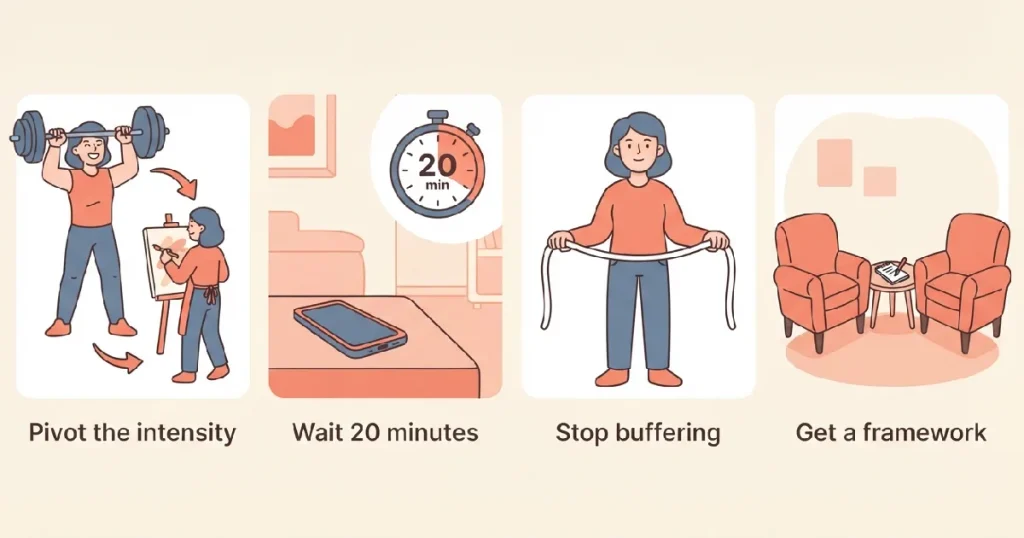
1. Ethical channeling (the pivot)
Your intensity is not the enemy. The target is. Take that same obsessive focus and point it at a high-barrier skill that cannot text you back. Heavy lifting. A difficult instrument. A language with a weekly tutor. A side project with a public deadline. The point is immersion. Your brain still gets a dopamine gradient. It just stops charging it to another person’s nervous system. Maya’s pottery wheel worked because it occupied her hands and her attention at the same time. Choose something that makes double-texting physically inconvenient.
2. The 20-minute separation rule
When the urge to check their location, reread the thread, or send the third follow-up hits, put the phone in another room and set a timer for twenty minutes. That is long enough for the autonomic nervous system (the automatic threat system in your body) to come down from a spike. Walk. Wash a dish. Stand outside. Do not “just peek.” The urge will tell you this is an emergency. It is a craving. Cravings peak and fall. Give them the twenty minutes they need to lie.
3. Aggressive boundary sourcing
If you are dating someone with this pattern, stop buffering the blast radius. Do not cover the overdraft. Do not call their boss. Do not rewrite the story for their parents. Natural consequences are not cruelty. They are the only feedback an impulsive nervous system respects. You can love someone and still refuse to be their shock absorber. That refusal is often what makes real change possible.
4. Get a framework, not just willpower
Willpower is a poor plan against a reward circuit. Cognitive behavioral therapy (CBT) helps you catch the thought that turns a late text into a catastrophe. Dialectical behavior therapy (DBT) teaches distress tolerance so you can sit in the twenty-minute gap without detonating. Groups such as Sex and Love Addicts Anonymous and Co-Dependents Anonymous give the pattern a room and a language. The American Psychological Association is clear that “addictive personality” is not a formal diagnosis. That does not make your suffering imaginary. It means you treat the cluster: impulse control, emotional regulation, and the relationship habits built on top of both. The National Institute of Mental Health outlines how structured talk therapies actually retrain those loops.
A useful question to ask yourself the next time the slot machine starts spinning: “Am I reaching for this person, or am I reaching for a feeling?”
If the honest answer is the feeling, you already know what to do. Put the phone down. Start the twenty minutes. Go do the hard thing that belongs to you.
You Do Not Need a High. You Need an Anchor.
Go back to that phone on the table. The unread silence. The thumb that wants to check. You now know what that tightness is. It is not a verdict on the relationship. It is a craving asking to be managed like any other craving.
An addictive personality in relationships does not mean you are incapable of love. It means you were taught, by chemistry and by history, to confuse intensity with intimacy. The goal is no longer the spike. The goal is a steady glow you no longer feel the need to twist.
You already have a new option you did not have an hour ago. You can feel the urge and not obey it.
Peace is not the absence of love. Peace is what love looks like when it finally puts the needle down.
My Closing Remarks
I have sat with people who loved with a kind of violence they later felt ashamed of. The shame was never the useful part. The useful part was the moment they realized their partner was never the drug. The unregulated hunger was. If that is you, you are not too much. You were under-skilled with a very loud nervous system. Skills can be learned. Intensity can be housed. You can want someone without disappearing into them. That is not a smaller life. That is a freer one.
More Related Stories for You
If the tracking loop in this piece felt familiar, read more on how constant scrolling rewires closeness in social media effects on relationships.