


You can stop walking on eggshells once you see their worry as a threat scanner, not a fight they picked with you.
Key Points
- How to deal with a neurotic person starts when you treat their spirals as a threat scanner stuck on high, not as a personal attack.
- Predictable replies, a three-strike venting limit, and loving detachment stop the text-checking loop without a blowup.
- You can stay close to a neurotic partner and still refuse to live inside their weather.
Contents
Table of Contents
We know this feeling well. The evening looks ordinary from the outside. Dinner is on the table. Then one unread text turns the room cold. Your partner’s face changes. You start scanning your own words for a crime you did not know you committed.
You answer faster. You explain more. You offer reassurance before anyone has even asked for it. And still the temperature in the house depends on whether a message got a heart emoji in time.
Someone might think you are living with a drama magnet. But what they don’t see is the 2 a.m. spiral about a three-word reply that only meant you were tired.
Someone might think patience is the whole job. But what they don’t see is how your sleep, focus, and warmth are thinning out week after week.
Someone might think constant worry is just how love looks. But what they don’t see is how that same pattern, left untouched, can quietly become the reason a couple stops feeling safe together.
You deal with a neurotic person by lowering false alarms, not by winning debates. Clear time stamps, a cap on repeated venting, and a steady emotional baseline teach their threat scanner that the relationship is safe. You stay kind. You stop disappearing into their weather.
Decoding High Neuroticism: Why Your Neurotic Partner Spirals
High neuroticism is not a slur and it is not a diagnosis of “craziness.” It is one of the Big Five personality traits, the five broad dimensions psychologists use to describe how people typically think, feel, and act. On this trait, one end is emotional stability. The other is emotional turbulence.
A turbulent brain treats small cues as possible danger. A late text. A short tone. A sigh in the kitchen. The body reacts before the facts arrive. That reaction has a name in research: negative affectivity, which simply means a stronger, faster pull toward worry, irritability, and gloom.
According to work by Bleidorn and colleagues on how personality shows up in daily life, neuroticism is one of the traits most tightly tied to how people experience close relationships. It does not mean your partner is trying to control you. It means their nervous system is doing extra work that yours may not be doing.
In my practice I have sat with partners who look exhausted in a way sleep cannot fix. They are not weak. They have been acting as a human dimmer switch for someone else’s alarm system.
The Science of the Threat Scanner and the Big Five Trait
Picture a smoke detector installed beside a toaster. The device is not broken. It is doing exactly what it was built to do. Toast still counts as smoke if the sensor is that sensitive.
That is high neuroticism in a relationship. A delayed “on my way” can register as abandonment. A quiet mood can register as secret anger. The mind then fills the gap with the worst story it can write. Clinicians call that catastrophizing: leaping from a small cue to a disaster ending.
Research on neuroticism has linked this trait to more daily stress, harsher readings of social cues, and a heavier load on both health and relationships. The point is not to pathologize your partner. The point is to stop arguing with a sensor and start changing what sets it off.
That’s not weakness. That’s wiring.
Common Triggers: Texting Anxiety, Rejection Sensitivity, and Overthinking
Three everyday triggers do most of the damage.
Texting anxiety. Silence is not neutral to a high-neuroticism brain. An unread message can feel like proof you are pulling away. The person checks, then checks the check, then writes a second text to “make sure.” You feel hunted. They feel dropped.
Rejection sensitivity. This is a hair-trigger fear of being unwanted. A brief answer sounds like coldness. A plan that changes sounds like a verdict on their worth. They are not hunting for insults. They are hunting for safety and using the wrong map.
Overthinking and analysis paralysis. They replay a conversation until the original meaning is gone. They ask you to confirm what you already said. Then they doubt the confirmation. You start to feel like a broken record. They start to feel like a burden. Both of you are right about the exhaustion and wrong about the cause.
Most people in this situation don’t realize the fight is rarely about the dishes, the tone, or the three missing hearts. The fight is about a nervous system that cannot find “safe” without extra proof.
How to Deal With a Neurotic Person Using Boundaries That Do Not Start a Fight
Advice to “just listen more” sounds loving. It often backfires. When you recycle the same worry with them, you are co-ruminating. Co-rumination means going over the same painful loop together until both people feel worse, not closer. Your mental bucket fills. Resentment grows in the leftover space where desire and humor used to live.
People who live this every day often describe a “victim energy” that takes over the room. Everything is happening to them. Nothing can be chosen. Your job is not to crush that feeling. Your job is to walk the talk back toward one real choice.
Signposting Stops the text-checking Loop Before it Starts
Signposting is a short, factual update you give before silence can turn into a story. You are not reporting your every move. You are removing the blank page their mind will fill with danger.
If you are heading into a meeting, you pick up or send: “I’m in a meeting until 3:00. I will call you after.” Then you do what you said.
Predictable loops lower their threat baseline. The scanner still exists. It simply gets fewer false alarms. Over time, many partners check less because the relationship starts to feel timed and solid, not foggy and risky.
This is the digital communication blueprint most generic advice skips. Faster replies train them to need even faster ones. Clear windows train them to wait.
The three-strike Rule for Co-rumination and Venting
You can care and still refuse to become a dumping ground. Partners who have tried this often land on a simple cap: the same unsolved problem gets three honest hearings. Not three minutes. Three rounds.
First time, you listen and name the feeling. Second time, you ask what would help. Third time, you pivot with warmth:
“We have talked about this a few times. Are we looking for a solution today, or do we need to shift our focus?”
If they want a solution, you pick one next step. If they want only the loop, you name that too: “I can sit with you for ten minutes. I cannot keep spinning the same wheel tonight.”
You are not punishing them. You are teaching the relationship that pain can be held without being rehearsed forever.
De-escalation Scripts for When they Catastrophize
When the spiral is already running, logic lectures fail. So does fake cheer. You need a sentence that honors the fear and returns to solid ground.
Try: “I hear that you are scared right now. We are safe. Let’s look at the facts.”
Or: “This feels huge in your body. The situation is still a late text, not a goodbye.”
Or, when the talk slides into “everything is going wrong”: “I believe this feels stacked against you. What is one choice we can make in the next hour?”
That last line is how you move someone out of victim mode without mocking them. You do not debate the whole sky. You hand them one switch they can actually flip.
When Maya Stopped Answering Every Spiral
Maya, 34, kept her phone face-up on the nightstand like a fire radio. Her partner Jordan would text “are you mad at me” if she took twenty minutes to reply after work. She answered faster each month. The questions multiplied. Their nights shrank into evidence reviews.
She changed one condition, not Jordan’s personality. She started signposting: “In a client call until 4. I will text you after.” She used the three-strike rule on the same office grievance. The first week was rocky. Jordan accused her of pulling away. She stayed warm and kept the window she had named.
By the third week the checking dropped. Maya slept through the night. The relationship did not get colder. It got quieter in the right way. Jordan still had a sensitive scanner. Maya was no longer living next to the toaster.
Protecting Your Peace From a Neurotic Person’s Anxiety

You can love someone and still catch their weather. That spread has a name: emotional contagion, the way one person’s feelings jump the gap and settle in your chest. You walk in calm. You walk out clenched. Then you snap at a small thing and become the “mean one” in a story you did not start.
Left alone, this is how secondary anxiety forms. Their threat scanner recruits yours. You begin overexplaining, over-soothing, and over-monitoring the mood of the house. That is not devotion. That is two nervous systems sharing one short fuse.
Recognizing Emotional Contagion in a Neurotic Relationship
Watch for three signs. Your shoulders rise when their phone lights up. You rehearse replies in the shower. You feel guilty for being in a good mood.
Those are not proofs that you are cold. They are proofs that the bond needs a membrane. Support without a membrane becomes fusion. Fusion feels loyal at first. Then it feels like drowning beside someone who is also drowning.
Most exhausted partners don’t realize they are allowed to keep a separate baseline. You can be the steady room. You do not have to become the siren.
Loving Detachment and the Controlled Grey Rock Method
Grey rock means you become uninteresting fuel. Short, neutral, dull replies. No defense. No matching heat. Family members who criticize for sport, and aging parents whose anxiety has hardened into control, often calm down when the show loses its audience.
With a partner you still want closeness with, you use a softer version. Call it loving detachment. You stay kind in the face. You stay out of the trench.
They say, “You don’t even care.” You say, “I care. I am not going to panic with you.” Then you keep your voice even. You do not file a twenty-minute brief in your own defense. The scanner looks for a second alarm. It does not get one.
This is harder with a micromanaging colleague or a hypersensitive boss, because you cannot leave the building. The same rule still holds. Give facts. Give timelines. Give no extra emotion for the spiral to eat.
Turning High Neuroticism Into a Relationship Strength
A threat scanner is miserable when it is aimed at your tone of voice. Aimed at the right target, it becomes hyper-preparedness. People high in neuroticism often notice risks early, plan in detail, and care deeply about what could go wrong before it does.
The move is not “stop feeling.” The move is “point the beam somewhere useful.”
Use their hyper-preparedness for good, not for relationship autopsies
Invite the energy onto an external project with a finish line. Trip logistics. A household budget. A family emergency folder. A training plan they can measure. Detail work soothes a brain that hates loose ends.
You might say: “Your mind is already running risk checks. I would love that skill on the vacation plan, not on whether I still like you.”
You are separating the person from the trait. They are not “too much.” Their talent is simply pointed at the one place it will do the most harm: the bond itself.
If you recognize yourself in these pages, the same redirect applies. Put the scanner on a spreadsheet, a run, a draft, a checklist. Stop using the person you love as the test site.
The SCAN Method: What to Do the Next Time They Spiral
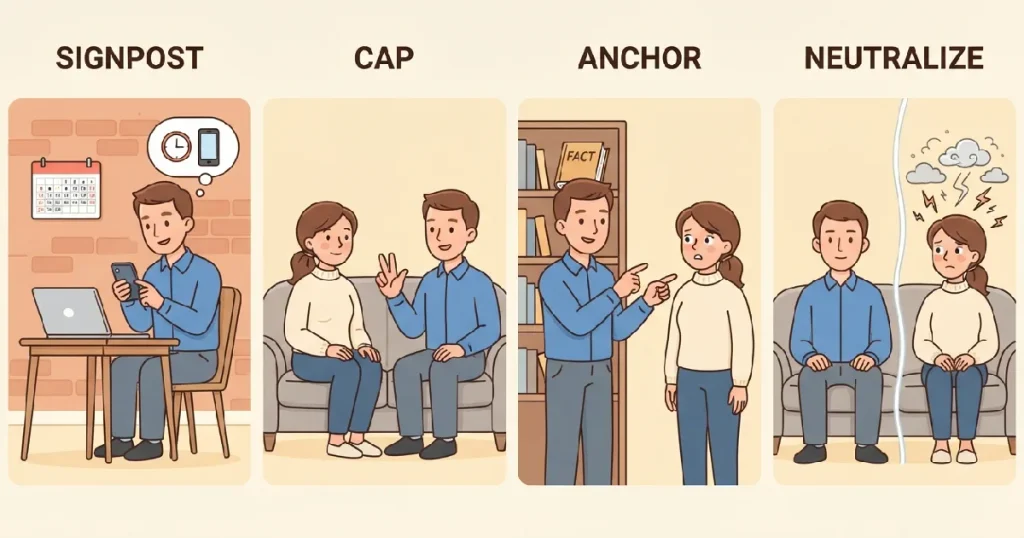
One place to start is a four-part loop you can remember under stress. Call it SCAN.
Signpost. Before a gap in contact, name the window. “Gym until 6:30. I’ll call after.” Do what you promised.
Cap. Let a repeated worry have a third hearing, then pivot to a solution or a subject change. Warm voice. Firm fence.
Anchor. When they catastrophize, name the feeling and return to one fact. “You are scared. The plan changed by one hour. We are still going.”
Neutralize. Keep your face, breath, and replies on a steady setting. If you are dealing with a parent or in-law who only wants a reaction, grey rock. If you are dealing with a partner, stay warm and refuse the trench.
A useful question to ask yourself tonight is simple. “Am I offering comfort, or am I feeding the alarm because I am afraid of their fear?”
The next time the phone lights up with “are you mad,” try one signpost and one calm sentence. Then put the phone down for the window you already named. That is enough for the next 24 hours.
If the pattern includes threats, isolation, or punishment when you set a limit, you are no longer looking at a personality trait. You are looking at harm. A licensed therapist can help you sort high neuroticism from an anxiety disorder that needs treatment, and from control that needs a much harder boundary.
You will still have evenings when a late reply makes the room go cold. The difference is that you now know what you are looking at. Not a trial. Not a test of whether you are kind enough. A smoke detector sitting too close to the toaster.
You move the detector. You do not spend your life apologizing to toast.
Stay close. Stay steady. Stop feeding the spiral.
My Closing Remarks
I have watched good people shrink themselves to keep a sensitive partner calm, then wonder why they feel lonely in a full house. I have also watched those same couples recover a surprising amount of ease once the “faster reply” habit ended. If your chest tightens when a message sits unread, you are not failing at love. You are tired of being the backup generator. You get to keep your warmth. You also get to keep a door on your own nervous system.
More Related Stories for You
- If unread messages and constant checking are already straining the bond, read more about how social media and digital habits affect relationships.