
 Nicole Adkins
The four letters on your screen are not a diagnosis. They are a first draft of how your mind actually works.
Key Points
- Personality Types Explained the honest way starts with cognitive functions, not flattering four-letter labels that change with your mood.
- Most popular quizzes measure the stressed version of you, which is why your result keeps flipping from one week to the next.
- Your real type lives in the mental process you use on autopilot, not in the description that felt nicest to read.
Contents
Table of Contents
We have all done it. A quiet evening, a half-finished cup of coffee, and a personality quiz that promises to name who we really are. The four letters appear. For a moment, everything clicks. Then a few weeks pass, and those same letters start to feel like a coat grabbed in the dark. It looked right at first. It does not keep you warm.
You reread the profile and wince. Half of it sounds like you. The other half sounds like a stranger who borrowed your name. You take the test again. A different type appears. Now you are not just confused. You are starting to wonder if the whole system is theater.
Here is the short answer. Popular quizzes sort you by slogans, not by the mental process running underneath. True self-awareness comes from watching how you take in information and how you decide what it means. That machinery has a name. Psychologists call it cognitive functions, which simply means the preferred ways your mind gathers data and makes judgments. Once you can see those preferences, the four-letter costume stops mattering.
Someone might think they are an “intuitive visionary” because the quiz used glowing language. What they do not see is that they answered while exhausted, grieving, or performing for a version of themselves they wish they were.
Someone might think they are a cold Thinker because they stay calm in conflict. What they do not see is that calm can be a Feeling type protecting the room, not a logic type solving a puzzle.
Someone might think they finally “found their type” after the third try. What they do not see is that they have been testing their coping strategy, not their baseline.
Left unexamined, this pattern does more than waste an evening. It can quietly become the story you tell about your marriage, your career, and your limits. The wrong map does not just confuse you. It sends you down streets that were never yours.
Why Popular Personality Tests Get Your Type Wrong
Most people in this situation do not realize the quiz was never built to find their type. It was built to give them a satisfying label fast. That is a product goal, not a psychological one.
The Transient Mood Trap in Personality Tests
You do not take a personality test as a clean, rested, typical version of yourself. You take it as whoever showed up that day.
If you are burned out, an Extravert can answer like an Introvert because the thought of people feels heavy. If you are newly in love, a reserved person can answer like a social spark. If you just left a controlling job, a structured Judging type can suddenly look like a free-spirited Perceiver. The test cannot tell the difference between your wiring and your weather.
Jungian practitioners call the stressed version of you a shadow pattern. In plain language, that means your mind reaches for unfamiliar tools when the usual ones stop working. A person who normally plans everything may start chasing novelty. A person who normally follows hunches may suddenly cling to rules. The quiz records the emergency kit and calls it your identity.
You did not fail the test. The test photographed a storm and labeled it the climate.
The Letter-Dichotomy Illusion and Why Percentages Matter
Forcing a rigid choice between Introvert and Extravert is like asking whether you are “tall or short” and then building your whole self-image around the answer. Real traits live on a continuum.
The scientific gold standard here is the Big Five, also called OCEAN. It measures Openness, Conscientiousness, Extraversion, Agreeableness, and Neuroticism as percentages, not boxes. The American Psychological Association’s overview of the Big Five treats personality as a set of sliding scales, which is why researchers trust it more than four-letter sorting. A clear guide to those five dimensions shows how a person can be moderately extraverted at work and deeply private at home without being a contradiction.
A 2023 comparison of type-based and trait-based models, published in Applied Sciences, found that continuous scores capture daily habits more reliably than static categories. That matters in real life. High Conscientiousness predicts whether you keep a calendar. A letter like “J” only tells you that a website thinks you like plans.
The MBTI letters can still be useful. Think of them as a shorthand for internal wiring, the preferred sequence your mind uses to process data and make judgments. They are not a verdict. They are a sketch.
Positive Bias and Intuitive Stereotyping
Here is a quieter problem. Many platforms describe “Intuitive” types with language that sounds like a compliment. Visionary. Deep. Original. Sensing types often get the leftover words. Practical. Detail-oriented. Grounded. Those are fine traits. They do not sound like a destiny.
So you tilt. You pick the answers that make you sound interesting. The algorithm rewards the tilt. Communities online have been saying this for years. The most idealized profiles attract the most mistypes, especially among people who are searching for permission to feel special after a season of feeling unseen.
That hunger is human. It is also a terrible compass.
Cracking the Code of Cognitive Functions
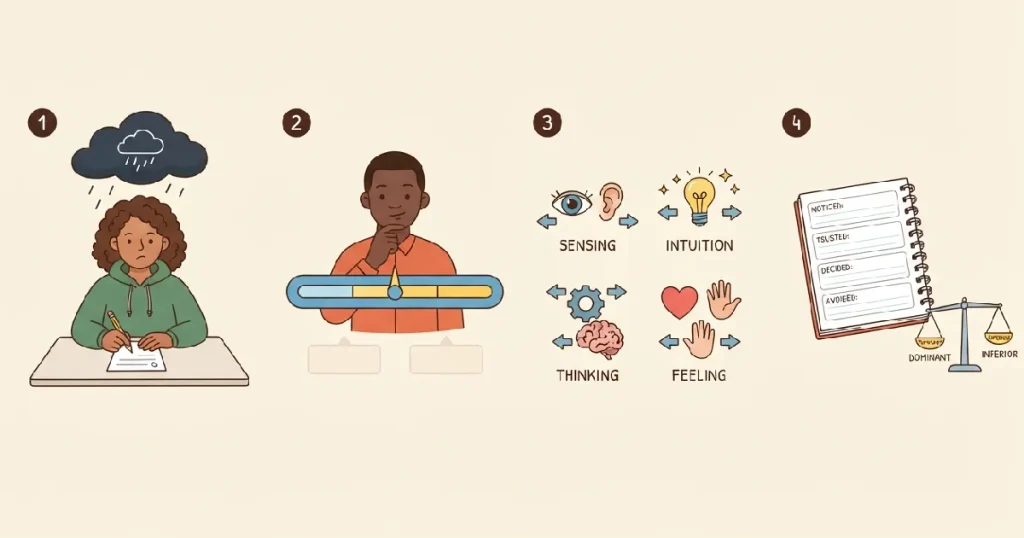
If the letters keep lying, you need a better unit of measurement. That unit is the cognitive function.
Carl Jung argued that the mind has two jobs. It takes in information. Then it decides what that information means. The Myers & Briggs Foundation still organizes the 16 types around those two jobs. Perceiving functions gather. Judging functions choose. Everyone does both. What differs is the order of preference, the sequence your mind trusts first.
The Four Pillars of Perception and Judgment
Perception is how raw life enters your awareness. Some people trust what their senses report right now. Others trust patterns, meanings, and what might be coming next. Judgment is what you do once the data is in. Some people sort it by impersonal logic. Others sort it by values, people, and what feels right.
You use all four pillars. Preference is not ability. A Sensing type can think in abstractions. A Thinking type has feelings. The honest version of Personality Types Explained refuses the cartoon version of this system. Thinkers are not robots. Feelers are not fragile. Sensors are not shallow. Intuitives are not prophets.
The difference is sequence. What does your mind reach for first when the room goes quiet and no one is watching?
Extraverted vs. Introverted Attitudes in Your Personality Type
Each function also has a direction. Extraverted functions point outward toward the shared world of objects, people, and measurable results. Introverted functions point inward toward your private store of memory, meaning, and internal standards.
Picture a camera. An extraverted function is a wide lens. It wants the whole room, the movement, the data that exists whether you like it or not. An introverted function is a microscope. It wants one slide, studied until the private pattern becomes clear.
Neither is better. They answer different questions. One asks, “What is happening out there?” The other asks, “What does this mean in here?”
The 8 Cognitive Functions Explained Without the Jargon
This is the part most quizzes skip, and it is the part that actually prevents mistyping.
Sensing and Intuition as Gathering Functions
Se, Extraverted Sensing, dives into the present. The temperature of the room. The tone of a voice. The opening in traffic. It trusts what is happening now.
Si, Introverted Sensing, files the present against a private archive. It asks whether this moment matches a known template. Comfort, routine, and “how we do things here” live in this function.
Ne, Extraverted Intuition, explodes outward into possibilities. One idea becomes twelve. Brainstorms feel like oxygen. Connections appear between things that do not officially belong together.
Ni, Introverted Intuition, does the opposite. It converges. Many signals collapse into one quiet conviction about where things are heading. People with strong Ni often cannot explain the steps. They just know the shape of the answer.
A simple way to tell them apart: Se tastes the meal. Si remembers the last time this meal was cooked. Ne invents five new recipes on the spot. Ni already decided which recipe the evening was always going to need.
Thinking and Feeling as Deciding Functions
Te, Extraverted Thinking, wants the outside world to work. Timelines. Metrics. Systems that other people can follow. It asks, “Does this get the result?”
Ti, Introverted Thinking, wants the inside model to be consistent. Definitions. Precision. A private logic that would still hold if nobody else agreed. It asks, “Does this actually make sense?”
Fe, Extraverted Feeling, tracks the emotional weather of the group. It adjusts tone, timing, and words so the room stays livable. It asks, “How does this land for us?”
Fi, Introverted Feeling, tracks an inner compass of authenticity. It will disappoint the room before it betrays a private value. It asks, “Is this still me?”
Most people in this situation do not realize they have been mistaking values for functions. You can prize kindness and still decide with Te. You can love spreadsheets and still lead with Fi. Watch the process, not the brand.
When Your Personality Type Acts Extraverted and Is Not
Here is the piece most beginner guides never mention. Your MBTI wiring and your Enneagram motivation can pull in opposite directions.
The Enneagram describes emotional fuel. The nine types name the fear and desire running underneath behavior. An introverted MBTI type with a strong Enneagram Three or Seven can look loud, social, and ambitious in public. They are not fake extraverts. They are introverts with a motive that requires an audience. Under rest, the quieter wiring returns.
That is why two INFJs can look nothing alike at a dinner table. One is protecting harmony. One is chasing achievement. Same cognitive sequence. Different fuel.
Treat type as scaffolding, not a life sentence. A well-known community line puts it cleanly: if you use it as temporary structure for observing yourself, rather than a fixed diagnosis, you get interesting results. The moment the scaffolding becomes a cage, take it down.
Maya Thought She Was Three Different Types
Maya, 31, took the same popular quiz after a breakup, after a promotion, and after a two-week vacation. She got ENFP, then INFJ, then INTJ. She started collecting descriptions the way some people collect horoscopes. Each one explained a different week of her life. None of them explained her.
In session she said she felt fraudulent in every label. The ENFP profile made her sound sparkling. She is not sparkling at 9 p.m. on a Tuesday. The INFJ profile made her sound mystic. She is a project manager who color-codes her calendar. The INTJ profile made her sound ruthless. She cries at commercials and then writes a better process document.
We stopped reading profiles. We watched her week. When a problem appeared, her first move was not brainstorming and it was not group harmony. She pulled the situation inward, looked for the hidden pattern, and then built an external plan other people could follow. That is Ni leading, Te supporting. The vacation answers had been her inferior function playing dress-up. The breakup answers had been her stress pattern reaching for connection she does not usually lead with.
She was not three types. She was one type under three weather systems.
How to Spot Your True Personality Type Without Another Bad Quiz

You do not need a prettier stereotype. You need a method that survives a bad week.
Map Your Dominant and Inferior Axis
Every type has a dominant function, the mental muscle you use without trying, and an inferior function, the shaky opposite that surfaces when you are depleted, ashamed, or cornered. The inferior is not your “real secret type.” It is the part of you that has the least practice.
When you are thriving, your dominant function feels like water. When you are drowning, the inferior function bursts in and you barely recognize yourself. An Extraverted Thinker under collapse may become oddly sentimental and raw. An Introverted Intuitive under collapse may binge on sensory noise, shopping, or reckless immediacy. That swing is data. It is not a new identity.
A useful question to ask yourself: when I am at my best, what do I do first without deciding to do it? When I am at my worst, what unfamiliar behavior takes the wheel?
Use Structural Assessments Over Casual Personality Quizzes
Casual quizzes ask whether you “like parties” or “trust your gut.” Those questions measure self-image. They do not measure process.
A better starting point is a tool that forces situational choices and then shows you the functions behind them. Communities that actually study typology often point people toward the Michael Caloz cognitive functions test, because it names the inferior function and treats type as a stack, not a slogan. Use any test as a hypothesis, not a christening.
Then do the unglamorous work. For one week, after conversations, decisions, and conflicts, jot four words: what I noticed, what I trusted, what I decided, what I avoided. Patterns beat profiles.
One place to start tonight is this. Do not retake a quiz. Replay the last hard conversation you had. Did you reach first for facts, feelings, possibilities, or precedent? That first reach is closer to your type than any result you have ever screenshotted.
Your Type Was Never the Point
The four letters that once felt like a costume can become something quieter. A working sketch. A way to notice your blind spots before they cost you a job or a relationship. Understanding your behavioral tendencies will not make you a different person. It will make you a more accurate witness to the person you already are.
That accuracy changes how you fight, how you rest, and how you choose the qualities of a good partner. You stop demanding that other people think in your sequence. You stop calling your own preference a moral high ground.
You were never a type. You were always a process. Watch the process, and the letters finally sit still.
My Closing Remarks
I have sat with enough mistyped people to know the hunger underneath the quiz. You were not looking for a label. You were looking for a witness. In my practice, the relief never comes from a more flattering acronym. It comes from the moment someone recognizes their own mind without needing it to sound impressive. If your result keeps changing, nothing is wrong with you. You have simply been measuring weather and calling it climate. Give your baseline a quieter week. Then look again. You are allowed to be specific without being boxed.
More Related Stories for You
- If type work is stirring questions about how you choose people, read more about the qualities of a good partner and how communication habits either protect a bond or quietly wear it down.
About The Author