
 Nicole Adkins
Your nervous system may be absorbing what everyone else only notices.
Key Points
- The Empath Personality Type is not a mystical gift. It is a nervous system that takes in other people’s feelings as if they were your own.
- Five clear signs show whether you carry this wiring, and why ordinary rooms can leave you emptied out.
- Once you can tell your emotions from borrowed ones, you stop drowning and start using your sensitivity with skill.
Contents
Table of Contents
We have all walked into a room and felt the air change. No one has spoken. The argument already happened, or it is about to. Most people shrug and keep moving. You cannot. The tightness is already in your chest, and you will carry it home like a bag you never packed.
Someone might think you are just moody. But what they do not see is that you walked into that kitchen fine and left with a stranger’s irritation sitting under your ribs.
Someone might think you hate people. But what they do not see is the grocery store, the open office, or the family dinner hitting your nervous system like a wall of noise.
Someone might think you are the strong friend who can hold it all. But what they do not see is you sitting in the car afterward, trying to remember which feelings actually belong to you.
An empath personality type is someone whose nervous system absorbs other people’s emotions and even their physical pain as if those states were their own. This is not a spiritual costume or a character flaw. It is how your brain is wired to process the world.
That wiring has a name, a science, and a cost. It also has a way through.
What Is an Empath Personality Type?
An empath sits at the far end of the empathy spectrum. Empathy is a skill most people can learn. An empath is different. You do not just understand another person’s state. You take it into your body before you have time to think.
Your nervous system works like an unfiltered microphone. It does not choose what to pick up. It records everything, including frequencies no one else can hear.
Two pieces of biology help explain this.
Hyper-Reactive Mirror Neurons in the Empath Brain
Mirror neurons are brain cells that fire both when you do something and when you watch someone else do it. They are the reason a yawn spreads across a room. Researchers at UCLA Health describe them as a core building block of empathy, because they let your brain run a quiet copy of another person’s experience.
In a highly empathetic person, that copy is loud. A coworker’s clenched jaw does not stay on their face. It shows up in your own shoulders. This is called embodied simulation, which simply means your body rehearses what it sees.
Sensory Processing Sensitivity and the Highly Sensitive Brain
The clinical cousin of the empath personality type is the Highly Sensitive Person, or HSP. This trait is called sensory processing sensitivity. It means your brain takes in more sensory and emotional data and processes it more deeply.
An fMRI study of the highly sensitive brain found greater activation in regions tied to awareness, empathy, and sensory integration. You are not imagining the volume. Your brain is actually running hotter on social and sensory input.
Psychology Today notes that this sensitivity has genetic roots and shows up as a deeper response to both beauty and stress. Some research also points to variations in the OXTR gene, the oxytocin receptor gene, which helps regulate bonding and social attunement. In plain language, your chemistry may be built to notice people more.
That is the map. Now here is how it looks in real life.
5 Signs of the Empath Personality Type
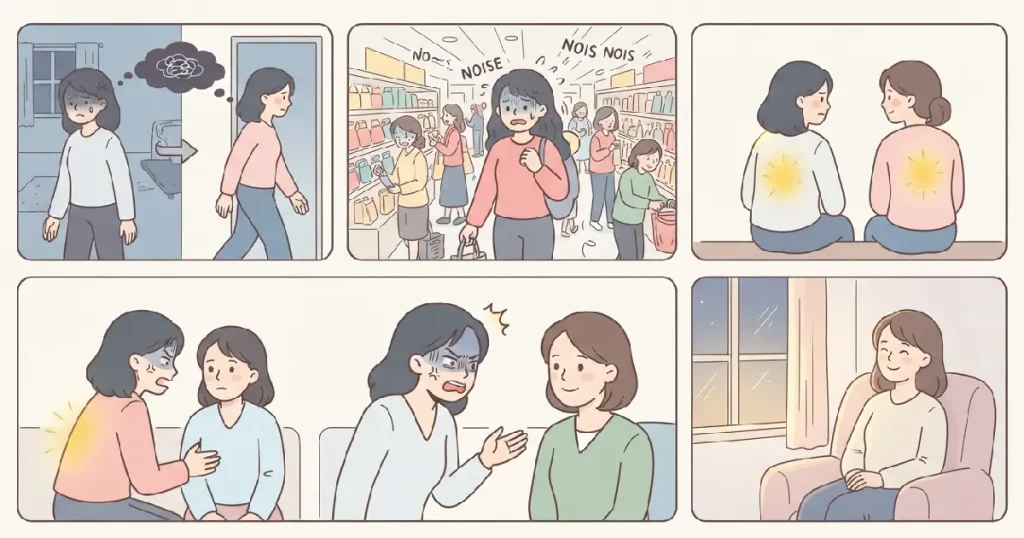
1. You Absorb Sudden Emotional Shifts That Are Not Yours
You can feel steady and then, within minutes, feel heavy, sharp, or strangely sad for no reason you can name.
This is emotional contagion. It is the rapid transfer of feeling from one nervous system to another. You walk into a meeting fine. You leave with chest tightness because the person across the table is quietly furious. Most people in this situation do not realize the mood they brought home was never theirs.
The next time your state flips without a story, pause. Ask who you were just with. The answer is often sitting in the next room.
2. Crowded Places Trigger Immediate Sensory Overload
Malls, transit hubs, open offices, and busy restaurants do not just annoy you. They flood you.
Your system is taking in lights, voices, smells, and stray emotion at the same time. That pile-up is sensory overload, a state where the brain cannot sort incoming data fast enough. You may feel dizzy, irritable, or suddenly desperate to leave. This is not social failure. It is a nervous system hitting its limit.
If you need to recover after a simple errand, that is data. Your threshold is lower because your intake is higher.
3. You Mimic the Physical Aches of People Nearby
This is the sign most lists skip, and it is one of the clearest.
A physical empath, sometimes called a somatic empath, copies bodily states. Somatic means “of the body.” You stand next to a coworker with a migraine and your own temples start to pound. You sit with a parent who has back pain and your lower spine lights up. The symptom often fades after you leave, which is the giveaway that it was never fully yours.
In my practice I have seen this pattern so often it no longer surprises me. The body was telling the truth the mind had not named yet.
If a pain arrives with a person and leaves with them, treat it as borrowed until proven otherwise.
4. You Attract Unsolicited Confessions and Energy Vampires
Strangers tell you their life story on flights. Coworkers cry in your doorway. You become the unpaid therapist of every room you enter.
People feel safer around an open nervous system. That is a real gift. It is also why you can get pulled into loops with people who take without giving, including narcissistic partners who use your care as fuel. An energy vampire is anyone who leaves you emptier than they found you, again and again.
There is a darker twin of this gift worth naming. A dark empath has high cognitive empathy, meaning they can read feelings with skill, but they do not feel with you and they do not care for you. They use that reading for charm, control, or quiet manipulation. A compassionate empath feels the cost. A dark empath collects the map.
If people constantly unload on you, your openness is visible. Visibility without a boundary becomes a vacancy sign.
5. Solitude Is Not a Luxury. It Is Survival Medicine.
You do not need alone time because you dislike people. You need it because your system has to sort what it absorbed.
This is deeper than introversion. Introverts recharge from low stimulation. Empaths also have to separate their identity from the emotional clutter of the day. Without that quiet, you start to live as a collage of other people’s weather.
If a cancelled plan feels like relief in your bones, that is not selfish. That is your nervous system asking for a reset.
How INFJ and INFP Empaths Absorb Feelings Differently

Here is the piece most personality writing gets wrong.
If you lean INFJ, you often lead with extroverted feeling, or Fe. Fe reads the room first. You absorb the emotional climate directly, like walking into humidity. The feeling hits you from the outside in.
If you lean INFP, you often lead with introverted feeling, or Fi. Fi does not swallow the room whole. It maps the other person’s state onto your own inner values and then feels it from the inside out. You are not soaking. You are matching.
Both can look like the same tenderness from the outside. Inside, the work is different. The Fe empath needs to leave the weather. The Fi empath needs to unhook the match. Knowing which one you do saves you years of using the wrong fix.
That’s not weakness. That’s wiring.
Three Empath Subtypes You May Recognize
Most people with an empath personality type lean toward one of these, though they can overlap.
The emotional empath takes in grief, anger, joy, and anxiety from people and from whole rooms. You know the mood before anyone names it.
The physical or somatic empath copies illness, fatigue, and pain. Your body becomes the echo.
The intuitive empath knows. You feel a person’s motive under their pleasant words. You sense the lie before you can prove it. This is gut-level pattern recognition, not magic. Your brain has been collecting micro-signals for years and now it speaks in flashes.
None of these makes you broken. Each one asks for a different kind of care.
When Feeling Everything Became Elena’s Full-Time Job
Elena, 34, managed a small team and prided herself on being “the calm one.” By Thursday she could not tell her own tiredness from her staff’s panic. In meetings she left with other people’s headaches. At home she snapped at her partner and then cried because she could not explain why. One afternoon she sat in her car after a grocery run and realized she had been holding the cashier’s shame, a stranger’s hurry, and her mother’s worry from a morning phone call. She wrote the three feelings down and crossed out the ones that were not hers. Two of them lifted within minutes. The third, her own, she could finally tend. Elena did not become less caring. She became accurate.
Why the Empath Personality Type Leads to Burnout
Sensitivity is a double-edged sword. It gives you rich inner life, creative depth, and a rare ability to make people feel seen. It also taxes the body.
A 2025 study in Nature Scientific Reports found that high sensory processing sensitivity is linked to stronger negative emotion, chronic stress, emotional loneliness, and body-based illness when it goes unmanaged. Left alone, this pattern does not just make you tired. It can quietly become the reason relationships thin out and your health starts to speak.
The danger is not that you feel. The danger is that you never put anything back down.
You cannot stay an open microphone in every room and expect a clear recording of your own life.
How to Thrive With an Empath Personality Type
You do not need a new personality. You need a few repeatable moves.
The Behavioral No. Imaginary shields sound soothing and wear you out. A firm, spoken no does the real work. Dr. Judith Orloff has long argued that private space and a clear no are practical tools, not personality defects. “I can’t take this on today” is a complete sentence. Try it once this week on a request that makes your stomach drop.
Emotional Sifting. When your mood flips, ask: “Is this mine, or am I carrying it?” Write the feeling in one line. If it arrived with a person, label it borrowed and set the page aside. This is not journaling for beauty. It is a discharge valve.
Strategic Solitude. Treat alone time as clinical processing, not a guilty extra. Twenty quiet minutes after a hard conversation can do more than an entire weekend of half-present socializing. Sit. Let the borrowed weather leave. Notice what remains.
Sensory Nutrition. Give your system even input. A weighted blanket uses deep pressure to settle an overactive nervous system. Steady brown noise can mask the jagged sounds that keep you braced. These are not indulgences. They are volume knobs.
A useful question for tonight: Which feeling did I bring home that was never mine?
You Can Keep the Gift Without Sinking
Remember that room from the beginning? The heavy air. The unsaid fight. The tightness in your chest.
You will still feel it. That part is the wiring. What changes is the next move. You notice the shift, name it as weather that is not yours, and walk out without taking the whole storm home.
You were never too much. You were a microphone with no filter. Now you get to choose what you record.
My Closing Remarks
I have sat with enough exhausted kind people to know this: the ones who feel everything are rarely the ones who were loved too well for it. If you saw yourself in these signs, you are not behind. You were just never handed a manual for a sensitive nervous system. Start with one honest no and one quiet hour. Let that be enough for this week. Your depth does not owe the world unlimited access. It owes you a life you can actually live inside.
More Related Stories for You
- If you keep giving your nervous system to people who only know how to take, it helps to learn the qualities of a good partner before you confuse intensity with safety.
About The Author