
 David Wall
A Fair Chore Split Isn’t About Equal Tasks. It’s About Equal Rest.
Key Points
- Learning how to split chores with partner successfully means dividing full ownership of tasks, not just the tasks themselves.
- The happiest couples don’t aim for a 50/50 chore chart. They aim for equal free time and equal mental rest at the end of the day.
- A quarterly check-in, not a one-time agreement, is what keeps any household system from quietly falling apart.
Contents
Table of Contents
We’ve all watched a couple bicker over a sink full of dishes and wondered how something so small could turn into something so loud. It’s never really about the dishes.
If you’re reading this, you already know that feeling. You’ve tried talking about it. You’ve tried a chore chart that lasted eleven days. You’ve tried keeping quiet, then exploding over something absurd, like a cabinet door left open.
You start to wonder if you’re just too particular, or if your partner is just checked out. Neither is usually true.
The short answer: the most effective way to split chores with a partner is to stop counting tasks and start assigning full ownership, from noticing a job needs doing to finishing it completely. Couples who divide labor this way report far less daily friction than couples who simply take turns.
Why Splitting Chores 50/50 Actually Backfires
Most couples chase a 50/50 split because it feels fair on paper. In practice, it rarely holds up.
Here’s why. A chore isn’t one action. It’s a chain of small decisions that happen before you ever pick up a sponge. Someone has to notice the dishwasher needs emptying. Someone has to remember it’s trash night. Someone has to plan dinner three days out so there’s actually food in the fridge.
Psychologists call this ongoing background thinking cognitive labor, meaning the mental work of noticing, planning, and tracking household needs, separate from the physical act of doing them. Data from the U.S. Bureau of Labor Statistics’ American Time Use Survey shows that even in homes where physical chores look evenly split, one partner still carries most of this invisible planning weight.
The Free-Time Parity Audit: A Better Way to Divide Household Chores
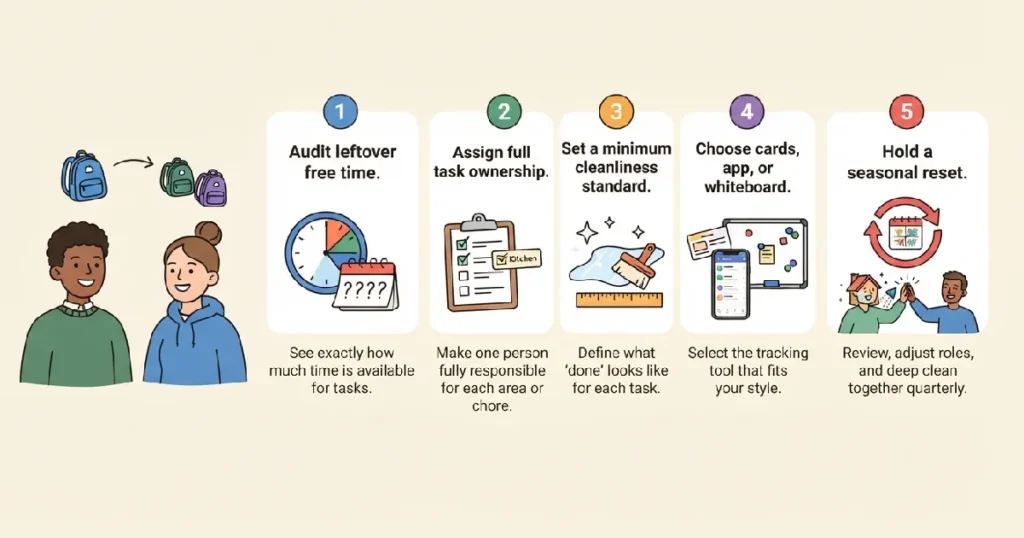
Instead of counting tasks, try counting hours left over. For one week, track your total load: your job, your chores, your childcare, all of it. Then compare your leftover free time to your partner’s.
If you’re working 50 hours a week and your partner works 30, matching you on vacuuming isn’t fair. Matching your remaining hours of rest is. This is what researchers mean by equity rather than equality: not identical treatment, but a balanced outcome once every factor is weighed.
Why a Bigger Paycheck Doesn’t Buy You Out of Household Labor
If one of you earns significantly more, it’s tempting to treat that as a built-in exemption. Data from Pew Research Center shows this exact pattern across dual-earner households, where higher income rarely translates into a proportional drop in domestic hours for the lower earner, and it doesn’t increase them for the higher earner either. Everyone ends up doing less than they should.
Money can buy convenience. It cannot buy immunity. A bigger income can fund a cleaning service or a dishwasher repair. It doesn’t erase the daily need to plan meals, notice what’s low, or take out the trash.
The Mental Load: The Invisible Work Behind Every Chore Split
Here’s what almost no one tells you.
Your partner might genuinely believe they’re pulling their weight, and in a narrow sense, they might be right. They do the dishes when asked. They vacuum when reminded. What they’re missing is the noticing, the remembering, and the planning that happens before any of that.
A 2024 study published in the Journal of Marriage and Family found that women in heterosexual couples still perform roughly 65 percent of this cognitive labor, even in households where physical chores appear evenly matched. That gap is exhausting in a way that’s hard to name, because there’s no visible task to point to. It’s not laziness on either side. It’s an invisible division that never got discussed out loud.
Think of it like the background apps running on a phone. You can’t see them working, but they’re draining the battery all day long, and by evening there’s nothing left, even though it doesn’t look like much happened.
The fix isn’t a longer chore list. It’s what I call the Full Ownership Rule: whoever owns a task owns the entire chain, from idea to finish, not just the physical step someone else assigned them.
Owning “kids’ lunches” under this rule means planning the menu, buying the ingredients, packing the bag, and washing the container that night. It does not mean waiting to be told what to pack. Once a task has one true owner from start to finish, the mental noticing disappears from the other partner’s mind completely. That’s the whole point.
How to Split Chores With Your Partner Based on Preference, Not Gender
Most couples default to whoever’s parent did a task growing up, or whoever complained first. Neither is a good system.
Try this instead. Each of you writes three short lists: tasks you don’t mind, tasks you actually don’t hate, and tasks you truly despise. Then swap your “despise” lists.
Often, the chore you dread is one your partner barely notices. Maybe you hate laundry but don’t mind dishes. Maybe your partner finds vacuuming oddly calming but can’t stand meal planning. Assign based on that overlap, not tradition.
This one exercise alone resolves more resentment than most couples expect, because it replaces silent assumption with an actual conversation.
When You and Your Partner Have Different Cleanliness Standards
If you’ve ever thought “why does this bother them so much” or “why don’t they care at all,” you’re dealing with what the Gottman Institute calls a perpetual problem, a personality-based difference that never fully resolves, only gets managed. Their research links these unresolved differences to roughly 69 percent of recurring couple arguments, and cleanliness standards sit right at the center of that category.
Your partner isn’t lazy. You’re probably not controlling. You just grew up with different definitions of “clean enough.”
The Minimum Viable Standard Exercise for Dividing Housework Fairly
Set a timer for five minutes. Each of you writes down the bare minimum acceptable state for the kitchen, the bathroom, and the living room, independently, without comparing notes.
Then trade papers. Wherever your standards overlap, that becomes the household rule, non-negotiable for both of you. Anything above that overlap is a personal preference, which means whoever wants it done that way does it themselves, without commentary.
Knowing When to Speak Up and When to Let It Go
Not every difference needs a conversation. If the bed is unmade but the bathroom is clean, that’s probably a preference issue, not a standards violation. Save your energy for the things that actually cross the agreed minimum. That distinction alone prevents most nightly arguments before they start.
The Best Systems for Splitting Household Chores: Cards, Apps, and Charts

Philosophy only gets you so far. At some point you need an actual tool.
Fair Play, the card-based system created by Eve Rodsky, assigns each household task its own card covering the full ownership chain. It works best for couples without small children who want a structured, tactile system they can return to often.
Shared apps like Sweepy or OurHome build in automatic reminders and rotation schedules, which suits tech-comfortable households or anyone managing chores alongside a demanding job. A simple shared whiteboard works just as well for visual thinkers who want something they see every morning without opening an app.
None of these tools fix anything by themselves. What they do is force the conversation about ownership to happen once, clearly, instead of never.
Outsourcing Chores Without Guilt: Buying Back Your Peace
Maya and Daniel had been together six years and argued about the same three chores every single week. Maya, a lawyer working 55-hour weeks, felt permanently behind. Daniel, a teacher with more flexible hours, felt criticized no matter what he did.
In one session, they ran the numbers on a $120 biweekly cleaning service against the three hours a week they spent arguing about dust and dishes instead. Once they framed it that way, hiring help stopped feeling like failure and started feeling like math.
The American Psychological Association’s Stress in America report links chronic household-management stress to measurable increases in cortisol, the body’s primary stress hormone, along with lower relationship satisfaction overall. A robot vacuum, a dishwasher upgrade, or a biweekly cleaning visit isn’t indulgence. It’s a documented way to lower the physiological cost of running a home.
If a $40-an-hour argument disappears because you spent $30 on a service, that’s not a splurge. That’s a fair trade.
How to Talk About Splitting Chores Without Starting a Fight
You know what needs to change. The hard part is bringing it up without triggering a defensive wall before you’ve finished your sentence.
Gottman’s research found that conversations opening with criticism, like “you never do the dishes,” trigger a defensive response almost every time. A softer opening changes the entire trajectory of the talk.
For couples just moving in together, try: “I want us to build a system before bad habits set in, not after.” For exhausted parents, try: “I’m not asking you to do more. I’m asking us to figure out what full is, for both of us.” For couples with an income gap, try: “Your paycheck covers more bills. I still need you present for the daily stuff.”
Each one opens a door instead of a fight.
Keep the System Alive: Revisit Your Chore Split Every Season
Whatever you agree on today won’t fit your life in a year. Longitudinal research from the University of Michigan’s Panel Study of Income Dynamics found that chore arrangements left unexamined for over twelve months correlate with a measurable rise in reported resentment.
A new baby, a promotion, a health scare, all of it quietly breaks a system that once worked fine. Set a 30-minute check-in every season. Ask each other five questions: What’s working? What’s not? What feels heavier than it should? What can we drop entirely? What needs a new owner?
Treat your chore system like a living agreement, not a contract carved in stone.
Where to Start Tonight

You don’t need to overhaul your entire household by morning. One place to start is the Ten-Minute Task Audit: sit down tonight and each write out every chore you handle in a normal week, including the invisible ones like meal planning or remembering appointments.
Compare lists side by side. You’ll likely both be surprised by what the other one is actually carrying.
Consider trying the Free-Time Parity Audit for just seven days before you assign anything permanently. A useful question to ask yourself before that talk: am I keeping score, or am I trying to understand what my partner’s day actually looks like?
The next time a chore conversation starts to tense up, try naming the real issue out loud: “I don’t think this is about the dishes.” More often than not, it isn’t.
The Real Goal Was Never a Perfectly Even Chart
Picture that same kitchen from the beginning, the one with the sink full of dishes and two exhausted people standing near it. Nothing about the mess has changed. What’s changed is that you both know what you’re actually fighting about, and you have language for it now.
A fair chore split was never about matching numbers on a whiteboard. It was always about making sure neither of you carries the whole house alone in your head at 11 p.m.
That’s the real finish line. Not equal chores. Equal rest.
My Closing Remarks: I’ve sat across from couples who could recite their chore chart perfectly and still felt completely alone in their own kitchen. The chart was never the problem. Nobody had ever said out loud who was carrying the thinking. Say it out loud tonight. It changes more than you’d expect.
If you’re struggling with ongoing conflict around household roles, consider speaking with a licensed couples therapist.
More Related Stories for You
- Before you settle into a long-term chore system, it helps to know what other big things to discuss before marriage might be sitting quietly unspoken in your relationship.
About The Author