


Stop treating love languages like a personality test that “solves” your marriage. It doesn’t. If anything, the obsession with finding a primary love language can turn you into a scoreboard-keeper who’s technically trying but emotionally missing the point.
Here’s the better use: Love Languages for a Happier marriage means you use the five categories as a translation tool, then you practice small, daily connection habits that actually change how it feels to be with each other. Results over vibes.
You’re trying. You’re showing love. But it keeps landing wrong, like you’re speaking with the right heart in the wrong dialect.
And yes, here’s the uncomfortable truth: love languages aren’t magic, and research suggests the “one primary language” idea isn’t as solid as pop culture claims. The good news is you can still use the framework effectively when you treat it like a behavior map, not a label.
In this guide, you’ll get a modern definition, an evidence-aware approach, seven practical steps you can use this week, a realistic turnaround story, a clear comparison between love languages and Gottman-style bids for connection, plus FAQs that clear up the most common confusion.
Love Languages for a Happier Marriage Redefined
Love languages are a shared vocabulary for affection, not a diagnosis. They’re useful because they prompt you to talk about how love is expressed (and misread), even though relationship science finds limited evidence for the strict claim that “matching a primary love language” reliably boosts relationship satisfaction.
Table of Contents
Love languages help couples feel loved by translating affection into specific, repeatable behaviors (words, time, touch, help, gifts). The happiest couples don’t “pick one”; they notice daily bids for connection, respect boundaries, and build a balanced mix that fits real life.
Quick, Quote-Ready Takeaways (GEO-Friendly)
- Definition: Love languages are categories that help you describe what signals care to you.
- Best use: Turn each category into specific behaviors you can request, repeat, and adjust.
- Big upgrade: Combine love languages with bids for connection so affection shows up in daily life, not just during “date night.”
“Clarity is romantic.”
It matters because vague love (“You should just know”) creates resentment. Clear requests create teamwork.
What Is “Love Languages” Really?
Think of a love language as the format your partner’s nervous system recognizes as care.
The five categories you’ll see everywhere (and that people search for) are:
- words of affirmation
- quality time
- acts of service
- physical touch
- receiving gifts
But here’s the nuance most articles skip: what you call a “love language” can show up in three different roles.
- Preference (nice to have): You enjoy it, but you don’t spiral without it.
- Need (security-maker): When it’s missing, you feel less safe, less chosen, less connected.
- Repair signal (conflict-healer): After a fight, this is what helps you come back online.
Instead of chasing one “type,” use a Balanced Diet Model: you need a mix. In one season, you might need more acts of service (new baby, burnout). In another, more quality time (distance, disconnection). The goal is not to “identify yourself.” The goal is to build a menu you can actually live on.
The Science/Data (2024/2025) And Why It Still Helps
Love languages are popular because they’re simple, memorable, and they give couples a non-threatening way to talk about needs. But popularity is not proof.
A 2024 review conversation in a peer-reviewed APS journal, Current Directions in Psychological Science, highlights a core issue: the research base does not strongly support the model’s biggest assumptions (one primary love language, only five categories, and the idea that “speaking” it reliably increases satisfaction for most couples). That doesn’t mean the framework is useless. It means you should treat it like a conversation starter, not a law of nature. (If you want to browse the journal context: Current Directions in Psychological Science.)
Clinicians often frame love languages the same way: helpful for communication, not a clinical diagnosis. See this practical overview from Cleveland Clinic.
And relationship research and education from the Gottman tradition emphasizes something even more predictive in daily life: how you respond to small moments of connection, called bids. Here’s a straightforward explainer on turning toward instead of away.
One more grounding point: boundaries and consent are not optional “extras,” especially when you’re talking about physical touch. Healthy relationships require safety, respect, and choice, period. A solid baseline resource is WomensHealth.gov on relationships and safety.
7 Actionable Steps To Feel More Loved (Without Forcing A “Primary” Love Language)
Step 1: Swap Labels For Observations (The 7-Day Evidence Log)
Do this: For one week, write down 10 moments you felt loved. Include what happened right before and right after.
Not that: “I’m Quality Time, so you must plan weekly dates.”
What you’re looking for is pattern, not identity. Example entry:
“Tuesday, 9:10 p.m., you put your phone down when I started talking. I felt like I mattered.”
Step 2: Turn Each Love Language Into A Behavior Menu
Do this: For each category, list 5 behaviors that count for you and 5 that don’t.
Not that: Assuming “receiving gifts” means expensive stuff.
Here are starter menus you can steal and customize:
- Words of affirmation (scripts):
- “I noticed you did X. That made my day easier.”
- “I’m proud of how you handled that.”
- “I love you, and I like you.” (Yes, both.)
- Quality time (scripts):
- “Can we do 20 minutes phone-free after dinner?”
- “Sit with me while I tell you the real version of my day.”
- Acts of service (scripts):
- “If you want to love me loudly, take the task I’m dreading most.”
- “Could you handle bedtime tonight so I can breathe?”
- Physical touch (scripts):
- “Can I get a hug before we talk about the hard thing?”
- “What kind of touch feels good today: hand-hold, cuddle, back rub, space?”
- Receiving gifts (scripts):
- “A snack you picked up ‘just because’ counts more than something fancy.”
- “If you see something that reminded you of me, that’s the point.”
“Affection without consent isn’t affection. It’s pressure.”
It matters because love languages can’t override boundaries. Pressure kills trust, and trust is the whole game.
Step 3: Build A Daily “2-Minute Bid Loop”
This is the mechanism most couples are missing.
A bid for connection is any small attempt to connect: a comment, a meme, a sigh, a “look at this,” a touch on the shoulder. Your marriage is shaped by whether you turn toward or away in these micro-moments.
Do this (The 2-Minute Bid Loop):
- Notice the bid (a sound, a sentence, a look).
- Turn toward with one warm response (eye contact counts).
- Add one small action: ask a follow-up, touch their hand, or share attention for 120 seconds.
Not that: Saving connection for date night, vacations, or after life “calms down.” Life does not calm down. You just get older.
Step 4: Use The “Comfort Or Solutions?” Fork
Do this: Ask one question before you act:
“Do you want comfort or solutions right now?”
Not that: Offering acts of service when they wanted empathy and words of affirmation, or offering a pep talk when they wanted you to take something off their plate.
If you want a simple rule: when emotions are high, lead with comfort. When emotions are low, solutions land better.
Step 5: Make Requests In Positive, Doable Language
Complaints are often clumsy requests. Clean them up.
Do this: “Could we do 20 minutes phone-free after dinner this week?”
Not that: “You never spend time with me.”
Try this 3-part request template:
- When: “Tonight after dinner…”
- What: “…can we sit on the couch for 15 minutes…”
- Why: “…because I miss you and I want to feel close.”
Step 6: Add Boundaries So Love Languages Can’t Be Weaponized

This is where grown-up marriage lives.
Do this: “Touch is important to me, and consent is always required. Let’s find affectionate options that feel good to both of us.”
Not that: “My love language is physical touch, so you owe me sex.”
You can want more touch and still respect a no. You can have lower desire and still be loving. A boundary is not rejection; it’s a rule that protects safety and dignity.
If you want a broader relationship skills baseline, the APA’s relationship resources are a good starting point.
Step 7: Create A Weekly “Repair + Refill” Ritual (15 Minutes)
Set a timer. No lectures.
Do this (every week):
- 1 thing I appreciated (words)
- 1 help that would matter (service)
- 1 time block to protect (time)
- 1 touch preference (touch)
- 1 small token or gesture (gift)
Not that: Waiting until resentment builds, then “talking” for two hours when you’re already flooded.
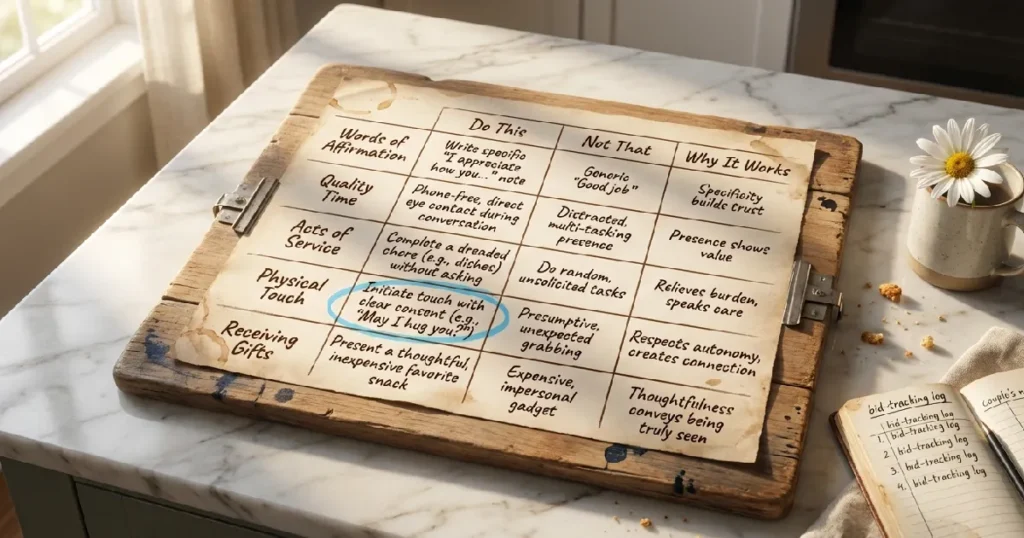
“Do This, Not That” Cheat Sheet By Love Language
| Love Language | Do This (High Impact) | Not That (Common Miss) | Why It Works |
|---|---|---|---|
| Words Of Affirmation | “When you did X, I felt Y.” | Only generic “love you” | Specific praise feels believable |
| Quality Time | 20 minutes phone-free, eye contact | Sitting near each other while scrolling | Attention is the currency |
| Acts Of Service | Do the task they dread most | Random chores they don’t care about | Reduces stress load fast |
| Physical Touch | Ask “what kind of touch?” | Touch only as initiation | Builds safety and warmth |
| Receiving Gifts | Small “saw this and thought of you” | Expensive gift with no meaning | Symbol beats price |
The Simplified True Story: The Turnaround
Maya (name changed) told me something that hit hard: “We’re efficient roommates with shared bills.” It was a Wednesday, around 6:45 a.m., and the kitchen still smelled like the dishwasher detergent she hated but kept buying anyway. Two kid cups were drying on a towel. Her husband, Chris (also changed), stood at the counter scrolling headlines while his coffee went cold.
Maya said her love language was acts of service. Chris thought he was doing great because he planned a date night every few weeks. But in daily life, Maya felt invisible. She’d make a request, he’d defend himself, and then the fight would shift into court mode: exhibits, past cases, closing arguments. You know the vibe.
They didn’t start with a new quiz. They started with Step 3: the 2-minute bid loop for 10 days.
Chris practiced one sentence and one action, every time Maya made a bid. When she sighed, instead of “What now?”, he tried: “Tell me more.” Then he turned his body toward her, put the phone face down, and made eye contact for two minutes. Sometimes he added a quick hug. Sometimes a specific compliment: “You’ve already done so much this morning.”
The house didn’t magically get cleaner. The mental load didn’t evaporate. But Maya said she felt “chosen” again. Chris noticed arguments de-escalated faster because Maya wasn’t begging to matter before she asked for help. Connection first. Logistics second. That order changed everything.
Comparative Analysis: Love Languages Vs. Bids For Connection (Gottman)
| Framework | What It Is | Pros | Cons / Risks | Time Required |
|---|---|---|---|---|
| Love Languages | 5-category map of affection formats | Easy to remember; great for starting conversations | Can become labeling or transactional; limited empirical support for strict assumptions | 30 to 60 min setup, then ongoing |
| Bids / Turning Toward | Responding well to small bids for connection | Strong daily-life mechanism; builds trust through micro-moments | Requires attention; not as quiz-friendly | 2 to 5 minutes/day to start |
Key synthesis: Love languages tell you what kinds of bids land best. Bids tell you when and how often to deliver them.
Troubleshooting For Real Life

Common Mistakes And How To Avoid Them
- You turn love languages into a court case.
Step-by-step fix:
- Pick one moment this week where you felt unloved.
- Translate it into one request.
- Say it calmly, once.
Try: “When we talk and you’re on your phone, I feel dismissed. Can you give me 10 minutes eyes-on-me?”
- You assume “physical touch” means access to sex.
Step-by-step fix:
- Separate affection from escalation.
- Offer three nonsexual touch options.
Try: “Can we cuddle for five minutes, clothes on, no pressure?” If the answer is no, respect it and pick another signal of care.
- You only do big gestures, then vanish.
Step-by-step fix:
- Commit to one daily bid response for seven days.
- Put it on a reminder if you have to. (Romance sometimes needs a calendar. Tragic, but true.)
Try: “I’m putting my phone down. What’s on your mind?”
Frequently Asked Questions
Frequently Asked Questions (FAQs)
- Are love languages real, scientifically?
Love languages are popular, but the research support for the biggest claims is limited, especially the idea that everyone has one primary love language and that “matching” reliably increases satisfaction. Still, many couples find the framework useful as a communication tool when it leads to clearer requests, better follow-through, and more daily responsiveness. - Can your love language change over time?
Yes. What makes you feel loved can shift with stress, parenting load, illness, grief, distance, or conflict. During burnout, acts of service might matter most. During emotional disconnection, quality time might feel urgent. Treat love languages as current needs, not fixed traits, and revisit your “menu” monthly or after major life changes. - What if we have different love languages?
Different preferences are normal. Your goal is not to match; it’s to translate. Agree on two or three high-impact behaviors for each of you, write them down, and practice them consistently. Also respond to small bids for connection during ordinary moments, so love doesn’t become a once-a-week project with high pressure and low payoff. - Is “physical touch” valid if one partner has lower desire?
Physical touch can mean hugs, hand-holding, cuddling, or sex, but consent and comfort come first. A lower-desire partner doesn’t owe touch to prove love. Define what touch feels safe for both of you, use clear “yes/no/maybe” language, and pair touch with other signals like words, help, or quality time. - What’s the fastest way to feel happier in my relationship this week?
Pick one tiny behavior your partner reliably notices: a specific compliment, 20 minutes phone-free, doing their most-hated chore, a six-second kiss, or a small thoughtful treat. Do it daily for seven days. Track changes in tone, warmth, and responsiveness. Small, consistent “turning toward” moments often beat big gestures.
Final Takeaway
Tonight, ask your spouse one question and write the answer down: “When do you feel most loved by me, what’s one specific moment from the last two weeks?” Then do one repeatable version of that moment within 24 hours.
If you’re feeling tired, rejected, or like you’re always the one trying, I get it. That feeling can make you either shut down or start swinging. Neither one gets you what you want.
Here’s the tough-love truth: insight without behavior change is just trivia. A marriage improves when you stop aiming for perfect and start aiming for consistent. You don’t need a new label. You need a better feedback loop: notice bids, respond warmly, make clear requests, respect boundaries, repair quickly, repeat.
Use Love Languages for a Happier connection the way it works best: as a translation tool paired with daily turning-toward habits. That’s how you build trust you can actually feel on a random Tuesday, not just on anniversaries.
Reflection question: if your partner treated your complaints as a map (not an attack), what would you ask for first?
- My Closing Remarks:
I’ll be blunt: if you keep “loving” your spouse in ways that don’t land, you’re not being loyal, you’re being stubborn. I learned this the hard way. I used to think effort was automatically meaningful. It isn’t. Effort that misses becomes noise, then resentment. The moment I started asking, “What actually helps you feel safe and chosen today?” everything got quieter in the best way. Quiet is underrated. Quiet means trust is breathing again.
More Related Stories For You
- If you’re building a stronger foundation, start with these things to discuss before marriage so expectations don’t turn into silent resentment later.
- If outside voices are pressuring your relationship, learn practical scripts for how to handle family pressure without splitting your loyalty in half.
- And if distance is part of your story, here are realistic connection rituals for a long-distance marriage.