
 Sara Carmen
Your home can easily feel loud, tense, rushed, or emotionally distant. Many families love each other deeply but still feel entirely disconnected when the front door closes. You might feel a heavy sense of guilt because you are trying hard every single day. Yet, the advice you hear online never seems to change your daily life.
Let me be blunt. Standard advice often fails because it treats connection like a rare event, not an ongoing system. You do not need more perfect family time or forced smiles. You need repeatable habits that create safety, trust, and faster recovery after stress.
You have probably already tried talking more, planning weekend outings, or simply asking everyone to be nicer to each other. What is usually missing is not love. What you lack is a practical rhythm for repair, regulation, and responsiveness.
Healthy Family Relationships grow through emotional safety, clear boundaries, responsive listening, shared rituals, and repair after conflict. Families do not need perfection. They need predictable habits that build trust, reduce defensiveness, and help every person feel respected, secure, and heard.
In this guide, we will cover exactly what makes a household system work. We will walk through 8 practical steps that actually work in real homes to build positive family relationships. I will show you a clear comparison between true connection and conflict avoidance. You will read a short human story about a mother who turned her house around. Finally, we will answer the most common questions you have been asking.
The Core Concept: Healthy Family Relationships Redefined
These connections are not just about getting along and smiling over dinner. They are reliable patterns of emotional safety, mutual respect, trust, flexibility, and repair that help each person feel secure enough to speak honestly and stay connected during heavy stress.
Table of Contents
What Is A True Family Connection Really?
Let us move far beyond the dictionary definition. It is not the absence of conflict. It is not constant harmony where everyone agrees perfectly. It is not parents controlling the emotional climate alone through strict rules.
It is a dynamic system where people feel completely safe to express bad feelings. They know disagreements can be handled respectfully. They trust that harsh mistakes can be repaired. They have both connection and strong boundaries. They feel seen as individuals, not just as roles they play to keep the peace.
These units take many beautiful shapes:
- Biological, blended, adoptive, or foster setups.
- Multigenerational living arrangements.
- Highly connected chosen families.
Real health in any relationship means balancing closeness and autonomy, warmth and structure, and honesty and kindness.
“True Connection Is Built In The Quiet Moments Of Daily Repair, Not In The Loud Moments Of Grand Gestures.”
This matters heavily because society sells us the lie that love requires massive financial effort. In reality, love requires simple, steady consistency.
The Science And Data Behind The Advice
Stable, supportive relationships physically buffer stress in the body. Predictable connection reliably supports emotional regulation. The2024 U.S. Surgeon General Advisory, “Parents Under Pressure,” clearly shows how caregiver stress heavily affects household functioning. When parents are overwhelmed, children feel the ripple effect instantly.
Reputable developmental science on resilience confirms this reality. Predictable routines and secure trust heavily improve long-term wellbeing. We need to focus on building positive communication, active listening, and strong emotional intelligence right at home. Quality time is great, but emotional safety matters far more.
8 Actionable Steps To Strengthen Trust And Daily Connection
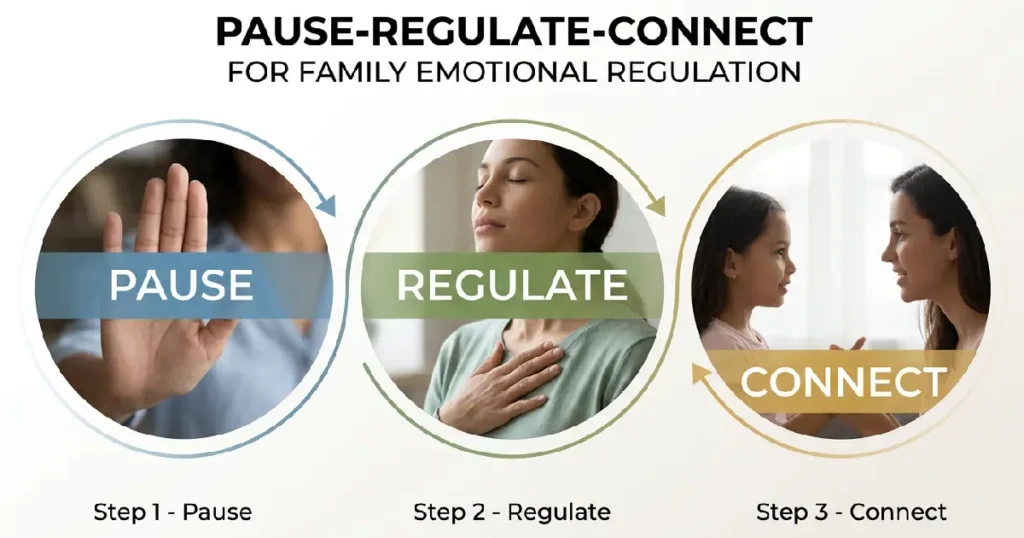
Let us get highly practical. Here is your list of immediate actions to improve family relationships.
Step 1: Create A 10-Minute Daily Connection Ritual
Connection grows far faster through daily consistency than weekend intensity. Small rituals instantly reduce the heavy pressure to create perfect, highly planned family moments.
- Do This: Pick one highly predictable time like after dinner, exactly before bed, at school pickup, or during morning breakfast. Ask two simple questions. “What felt good today?” and “What felt hard today?”
- Not That: Do not wait for summer vacations, free weekends, or that imaginary day when life finally calms down.
- Why It Works: Repetition quickly builds security. Short family rituals feel highly sustainable for incredibly busy schedules.
Step 2: Notice Bids For Connection And Answer Them
Many people ask for connection indirectly. They might show you a random video, tell a pointless story, joke around, sigh heavily, or act highly irritable.
- Do This: Pause what you are doing and respond using active constructive responding. Say, “Tell me more,” “That matters to me,” or “I am listening right now.”
- Not That: Do not only look up from your phone when their behavior becomes disruptive or highly annoying.
- Why It Works: Small moments of daily responsiveness prevent massive emotional distance from building up over the long years.
Step 3: Regulate First, Talk Second
Communication breaks down instantly when nervous systems are totally overloaded. Your household needs serious co-regulation, not just better vocabulary.
- Do This: Lower your physical voice. Sit directly beside the person rather than towering over them. Name the feeling honestly by saying, “You seem overwhelmed right now.” Use a long, quiet pause when needed.
- Not That: Do not lecture a crying child, an angry partner, or a shut-down teen at peak emotion. Do not demand instant calm while you are clearly escalating yourself.
- Why It Works: Calm brains solve complex problems much better than stressed brains. True emotional safety makes real listening actually possible. Think of a young child in a full grocery store meltdown, a teen shutting down after school, or a stressed adult returning from a brutal workday.
Step 4: Replace Blame With I Statements And Reflective Listening
Let us move from bitter accusation to absolute clarity. Building strong family relationships requires better mechanics.
- Do This: Say, “I feel highly stretched when everyone talks over each other.” Or try, “I need us to decide household chores together.” Always reflect back before responding by stating, “What I hear you saying is…”
- Not That: Stop saying, “You never listen to me,” or “You always ruin dinnertime.” Stop expecting your partner or kids to successfully read your mind.
- Why It Works: It instantly reduces high defensiveness. It directly builds deep trust and creates a safe and supportive environment.
- Practical Script Box: “When [action] happens, I feel [emotion]. I need [request]. Can we try [solution] tomorrow?”
Step 5: Make Repair After Conflict A Family Habit
Healthy groups do not avoid rupture. They actively practice rupture-and-repair. This is the exact piece of advice most internet guides miss completely.
- Do This: Repair the damage within 24 hours. Use a highly specific apology. Say, “I got too sharp earlier,” or “That was not fair to you,” or “I want to try again right now.” Always ask, “What would help next time?” Use the 3-Step Repair Loop: Acknowledge the hurt, own your exact part, and ask for a quick redo.
- Not That: Do not pretend nothing bad happened. Do not buy expensive gifts instead of simply apologizing. Do not force instant, fake forgiveness from anyone.
- Why It Works: Repair rebuilds trust much faster than perfection ever could. It teaches children and adults that heavy conflict resolution is entirely survivable.
“The Goal Is Not Fewer Mistakes. The Goal Is Faster And Healthier Repair.”
This heavily shifts how you view household arguments. It completely removes the heavy shame of fighting and replaces it with a clear, actionable plan.
Step 6: Build Two Anchor Rituals Every Week

You must differentiate true rituals from random, chaotic activities.
- Do This: Choose incredibly low-pressure rituals.
- Sunday morning pancakes together.
- A Friday evening walk around the block.
- Bedtime gratitude sharing.
- A weekly board game night.
- A short monthly check-in chat.
Tie these simple rituals directly to shared values like fun, faith, community service, active learning, or deep appreciation.
- Not That: Do not over-plan expensive, exhausting outings that end up creating far more financial stress than actual family bonding.
- Why It Works: Solid rituals create predictability, personal identity, and a fierce sense of belonging. They become solid emotional anchors during highly stressful seasons.
Step 7: Share Voice, Responsibility, And Problem-Solving
True teamwork requires everyone to actually pitch in and share the mental load.
- Do This: Hold a short, ten-minute weekly meeting. Co-create a few basic household guidelines together. Assign strictly age-appropriate chores. Let children and teens actively contribute fresh ideas.
- Not That: Do not make the home entirely top-down unless physical safety absolutely requires it. Do not assume that making someone “help out” equals making them actually feel included.
- Why It Works: Active participation increases personal ownership. Shared responsibility drastically reduces bitter resentment and exhausting power struggles. Healthy units are highly collaborative, not just loosely affectionate.
Step 8: Protect Connection With Boundaries Around Stress, Screens, And Disrespect
This step completely beats shallow, generic advice. You need serious psychological safety to thrive.
- Do This: Create strict screen-free zones or times. Protect tricky transitions like right after school, directly after work, and exactly before bed. Protect one-on-one time, especially with younger children who often compete for your attention. Set highly respectful rules for your tone and constant interruption.
- Not That: Do not confuse being in the exact same room with being emotionally present. Do not allow chronic sarcasm, deep contempt, or digital distraction to become the normal household baseline.
- Why It Works: Attachment security heavily depends on reliable boundaries. Firm boundaries actually make your warmth much more believable to everyone around you.
Comparison: Why Generic Advice Stalls Out
| Common Advice | Better Strategy | Why It Works Better |
| Spend more time together | Build a 10-minute daily ritual | Predictability easily beats occasional weekend intensity. |
| Communicate better | Use reflective listening and I statements | Gives tired readers a concrete, highly usable tool. |
| Stop arguing completely | Repair quickly after conflict | Conflict is highly normal; unrepaired conflict is damaging. |
| Plan fun family activities | Create heavily repeatable rituals | Less financial pressure, much more emotional consistency. |
| Be more positive daily | Regulate first, then talk | Physical calmness makes communication actually possible. |
| Set strict house rules | Co-create values and roles together | Increases rapid buy-in and a deep sense of belonging. |
The Simplified True Story: The Turnaround

Meet Nadia. She is a busy working mother in a blended family with two children, ages ten and fourteen. For long months, evenings in her home felt incredibly tense. Everyone was technically sitting together in the living room, but they remained entirely emotionally separate. Dinners were incredibly short, snappy, and usually followed by an uncomfortable, heavy silence.
It was a rainy Tuesday at 6:30 PM. Nadia stood near the kitchen counter, listening to the heavy clinking of forks against plates. Her teenage son sighed heavily and stared blankly at his glowing phone. Nadia kept planning bigger weekend activities to fix this distance, but weekday stress kept undoing all her hard work. She started panicking, worrying that her household was becoming permanently disconnected.
She decided to use exactly one tip from this exact framework: Step 5, which focuses heavily on active repair after conflict.
After a very loud argument with her fourteen-year-old over homework that same night, she stopped her usual habit of pretending it had not happened the next morning. Instead, she knocked quietly on his bedroom door.
She looked at him and said bluntly: “I got highly defensive earlier. I talked at you instead of actually listening to your stress. Can we restart this conversation tonight?”
Her teen did not magically open up instantly. But he put his phone down and stayed in the room. The next time they argued, the conflict ended much faster. Within a few short weeks, arguments felt significantly less threatening. Nadia told me the biggest change was entirely internal.
She said, “We stopped acting like conflict meant utter failure. We learned it could be successfully repaired.”
Comparative Analysis: Secure Connection Versus Conflict Avoidance
Many people mistakenly assume a totally quiet household is a healthy one. Actually, let me back up. Some homes look completely peaceful only because people are actively suppressing their real feelings. They spend long years walking on eggshells or avoiding hard, honest conversations simply to keep a totally fake sense of peace.
Let us break down the exact differences so you can accurately spot them in your own living room.
- Expression: In a healthy environment, feelings can be expressed respectfully without any fear of harsh punishment. In an avoidant home, feelings are constantly hidden to keep the quiet peace.
- Structure: When connection is highly secure, boundaries are crystal clear and discussed openly. When people heavily avoid conflict, boundaries remain incredibly vague, unspoken, or deeply resented.
- Friction: Healthy groups strictly allow disagreement, while avoidant groups fear disagreement like a deadly plague.
- Recovery: In strong homes, apologies and active repair happen incredibly fast. In avoidant ones, glaring problems get heavily minimized, swept completely under the rug, or ignored entirely.
- Growth: Trust grows directly through brutal honesty when things work well. Bitter resentment quickly grows under the surface when things look perfectly fine on the outside.
Ultimately, people feel highly secure and totally seen when they can be completely honest. They feel painfully careful, highly anxious, or totally emotionally alone when the peace is totally fake. If your home seems perfectly fine but no one can speak the hard truth, that is absolutely not health. The real goal is safe truth, not fake calm.
Common Mistakes And How To Avoid Them
Let us talk about where things usually fall completely apart. You are trying your absolute best, but you might be aggressively stepping into some very common emotional traps.
- Mistake 1: Fixing feelings instead of simply hearing them.
When someone you deeply love tells you they had a terrible day, your first instinct is probably to offer five different, highly logical solutions. Stop doing that right now. It makes the other person feel incredibly dismissed and totally unheard.
Step-by-step fix: The next time your partner or child complains, bite your tongue physically. Try this exact message: “That sounds completely exhausting. Do you want me to help you fix this, or do you just need to vent?” Usually, they just need you to listen quietly. - Mistake 2: Forced family fun.
You heavily pack everyone into the hot car for a massive Saturday outing. You spend way too much money, everyone gets incredibly tired, and a huge fight rapidly breaks out in the crowded parking lot. You forced the fun.
Step-by-step fix: Lower your high expectations immediately. Pick a totally free, twenty-minute activity right at home. Play exactly one card game or take a short, quiet walk around the block. You want zero-pressure interactions, not a huge Hollywood production. - Mistake 3: The silent treatment masquerading as real peace.
You might walk away from a heated fight and just ignore the person completely for two entire days because you think you are “keeping the peace.” Which, if you’ve ever dealt with this, you know is maddening.
Step-by-step fix: Take a strict twenty-minute cooldown break, but tell them clearly you are coming back. Say, “I am too angry to speak kindly right now. I need twenty minutes alone, and then we will finish this hard talk.” Never leave them guessing.
Frequently Asked Questions (FAQs)
1) What are the signs of a well-functioning household?
A strong home usually shows five distinct patterns: absolute emotional safety, respectful daily communication, incredibly reliable boundaries, deep trust, and fast repair after conflict. That absolutely does not mean everyone agrees all the time. It means people feel completely heard, can express needs without any fear, and know problems will get addressed immediately rather than being ignored.
2) How can busy families strengthen relationships without adding a lot more to their schedule?
If your weekly schedule is packed tightly, aim for daily consistency over duration. A highly predictable ten-minute ritual right after dinner, exactly at bedtime, or in the car can strengthen your connection far more than occasional big outings. Ask one open question, listen closely without fixing, and always end with genuine appreciation to build strong daily habits.
3) What should you do when family conversations keep turning into arguments?
When conversations continuously turn into arguments, stop focusing on the topic immediately and tightly regulate the tone. Lower your voice physically, take a pause, honestly name what you are feeling, and use an I statement. If anyone gets highly flooded, take a short break and return at a firmly set time later. Regulating the body stops the yelling.
4) Are disagreement and boundaries normal in healthy families?
Yes. In fact, heavy disagreement is totally normal and often quite healthy when it gets handled with deep respect. Strong homes allow very different opinions, strictly age-appropriate boundaries, and brutally honest emotions. The exact goal is not constant harmony. The goal is building secure connection where people can safely say no, own their mistakes, and move forward.
5) When is family counseling a good idea?
Consider professional family counseling when heavy conflict stays highly intense, communication feels permanently unsafe, a child seems persistently withdrawn or fearful, or the exact same issues repeat constantly without progress. Support is incredibly wise after divorce, heavy grief, trauma, addiction, or major life changes. Therapy is a structured place to safely rebuild trust and heavily repair connection.
Final Takeaway
Do not just read this article and quickly move on with your incredibly busy day. I want you to take one immediate, highly specific action. Ask yourself honestly right now: are you building a home where people feel completely safe to fail?
Tonight, ask exactly one person in your house this exact question: “What felt terribly heavy today, and what would help tomorrow feel just five percent easier?”
Then do one very hard thing. Just listen closely without completely interrupting them. Do not try to fix their heavy problem immediately. Simply reflect back exactly what you clearly heard them say.
Building Healthy Family Relationships does not magically change in one grand, highly cinematic moment. It changes directly in incredibly small moments that you repeat heavily on purpose every single day.
My Closing Remarks
Let me tell you the honest truth. I might be wrong about this, but I strongly believe you cannot force people to completely change, but you can absolutely change the physical environment they currently live in. Growing up, I watched so many families rip themselves completely apart simply because nobody was willing to be the very first one to say, “I was terribly wrong.” Stubborn pride destroys far more homes than quick anger ever will. Stop waiting for the other person to make the first move. Be the brave one. Apologize first today. Set the boundary first. Change the rhythm yourself, and watch how quickly the rest of the house falls right into line.
More Related Stories For You
If you are actively trying to understand how totally different dynamics heavily impact your household, you definitely need to read more.
- I highly recommend checking out how bipolar disorder and relationships heavily intersect, as mental health completely shifts how we daily communicate.
- Furthermore, if you desperately want a broader guide, check out our highly practical piece on exactly how to have good relationships in every single area of your life.
- Finally, do not ignore the glowing digital elephant in the room; deeply understand the intense social media effects on relationships before glowing screens tear your hard progress completely apart.
About The Author