
 David Wall
You have been sold a soft lie: that love, by itself, should make relationships easy. If that were true, you would not be up at night googling How to Have Good Relationships while lying next to someone who feels miles away.
You can love someone and still feel lonely beside them. You can “communicate” all day and still miss each other. You can schedule date nights, say you are grateful, try to “be less sensitive,” and yet the whole thing still feels fragile. You are not broken. Your relationship system is.
Most relationships do not collapse from one dramatic betrayal. They wear down from thousands of tiny moments where one person reaches out and the other does not respond, or responds badly. Those micro-misses stack up. This is why “communicate better” is useless advice. It has no gears.
Good relationships are built by consistent responsiveness, quick repair after conflict, fair boundaries, and daily “turning toward” small bids for connection. When you practice these skills, trust grows, resentment shrinks, and intimacy becomes reliable, even during stressful seasons.
In this guide, you will get a simple relationship operating system. You will see a clear definition of what “good” actually means, the science behind it, nine concrete steps with “Do this, not that,” one true-to-life turnaround story, a comparison table, FAQs, and one small task you can try tonight.
The Core Concept: How To Have Good Relationships Redefined
At its core, having good relationships with partners, friends, family, and coworkers means you create a repeated experience of emotional safety, mutual respect, responsiveness, and repair. It does not mean you never fight. It means you know how to recover well, keep power reasonably fair, and maintain more positive connection than negative friction, especially when life is heavy.
Table of Contents
Think of it as a simple “Relationship OS” built on five pillars:
- You respond to each other’s needs often enough that both feel cared for.
- You use active listening and “I” statements instead of blame.
- You set and respect boundaries that keep both people free and safe.
- You use early repair attempts when conflict starts to spin.
- You pay attention to power, gratitude, and fairness, not just feelings.
What Is “Good Relationships” Really?
Let’s translate the buzzwords into something you can test in real life.
- “Good” = Predictable Care
You can reach for the other person and they respond reasonably often. Not perfectly. Not always. Often. You feel seen, not treated as an afterthought. - “Healthy” = Freedom And Fairness
Boundaries are respected. There is no coercion, no silent control games. You both keep your autonomy, and consent matters in decisions about time, money, sex, and family. - “Lasting” = Repair Capacity
Conflict becomes a skill moment, not a character trial. You can say “I messed up,” use a repair attempt, cool down, and come back. Problems turn into “us vs the problem,” not “me vs you.”
“Love that lasts is less about dramatic gestures and more about reliable patterns.”
That line matters because your future is built from what you repeat on regular Tuesdays, not from anniversaries or apologies after a blow-up.
The Science / Data
A few research points to keep us honest:
- A 2024 paper in Scientific Reports found that gratitude is linked to relationship satisfaction mainly through perceived partner responsiveness. When one person holds most of the power, that gratitude effect weakens, which means “just be grateful” falls flat if the dynamic is unfair. You can read about the journal here: Scientific Reports.
- Work from the Gottman Institute shows stable couples tend to respond to each other’s bids for connection and keep roughly a 5-to-1 ratio of positive to negative interactions during conflict.
- Harvard researchers have linked strong social ties with better physical and mental health over the long term, not just happier feelings in the moment Harvard Health.
- Public health sources such as the CDC and university counseling centers highlight emotional safety, communication skills, and respect for boundaries as core markers of healthy relationships.
These findings line up: active listening, clear “I” statements, boundaries, early repair attempts, and responsiveness to bids are not cute extras. They are the structure that holds everything up.
9 Actionable Steps To Build Relationships That Last
Here is the operating system in nine moves. Each one includes “Do this, not that” so you can run a quick mental check in real time.
Step 1: Upgrade Your Goal From “Be Understood” To “Be Responsive”
Do This:
Instead of trying to win the point, aim to make the other person feel understood, validated, and cared for. Use the triad:
- “That makes sense.”
- “I get why you feel that way.”
- “What do you need from me right now?”
This feeds perceived partner responsiveness.
Not That:
Fact-checking, rapid-fire solutions, or “Here is what you should do.”
Step 2: Catch Bids For Connection Like They Are Oxygen
Do This:
Treat small comments, sighs, or “Look at this meme” moments as bids for connection. Within ten seconds, look up, make eye contact, and give one genuine follow-up:
- “Tell me more.”
- “How did that feel?”
- “That sounds rough or fun.”
Not That:
“Uh-huh” while scrolling, or “Can we talk later?” every time they reach.
Step 3: Use The 5:1 Rule As Your Emotional Budget
Do This:
During tense talks, aim for at least five small positives for every negative. Examples:
- “I love you, and this matters to me.”
- Gentle touch on the arm.
- A tiny shared joke that does not dismiss the topic.
Not That:
Sarcasm, eye-rolling, or stacking complaints until the other person shuts down.
Step 4: Learn One Repair Phrase And Use It Early
Do This:
Pick two or three repair attempts that feel natural and keep them ready:
- “Can we restart? I am getting sharp.”
- “I am on your side. Help me understand.”
- “I need 20 minutes to cool down, then I am back.”
Use them before voices rise, not after someone cries.
Not That:
Waiting for an explosion, then using “I am sorry” as a reset button without changing the pattern.
Step 5: Make Boundaries Specific, Time-Bound, And Mutual
Do This:
Use this formula: behavior + limit + consequence + reassurance.
Example: “If voices rise, I am taking a 15-minute break so I do not say something cruel. I will come back after that.”
This protects both people.
Not That:
Vague lines like “Stop being toxic,” silent treatment, or angry withdrawal with no plan to return.
Step 6: Talk About Power Before It Turns Poisonous
Do This:
Sit down and name where power shows up:
- Who controls most of the money decisions?
- Who has more social freedom?
- Who decides on sex, time, and holidays?
Create “shared decision zones” where both must agree.
Not That:
Assuming love automatically makes everything equal. It does not.
Step 7: Use Conflict Hygiene: Calm Body, Then Solve Problem
Do This:
- Name what feels threatening: “I feel shut out,” or “I feel attacked.”
- Regulate your body: slow breathing, short walk, cold water on your face.
- Return to one topic only.
This cuts off courtroom-style fights.
Not That:
Bringing up the entire history with “And another thing you always do.”
Step 8: Practice Gratitude As A Relationship Skill

Do This:
Tie gratitude to effort and impact. For example:
- “When you handled bedtime tonight, I felt supported.”
- “Thanks for checking on me after my meeting. It helped me exhale.”
Research from Greater Good Science Center shows that real gratitude tends to improve connection when paired with responsiveness and fairness.
Not That:
Forced positivity that ignores unequal workload or control, such as “Just be thankful, other people have it worse.”
Step 9: Run A 10-Minute Weekly Relationship Sync
Do This:
Pick the same day and time each week. Sit down, phones away, and ask three questions:
- “What worked for us this week?”
- “What felt hard between us?”
- “What is one small thing we will try next week?”
This is your maintenance ritual, not a complaint session.
Not That:
Only talking when something is already on fire.
The Micro-Skill Swap Table
| Situation | Do This (High-Leverage) | Not That (Common Trap) | Why It Works |
|---|---|---|---|
| Partner vents stress | “Do you want comfort or solutions?” | Instant advice | Protects responsiveness and safety |
| You feel criticized | “Ouch. Can you say that as a request?” | Counterattack or shutdown | Invites repair and clarity |
| Missed connection moment | “I missed that. Can you try again?” | Pretend it never happened | Repairs bids for connection quickly |
| Boundary needed | “I can do X, not Y, for Z weeks.” | “Just stop it.” | Makes boundaries specific and doable |
| Conflict spirals | “Let us pause 20 and come back at 8:30.” | Storming out or stonewall | Calms the nervous system for both |
Common Mistakes And How To Avoid Them
Let us be blunt. Some habits quietly ruin good relationships. Here are three of the biggest, plus what to do instead.
Mistake 1: Treating “Talking More” As The Fix
You talk for hours, but you leave the conversation feeling worse. The problem is style, not minutes.
Do instead:
- Start with “Here is what I am feeling and what I hope for from this talk.”
- Use “I” statements: “I feel ignored when you walk away,” not “You never listen.”
- End with one clear next step, even if it is small.
Mistake 2: Avoiding Boundaries To Keep The Peace
You say yes when you mean no, then stew in silence. Resentment quietly replaces affection.
Do instead:
- Notice your body. Tight chest or stomach usually means you need a limit.
- Try a simple script: “I care about you, and I cannot say yes to that today.”
- Offer an alternative you can handle, if there is one.
Mistake 3: Only Repairing When Things Are Already Broken
You wait for big fights to fix things, instead of doing small tune-ups.
Do instead:
- Use tiny repair attempts during mild tension: “Can we reset?”
- After a conflict, ask, “What should we do differently next time?”
- Write down one repair phrase that works for both of you and keep using it.
“Small repairs done early beat grand gestures done late.”
This matters because prevention is kinder than damage control, for both of you.
The Simplified True Story: The Turnaround

Let me introduce you to “Leah” and “Marcus” (names changed).
Most weeknights at 9:30 p.m., their living room looked like this: TV glowing, Leah scrolling on her phone, Marcus at his laptop. They cared about each other, but the air felt stale. Leah described it as “roommates who sometimes kiss.”
When Leah tried to talk about her day, Marcus would say, “One sec, let me finish this email.” That “one sec” often became fifteen minutes. She started keeping her wins and hurts to herself. Marcus, on the other hand, believed he was being a good partner because he handled bills, drove the kids to practice, and never yelled.
One night, after yet another quiet evening, Leah blurted, “If I vanished, would you even notice?” The sentence hit Marcus like a bucket of cold water. They did not have a screaming match. They just sat there, stunned.
The next day, they tried one change: the 10-Second Turn Toward Rule. For one week, whenever one made any kind of bid for connection, the other had ten seconds to turn toward it. Look up. Make eye contact. Say one sentence that shows genuine interest.
Leah would call from the kitchen, “Taste this sauce?” Marcus would get up, spoon in hand. Marcus would sigh, “That meeting drained me.” Leah would pause her podcast and ask, “What happened?”
By day four, Leah caught herself sharing a small work win without forcing it. By day seven, Marcus said, “I feel like we are actually in the same life again.” Their bigger issues did not disappear, but the room stopped feeling icy. Once the everyday warmth returned, harder talks stopped feeling like a threat and started feeling like team meetings.
Comparative Analysis: “Good Relationships” vs “Good Relationship Advice”
Not all advice is equal. Some feels inspiring for ten minutes, then disappears when your nervous system is screaming. Here is how different approaches stack up.
| Approach | Pros | Cons | Time Required |
|---|---|---|---|
| Advice-only (“communicate more”) | Easy to read, may give short bursts of hope | Vague, breaks down under stress, ignores power and repair | 0–1 hour per week, low impact |
| Skills-first (responsiveness, bids, repair, boundaries) | Works in real moments, based on clear behaviors, reduces resentment over time | Can feel awkward at first, needs repetition | About 10 minutes a day plus a weekly sync |
| Therapy or structured programs | Personalized, can address deeper patterns, accountability | Cost, time, access issues | Weekly sessions plus homework |
Positioning line: Advice tells you what you “should” care about. Skills tell you what to do when your heart is racing and your old patterns are screaming.
If you are feeling stuck, start with skills. If you keep looping the same painful cycle, consider adding a therapist or counselor, which you can find through sources such as APA’s psychologist locator or your local health system.
Frequently Asked Questions
Frequently Asked Questions (FAQs)
1) What are the signs of a good relationship?
You feel emotionally safe most of the time. You can bring up issues without fear of punishment, and conflict includes repair, not insults or silent treatment. You notice small positives on regular days, like interest, kindness, and affection. Both people respect boundaries and follow through on promises often enough that trust slowly grows.
2) Can a relationship be good if we argue a lot?
Yes. What matters more than how often you argue is how you argue and how you repair. Healthy couples still disagree, but they avoid name-calling, threats, and long stonewalling. They use repair attempts, take breaks when overwhelmed, then return to the topic. If fights involve fear or control, that is a warning sign, not “normal conflict.”
3) How do I set boundaries without sounding mean?
Use a calm tone and a simple structure: behavior, limit, reason, reassurance. For example, “I want to talk about this, and I cannot do it while we are yelling. I am taking 15 minutes to cool down, then I will come back.” Boundaries are not punishment. They are clarity that protects connection for both of you.
4) What if I am doing all the work in the relationship?
You are likely facing a power and fairness issue, not just a motivation problem. Start by listing what feels one-sided: chores, planning, emotional support, decision-making. Share that list and say, “I need this to feel fairer.” Research shows power dynamics can change how gratitude and positive actions land, so create shared responsibility, not martyrdom.
5) What is the fastest way to feel closer again?
For one week, focus only on answering bids for connection. When the other person wants to show you something, vent, or share news, pause what you are doing, make eye contact, and ask one follow-up question. Closeness is built from these micro-moments. Paired with a short weekly sync, it can shift the whole emotional climate surprisingly fast.
Final Takeaway
If you are reading this with a knot in your stomach, wondering whether your connection can be repaired, hear this clearly: most relationships do not fail because people are bad. They fail because people never learn the skills that make love feel safe.
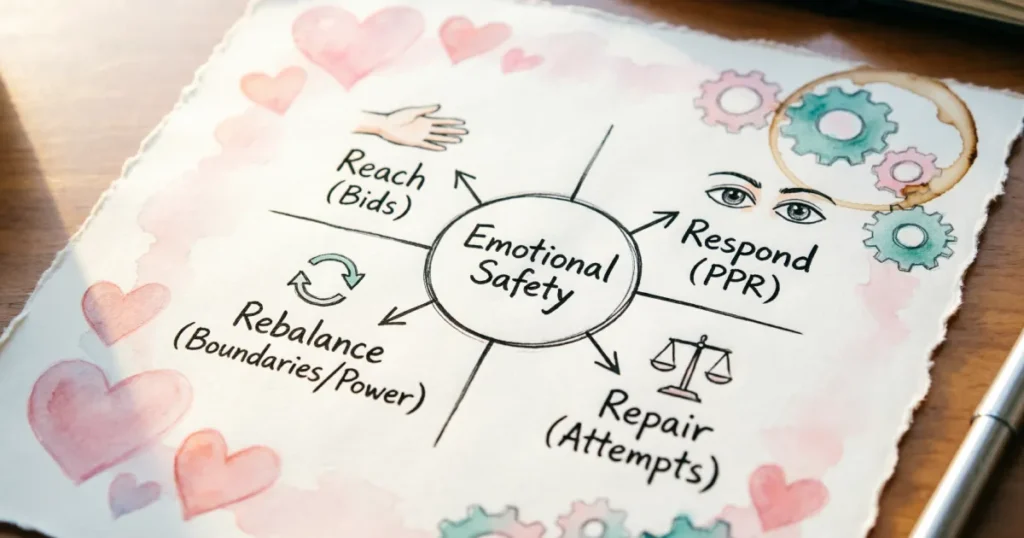
You now have a simple model you can hold in your head: I call it The 4R Relationship OS.
- Reach: Notice bids for connection.
- Respond: Turn toward them with presence.
- Repair: Use early repair attempts when things feel tense.
- Rebalance: Talk openly about power, boundaries, and fairness.
Tonight, try a 10-minute “Responsiveness Reset.” Ask the other person, “If you could describe our relationship in three words, what would they be, and why?”
Your only jobs are to reflect back what you heard and then ask, “What do you want more of this month?” No defending. No fixing. Just responsiveness and one small next step.
Remember: you do not have to overhaul your entire life to change your connection. You just have to repeat a new pattern more often than the old one. Strong relationships are not magic. They are built. And you now know how to start building, even if yesterday was a mess.
If you ever doubt yourself, come back to this: “The boring skills you practice daily will protect the love you care about most.”
And yes, that includes yours.
My Closing Remarks:
You deserve more than half-love and half-listening. I have seen people on the edge of walking away bring a relationship back to life with the exact skills you just read. Not because they became perfect, but because they finally treated love as a practice, not a mood. If any part of this stung, good. That sting is the part of you that still wants more. Do not numb it. Use it. Start with one small change tonight.
More Related Stories For You
- If you are serious about long-term commitment, you may want to read about the key things to discuss before marriage so you are not surprised later.
- If jealousy has already started to creep in, especially before a wedding or engagement, this guide on jealousy issues before marriage can help you understand what is normal and what needs attention.
- For a deeper dive into feeling close, not just coexisting, spend some time with this piece on how to build emotional intimacy. Pairing that with the 4R Relationship OS in this article is a powerful combination.
About The Author