
 Sara Carmen
Romances fade. The friendship is what keeps you on the same side of the bed, the budget, and the hard years.
Key Points
- Friendship in marriage is not what you settle for after the spark cools. It is the structure that lets love survive real life.
- The shift from heat to companionship is your brain doing its job, not proof that you married the wrong person.
- Small habits of inclusion beat expensive date nights when you want a marriage that still feels like a true partnership.
Contents
Table of Contents
Friendship in marriage is the daily choice to treat your spouse as your closest companion, not just your co-parent or household manager. When romantic intensity naturally quiets, that friendship becomes the safety net that holds you through stress, conflict, aging, and the long middle of life together.
We treat early romance like the gold standard of a good marriage. We measure Tuesday night on the couch against the version of us that talked until 2 a.m. We call it a crisis when that version fades. The quieter truth is that the fade was never the emergency. The emergency is what we fail to build in its place.
You know this feeling. You still love this person. You would still choose them. And yet some nights you look across the room and feel more like co-managers of a household than two people who once could not stop talking.
Someone might think a quiet marriage is a failing marriage. But what they don’t see is a nervous system that has simply left chase mode and entered attach mode.
Someone might think they have grown apart because they no longer finish each other’s sentences. But what they don’t see is that they stopped inviting each other into the small corners of the day.
Someone might think a nicer date night will close the gap. But what they don’t see is last month’s dinner. Two phones. One shared appetizer. Almost no actual conversation.
Left alone, that pattern does not explode. It thins. Parallel lives become the quiet reason some marriages end.
The Science of Marital Friendship: Why Passion Was Never the Whole Plan
Your brain was never designed to stay in infatuation. The first one to three years of a romance run hot on dopamine, the chemical that drives craving, novelty, and reward. That state is loud on purpose. It glues two people together long enough to form a bond.
Then the system changes.
Oxytocin takes more of the lead. Oxytocin is the bonding hormone tied to calm closeness, trust, and that felt sense of home. Researchers often call this later stage companionate love, which simply means warm, steady affection rather than hunger. The butterflies quiet. The body starts asking a different question. Not “Do I want you right now?” but “Can I rest with you?”
That is not a downgrade. That is an evolutionary win.
According to data from the Pew Research Center, love and companionship remain the top reasons adults choose to marry, far ahead of money or social pressure. People already know, at some level, what actually holds. They just forget it when the house gets loud and the phones get brighter than the person sitting three feet away.
Most couples between years three and ten feel this shift and misread it as loss. You are not broken for feeling less electric. You are in the part of marriage that asks for skill instead of chemistry.
Emotional Bids and the Tiny Moments That Build Marital Friendship
Dr. John Gottman spent decades watching how couples actually live, not how they describe their love on a good day. One of his most useful ideas is the emotional bid. A bid is any small attempt to get your partner’s attention, affection, or support. A sigh. A joke. A photo turned toward you. A comment about the weather that is really a request to be met.
The Gottman Institute found that lasting couples turn toward those bids far more often than couples who later come apart. The marriage is not saved by the vacation. It is saved by what you do with the sigh.
This is why friendship in marriage can feel invisible until it is gone. It lives in micro-moments. It dies in micro-refusals. Not cruel ones. Tired ones. Distracted ones. The “mm-hmm” said into a screen.
Think of your marital friendship as the load-bearing wall of the house. Chemistry is the furniture. You can replace a sofa. You cannot knock out a load-bearing wall and expect the roof to stay up.
Combatting Roommate Syndrome With Real Friendship Habits
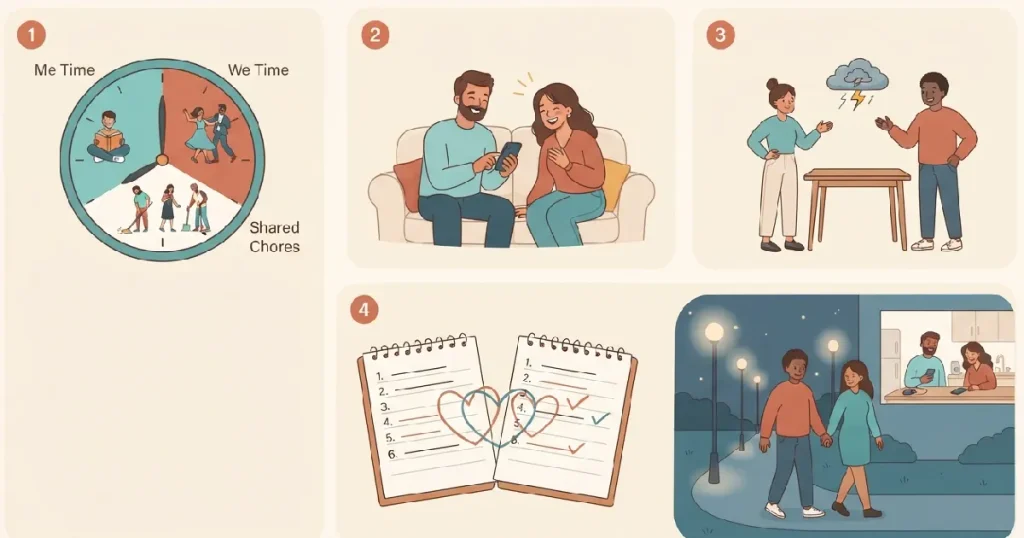
Roommate syndrome is what happens when you still function well as a team and barely exist as companions. The bills get paid. The children get to school. The calendar stays full. The friendship starves in plain sight.
The modern version has a twist older advice rarely names.
The Phone-Scrolling Paradox in Married Life
You can sit beside your spouse for two hours and never enter their mind. That is the phone-scrolling paradox. Passive proximity looks like togetherness. It is not. Two people can share a sofa and live in two different worlds.
Active micro-sharing is the fix, and it is almost embarrassingly small. If you are on your phone, you pull your partner into what you just found. You read one sentence out loud. You turn the screen. You say, “This made me think of you,” or “I do not fully get this. Can I talk it through?”
You are not reporting the news. You are handing over a piece of your inner life before the day files it away without them.
Couples who stay close often describe the same habit. One partner is scrolling. Instead of disappearing, they share the choice clips, the odd fact, the thing that made them laugh. The phone stops being a wall and becomes a doorway.
Presence is not the same thing as being in the room. Presence is letting your partner keep a current map of you.
The 3-3-3 Rule for Friendship in Marriage
Grand plans collapse under real weeks. A simpler frame holds better. Call it the 3-3-3 rule.
Give about three hours a week to your own hobbies or rest so you do not arrive at the marriage empty. Give about three hours to focused couple time with no logistics and no screens. Give about three hours to shared domestic work done side by side, not divided into silent shifts.
The third block surprises people. Folding laundry together or cooking while you talk can rebuild friendship faster than a rushed Saturday reservation. You are practicing the sentence that matters most in a long marriage: we live this life together.
This is not a rigid timetable. It is a weekly check against a common drift. All self. All grind. Almost no us.
External Friendships and the Exclusive Core of Marital Friendship
You need friends outside the marriage. A single relationship cannot carry every need without strain. That part is healthy.
The tension starts when the best parts of you stop coming home.
Opposite-sex friendships and deep outside bonds become a problem not because friendship is wrong, but because marital friendship needs a kind of exclusivity that is not about control. It is about landing. The first telling of the hard day. The private joke. The fear you have not said out loud yet. The version of you that is unpolished.
If your spouse keeps getting the leftover self while someone else gets the vivid self, the load-bearing wall starts to crack. You can keep rich outside support and still protect that core. A useful test is simple. Would your partner feel like a guest in a conversation that should have included them first?
Healthy outside friendship feeds you. It does not replace the person who is supposed to be your soft place to land.
The Same Team Mindset That Protects Friendship During Conflict
Friendship in marriage is easiest to feel on a calm night. It is most important in a fight.
Most arguments slide into Me versus You because the nervous system hears criticism as danger. Ego comes online. You start defending a position instead of protecting a partnership.
When Maya Stopped Feeling Like Tom’s Friend
Maya was 36, eight years married, with two children under seven. She loved Tom. She also told a version of the same sentence many partners whisper once the house is finally quiet. She felt like his coworker who happened to share a last name. They were efficient. They were polite. They were lonely in the same kitchen.
Their fights had a pattern. One of them would start with a logistics problem, usually bedtime or money. Within minutes it became a character trial. She heard “you never.” He heard “you always.” Both left the room feeling unseen.
They did not need a new personality. They needed a new frame. The first change was almost too plain to trust. When a fight started climbing, one of them had to say two words out loud: same team. It felt awkward. It also interrupted the ego cycle long enough for them to put the problem back outside the marriage, where it belonged. The second change was smaller still. At night, instead of scrolling in silence, Maya started showing Tom the odd video or the sentence that had stuck with her. He started asking one better question. Not “How was your day?” but “What is taking up the most space in your head right now?”
Six weeks later the house was still loud. The friendship had a pulse again.
Using Verbal Cues to Break the Ego Cycle
“Same team” works because it gives your body a new instruction in the exact moment it wants to win. You are not pretending the problem is small. You are refusing to make your spouse the opponent.
From there, move the language from verdict to alliance.
- “I am on your side. I am frustrated with this situation.”
- “Can we look at this as something happening to us, not something you did to me?”
- “I want to understand you before I try to fix this.”
Research published through NCBI has found that a robust friendship foundation improves long-term marital adjustment and can lower the body’s stress response during conflict. In plain language, being friends makes fighting safer. Your heart rate does not have to treat your spouse like a threat.
That is not softness. That is physiology working in your favor.
Low-Pressure Ways to Rebuild Friendship in Marriage This Week
You do not need a personality transplant. You need a few practices small enough to survive a normal Wednesday.
The Shared Interest Ranking Game
If you have told yourself you have nothing in common anymore, test that before you believe it. Each of you lists ten ordinary activities. Walking. Cooking a new recipe. Thrift shopping. A puzzle. A documentary. A gym class. Rating them from 1 to 10, separately, often reveals a hidden overlap you stopped noticing.
You are not hunting for a shared identity. You are hunting for one low-pressure yes. Friendship grows in shared attention, not in forced sameness.
Building Love Maps Before the Day Closes
A Love Map is Gottman’s term for your living mental picture of your partner’s inner world. Stresses. Hopes. People who matter this month. The thing they are quietly dreading on Thursday.
That map goes stale. People change jobs, fears, and private longings while still sleeping in the same bed. The Gottman Relationship Blog treats friendship as something you keep current through better questions, not better guesses.
Try one open question tonight.
- “What are your top three stresses right now?”
- “What would make this week feel lighter?”
- “What is one thing I have not asked you about lately that you wish I would?”
Then listen like a friend, not like a manager collecting data.
Tech-Free Micro-Routines That Actually Fit Real Life
Work collected in the BYU ScholarsArchive points to a truth most exhausted couples already suspect. Small daily affectionate routines often outperform grand romantic gestures. Ten honest minutes can do what a once-a-month production cannot.
A nightly loop around the block with phones left on the counter is enough. So is coffee on the porch before the house wakes up. So is sitting on the edge of the bed and trading one real sentence before sleep.
The point is rhythm. Friendship likes repetition. It does not need spectacle.
In my practice I have watched couples rebuild this without a single candlelit dinner. They rebuilt it by becoming curious again.
If you want a wider picture of the qualities of a good partner, start with this one: a good partner stays interested.
You already have more power here than the roommate feeling suggests. You can turn toward the next bid. You can say “same team” before the argument hardens. You can share the video instead of swallowing the laugh alone.
The couple on the couch is still the same couple who once talked until 2 a.m. The weather changed. The climate does not have to.
The couples who last are not the ones who never lose the spark. They are the ones who never lose the friend.
My Closing Remarks
I have sat with couples who still loved each other and could not find their person in the daily noise. What surprised me was never the missing passion. It was the hunger for simple companionship. A joke. A walk. Someone at home still curious about them. You do not need to become newlyweds again. You need to become friends again. That is a smaller and far more honest ask
More Related Stories for You
- If this spoke to the kind of partner you want to be, keep going with the qualities of a good partner that turn everyday companionship into a marriage that can last.
About The Author