
 Sara Carmen
The pattern that drains your energy today is the same pattern that will decide your credit score, your safety, and your retirement tomorrow. Here is how to read it before the paperwork makes it permanent.
Key Points
- The clearest signs of an irresponsible husband are not the chores he skips but the quiet way he hands you the cost of skipping them.
- Weaponized incompetence, learned helplessness, and overfunctioning are three different problems with three different fixes, and knowing which one you are facing changes everything.
- You do not need to fix him. You need a pattern ledger, a financial firewall, and a clear line you will not cross.
Contents
Table of Contents
Most of us can name the exact week we stopped feeling like a partner and started feeling like a manager. We remember building the shared calendar for two. We remember the first time we checked behind him and found the bill still sitting there unopened. You probably remember your version too. And lately the tiredness has started to feel less like a rough patch and more like the design.
Someone might see a relaxed guy who doesn’t sweat the small stuff. But what they don’t see is that the small stuff has a due date and a late fee and you are the only one in the house who knows either.
Someone might think you are lucky because he “helps” with the kids. But what they don’t see is that you wrote the list, bought the supplies, and will quietly repack the lunch after he leaves the room.
Someone might call you controlling. But what they don’t see is the collection notice you found in his glovebox last spring.
Left alone, this pattern does more than exhaust you. It quietly decides whose name ends up on the debt, whether the smoke detectors have batteries, and how much of your future is spent cleaning up a mess you didn’t make. The cultural story that “that’s just how men are” is the very thing keeping you from reading the pattern clearly.
Quick answer: The early signs of an irresponsible husband include weaponized incompetence around basic tasks, hidden or ignored debt, impulsive solo decisions, blaming you for “nagging,” freezing during emergencies, unstable work with no plan, careless attitudes toward safety, and apologies that never turn into changed behavior. The fix is boundaries and data, not more reminders.
What an Irresponsible Husband Actually Looks Like Day to Day
Irresponsibility is not one forgotten anniversary or a single missed payment. Everyone drops things. What you are trying to spot is a repeating pattern with three parts: labor gets shifted onto you, accountability gets dodged, and basic adult obligations get treated as optional.
Much of that shifted labor is invisible. Psychologists call it cognitive load or the mental load, which simply means the ongoing work of remembering, anticipating, and monitoring everything a household needs. A 2019 study by sociologist Allison Daminger found that this mental work has four stages: anticipating a need, identifying options, deciding, and following up. Women did far more of the anticipating and following up, even in couples who believed they split things evenly.
Now add the second layer. Weaponized incompetence is when a partner performs a task badly, slowly, or with so much sighing that the job becomes cheaper for you to do yourself. Verywell Mind’s explanation of weaponized incompetence points out how gendered conditioning sets this up: many boys were never expected to run a home, so as men they lean on “I’m just not good at this” as a permanent excuse. Sometimes it is fully conscious. Sometimes it is a habit he never examined. Either way the outcome for you is identical.
The toll arrives in a predictable order. Resentment first. Then emotional shutdown, where you stop asking because asking costs more than doing. Then burnout, which online spaces loosely label “depleted husband syndrome” or partner burnout. Neither is a diagnosis. Both describe what happens when one person becomes the only adult in the house. This is common enough that a 2023 Pew Research Center analysis found wives still do more housework and caregiving even in marriages where both partners earn the same.
You are not imagining the imbalance. Now let’s name the ten places it shows up first.
10 Early Signs of an Irresponsible Husband and How to Take Control
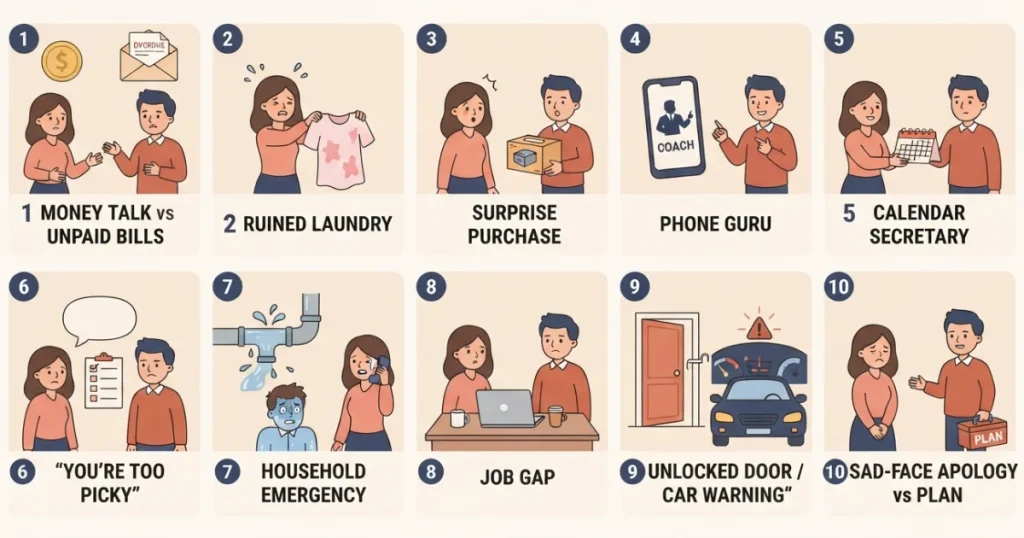
1. Financial Signs of an Irresponsible Husband: The “Borrowed Grandeur” Pattern
The warning sign: He talks fluently about the promotion that’s coming, the crypto position he’s watching, the business idea that will change everything. Meanwhile the water bill has been late three months running and you found out about a personal loan from a text notification on his phone. Big-picture confidence paired with small-picture chaos is one of the most reliable financial signs of an irresponsible husband.
Take control: Before you co-sign anything, schedule a mutual “financial physical.” Both of you pull your credit reports, share account statements, and list every debt on one page. Try this script: “Before we sign anything together, I want us both to see the full picture, mine included.” A partner who is merely disorganized will be relieved. A partner who is hiding something will get defensive. Both responses give you information.
2. Chronic Weaponized Incompetence Around the House
The warning sign: The whites come out pink. The dishwasher is “loaded” with food still stuck to every plate. He asks where the baby’s socks are for the fortieth time. Then comes the line that ends the conversation: “You’re just better at this stuff.”
Here is the tell. He can assemble a gaming PC from scratch and memorize fantasy football stats but cannot learn a laundry setting. That is selective competence, and it means capacity was never the problem.
He is not failing at these tasks. He is succeeding at avoiding them.
Take control: Use the Let It Drop method. Stop redoing his work and stop checking behind him. If his shirt goes to work wrinkled, that is his shirt. If his lunch doesn’t get packed, he buys lunch. Natural consequences teach faster than reminders because reminders keep the task on your desk.
3. Unilateral Impulse Decisions Without Consulting You
The warning sign: The $1,800 television that “was on sale.” The car he traded in on a Tuesday afternoon. The puppy he brought home while you were at your mother’s. Each one is framed as a fun surprise. Each one is actually a financial or lifestyle decision made for both of you by one of you.
Take control: Set a Double Signature rule. Any household expense over an agreed amount, say $200, requires both of you to say yes before the money moves. Then protect yourself independently: keep an account in your own name that he does not have access to, and make sure your own credit stands on its own. This is not distrust. This is basic financial hygiene for any adult.
4. Sudden Obsession With Online “Alpha” Gurus and Get-Rich Schemes
The warning sign: Overnight he starts using phrases like “high-value man” and “feminine energy.” He suggests you quit your job. He wants to put your shared savings into a course or a trading program run by a stranger with a rented Lamborghini. The rigid gender roles arrive at exactly the same moment as the volatile money ideas, which is not a coincidence. Both let him avoid the unglamorous responsibilities in front of him.
Take control: Treat an abrupt shift in shared values as a yellow flag that requires a direct conversation, not a wait-and-see approach. Try: “Our plan changed overnight and I wasn’t part of that. Where did this come from, and when were you going to bring me in?” His answer tells you whether you are still a team.
5. Subcontracting His Emotional and Social Labor to You
The warning sign: You buy his mother’s birthday gift. You book his dentist appointment. You remember his best friend’s kids’ names and remind him to text back. Sociologists call this kin-keeping, the work of maintaining family and social ties, and in your house it has become your job for two families.
Take control: Return the labor to its owner with one polite sentence. When his sister texts you about Thanksgiving plans: “You’ll need to sort that with him directly.” When his mother asks why he hasn’t called: “I’ll let him know you’d love to hear from him.” You are not being cold. You are refusing to be his social secretary.
The Sign of an Irresponsible Husband Most Checklists Miss: How He Treats His Own Tomorrow
Most lists stop at how he treats you. Watch instead how he treats his future self. Does he leave the gas tank on empty for tomorrow-him? Skip his own physical for three years? Renew nothing until it lapses? Behavioral economists call this present bias, meaning the tendency to grab comfort now and hand the cost to a later version of yourself.
Here is why it matters for you. A man who routinely betrays his own future self will treat you the same way, because in his mind you are simply another person who will absorb the cost later. You cannot out-organize this. You can only stop being the place where his deferred costs land.
6. Deflecting Blame With “Your Standards Are Too High”
The warning sign: You ask about the unpaid registration and you are “nagging.” You mention the mold in the shower and you are “so anxious lately.” Your reasonable expectations get relabeled as personality flaws until you start wondering whether the problem is you. This is a form of gaslighting, which means being pushed to doubt your own accurate perception of events.
Take control: Move the argument out of feelings and into records. Use a shared calendar or a simple task app for two weeks and assign every recurring household item to a name. Data does not nag. When the list shows 34 items under your name and 6 under his, “high standards” stops being a believable explanation.
7. Treating Every Household Crisis as “Your Problem”
The warning sign: The pipe under the sink bursts and he stands in the doorway holding his phone out to you. The dog eats a chocolate bar and he goes quiet. Your daughter splits her chin open and he says “what do we do?” while you are already grabbing keys. Freezing is a human stress response, but a partner who freezes every time and never learns to move is leaving you to run every emergency alone.
Take control: Run a 72-hour observation during low stakes. Go away for a weekend and do not leave a list. Do not text reminders. Come home and look. Were the kids fed, the pets alive, the doors locked, the trash out? You are not testing him for sport. You are finding out whether the household can survive without you before you find out the hard way.
8. Employment Instability Paired With Zero Ambition
The warning sign: Four jobs in three years and every exit was a bad boss, a toxic team, a company that “didn’t see his value.” In between, the gaps fill with gaming and sleeping in rather than a certification, a course, or even an updated resume. Instability alone is not the flag. Instability plus no plan is.
Take control: Do not subsidize his personal debts or lifestyle spending, and set clear timelines. A fair script sounds like: “I can carry the rent for 90 days while you search. After that we need a different arrangement.” And do not sign a mortgage or a long lease until you have seen at least a year of steady income. Love is not collateral.
9. Boundary Degradation Around Physical Safety
The warning sign: The front door left unlocked overnight. The bald tires he keeps “meaning to replace.” The medication left on the counter within a toddler’s reach. When you raise it, you are “paranoid.” This is the most serious of all the signs of an irresponsible husband because the cost is not money or time. It is bodies.
Take control: Safety is the one category where negotiation ends. State it once and clearly: “This is not a preference. This is a line.” If he continues to compromise physical safety after that conversation, you are looking at a counseling-level problem at minimum, and a physical separation is a legitimate option to protect yourself and your children.
10. Apologies That Never Turn Into Accountability
The warning sign: He misses the deadline that costs the family $300 and within seconds it’s “I can never do anything right, I’m such a screw-up.” Now you are comforting him. The roles flip, his guilt becomes your job, and the actual mistake never gets discussed. Self-pity that arrives instead of a plan is a management tool whether or not he knows it.
Take control: Do not attend the pity party. Stay warm and stay on task: “I don’t need you to feel bad. I need to know your plan so it doesn’t happen again.” A genuine apology has three parts: naming what happened, naming the impact, and naming the repair. Anything without the third part is just noise.
Maya’s Story: Recognizing the Signs of an Irresponsible Husband Before the Mortgage
Maya was 31 and six months from her wedding when she caught herself setting a phone reminder for Daniel’s student loan payment. She had also booked his dental cleaning, replaced the smoke detector battery he’d been “getting to,” and covered the electric bill twice. When she brought it up, he told her she was stressed about the wedding and seeing problems everywhere. So she stopped arguing and started tracking. Two weeks of a shared task app showed 41 items under her name and 7 under his, and the 72-hour weekend test ended with a dead houseplant and an unlocked back door. Maya didn’t cancel the wedding. She opened an account in her own name, postponed the house hunt by a year, and told Daniel exactly what would need to change and by when. Some of it did change. The rest she no longer carries, because she finally understood that his effort, not her patience, was the variable that mattered.
Laziness vs. Learned Helplessness in an Irresponsible Husband

Not every irresponsible man is running a con. In my practice I have sat across from husbands who genuinely did not know how to start, and their wives were exhausted by the same behavior a manipulator would produce on purpose. The distinction matters for the fix, not the verdict.
In 1967 psychologists Martin Seligman and Steven Maier described learned helplessness: when a living being repeatedly learns that its efforts don’t change the outcome, it stops trying even after trying would work. Some men grew up with a parent who redid everything they touched or criticized every attempt. Failing became safer than trying. As adults they arrive at “I’ll just mess it up” without ever noticing it was a lesson someone taught them. YourTango’s piece on the well-meaning but unintentionally useless partner captures this version well.
Then there is your side of the loop. Family therapist Murray Bowen described overfunctioning and underfunctioning as a reciprocal pattern: the more one partner steps in, the more the other steps back, and each person’s behavior quietly trains the other’s. If you were the responsible kid in a chaotic home, stepping in fast feels like love. It is also fuel.
Think of it as carrying one backpack for two hikers. He walks lighter. You walk slower. Every mile the straps cut a little deeper, and the strangest part is how quickly it starts to feel like your backpack. Explaining why he handed it to you does not make it yours. An adult with a pattern is still responsible for changing it.
Tactical Tools to Protect Your Money and Mind From an Irresponsible Husband
Insight without structure fades by Thursday. Consider building these four tools this month.
The Financial Firewall. Keep an account and at least one credit card solely in your name. Pull your own credit report every few months. Decide in advance which liabilities you will not co-sign until you have seen twelve months of consistent behavior. In practice this looks like: “I’m happy to plan for a house together. We’ll start the application once we’ve had a year of on-time bills.”
The Let It Fail Boundary. Choose two of his personal responsibilities, his car registration and his mother’s calls for example, and formally hand them back. Say it out loud so it isn’t a silent test. Then let the consequences land on him and not on you. Discomfort is the teacher here, not your voice.
The Pattern Ledger. For fourteen days write down what you did, what he did, and what he promised. Then decide based on the ledger, not the apology. A useful question to ask yourself: if a friend showed me this exact list, what would I tell her it means?
The Exit Threshold. Name your line now, while you are calm. For many women it is some combination of hidden debt, repeated lies, contempt toward your concerns, or any compromise of your children’s safety. Writing it down turns a vague dread into a clear decision you will recognize when you reach it.
Prioritizing Your Future Over His Potential
Go back to that week you stopped feeling like a partner. You didn’t lose anything that week. You noticed something. And noticing is the first responsible act in a relationship where you were the only one taking any.
You cannot fix someone who refuses to see the mess. What you can do is set the second backpack down, watch what he does with it, and believe what you see instead of what he promises.
Potential is not a plan. Pattern is.
My Closing Remarks
I’ll be honest with you: the women who worry most about being unfair are almost never the unfair ones. The fact that you read this far, second-guessing yourself the whole way, tells me you have been generous for a long time. What I have learned from sitting with couples is that clarity rarely feels kind in the moment, and it is still the kindest thing you can offer both of you. You deserve a partner who carries his share without being asked. Trust the ledger. You already know how to read it.
More Related Stories for You
- If the pattern you are seeing includes contempt and blame-flipping rather than plain avoidance, you may also want to read about how to deal with a narcissist husband.
About The Author