
 Nicole Adkins
The same hunger drives him in every room. Only the costume changes.
Key Points
- Narcissist traits male stay the same at the core. Only the performance changes to fit love, friendship, or work.
- He does not see people as people. He sees them as supply, a word clinicians use for the admiration and control that keep his self-image intact.
- Once you can name the pattern in one setting, you can cut the fuel in all three.
Contents
Table of Contents
We have all met a man who felt almost too right at the start. He listened like you were the only person alive. He planned weekends you had mentioned once. He made your friends laugh and your parents relax. Then the temperature dropped. The same mouth that praised you started correcting you. The same hands that reached for you started withholding. You replayed the early days and wondered if you invented them.
You did not invent them. You met the mask first.
A male narcissist is driven by one need: a steady stream of admiration, control, and emotional fuel that clinicians call narcissistic supply. He will change his tactics to fit a date, a friendship, or an office. The hunger underneath stays the same. That is the whole map.
Someone might think he is simply confident. But what they do not see is how quickly that confidence turns into contempt the moment you stop clapping.
Someone might think he is the most generous friend in the group. But what they do not see is the invoice hiding inside every favor.
Someone might think he is a driven colleague who just wants the team to win. But what they do not see is how often the win has his name on it and your fingerprints wiped off.
According to the Mayo Clinic, narcissistic personality disorder involves an inflated sense of importance, a deep need for excessive attention, and a lack of empathy. The condition is diagnosed more often in men than in women. You do not need a formal diagnosis on paper to feel the damage. High narcissistic traits can wreck a relationship, a friendship, or a career long before anyone uses the clinical name.
He is not three different men. He is one hunger wearing three masks.
The Anatomy of Male Narcissism: One Need, Three Costumes
The inner engine never changes. Psychologists call that engine narcissistic supply. In plain language, supply is any reaction that proves he still matters. Praise works. Fear works. Even your tears can work, because they confirm he still has power over you.
That is why the guide to narcissism describes these bonds as highly deceptive at first and strictly transactional underneath. You feel chosen. He is collecting.
Harvard Health draws a useful line between two common presentations. The grandiose type is loud, boastful, and easy to spot at a dinner table. The covert type, sometimes called vulnerable narcissism, is quieter. He sulks. He plays the martyr. He builds a flawless public image and does his harm behind closed doors. A third presentation, the high-functioning type, often looks successful on paper and still leaves a trail of exhausted people. You can read the Harvard Health breakdown of these subtypes if you want the clinical language. What matters for your daily life is simpler.
The grandiose man dominates the room. The covert man dominates the story people tell about him. Both of them need you to keep the story going.
Modern life makes this easier for him than it used to be. Dating apps, rapid texting, and polished social profiles give him instant, low-effort supply. A curated feed can manufacture the perfect mate in an afternoon. A late-night message streak can create a false sense of intimacy before you have shared a single ordinary Tuesday. The algorithm rewards intensity. So does he.
1. Narcissist Traits Male in Romantic Relationships
In love, the goal is control, validation, and a slow erosion of your trust in your own mind.
Love-Bombing: The Mirage of the Perfect Mate
Love-bombing is a flood of attention designed to hook you before you have time to think. He texts from morning until midnight. He calls you his soulmate in week two. He plans a trip, meets your family, and talks about the future as if it is already decided. The speed feels romantic. It is actually a strategy.
He is manufacturing closeness faster than your nervous system can fact-check it. You feel seen. He is studying you. Every preference you share becomes a tool he can use later, first as a gift and then as a weapon.
If a partner pushes for whirlwind commitment or treats you like a flawless soulmate overnight, treat the speed itself as the red flag. Healthy attachment has a pulse. It does not sprint.
Devaluation, Gaslighting, and Sleep as a Weapon
Then the shift arrives. The compliments thin out. The criticism thickens. You can do nothing right. Your laugh is too loud. Your friends are a problem. Your memory of last Tuesday is “dramatic.”
Gaslighting is the tactic of making you doubt your own perception. He rewrites small events until you start asking him what happened instead of trusting yourself. The silent treatment often follows. So does something people rarely name in polite conversation: sleep disruption.
On forums where partners of narcissistic men compare notes, a pattern keeps appearing. He starts a fight at midnight. He “needs to talk” when you have an early meeting. He sighs, paces, or picks at an old wound until your body is too tired to hold a boundary. Sleep deprivation is not a personality quirk. It is domestic warfare. A worn-down nervous system is easier to manage than a rested one.
The Cleveland Clinic notes that people with these traits are often hyper-sensitive to criticism. That fragility is why a small request from you can trigger a night-long storm. Your need feels like an attack on his worth. So he attacks your rest instead.
Traumatic Discards and the Hoovering Cycle
When your supply runs low, or when a shinier source appears, he may vanish. This is the discard. It can look like a cold breakup, a sudden affair, or a quiet fade that leaves you holding the history alone.
Then, weeks or months later, he hoovers. Hoovering is the attempt to suck you back in. A late apology. A “I miss us” text. A crisis that only you can soothe. The cycle restarts because the hunger never left. Only the timing changed.
2. Narcissist Traits Male in Platonic Friendships
In friendship, the goal is status, leverage, and a social audience that never questions him.
The Altruistic Friend Mask and Favors as Currency
The covert male narcissist often looks like the best man in the group. He volunteers. He shows up with a trailer when you move. He pays for dinner and waves it away. The public version of him is almost impossible to criticize.
That is the point.
The favor is not a gift. It is currency. Each grand gesture buys him psychological leverage and the right to collect later. When you finally say no, he will remind you of the trailer, the dinner, the time he “saved” you. Generous people do not keep receipts like that.
Watch how he handles a simple no. If a boundary produces a tantrum, a guilt trip, or a sudden chill, you have your answer. Quietly fade. You do not owe a speech to a man who treats kindness like a contract you never signed.
One-Sided Conversations and Hidden Envy
Sit with him for an hour and notice the current of the talk. It flows toward his wins, his wounds, his next plan. Your news is a bridge back to him. Your success can sour the air. A promotion might earn a joke that cuts a little too close. A new relationship might earn a warning dressed up as concern.
This is not ordinary self-focus. It is a failure of reciprocal empathy, the basic human skill of making space for someone else’s inner life. He can perform care in public. In private, your feelings are either useful or in the way.
After a toxic breakup, he may offer to “just be friends.” Forum survivors call this contingency supply. You stay on standby as backup validation. Decline the seat. Friendship after harm is not closure. It is a waiting room.
Smear Campaigns and Loyalty Tests
When a friend sets a limit, the male narcissist often moves the fight into the group chat. He tells a polished version of events first. He casts himself as wounded and you as unstable, ungrateful, or “different lately.” Mutual friends, who only know the altruistic mask, may side with the story that is easier to believe.
This is a smear campaign. Its job is to isolate you and protect his status. You do not win it by explaining harder. You win it by refusing to audition for people who already chose the performance.
3. Narcissist Traits Male in the Corporate Workplace

At work, the goal is dominance, credit, and a hierarchy that always tilts toward him.
Kicking Down and Kissing Up
Bill Eddy, writing for Psychology Today, describes a classic pattern: the narcissist kisses up and kicks down. He is charming with upper management. He is punishing with peers and direct reports. The same man who laughs at the director’s jokes will rewrite your contribution in the next meeting.
If your boss has two personalities and the nicer one only appears when someone powerful walks in, trust the split. That split is data.
Credit-Stealing and Corporate Gaslighting
He takes ownership of team work with a casual “we,” then a quieter “I.” He forwards your deck with his name in the subject line. When a project fails, the story changes. Suddenly there were “gaps in communication.” Suddenly your timeline was the problem.
This is workplace gaslighting. He does not only steal credit. He steals the record of what happened. That is why a polite, boring paper trail matters more than a clever comeback.
Follow every verbal agreement with a short summary email. Date it. Keep it flat. You are not being petty. You are building a version of reality that does not depend on his memory.
The Toxic Micromanager and a Fragile Ego in Power
A narcissistic manager often treats disagreement as insubordination. Feedback, even gentle feedback, can feel like a threat to his entire identity. The Cleveland Clinic overview of narcissist signs helps explain the inner mechanics: the grand self is a thin shell over deep insecurity. Constructive notes hit the shell and sound like an attack.
The result is a hostile climate. Staff learn to manage his mood instead of the work. People stop bringing problems. The best employees leave first, because they have somewhere else to go.
Never hand him your private life. Career fears, family stress, and old wounds become files he can open later. Stay polite. Stay professional. Starve the office gossip factory by giving it nothing personal to eat.
When Lena Mapped the Same Man in Three Rooms
Lena, a composite of several people I have sat with in my practice, dated a man named Cole for eleven months. He planned a weekend away on date three and told her he had never felt this safe. By month four he was waking her at 1 a.m. to “process” why she had laughed too long at a coworker’s joke. She thought she had a communication problem.
Then she noticed the rest of the map. Cole was the friend who organized every birthday and later used those parties as proof that no one could question him. At work he was the project lead who presented her analysis as his “direction.” The charm, the favors, and the credit-grab were not three stories. They were one economy. Lena stopped arguing about each incident and started cutting supply. She used grey rock at home, declined the after-hours “just friends” offer, and put every workplace agreement in writing. The man did not become kinder. Her life became quieter. That was the win.
How to Protect Your Peace Across Love, Friendship, and Work
You cannot renovate a person who needs you small. You can change the terms of contact.
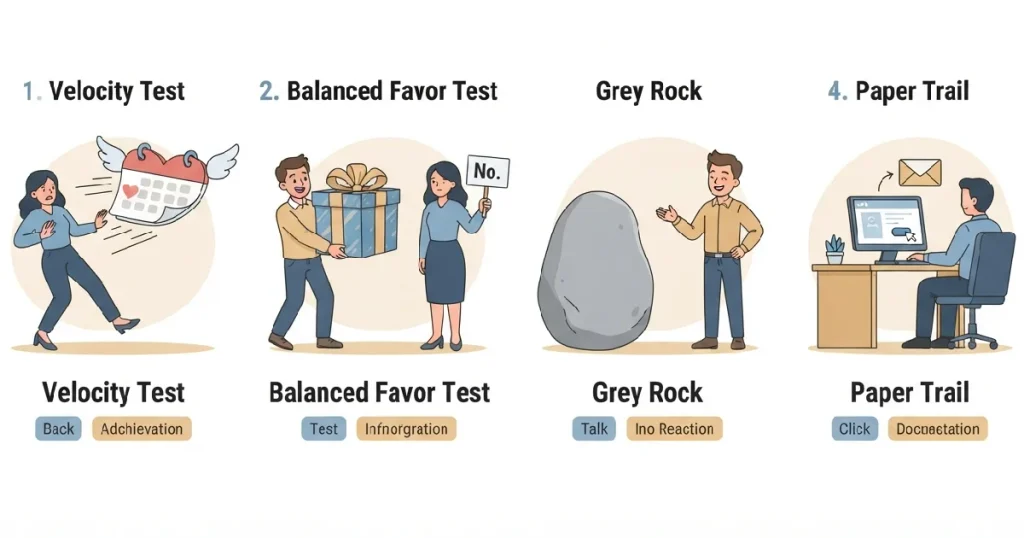
The Velocity Test. In dating, slow the pace on purpose. If he punishes the slowdown, you have learned what the rush was for. A useful question to ask yourself is simple: would this still feel romantic if it happened at half speed?
The Balanced Favor Test. In friendship, say no to one small request and watch the weather. A real friend adjusts. A transactional friend collects.
The Grey Rock Method. Become as dull and unreactive as a grey rock. Short answers. No emotion for him to hook. No fresh details to mine. If you share children or a workplace, total silence may not be possible. Grey rock is the next best thing. You are not being cold. You are closing the tap.
The Paper Trail. At work, document. Send the recap email. Save the chat. Keep your tone neutral enough that a stranger could read it without taking sides. The record is your ally when his story starts to move.
Radical acceptance. He is unlikely to wake up converted by your best explanation. Most people in this situation waste months trying to be understood by someone who needs them confused. Acceptance is not approval. It is the end of a useless project.
The next time the charm surges, or the midnight argument starts, or the public favor appears with a private price, you do not have to solve his childhood. You only have to refuse the role.
That refusal is not cruelty. It is self-respect with a calendar.
You thought you were dealing with three different problems. You were dealing with one pattern that learned how to dress for each room. Now you can see the costume and the hunger underneath it. Seeing it does not make the loss smaller. It makes the next choice cleaner.
Protect the quiet. He cannot live there.
My Closing Remarks
I have watched bright, loyal people spend years translating a man who was never speaking their language. If that has been you, nothing in you was too much, too sensitive, or too hard to love. You were bringing a whole self to someone who only had use for parts. Grief may still visit. Let it. Then put your energy back into rooms where your no is respected and your yes is not an invoice. You already survived the confusing part. The clear part is allowed to be smaller, slower, and kind.
More Related Stories for You
If you are rebuilding after a one-sided bond, it helps to remember what healthy care actually looks like. Read more about the qualities of a good partner and use that list as a contrast, not a consolation prize.
About The Author