
 Nicole Adkins
The traits that look like confidence, growth, and vulnerability are often the ones that keep you doubting your own mind.
Key Points
- The characteristics of a narcissist man are not random selfish moments. They form a stable pattern that clinicians measure against nine specific traits.
- Modern narcissistic men often hide those traits behind therapy language, fake vulnerability, and a cycle that makes you look like the unstable one.
- Once you can name the pattern in real time, you stop arguing with a version of events that was never built to be fair.
Contents
Table of Contents
We have all sat across from a man who made us feel like the problem. He forgot what he promised and somehow you were too sensitive for bringing it up. He crossed a line and you were insecure for noticing. We call it a rough patch. You call it love. The confusion is not an accident. It is the design.
The characteristics of a narcissist man go far beyond selfishness. Clinically, narcissistic personality disorder is diagnosed only when a stable pattern of at least five of nine traits shows up across many settings, not one bad month. What most people miss is that the current version often hides those traits behind growth language, wounded stories, and a performance of self-awareness.
Someone might think he is just emotionally unavailable. But what they do not see is how quickly your needs become “too much” the moment they compete with his image.
Someone might think the constant confusion is a communication problem. But what they do not see is that confusion is useful to him. If you cannot hold a clear memory of what happened, you cannot hold him accountable for it.
Someone might think they are overreacting because he cries, journals, and talks about his inner child. But what they do not see is that vulnerability can be a costume. It can be used to collect sympathy while avoiding change.
This pattern exists because a narcissistic man does not generate a stable sense of worth from the inside. He borrows it from other people. Clinicians call that borrowed fuel narcissistic supply, which simply means attention, admiration, fear, or emotional intensity that keeps his self-image inflated. According to a large national survey of more than 34,000 American adults, about 7.7 percent of men met criteria for narcissistic personality disorder, compared with 4.8 percent of women. That does not mean every difficult man has a disorder. It does mean this pattern is common enough that many women will meet it in dating, and rare enough that people around you may still tell you that you are imagining it.
That gap between what you feel and what other people will name is where a lot of women get stuck.
Selfish or Something More? The Real Line Between a Jerk and a Narcissist Man
A selfish man wants the bigger slice of pizza. A narcissistic man needs you to agree that he deserved the whole pie, that you were greedy for wanting any, and that bringing it up means you are the problem.
The clinical line is not how hurt you feel after one fight. The line is pattern, pervasiveness, and lack of genuine repair. The DSM-5-TR, the manual clinicians use to diagnose personality disorders, requires at least five of nine traits, present across many situations, and stable over time. A rough patch after a job loss is not the same thing. A man who is grandiose with you, with friends, at work, and in every relationship he has had is a different story.
Two men can both meet five of the nine criteria and look nothing alike. One may be loud, charming, and openly superior. Another may be quiet, wounded, and constantly talking about how no one has ever understood him. The second man is harder to spot because he does not match the cartoon version of narcissism most people carry in their heads.
That is why so many women stay longer than they meant to. They are waiting for the obvious monster. What they get is a man who sounds evolved.
The 9 Official Characteristics of a Narcissist Man, Decoded
Clinicians look for a grandiose sense of self-importance, fantasies of unlimited success or ideal love, a belief that he is special, a need for excessive admiration, entitlement, exploitation of others, a lack of empathy, envy, and arrogant behavior. You do not need a formal diagnosis to protect yourself. You do need to know how these traits actually sound in a text thread at 11 p.m.
The signs of a narcissist become clearer once you stop looking for a villain and start looking for a pattern of self-protection at your expense.
How These Characteristics of a Narcissist Man Show Up in Texts and Dates
Grandiose self-importance does not always sound like “I am a genius.” It often sounds like “No one at that restaurant understood the vision” or “My ex could never keep up with me.” Fantasies of ideal love sound romantic at first. He says he has been waiting for a woman like you. Then the fantasy becomes a demand. You are no longer a person. You are a role he cast.
The belief that he is special shows up as rules that apply to everyone except him. He can cancel. You cannot. He can flirt. You cannot have male friends. The need for admiration is the constant hunger underneath it all. A delayed reply becomes disrespect. A night when you are tired becomes proof that you do not appreciate him.
Entitlement is the quiet assumption that your time, body, and emotional labor are available on request. Exploitation is using your kindness, your apartment, your connections, or your calm as raw material. Lack of empathy is not always coldness. Sometimes it is a quick nod at your pain, followed by a return to his story. Envy sounds like mockery of people who have what he wants. Arrogance is the eyeroll when you try to explain a feeling he has already decided is inconvenient.
A recent network analysis of narcissistic traits is useful here because it treats these qualities as connected, not isolated. One trait feeds the next. Admiration-seeking makes exploitation easier. Low empathy makes rewriting your memory feel justified to him.
The Kidney Dialysis Analogy: Why a Narcissist Man Cannot Just Try Harder
Here is the image that makes this whole pattern click.
A narcissistic man is like a person whose kidneys cannot clean his own blood. He needs an external machine. That machine is you. Your praise, your panic, your attention, even your tears keep his sense of self from collapsing. This is why “trying harder” does not fix it. You cannot pep-talk a kidney into working. You also cannot love someone into growing an organ they have organized their whole personality around not needing.
That is not weakness. That is wiring.
Once you see him as a person who must extract supply, the confusing parts start lining up. The love-bombing is the hookup to the machine. The devaluation starts when your admiration becomes less automatic. The smear campaign starts when you threaten to unplug.
Most people in this situation do not realize they have been performing a medical function they never agreed to.
The New Mask: Therapy-Speak, Boundaries, and Fake Vulnerability
The old narcissist man announced his greatness. The current one announces his healing.
Weaponized therapy-speak is the strategic misuse of clinical words to shut you down. He says you are gaslighting him when you remember a conversation accurately. He says you have no boundaries when you ask him not to disappear for two days. He calls you dysregulated when you raise your voice after being ignored for a week. He labels your protest as toxicity so he never has to face the original injury.
This is where diagnostic criteria meet modern dating. The need for admiration now sounds like “I need you to hold space for my process.” Exploitation now sounds like “If you really supported my healing, you would not make this about you.” Both phrases protect his image while using your empathy as fuel.
You can tell the difference by what happens after the language. Real growth makes more room for your reality. Fake growth makes your reality smaller. If you leave a conversation feeling pathologized, confused, or newly ashamed of a reasonable request, you were not in therapy. You were in a performance.
When His Trauma Story Becomes the Trap
Heal-baiting is the cycle where a man uses his wounds to create intimacy fast, then uses those same wounds as a permanent exemption from accountability. He tells you about his mother, his ex, his childhood, sometimes on date two. You feel chosen. You become careful with him. Then every later conflict gets absorbed back into that origin story. You cannot be angry because he is hurting. You cannot leave because you would become another person who abandoned him.
The trap works because your compassion is real. His use of it is not the same thing as intimacy.
Lena Thought She Was the Unstable One
Lena was 32 and proud of how patient she had become. Marcus talked about attachment styles on the third date and cried when he told her no one had ever stayed. For months she organized her life around not triggering him. When she finally said she felt lonely, he told her she was being emotionally unsafe. After one fight she slammed a cupboard. He filmed the last ten seconds, sent it to a friend, and later said he was scared of her. Lena spent weeks apologizing for a reaction that only existed because he had needled her for an hour. What changed was not a dramatic exit. She started writing down the hour before the cupboard. The record did not make her cruel. It made her accurate. Accuracy was the first thing he could not stand.
Gaslighting Is Not Just Lying. It Is Rewriting Your Memory

Lying says the event did not happen. Gaslighting says your mind cannot be trusted to know what an event was. Over time you stop bringing receipts to the conversation and start bringing them to yourself. You reread texts. You ask a friend, “Does this sound crazy?” You become a detective in your own life.
This is one of the most painful characteristics of a narcissist man because it attacks the tool you need to leave: your confidence in your own perception. Left alone, that erosion does not just strain the relationship. It can become the reason you stay, because a person who no longer trusts her memory will keep asking the person who broke it for the official version.
A private, dated note after a conflict is not petty. It is an external anchor. Your nervous system should not have to be the only archive.
Reactive Abuse: Why You Suddenly Look Like the Unstable One
Narcissistic men often push until you break your own rules. Then they hold up the break as proof that you were the problem all along. Clinically adjacent writing on what reactive abuse actually is describes a predictable sequence, not a mysterious vibe.
First comes tension. Small comments, silences, bait. Then the incident: a cruelty, a smear, a disappearing act. Then your reaction: the raised voice, the long text, the cupboard. Then the inversion. He becomes the wounded party. Friends hear his version first. You are now “volatile.”
Lenore Walker’s cycle of violence is older than dating apps, and it still maps onto this with uncomfortable precision. The point of recognizing the four stages is not to become a perfect victim who never reacts. The point is to get out of the scene before the third stage, because that is the footage he came for.
You were never the crazy one. You were the one who finally responded on camera.
Realistic Solutions When You Cannot Leave a Narcissist Man Yet
If you share a lease, a child, or a workplace, walking out tonight may not be possible. That does not mean you have to keep feeding the machine.
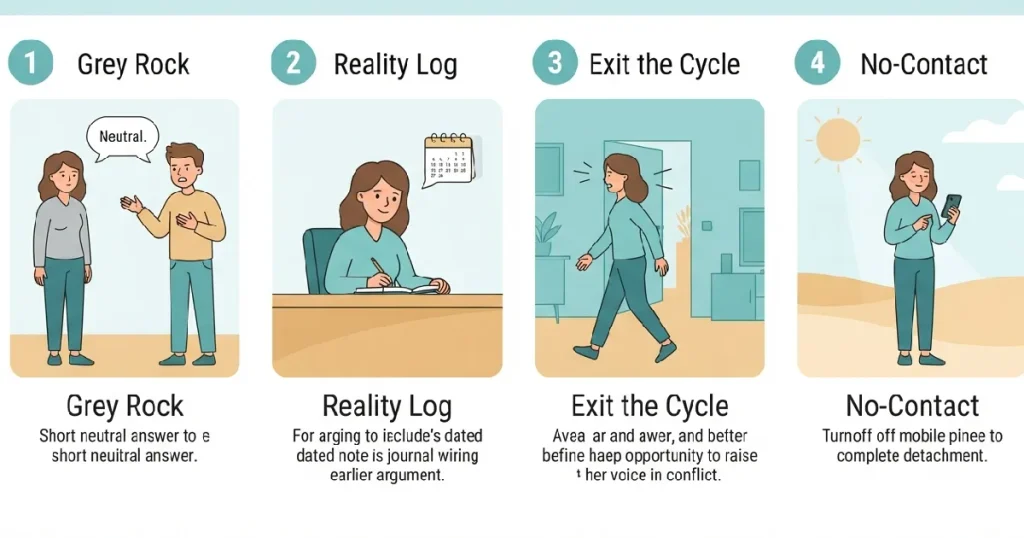
- The Grey Rock Protocol. You become emotionally uninteresting. Short answers. Neutral tone. No defense speeches. The aim is to remove the reaction he is fishing for. Mental health writers have described how the gray rock method can create distance in high-conflict contact. There is an honest limit. There is little controlled research proving it works, and when it does work it can trigger an extinction burst, a temporary spike in the very behavior you are trying to starve. Academic reporting on the grey rock method is clear that this is a self-protection tactic for limited contact, not a cure and not a safe plan in every home. If his behavior escalates, the method is no longer the priority. Safety is.
- The Reality Log. After a conflict, record a two-minute voice memo or a dated note while the details are still sharp. What he said. What you said. What you felt in your body. You are not building a court case. You are keeping your memory from being edited overnight.
- The Cycle Exit. Name the four stages as they start. Tension is your cue to leave the room, end the call, or go silent. The win is not winning the argument. The win is denying him stage three.
- No-Contact as Removal, Not Revenge. If you can leave fully, no-contact is not a punishment. It is taking the dialysis machine offline. Block, document, tell one trusted person the real timeline, and expect a surge of charm or rage when the supply stops.
- Specialized Recovery Support. Survivors often carry anxiety, depression, and trauma symptoms that look like “being too sensitive” long after the relationship ends. A therapist who understands narcissistic abuse can help you separate your nervous system from his story. Simple mindfulness exercises can also help you come back to your body when an old text still hijacks your afternoon.
One place to start tonight is a single dated note after the next confusing conversation. A useful question to ask yourself is not “Is he a narcissist?” It is “Do I trust my mind more or less than I did a year ago?”
Co-occurring depression, anxiety, and substance use can make the same man look twice as dangerous on some nights. That does not excuse the pattern. It does explain why you keep hoping the sober, tender version is the real one. The real one is the whole pattern, including the nights that scare you.
When Grey Rock Is Not Enough and No-Contact Becomes the Only Clean Exit
Grey rock is a dimmer switch. No-contact is cutting the power. If you are co-parenting, the cleanest version may be parallel parenting with written communication only. If you are not tied to him by law or children, lingering “for closure” usually becomes another supply session.
You do not need a clinician to stamp a file before you choose peace. Diagnosis is a tool for treatment. Pattern recognition is a tool for survival. Those are not the same job.
You sat across from a man who made you feel like the problem. You now have language for the machine, the mask, the rewritten memory, and the moment he tries to make your reaction the whole story. That language is not bitterness. It is orientation.
Confusion was never your personality. It was his method.
My Closing Remarks
I have sat with women who could describe a partner’s childhood in more detail than their own needs. That imbalance still stays with me. In my practice, the turning point is rarely a dramatic label. It is the quiet second a woman reads her own notes and realizes she had been sane the entire time. If that is you, nothing about your delayed recognition makes you foolish. It makes you someone who tried to love a person who needed a witness more than a partner. You get to stop auditioning for a role that was designed to empty you.
More Related Stories for You
- If the aftermath of this kind of relationship has left your mind racing, these mindfulness exercises can help you come back to the present without forcing yourself to “just move on.”
About The Author