
 Nicole Adkins
Key Points
- Effective neuroticism treatment targets the underlying trait, not just surface symptoms like anxiety or low mood.
- The Unified Protocol is the only therapy explicitly designed to reduce neuroticism, yet most people have never heard of it.
- Combining cognitive reappraisal with small behavioral habits produces deeper, longer-lasting personality change than either strategy alone.
Contents
Table of Contents
The Hook
You lie awake at 2 a.m. replaying a conversation from twelve hours ago. Your stomach tightens over a text that “felt off.” You know you’re spiraling, and somehow knowing makes it worse, not better.
You’ve tried the apps. You’ve journaled. You’ve read the books with the calming covers. Some of it helped for a week or two. Then the static came back, louder.
You start to wonder if you’re broken. You’re not. You’re working with the wrong map.
The Real Reason Generic Treatment Keeps Failing You
Neuroticism is a personality trait that shapes how often, how intensely, and how long you experience negative emotions like worry, irritability, self-doubt, and sadness. It is not a disorder. It is not a character flaw. It is closer to a thermostat setting in your nervous system, one that runs a little hotter than average.
Here is the part that gets buried in most articles. According to a randomized trial led by Dr. Shannon Sauer-Zavala and colleagues published in Psychological Medicine, outcome research on neuroticism has produced mixed results because most therapies are built to target specific symptoms, like a panic attack or a depressive episode, rather than the underlying trait driving them.
Translation: your therapist may be excellent. Your effort may be heroic. But if the treatment is aimed at the smoke, the fire keeps relighting.
That is the gap this article closes. You are about to learn what trait-level treatment looks like, why it works, and how to ask for it.
Neuroticism Treatment, Reframed
Most people picture treatment as “managing” their reactions. Trait-level treatment is different. It rewires the conditions that produce those reactions in the first place.
Think of it this way. Imagine your emotional life as a river with steep, narrow banks. Every small rainfall causes a flood. Symptom-focused therapy hands you a better bucket. Trait-focused treatment widens the banks.
That widening happens at three levels at once: how you interpret moments (state), how you respond habitually (habit), and how your baseline shifts over time (trait). The newer science of personality change suggests that interventions touching all three layers produce the deepest, most durable reductions in neuroticism.
This is the insight most articles skip. And it is the reason five years of journaling never quite did what you hoped.
What Therapists Rarely Tell You: 5 Evidence-Based Steps That Actually Work
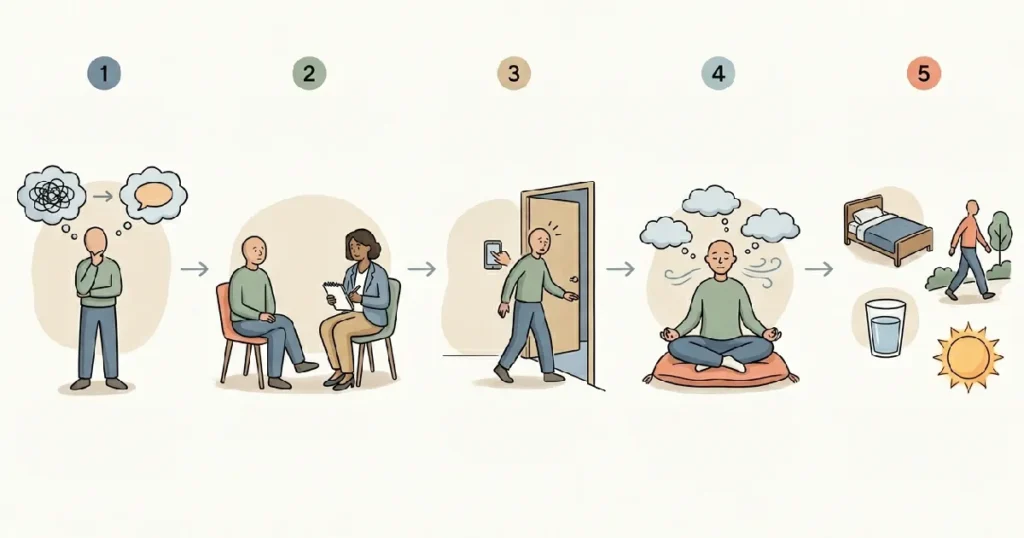
Below are the five steps that map onto current research. Each one includes what to do, what to avoid, and why it matters at the trait level.
Step 1: Replace Suppression With Cognitive Reappraisal
Do This: When something stings, reinterpret the situation before the emotion peaks. Your boss’s curt email becomes “she is buried in meetings,” not “I am about to be fired.”
Not That: Stuffing the feeling down with distraction, food, scrolling, or the silent “just stop thinking about it” loop.
Why It Matters: Cognitive reappraisal interrupts the emotion early, before it floods your system. According to a review published in Frontiers in Systems Neuroscience, reappraisal has a healthier short-term and long-term profile than expressive suppression, which is associated with worse affect, weaker social functioning, and reduced well-being.
Suppression is like holding a beach ball underwater. The harder you push, the more violently it pops up later. Reappraisal lets the air out of the ball before it ever hits the surface.
Step 2: Ask Specifically for the Unified Protocol
Do This: At your next session, say: “I want to address my neuroticism as the root pattern, not only my symptoms. Are you trained in the Unified Protocol, or can you refer me to someone who is?”
Not That: Settling for open-ended supportive talk therapy where you spend forty-five minutes recapping your week.
Why It Matters: The Unified Protocol, developed by Dr. David Barlow at Boston University, is one of the few therapies designed from the ground up to target neuroticism itself. It uses five modules covering emotion awareness, cognitive flexibility, countering avoidance behaviors, and tolerating physical sensations of distress. Sauer-Zavala’s trial found that the UP produced greater reductions in neuroticism than gold-standard, symptom-focused CBT.
Most therapists are not trained in it. That is not their fault. It is a reflection of how slowly research moves into practice. But you can ask.
Step 3: Build One Tiny Behavioral Habit Each Week
Do This: Choose one small action that gently pushes against your usual avoidance. Send the email without re-reading it four times. Leave the dishes in the sink overnight. Say no to a request without an explanation.
Not That: Relying only on thinking strategies like journaling, affirmations, or thought records.
Why It Matters: Cognitive strategies shift the story in your head. Behavioral strategies shift the wiring in your nervous system. The emerging research on personality change suggests that behavioral habits produce more lasting reductions in neuroticism than cognitive habits alone, because action teaches the brain a new prediction about what is safe.
You can think your way into insight. You behave your way into change.
Step 4: Choose Mindfulness-Based Cognitive Therapy, Not Random Meditation

Do This: Look for a structured eight-week Mindfulness-Based Cognitive Therapy (MBCT) program, ideally one delivered by a trained clinician.
Not That: Opening a meditation app for five minutes when you feel anxious and assuming that is the same intervention.
Why It Matters: Unstructured meditation can sometimes deepen rumination in highly neurotic minds, because sitting quietly with an active threat-detection system without skills training can amplify the noise. MBCT, by contrast, teaches a specific skill called decentering, which is the ability to watch your thoughts pass by without believing every one of them. Research from Oxford’s MBCT program suggests this approach significantly reduces rumination and increases self-compassion in participants prone to recurring distress.
Decentering does not mean you stop having anxious thoughts. It means the thoughts stop running you.
Step 5: Protect Your Biological Foundation
Do This: Prioritize seven to nine hours of sleep. Move your body hard three to four times per week. Reduce alcohol and caffeine, both of which raise baseline arousal.
Not That: Trying to think your way to calm while running on five hours of sleep, two cold brews, and a glass of wine.
Why It Matters: Neuroticism is amplified by a hot nervous system, and a hot nervous system is amplified by poor sleep, sedentary days, and stimulants. The American Psychological Association notes that regular vigorous exercise is one of the most reliable ways to reduce baseline anxiety. You cannot out-therapy a chronically depleted body.
The Insight Almost No One Talks About
Here is the piece I rarely see written in plain language.
In my practice, the clients who change the most are not the ones who try hardest to feel calm. They are the ones who stop fighting their emotions and start changing their relationship to them.
That shift sounds small. It is not.
A highly neurotic mind treats every negative emotion as evidence that something is wrong, dangerous, or shameful. The instinct is to fix it, suppress it, or analyze it into submission. All three reactions tell the nervous system the emotion is a threat. The threat signal then produces more emotion. The loop tightens.
The Unified Protocol calls this the aversive reaction to emotion. It is the secondary layer of distress that turns an ordinary feeling into a flood. And it is often the real target of treatment, not the original feeling itself.
That is not weakness. That is wiring.
Once you stop reacting to your reactions, the river starts to widen on its own.
Meet Dina: A Composite Story of What Change Actually Looks Like

Dina is thirty-four, a project manager, and a composite drawn from clients I have worked with over the years. For three years she saw a kind, competent therapist for generalized anxiety. Sessions helped during the hour. By Tuesday morning she was spiraling again over an unanswered Slack message.
After reading about trait-level treatment, Dina asked her therapist directly about the Unified Protocol. Her therapist had heard of it but referred her to a colleague trained in the approach. Over the next fourteen sessions, Dina learned to label emotions without judgment, reinterpret triggering events, and practice tiny behavioral exposures.
Four months in, her partner noticed it first. The arguments were shorter. The Sunday-night dread was softer. Dina still felt anxiety. She just no longer drowned in it.
The shift was not magic. It was the right target, finally hit.
The “Now What?”: Four Things You Can Try This Week
Knowledge without action is just well-organized worry. Pick one of the following and start small.
1. The Two-Reframe Practice. Each night, write down the most stressful thought of your day. Below it, write two alternative, realistic interpretations of the same event. Do this for seven nights. By night four, you will start catching reframes in real time.
2. The Therapist Script. At your next session, or your next intake call, say: “I want to treat my neuroticism as a trait, not only its symptoms. Are you familiar with the Unified Protocol or a transdiagnostic approach?” The answer will tell you a lot.
3. The Tiny Exposure. Pick one small avoidance behavior this week and do the opposite once. Send the imperfect text. Wear the outfit. Leave the voicemail. Notice that the predicted catastrophe does not arrive.
4. The Baseline Check. Take the free Big Five personality inventory on a credible site today. Save your score. Retake it in ninety days. Watching the number move is more motivating than any pep talk.
A useful question to sit with this week: What if my emotional sensitivity is not the enemy, but the equipment I am learning to use better?
The Honest Timeline
Personality changes slowly. State strategies, like reappraisal, can shift your day-to-day experience within two to four weeks. Habit changes take six to eight weeks to feel automatic. Trait-level change through structured therapy usually requires three to six months of consistent work.
That is not bad news. That is permission to stop expecting yourself to transform by Friday.
The people who succeed with neuroticism treatment are not the ones who try hardest. They are the ones who stay consistent longest.
One Last Reframe
You came into this article wondering if you were broken. You are not.
You came in wondering if this part of you could change. It can.
You came in wondering what to do tonight. You now know: write down one stressful thought, give it two new interpretations, and let your nervous system learn something new before you fall asleep.
The river is already widening. You just needed a better map.
My Closing Remarks
Here is what I want you to hear, honestly. I have watched too many smart, sensitive people spend years blaming themselves for a trait they were never taught how to work with. The truth is that your sensitivity is not a defect waiting to be deleted. It is a finely tuned instrument that has never had the right teacher. The day you stop trying to silence it, and start learning to direct it, is the day everything changes. You are not too much. You have just been treated with the wrong tools, by people who meant well.
More Related Stories for You
- Learn how to recognize harmful people in your life by reading about toxic people traits.
- Understand the patterns of difficult relationships through these signs of a narcissistic woman.
About The Author