
 Nicole Adkins
Key Points
- The Dark Factor of Personality is the unifying core trait that links narcissism, psychopathy, sadism, and six other harmful tendencies into one underlying disposition.
- People high in the Dark Factor of Personality consistently put their own gain first while building convincing stories to justify the harm they cause.
- Recognizing the Dark Factor of Personality early gives you something that arguing, explaining, or fixing never will: protection.
CONTENTS
Table of Contents
You’ve replayed that conversation in your head at least a dozen times. The one where you walked away feeling smaller, confused, somehow guilty for being upset. You couldn’t quite name what happened. They were charming. They made sense. And yet your stomach knew.
If that feeling lives somewhere in your chest right now, you’re not too sensitive. You’re not imagining things. You may have brushed up against something psychologists are only beginning to map clearly.
It has a name. And once you see it, you can’t unsee it.
What Psychology Finally Got Right About “Bad People”
For decades, psychology treated harmful personality traits like separate diseases. Narcissism over here. Psychopathy over there. Machiavellianism in another bucket. The labels multiplied. The clarity didn’t.
Then in 2018, a team of researchers, Morten Moshagen, Benjamin Hilbig, and Ingo Zettler, published a study that quietly reorganized the field. Drawing on data from more than 2,500 people, they found that nine “dark” traits, including egoism, sadism, and entitlement, all share a single statistical core. They called it the Dark Factor of Personality, or simply D.
Think of D as the underground root system feeding nine different poisonous plants. You see the plants. You don’t see the roots. But the roots are where the harm actually lives.
According to research published by the American Psychological Association, people high in this core share three quiet mechanisms: they prioritize their own benefit, they accept harm to others as a fair price, and they construct beliefs that make the harm feel justified. That third part, the justification, is what makes them so disorienting to be around.
You’re not crazy. You’re standing next to someone whose internal story keeps rewriting yours.
The 9 Hidden Traits Hiding Inside the Dark Factor of Personality
Here is where the picture sharpens. These nine traits are not nine different problems. They are nine windows into one room. Most high-D people show three or four of them at once, often disguised as confidence, ambition, or “just being honest.”
1. Egoism, the Quiet Center of Gravity
Egoism is the steady belief that one’s own needs simply matter more. It rarely announces itself. You notice it when plans always somehow shift to suit them. The weekend trip becomes their weekend trip. The promotion conversation becomes about why they deserved yours.
What to do: stop explaining your needs as if you’re filing an appeal. Their answer rarely changes; your exhaustion does.
2. Machiavellianism, the Strategist in the Room
This is calculated manipulation dressed as wisdom. They study people the way a chess player studies a board. You’ll hear it in casual lines like, “Everyone is just protecting their own interests anyway.”
If someone tells you, repeatedly, that everyone is selfish, believe them. They’re describing themselves out loud.
3. Moral Disengagement, the Reality Editor
This is the cognitive armor that lets harmful people sleep at night. Layoffs become “tough leadership.” Cheating becomes “you pushed me away.” Your hurt becomes “your reaction problem.”
You cannot out-argue a reality editor. You can only stop submitting drafts.
4. Narcissism, the Mask That Cracks
Grandiose narcissism looks like confidence; vulnerable narcissism looks like wounded sensitivity. Both share one thing: a fragile self that requires your reflection to stay intact. When you stop reflecting, the mask cracks, and the cracks are usually loud.
5. Psychological Entitlement, the Invisible Tab
This is the silent belief that special treatment is owed. You’ll feel it as a low hum of obligation, like you’ve taken out a loan you never signed for. Birthdays must be epic. Apologies must be elaborate. Grace flows one direction.
6. Subclinical Psychopathy, the Cool Engine
Most psychopathic traits never reach a courtroom. They reach a boardroom, a pulpit, a dating app. The signature is impulsivity paired with eerie emotional flatness. They can describe pain, including yours, without flinching.
7. Everyday Sadism, the Smile Behind the Sting

This is the subtle pleasure some people take in another’s discomfort. The “joke” that lands a little too sharp. The story they retell that they know embarrasses you. They’ll laugh and call you sensitive. Your nervous system already knows.
8. Self-Interest, the Acceptable Disguise
Self-interest, on its own, isn’t toxic. Inside D, it becomes a one-way valve. They accept your generosity as tribute, not gift. Reciprocity feels foreign to them, almost philosophically offensive.
9. Spitefulness, the Final Tell
Spite is willingness to harm yourself if it harms someone else more. It’s the ex who tanks the co-parenting plan. The colleague who burns the project rather than let you lead it. As Psychology Today contributors have noted, spite is the trait that most reliably reveals D when the other masks slip.
You don’t need to spot all nine. Three is a pattern. Four is a warning. Five is a wall.
The Beach Ball Beneath the Surface
Here’s the metaphor worth keeping.
Living near someone high in the Dark Factor of Personality is like trying to hold a beach ball underwater while smiling at a dinner party. You’re using both hands, all your strength, all your attention, just to keep the truth submerged so the evening can continue. They look relaxed. You look fine. Inside, you are working harder than anyone in the room.
That exhaustion you feel is not weakness. That’s the cost of submersion.
Most people in your situation don’t realize that the tiredness itself is data. Your body has been keeping score of something your mind kept trying to explain away.
The Insight No One Talks About: D Doesn’t Want to Be Fixed by You
Here is the perspective most articles will not give you.
The reason standard advice, “set boundaries,” “communicate clearly,” “use I-statements”, so often fails with high-D individuals is that those tools assume good faith. They assume the other person wants connection and is simply bad at it. D does not want connection on equal terms. D wants utility on favorable terms.
This is the quiet hinge of the entire conversation. You have been trying to solve a relationship problem. They have been running a different game entirely.
Once you accept that, your strategy changes. You stop trying to win understanding. You start protecting your time, your money, your reputation, and your nervous system. That is not coldness. That is correct calibration.
In my clinical work, I’ve watched the moment of recognition land in clients again and again. There’s grief in it. And then, almost always, there’s relief.
A Short Story About Maya

Maya, 34, came in describing herself as “the problem.”
Her partner of three years was successful, articulate, and, in her words, “smarter than me about feelings.” Every fight ended with her apologizing. Every concern she raised was reframed as her anxiety. Her savings had quietly drained into “our investments.”
We didn’t diagnose him. We did something more useful. We mapped his behavior against the nine traits of D. Six fit. She stopped asking whether he was a narcissist and started asking a better question: what does my life look like in twelve months if nothing changes?
Twelve weeks later, she had a separate bank account, a documented timeline of incidents stored outside their shared cloud, and a quiet exit plan. She didn’t confront. She didn’t explain. She simply left the game.
She told me, “I stopped trying to be understood by him. That was the day I came back to myself.”
What To Actually Do Now
Insight without action is just a heavier kind of pain. Here is what changes things.
Practice the Two-Sentence Rule
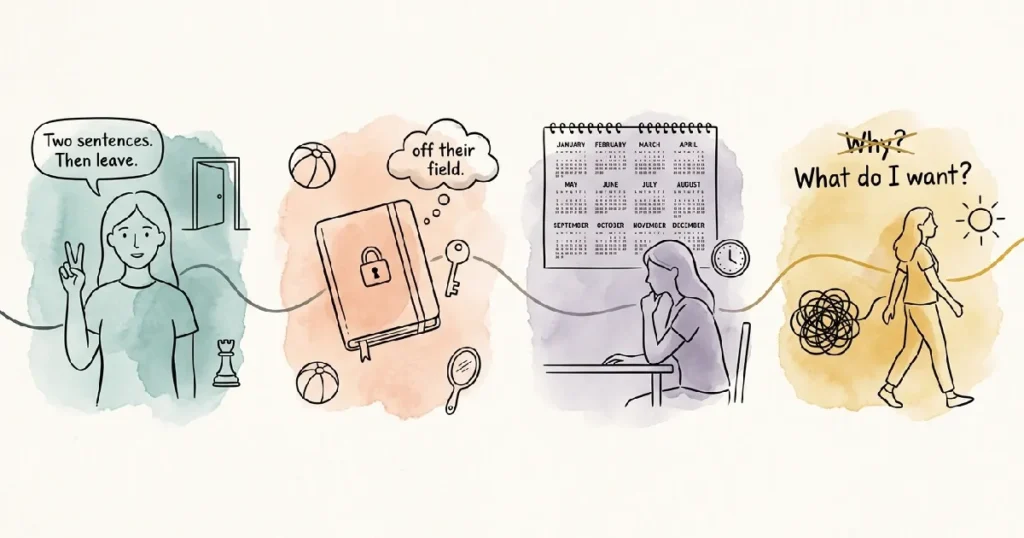
When a high-D person tries to drag you into debate, give them two sentences. No third. “I see it differently. I’m not going to keep discussing this.” Then physically leave the room or the chat. Engagement is fuel; brevity is starvation.
Move Evidence Off Their Field
If you’re documenting concerning behavior, in a relationship, a workplace, a custody situation, store it somewhere they cannot reach. A separate email account. An offline notebook. A trusted friend’s drive. According to guidance from the National Domestic Violence Hotline, keeping records in shared accounts is one of the most common, and most preventable, mistakes.
Run the Twelve-Month Test
Ask yourself one quiet question: if absolutely nothing about this person changes in the next twelve months, what does my life look like? If the honest answer makes your chest tight, you already have your data. As resources from Marriage often emphasize, hoping someone will change is not a strategy; observing whether they do is.
Trade “Why Are They Like This?” for “What Do I Want?”
The “why” question keeps you tethered. The “what” question hands you the steering wheel. You don’t need a complete diagnosis of them to make a clear decision for you. Research summaries hosted at the National Library of Medicine consistently show that personality traits in the D cluster are highly stable across adulthood. People can change. Most don’t. Plan accordingly.
You Already Knew. Now You Have Words.
Go back to that conversation you replayed a dozen times. The one in the opening of this article. The one that left you smaller.
Look at it again with what you now know. The charm wasn’t connection. The logic wasn’t logic. The guilt was never yours to carry. You were standing inside someone else’s justification system, and your only mistake was assuming it ran on the same fuel as yours.
It doesn’t. It never did.
You don’t have to prove it to them. You don’t have to win the argument. You only have to stop volunteering for a game whose rules were never written for your benefit.
That’s not bitterness. That’s clarity.
And clarity, once you have it, is something no one can talk you out of.
My Closing Remarks
I’ll be honest with you, friend to friend. I have sat across from too many brilliant, kind, thoughtful people who spent years convinced they were the broken one in the room. They weren’t. They were just decent humans trying to play fair with someone who had quietly opted out of fairness years ago. If any part of this article made your shoulders drop an inch, trust that signal. Your body has been telling you the truth long before psychology gave it a name.
More Related Stories for You
- Curious whether someone you love has an addictive personality pattern? The signs are quieter than you’d think.
- Want a healthier baseline to compare against? Start with the 5 main personality traits every adult should understand.
About The Author