
 Nicole Adkins
Why memorizing a list won’t change your life, but choosing five traits will rewire your daily habits from the inside out.
Key Points
- Out of the powerful 100 character traits to build better habits, only a handful become identity-shaping when paired with daily behavior.
- Character is not who you say you are; it is the trait your nervous system defaults to when you are tired, triggered, or alone.
- You do not need more traits. You need fewer, practiced longer, and tested in your real, ordinary life.
Contents
Table of Contents
You Already Have the List. Why Hasn’t It Changed You?
You bookmarked another character traits article last week. Maybe two. You read the words integrity, patience, discipline, courage, and you nodded along. You promised yourself this would be the one that finally stuck.
Then Tuesday happened. Someone snapped at you in a meeting. Your phone pulled you under for ninety minutes. You said yes when you wanted to say no. And the list, neatly tucked into your Notes app, did absolutely nothing.
You are not lazy. You are not broken. You are simply doing what almost everyone does with personality content. You are collecting traits like trading cards, hoping the act of knowing them will quietly turn into being them.
It will not. And that is the first thing I want to gently challenge in you today.
What Character Actually Is (And Why Lists Keep Failing You)
In my work with adults rebuilding their lives after burnout, divorce, or a sudden professional reset, I see the same pattern. People conflate aspiration with identity. They want to be patient. They are not yet patient. The gap between those two facts is where most self-improvement quietly dies.
Here is the cleaner truth. Personality is what you were born with. Character is what you build through repeated behavior under pressure. The Big Five model, used widely in personality research, describes the stable traits you arrive with. Character traits are different. They are trainable. They respond to practice the way muscles respond to weight.
A 2024 review by Bleidorn and colleagues, published in Psychological Bulletin, confirmed something surprising. Adult personality is not fixed. It shifts measurably when people commit to small, deliberate behaviors over twelve to sixteen weeks. Character is even more responsive than that.
So when you read a list of one hundred traits and feel nothing change, it is not because the list is wrong. It is because lists are inert. Repetition is what writes character into the body.
Think of it this way. A trait is a seed. Identity is the soil. Habit is the water. Without all three, nothing grows.
Your Habits Are Your Character Speaking Out Loud
Here is the single insight I want you to carry away from this article.
Your habits are not separate from your character. They are the visible shape of it.
Every time you reach for your phone instead of your partner’s eyes, you are casting a vote for who you are becoming. Every time you keep a quiet promise to yourself, you are casting a vote in the opposite direction. Character is just the running total of those votes.
This means the powerful 100 character traits to build better habits are not a menu you scan. They are a mirror you stand in front of. Your existing habits already tell you which traits are strong in you and which ones are dormant.
But here is what no one tells you.
You do not need to build all one hundred. You need to identify the five that, if practiced daily, would quietly rebuild every other area of your life. Psychologists call this keystone trait activation. I call it choosing your soil before planting your seeds.
Meet Daniel: The Composite Story I Tell Most Often

Daniel, a 38-year-old engineer I worked with in a small group setting, came to me with a printed list of seventy-three traits he wanted to develop. He had highlighted them in three colors. He had not slept well in months.
We threw the list away in our second session.
Together, we picked three traits. Patience, honesty, and what he called “phone restraint.” For ninety days, he practiced one tiny behavior tied to each. He paused four seconds before replying to anything. He told one small uncomfortable truth a week. He left his phone in another room during dinner.
By the end of three months, his wife told him he seemed like a different husband. His team called him steadier. He had not memorized more traits. He had embodied three.
This is the work. Not the list.
The 7 Domains That Hold All 100 Character Traits
To make the full set of one hundred traits useful instead of overwhelming, group them into seven domains. Read them once. Notice which two or three domains feel weakest in your life right now. That is your starting point.
| Domain | Sample Traits | What It Governs |
|---|---|---|
| 1. Integrity & Moral | Honest, principled, accountable, fair, sincere, ethical, trustworthy, loyal, just, transparent, dependable, conscientious, humble, faithful, modest | How you behave when no one is watching |
| 2. Resilience & Grit | Patient, disciplined, persistent, adaptable, courageous, gritty, determined, steadfast, tenacious, hardworking, resourceful, brave, composed, tolerant | How you respond when life pushes back |
| 3. Social & Relational | Empathetic, generous, loyal, diplomatic, kind, warm, considerate, attentive, forgiving, gracious, sociable, agreeable, supportive, affectionate, respectful | How safe people feel near you |
| 4. Intellectual & Curious | Analytical, open-minded, observant, thoughtful, inquisitive, reflective, perceptive, wise, studious, articulate, logical, creative, imaginative, discerning | How you make sense of the world |
| 5. Emotional & Self-Aware | Calm, self-compassionate, grounded, emotionally honest, expressive, intuitive, mindful, self-regulated, balanced, vulnerable, gentle, secure, peaceful, steady | How you live with your own mind |
| 6. Modern Digital | Attention-aware, screen-disciplined, AI-honest, parasocially restrained, comparison-resistant, privacy-conscious, focused, deliberate, present, slow, careful, intentional, boundaried, calm online | How you keep your soul intact in a noisy century |
| 7. Leadership & Vision | Decisive, visionary, courageous, mentoring, principled, accountable, inspiring, bold, strategic, charismatic, generous in credit, fair, future-oriented, hopeful | How you carry others alongside you |
Most adults are strong in three of these domains and quietly starving in two. The two you are starving in are usually the ones reshaping your daily habits without your permission.
How to Choose Your Five Traits (And Build Them Into Habits That Stick)
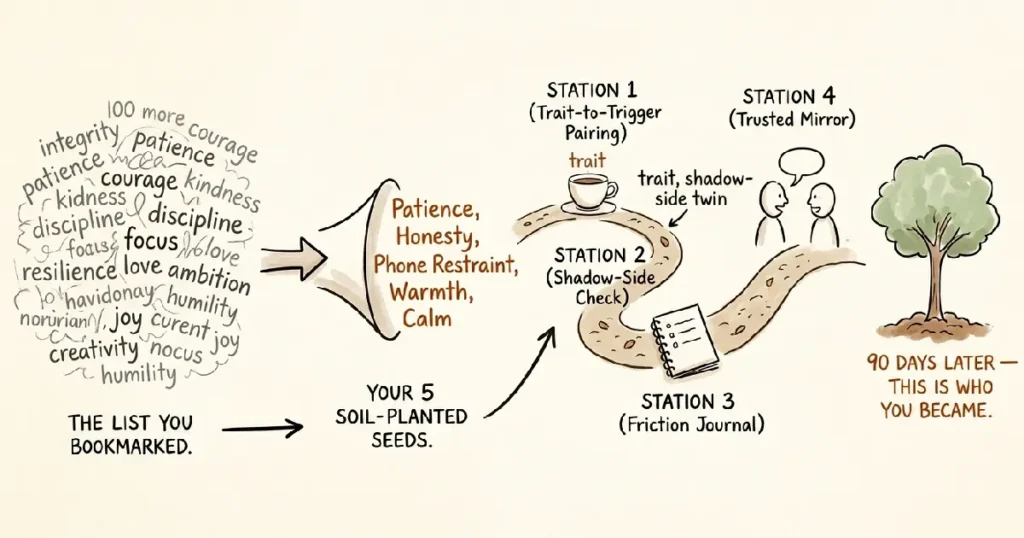
This is where insight becomes action. Pick the five traits that, if strengthened, would change everything else. Then practice them through these four named methods.
1. The Trait-to-Trigger Pairing
Take one trait. Attach it to a behavior you already do without thinking. The format is simple. After [existing habit], I will [tiny trait-building action].
For example. After you pour your morning coffee, you send one honest, specific appreciation to someone you love. That is the trait of warmth becoming a habit. Identity-based habits, as researched in behavioral psychology and discussed at length on Psychology Today, stick four times longer than goal-based ones because they answer the question who am I becoming rather than what am I getting.
A useful question to ask yourself. Which existing habit could carry one of my five traits today?
2. The Shadow-Side Check
Every trait you build has a dark twin. Kindness becomes people-pleasing. Discipline becomes rigidity. Confidence becomes contempt. The strongest people are not the ones with the most traits. They are the ones who know when their strengths begin betraying them.
Once a week, ask yourself. Where did this trait stop serving me and start using me? Write the answer down. Two sentences is enough.
3. The Friction Journal
Strong character is forged in friction, not comfort. Each Sunday evening, write one moment your target trait was tested. What happened. What you did. What you wish you had done. Keep it short. Three lines maximum.
This works because reflection converts behavior into identity. Without reflection, you repeat. With reflection, you choose.
4. The Trusted Mirror
Self-perception lies. Pick one honest friend, partner, or mentor. Once every ninety days, ask them a single question. Have you noticed any change in how I show up around [your target trait]?
Their answer will be more accurate than yours. Sit with whatever they say without defending yourself. That sitting is itself a character-building act.
The Mistake Almost Everyone Makes With Character Lists
Most people in this situation do not realize that they are trying to build character through content consumption rather than behavioral repetition. They read more, listen more, save more. The traits stay theoretical.
That is not weakness. That is wiring. Modern attention economies reward the dopamine of knowing far more than the slower satisfaction of becoming. Recognizing this pattern is the first act of character itself.
Left unexamined, this loop quietly becomes the reason people reach forty and feel exactly the same as they did at twenty-five, only tireder.
You are reading this article. That is fine. But the moment you close this tab, the test begins.
Returning to Tuesday
Remember the Tuesday I mentioned at the start. The meeting. The phone. The yes you meant as no.
That same Tuesday is coming again this week. Maybe tomorrow. The difference is that now you know something you did not know before. You know that character is not a list you read. It is the small, almost invisible act you choose when the moment arrives.
You do not need one hundred traits. You need three to five, practiced quietly, for ninety days, until your nervous system forgets any other way of being.
The list was never the answer. You were.
My Closing Remarks
Honestly, I have written and rewritten my own list of traits more times than I can count. I have been the person who collected them like souvenirs and the person who lived only two of them well. The truth I have earned the hard way is this. The traits you actually own are the ones that show up when you are exhausted, embarrassed, or alone in a hotel room at midnight. Everything else is performance. Pick fewer. Practice longer. Let the work be quiet. That is where the real change has always lived for me, and I believe it lives there for you too.
More Related Stories for You
Once you start noticing your own patterns, you will also start spotting toxic people traits more clearly in others, and you will find yourself drawn toward people with genuinely positive character traits who quietly reflect the version of you that you are becoming.
About The Author