
 Nicole Adkins
You’ve read the lists. Fifty traits. A hundred traits. Three hundred traits. And you walked away more confused than when you started — because no one told you which ones actually matter for YOUR life
Here’s the truth most articles won’t tell you: the majority of pages ranking on Google for “positive character traits” were written for fiction writers building imaginary characters. Not for real people trying to build real lives. That’s why the advice feels hollow.
Character isn’t a vocabulary exercise. It’s a behavioral system. And the science of character strengths — grounded in two-plus decades of positive psychology research — has proven that specific traits are directly linked to happiness, career success, and resilience. Almost no popular article shares this data. That changes today.
What are positive character traits? Positive character traits are consistent personal qualities — like integrity, resilience, empathy, and self-discipline — that shape how you respond to challenges, build relationships, and achieve goals. Research links deliberate use of your top character strengths to significantly greater life satisfaction, wellbeing, and professional success.
In this guide, you’ll discover the 20 most impactful traits backed by science, learn the critical difference between traits and feelings, take a self-assessment to identify your existing strengths, and get a specific daily action plan to develop the ones you’re missing.
Positive Character Traits Redefined: Why Everything You’ve Read Is Incomplete
What Are Positive Character Traits, Really? (Beyond the Dictionary)
Most definitions stop at something like “admirable qualities that reflect your values.” That’s technically correct, but it’s also frustratingly useless.
Table of Contents
Here’s what you actually need to understand. Character strengths are the positive parts of your personality that impact how you think, feel, and behave. But unlike your mood on a Monday morning, they don’t disappear when life gets hard. That’s the distinction almost no one explains clearly. Feelings are temporary. Traits are consistent qualities. When you ask yourself, “Is this always true about me, or just true right now?” — that question is the test. If honesty only shows up when it’s convenient, it’s not yet a trait. It’s a preference.
The confusion runs even deeper when people mix up character traits, personality traits, and skills. They’re not the same thing. Personality traits (like being introverted or extroverted) are relatively stable and descriptive. Skills are learned capabilities. But character traits? They’re prescriptive. They tell you what to develop. They’re tied to your moral compass and your choices under pressure.
This is where the gold-standard scientific framework enters the picture. The result of years of research by 55 distinguished scientists was the VIA Classification of Character Strengths and Virtues (Peterson and Seligman, 2004), a classification of positive traits in human beings. Since then, hundreds of peer-reviewed articles have been published across many cultures. This framework describes the 24 positive qualities rooted in every personality type — and yes, you have all 24 in varying degrees. The question is which ones are your strongest.
The Science: What Research Actually Proves About Character Strengths
Let me give you the data — because this changes everything about how you approach self-development. Based on responses from 3,000 study participants, the results of the 2025 VIA Survey Impact Study show the VIA Survey experience itself is both meaningful and transformative. Those who completed the VIA Survey were five times more likely to take positive action — such as sharing results with others or pursuing further training — and reported clear benefits for mental health, resilience, and self-perception.
Five times more likely to take positive action. That’s not a small effect. That’s the difference between knowing you should change and actually doing something about it. Character strengths — the 24 positive traits that reflect who we are at our best — are scientifically linked to resilience, optimism, and well-being. They are backed by more than 1,000 peer-reviewed studies across psychology, education, health care, and organizational science, making the VIA Classification one of the most validated frameworks in the field.
Dr. Neal Mayerson, Founder of the VIA Institute on Character, put it plainly:
“The VIA Classification turned that model on its head by systematically identifying what’s right with people — their character strengths.”
This matters because for over a century, psychology focused on diagnosing what’s broken. The VIA framework flipped that script. When you understand your strengths, you stop working from a place of deficit and start building from a place of genuine power. Peterson and colleagues identified several strengths — including curiosity, zest, and hope — as important to happiness through meaning, a key element of Seligman’s PERMA model. And that’s exactly the research backing our curated list below.
The 20 Most Powerful Positive Character Traits for Real-Life Success

We’re not going to dump 100 traits on you and call it a day. That’s the old way, and it doesn’t work. Instead, here are the 20 most impactful traits organized into four research-backed pillars. Think of each pillar as a zone of your life — your inner world, your relationships, your growth, and your impact on others.
Pillar 1: Inner Foundation (The Traits That Hold You Together When Life Doesn’t)
1. Integrity Integrity is the alignment between what you say and what you do, especially when nobody’s watching. In 2026, trust is in short supply. AI-generated content, deepfakes, and curated online personas have made authenticity rare and incredibly valuable. Daily micro-behavior: Make one promise today and keep it visibly, even a small one.
2. Self-Discipline Self-discipline is the ability to act on your long-term goals rather than your short-term feelings. In a world of infinite scrolling and constant digital distraction, this trait is your strongest shield. Daily micro-behavior: Before opening your phone in the morning, complete one task you’ve been avoiding.
3. Resilience Resilience is the capacity to recover from setbacks without losing your sense of direction. In an era of economic uncertainty and rapid change, this isn’t optional — it’s survival. Character strengths are connected with resilience and buffer people from vulnerabilities that can lead to depression and anxiety. Daily micro-behavior: After any frustration, write one sentence about what you can control in the situation.
4. Accountability Accountability is owning your outcomes, full stop — not just the wins, but the mistakes too. In remote and hybrid work environments, where no one is physically supervising anyone, accountability is the trait that separates trustworthy professionals from everyone else. Daily micro-behavior: In your next team email, own one thing that didn’t go perfectly instead of framing it away.
5. Emotional Maturity Emotional maturity is the ability to feel strong emotions without letting them drive your decisions. It’s not about suppressing feelings. It’s about responding with intention rather than reacting from impulse. This is the trait that gets people promoted more than almost any technical skill. Daily micro-behavior: In your next conflict, pause for five seconds before responding.
Pillar 2: Connection and Empathy (The Traits That Build Bridges)
6. Empathy Empathy is the ability to genuinely understand someone else’s experience without needing to have lived it yourself. Remote work has created real isolation. People are lonelier than ever. Empathy is what cuts through that. Daily micro-behavior: Send one unprompted check-in message to a colleague or friend — no agenda, just “how are you doing?”
7. Kindness Kindness is choosing to act for someone else’s benefit, even when you’re busy, even when you’re stressed. When individuals use character strengths such as kindness and teamwork, they experience enhanced autonomy through self-directed behavior, increased competence through effective action, and deeper relatedness through social connections. Daily micro-behavior: Do one kind act today that the recipient will never be able to repay.
8. Forgiveness Forgiveness is releasing resentment — not for the other person’s sake, but for yours. Carrying grudges is metabolically expensive. It costs you energy that you could be using to build something. Daily micro-behavior: Write one sentence describing what holding a current resentment is costing you in energy and focus.
9. Gratitude Gratitude is the active practice of noticing what’s going right, even when plenty is going wrong. Research consistently shows that gratitude is among the character strengths most strongly correlated with life satisfaction. Daily micro-behavior: Write three specific things you’re grateful for — not generic, but specific (“my colleague laughed at my joke in that meeting”).
10. Humility Humility is knowing what you don’t know — and being genuinely OK with that. In a world that rewards confidence and bravado, humility can feel like a liability. It’s actually a massive advantage. Humble people are easier to collaborate with, faster to learn, and more trusted over time. Daily micro-behavior: In your next conversation, ask a follow-up question instead of sharing your own opinion first.
Pillar 3: Growth and Drive (The Traits That Move You Forward)
11. Curiosity Curiosity is a love of learning and exploring the new. Curiosity is specifically identified as a strength important to happiness through meaning, and in 2026, when AI is reshaping entire industries, curiosity is what keeps you relevant. The people panicking about AI are usually the ones who stopped being curious. Daily micro-behavior: Spend 15 minutes learning one new thing that has nothing to do with your current job.
12. Courage Courage is not the absence of fear. It’s action in the presence of it. Courage looks like sending the difficult email, speaking up in the meeting when you disagree, or starting the business when the outcome isn’t guaranteed. Daily micro-behavior: Today, identify the one conversation you’ve been avoiding and schedule it.
13. Perseverance Perseverance is showing up consistently over time, especially when the results are not yet visible. It’s the trait that quietly separates people who achieve from people who almost achieve. Daily micro-behavior: Work on one long-term goal for 20 minutes today — not when you’re motivated, but specifically when you don’t feel like it.
14. Adaptability Adaptability is the ability to pivot without falling apart. In 2026, the average professional has changed job functions, workflows, and tools multiple times in the past two years alone. Adaptability isn’t just nice to have — it’s a professional survival skill. Daily micro-behavior: Deliberately do one familiar task a different way today, just to practice cognitive flexibility.
15. Optimism Optimism is the belief that positive outcomes are possible and worth working toward. But here’s the distinction that matters: healthy optimism is not naive. It’s the choice to focus your energy on solutions rather than on fears. Research by Schutte and Malouff (2019) found that developing signature strengths can improve positive affect and boost life satisfaction, and also play a role in reducing depression. Daily micro-behavior: When something goes wrong today, name one thing it taught you or opened up for you.
Pillar 4: Influence and Impact (The Traits Others See in You)
16. Honesty Honesty is telling the truth even when the truth is inconvenient. In the age of AI-generated content and social media performance, genuine honesty is a radical act. People can sense inauthenticity fast, and they remember it. Daily micro-behavior: In one conversation today, share a genuine opinion rather than the one you think the other person wants to hear.
17. Leadership Leadership isn’t a title. It’s the choice to take responsibility for outcomes, even when you could reasonably avoid it. Research shows that strengths such as hope, leadership, and persistence directly impact self-efficacy and performance outcomes. Daily micro-behavior: In your next group situation, take ownership of one problem that isn’t technically “your job.”
18. Patience Patience is the ability to wait without losing your sense of purpose. We live in an instant-gratification era. Patience is increasingly rare — which means it’s increasingly valuable. Daily micro-behavior: The next time you feel impatient (in a line, in traffic, waiting on email), use the waiting time to practice a breathing technique or mentally plan something important.
19. Fairness Fairness is treating people consistently and equitably, regardless of how you personally feel about them. It’s the foundation of every high-functioning team. Daily micro-behavior: Before making a decision that affects others today, ask yourself: “Would I be comfortable if the people affected could see exactly how I made this call?”
20. Zest/Enthusiasm Zest is bringing genuine energy and vitality to what you do. And yes, research backs this one hard. Zest is specifically identified alongside curiosity and hope as one of the strengths most strongly correlated with life satisfaction. Enthusiasm is contagious. It changes the energy of rooms and relationships. Daily micro-behavior: Find one thing about your work today that you genuinely find interesting and talk about it with someone.
7 Steps to Actually Develop Positive Character Traits (Not Just Know Them)
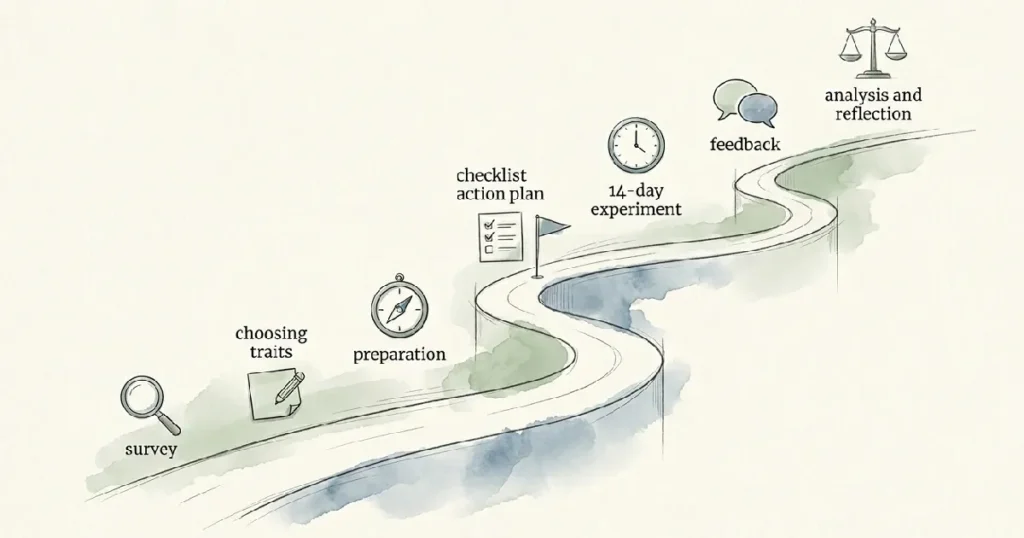
Knowing the list means nothing if you don’t have a system for building the traits you need. Here’s the exact process — and I want you to treat this like a coach handing you a game plan, not a professor giving a lecture.
Step 1: Take a Validated Character Strengths Assessment
Do This: Go to viacharacter right now and take the free VIA Character Strengths Survey. This short survey takes only 12 minutes, and 90% of survey takers look forward to applying their results. It identifies your “Signature Strengths” — your natural top traits — among 24 scientifically validated qualities.
Not That: Do NOT rely on gut feeling or a social media personality quiz to understand your character.
Why This Matters: 83% of study participants found discovering their character strengths meaningful. You can’t develop what you haven’t measured.
Step 2: Choose 3 Traits (Not 20) to Focus On
Do This: Pick your top 2 Signature Strengths (your natural advantages to use more) plus 1 “growth trait” (the one you most want to develop). Write them on a sticky note and put it somewhere you’ll see it daily.
Not That: Don’t try to improve all 20 traits simultaneously. That’s a burnout blueprint.
Why This Matters: The use of signature strengths has been connected with individuals making greater progress on their goals. Start from strength, then layer in growth.
Step 3: Define “In the Wild” Behaviors for Each Trait
Do This: For each of your 3 focus traits, write one specific, observable behavior. Not “be more courageous” — instead: “In meetings, I’ll ask one clarifying question before I disagree.”
Not That: Do not set vague goals like “I’ll be more patient this year.” Vague goals produce zero results.
Why This Matters: Traits only become real when they’re translated into observable, repeatable actions. Your brain needs specificity to build new behavioral patterns.
Step 4: Run a 14-Day Behavioral Experiment
Do This: Commit to two weeks. Track one micro-behavior per trait daily. It takes five minutes. Use a habit tracker app or a simple notes app.
Not That: Don’t wait until you “feel ready” or until motivation shows up uninvited. It won’t.
Why This Matters: Discipline is what separates people who dream from people who build. Consistency doesn’t require inspiration — it requires structure.
Step 5: Request Targeted Feedback
Do This: Ask one trusted person a specific question. Not “How am I doing?” — try: “When I’m under pressure, what’s the first thing you notice about how I communicate?” That’s the kind of question that gets you real data.
Not That: Don’t fish for compliments or avoid feedback to protect your ego.
Why This Matters: External feedback corrects the blind spots your own self-perception can never see. This is why coaches exist.
Step 6: Use Setbacks as Trait-Building Moments
Do This: When you fail, immediately ask: “Which of my 3 focus traits can I apply to this situation right now?” Then do it.
Not That: Don’t spiral into self-criticism or conclude “I’m just not that kind of person.” That story is never true.
Why This Matters: Character is not what you demonstrate when things go smoothly. It’s what you do when things fall apart. That’s exactly when the practice matters most.
Step 7: Review and Rotate Every 90 Days
Do This: Every quarter, retake the VIA Survey or do a self-assessment. Retire one growth trait (now internalized) and add a new one.
Not That: Don’t assume character development is a one-time project.
Why This Matters: When you know your best character traits, you can improve your life and thrive. Research shows that using your character strengths can help you improve your relationships, enhance health and overall wellbeing, and buffer against problems. That growth is ongoing — not a destination.
The Story of Daniela: How One Trait Changed Everything

It’s 6:47 a.m. on a Tuesday in Chicago. Daniela, 34, is in her car in the parking garage below her office. She’s not moving. She’s been passed over for promotion twice, and she can’t understand why. Her manager said she “had potential” — but that felt like code for something no one was willing to say out loud.
For the previous eight months, Daniela had done what most of us do when we suspect something is wrong: she fixed the wrong thing. She took an Excel course. She got a project management certification. She updated her LinkedIn. None of it helped.
What Daniela didn’t realize — and what her manager never said directly — was that her issue wasn’t her skills. It was a pattern. In team conflicts, she deflected blame. In performance reviews, she got defensive when given critical feedback. Her emotional maturity and accountability were both seriously underdeveloped, and people around her could feel it, even if they couldn’t name it.
Then Daniela took the VIA Survey on a whim, mostly out of desperation. Her results showed her top Signature Strengths were curiosity and kindness — both real, both authentic. But her growth area was accountability.
So she did Step 3. She wrote one behavioral rule on a Post-it note and stuck it to her laptop: “When criticized, I will pause for five seconds and say: ‘Thank you for telling me that. Let me think about it.'”
She ran the 14-day experiment. Tracked it daily. It felt uncomfortable and artificial at first — like wearing someone else’s coat. But she did it anyway.
Two months later, her manager sat across from her at a performance review and specifically cited her “emotional maturity and accountability in difficult conversations.” She got the promotion.
Here’s the part that matters: accountability was not Daniela’s natural strength. But pairing it with her existing strengths of curiosity (to stay open to feedback) and kindness (to extend good faith to colleagues) made the change feel real rather than forced. That’s the strength-first approach. And it works.
Positive Character Traits vs. Personality Traits: The Critical Difference Nobody Explains
This comparison is one of the most Googled-but-never-answered questions in personal development, so let’s settle it once and for all.
Character Traits vs. Personality Traits
| Dimension | Character Traits | Personality Traits |
|---|---|---|
| Definition | Moral and behavioral qualities tied to values | Patterns of thinking, feeling, and behaving |
| Changeable? | Yes — can be deliberately developed | Relatively stable over time |
| Framework | VIA Classification (24 strengths) | Big Five (OCEAN model) |
| Example | Integrity, courage, kindness | Extroversion, openness, agreeableness |
| Focus | What’s right with you | What’s typical of you |
The key distinction: character traits are prescriptive. They tell you what to build. Personality traits are descriptive. They tell you how you tend to show up. You can absolutely strengthen your integrity without changing whether you’re an introvert or extrovert. These systems operate at different levels. Virtue ethics provides a theoretical framework for understanding character strengths as moral excellence. Peterson and Seligman (2004) developed their classification of character strengths as a social science that emphasizes the cultivation of virtues to achieve moral excellence. This is why character work is fundamentally different from personality work — one is about your values in action, the other is about your natural tendencies.
Common Mistakes That Prevent You From Building Positive Character Traits

Mistake 1: Confusing Positive Feelings With Positive Traits
You feel motivated on Monday and tell yourself you’re “disciplined.” By Wednesday, you’ve skipped every commitment. Here’s the truth: feelings are temporary. Traits are consistent.
The fix: Use the “always or right now?” test before labeling any quality a character trait. If it only shows up when you’re in a good mood, it’s not a trait yet — it’s a feeling. Build the actual trait by practicing it especially on the days you feel terrible. That’s when the repetition rewires behavior.
Mistake 2: Trying to Develop Traits in Total Isolation (The Lone Wolf Error)
In 2026, the biggest character-building mistake is attempting self-improvement in a digital vacuum — consuming content alone, scrolling personal development accounts, and never having an actual human being hold you accountable. It feels like growth. It isn’t.
The fix: Tell one person your three focus traits this week. Share your 14-day experiment with them. Ask them to check in. Research consistently shows that social reinforcement accelerates behavioral change. Mentors, coaches, and even honest friends dramatically speed up the process compared to solo effort.
Mistake 3: Performing Virtue Instead of Practicing It
This one is a 2026-specific trap. In the age of curated online personas, it’s dangerously easy to post about gratitude on Instagram without practicing it, to tweet about accountability without demonstrating it at work, to talk about leadership without taking on any real risk.
The fix: Apply the “no-audience test.” Would you practice this trait if absolutely nobody could see it? The VIA Classification turned the old model on its head by systematically identifying what’s right with people — their character strengths. The VIA Survey is the practical doorway into this framework — and real character development happens inside, not on a feed. If you’re only kind when someone is watching, you haven’t internalized kindness yet.
Mistake 4: Ignoring Your Existing Strengths While Only Fixing Weaknesses
Most people default to a deficit mindset: “I need to fix my weakness.” They obsess over the bottom of their VIA results and ignore the top five. This kills motivation fast, because you’re fighting upstream against your own nature.
The fix: Start with your Signature Strengths. Research by Schutte and Malouff found that developing signature strengths can improve positive affect and boost life satisfaction. Build from your natural advantages. Use your strengths as the scaffolding to construct the growth traits you want to add. That’s exactly what Daniela did — and it worked.
Frequently Asked Questions
What Are the Most Important Positive Character Traits?
The most important positive character traits supported by research are integrity, empathy, resilience, self-discipline, and curiosity. According to positive psychology’s VIA framework, zest, hope, gratitude, love, and curiosity show the strongest correlations with life satisfaction. The “best” traits depend on your personal goals — career success prioritizes accountability and adaptability, while relationships benefit most from empathy, forgiveness, and kindness.
Can Positive Character Traits Be Learned, or Are They Innate?
Positive character traits can absolutely be learned and developed at any age. While some traits may have a genetic component — such as natural empathy or curiosity — evidence shows that people can be helped to develop their character by a catalytic sequence of practical methods. People can learn to flourish and to be more self-directed through deliberate behavioral practice, mentorship, and environmental reinforcement. Your brain’s neuroplasticity supports trait development throughout your entire life.
What Is the Difference Between Character Traits and Personality Traits?
Character traits reflect your moral values and influence ethical decision-making — things like honesty, courage, and fairness. Personality traits describe your behavioral tendencies — like introversion, openness, or agreeableness. The key distinction: character traits are developable and tied to growth, while personality traits are relatively stable over time. You can strengthen your integrity without changing whether you’re an introvert or extrovert.
How Do I Identify My Own Positive Character Traits?
The most reliable method is taking the VIA Character Strengths Survey — a free, scientifically validated 12-minute assessment. With more than 35 million survey takers worldwide and availability in 46 languages, it’s the gold standard. You can also ask trusted friends or colleagues what qualities they consistently observe in you when you’re at your best and under pressure. Both perspectives together give you the fullest picture.
What Positive Character Traits Do Employers Value Most?
Employers consistently rank integrity, accountability, adaptability, self-discipline, and teamwork as the most valued positive character traits in the workplace. In 2026, curiosity and emotional intelligence have risen sharply in importance due to AI-driven changes in almost every field. Hiring managers look beyond technical skills for signals that a candidate can handle pressure, collaborate across diverse teams, and take ownership of both successes and failures.
How Long Does It Take to Develop a New Character Trait?
Developing a new character trait takes approximately 60 to 90 days of consistent behavioral practice. The process involves defining specific daily micro-behaviors, running two-week experiments, tracking progress, and requesting external feedback. Unlike habits, traits require internal value alignment — not just repetition. Expect initial discomfort as the trait feels “unnatural,” followed by gradual internalization. Quarterly reviews help solidify gains and identify new growth areas.
Final Takeaway
Here’s your challenge for the next 24 hours — and it takes less than 15 minutes. Go to viacharacter and take the free VIA Character Strengths Survey right now. When your results arrive, screenshot your Top 5 Signature Strengths and save them somewhere visible. Tomorrow morning, before you start work, ask yourself one question: “How will I use Strength #1 today?”
That single question, asked daily, is the seed of every trait on this list.
The science is clear. Those who completed the VIA Survey were five times more likely to take positive action and reported clear benefits for mental health, resilience, and self-perception. But the survey is just a starting point. The real work is in the daily behaviors — the small, consistent choices that slowly, invisibly, become the person you’re becoming.
Character isn’t something you have. It’s something you build. Start yours today.
My Closing Remarks
I’ll be honest with you. I’ve sat across from hundreds of people who told me their life changed when they finally stopped trying to fix everything that was wrong with them — and started building from what was already right. That shift? It sounds simple. But it’s quietly one of the most radical things a person can do. You already have strengths. Real ones. You’ve been using them your whole life without knowing their names. Find them. Name them. Then use them on purpose. That’s where real change lives.
– Nicole Adkins, LMFT
More Related Stories for You
- Curious about the deeper science behind these qualities? Read our full guide on Character Strengths and Virtues and discover how positive psychology has mapped the best of what humans are capable of.
- Want to explore how these traits show up in your everyday interactions? Our article on Good Personality Traits breaks down the qualities that shape how others experience you — and how to intentionally develop them.
About The Author