
 Nicole Adkins
Your confusion isn’t a personality flaw. It’s a nervous system in survival mode, and there’s a science-backed way out.
Key Points
- Generic talk therapy and couples counseling can quietly retraumatize survivors, which is exactly why therapy for narcissistic abuse requires trauma-specific training.
- The most effective therapy for narcissistic abuse recovery pairs body-based tools like EMDR and Somatic Experiencing with mind-based work like CBT and IFS.
- Breaking a trauma bond follows a sequence: stabilize the body first, question the story second, rebuild identity third.
Contents
Table of Contents
You keep replaying the last conversation, searching for the exact sentence where you lost your footing.
Maybe it was the calm, reasonable voice that made your very real reaction look unhinged. Maybe it was the way everyone else in the room seemed to believe him and not you.
You’ve tried explaining it to friends. The words come out sounding smaller than the truth ever was.
So you start to wonder if you imagined the whole thing.
You didn’t.
This is the gaslighting hangover. It’s the fog that lingers long after you’ve left, where you question memories you lived through in your own body. It is not a character flaw. It is a documented response to prolonged psychological control.
Recovery from this kind of harm is not a standard breakup bounce-back. You aren’t just grieving a person. You’re rewiring a brain that learned to scan for danger in a place that should have felt safe, and untangling physical hooks that kept you attached long after logic told you to leave.
That’s exactly why therapy for narcissistic abuse looks different from ordinary counseling. Real healing here goes past talking about what happened. It requires methods built to calm an overworked nervous system, break the trauma bond, and reverse what researchers call complex PTSD, or CPTSD: a pattern of psychological injury caused by repeated, inescapable trauma rather than a single event.
Why Standard Therapy for Narcissistic Abuse Often Fails Survivors
The Hidden Traps of Traditional Talk Therapy
Standard talk therapy asks you to recount what happened, week after week, in detail. For many kinds of pain that process helps.
But narcissistic abuse doesn’t live only in your thoughts. It lives in your body as a trauma loop of chronic stress and hypervigilance, that constant sense of scanning a room for danger even when nothing is wrong.
Repeating the story out loud without the right tools can pull your nervous system right back into that loop instead of processing it. You leave session feeling raw instead of relieved. That’s not you doing therapy wrong. That’s a mismatch between the method and the injury.
The Danger of Couples Counseling with a Narcissist
If you’ve tried couples counseling with a partner who shows narcissistic traits, you already know how it can go. He walks in charming. He nods along with the therapist. He might even cry.
Then the session ends, and the material from that hour becomes a new weapon. Suddenly he’s using therapy language against you, calling your boundaries “avoidant” or your anger “toxic.”
In my practice, I’ve watched clients leave couples counseling more confused and more doubted than when they walked in. That’s a common pattern, not a personal failure on your part.
Major health and family organizations now caution against traditional couples therapy when active emotional abuse or coercive control is present, because the format assumes both partners are negotiating in good faith. This detailed step-by-step guide to narcissistic abuse therapy walks through exactly why a solo, trauma-informed approach protects you in ways joint sessions cannot.
The Mandate for a Narcissistic Abuse Specialist
A well-meaning but untrained therapist can do real damage without knowing it. They might land on “it takes two to tango,” treating your relationship like a communication problem between equals.
For a survivor, that kind of neutrality feels like the abuse continuing in a new room.
Real recovery calls for a clinician trained specifically in CPTSD and what psychologists call Cluster B relational dynamics, a term for patterns involving narcissistic, borderline, or antisocial traits marked by manipulation, low empathy, and unstable self-image. Ask directly whether a prospective therapist has this training before you book a first session.
Think of your mind as software running on the hardware of your nervous system. You can install new, healthier scripts through insight and self-talk all day long, but if the hardware itself got fried by years of unpredictable shocks, the new software keeps crashing.
That’s why real therapy for narcissistic abuse works on both layers at once. Here are the seven methods doing that work right now.
7 Proven Methods Used in Therapy for Narcissistic Abuse Recovery
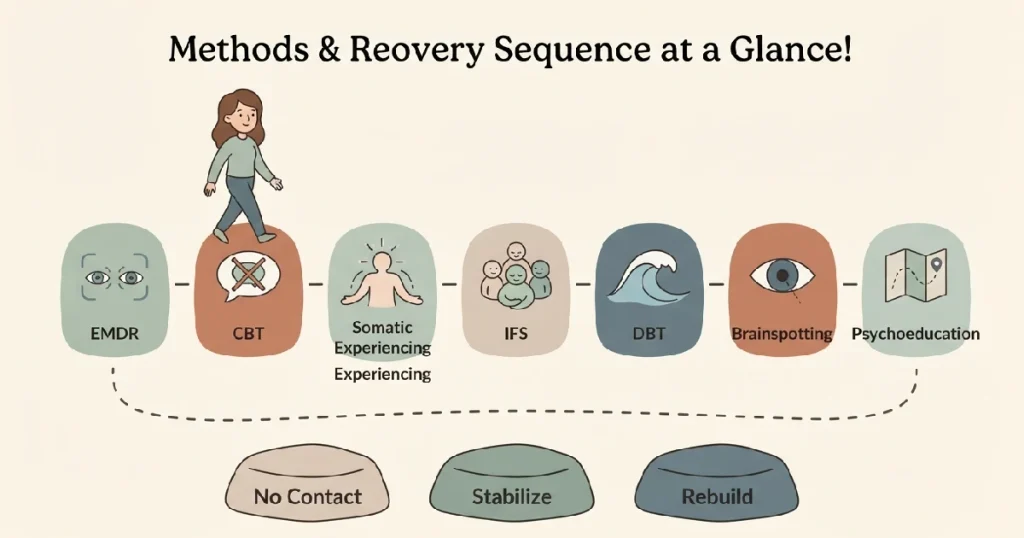
Before the list, it helps to understand why leaving still hurts this much even when you know, logically, that the relationship was harmful.
Psychologist B.F. Skinner’s research on operant conditioning found something counterintuitive: rewards that show up unpredictably create stronger, more addictive behavior patterns than rewards that show up every single time. Slot machines run on this exact principle, known as a variable ratio reinforcement schedule.
Narcissistic relationships run on it too. The affection wasn’t constant, so your brain never stopped hoping the good version would come back.
That’s not weakness.
That’s wiring.
1. EMDR for Trauma Bond Healing
EMDR, or Eye Movement Desensitization and Reprocessing, uses bilateral stimulation, short sets of guided eye movements or alternating taps, to help your brain unstick emotionally charged memories. Instead of staying frozen in a loop, the memory gets filed away as something that happened rather than something happening right now.
You don’t have to narrate every painful detail out loud to get relief. A 2014 review published in the Journal of EMDR Practice and Research found the majority of participants experienced a significant drop in PTSD symptoms within a limited number of sessions. For survivors bracing against every triggering word, that matters a great deal.
2. Cognitive Behavioral Therapy (CBT) to Rewrite Internalized Beliefs
CBT targets the toxic scripts a narcissistic partner or parent installed in your head, beliefs like “everything is my fault” or “I’m too much for anyone to love.” It helps you catch these automatic thoughts and test them against actual evidence.
Timing matters here. Introduce CBT too early, before your body feels safe, and it can backfire, making you feel like you’re just gaslighting yourself in a different direction. Once your nervous system has some ground under it, CBT becomes one of the fastest ways to dismantle those old scripts for good.
3. Somatic Experiencing for Nervous System Reset
Trauma doesn’t just stay in your memory. It settles into muscle tension, posture, digestion, and sleep, which is why so many survivors describe a bone-deep exhaustion that rest alone never fixes.
Somatic Experiencing works from the bottom up. Instead of starting with the story, it tracks physical sensations, a tight chest, a clenched jaw, shallow breathing, and helps that trapped fight-or-flight energy discharge safely. You leave sessions feeling lighter in your actual body, not just clearer in your head.
4. Internal Family Systems (IFS) for Rebuilding a Fractured Identity
IFS treats your mind as made up of different “parts”: a protective part that stays angry, a part that still hopes he’ll change, a wounded inner child still chasing his approval. Instead of shaming these parts, IFS teaches your core Self to lead them with curiosity.
This matters enormously after narcissistic abuse, because you likely feel fractured, furious one moment and grieving the next. IFS gives every one of those reactions a legitimate seat at the table instead of treating your mixed feelings as a malfunction.
5. Dialectical Behavior Therapy (DBT) for Withdrawal and Distress Tolerance
Breaking a trauma bond can feel physically similar to substance withdrawal, complete with anxiety spikes, sleeplessness, and sudden waves of grief. DBT hands you concrete crisis survival tools built for exactly this kind of agony.
Skills like TIPP, which stands for temperature, intense exercise, paced breathing, and paired muscle relaxation, give you something to do the moment an urge to reach out hits. This isn’t about suppressing your feelings. It’s about surviving the wave without drowning in it.
6. Brainspotting and Accelerated Resolution Therapy as Gentler Alternatives
Brainspotting locates specific points in your visual field connected to where trauma sits in the deeper, nonverbal part of the brain called the midbrain. Accelerated Resolution Therapy, or ART, works on a similar principle with faster eye movements over fewer sessions.
Both offer real relief for survivors who find EMDR’s rapid tracking overstimulating. If your system is already on high alert, these gentler entry points can reach the same deep processing without adding more sensory noise to an already overloaded body.
7. Psychoeducation as the Foundation of Narcissistic Abuse Recovery
Before any of the tools above fully work, you need language for what happened to you. Terms like hoovering, meaning attempts to suck you back in after discard, flying monkeys, the people an abuser recruits to pressure or discredit you, and intermittent reinforcement, the unpredictable affection that keeps you hooked, turn a chaotic experience into a recognizable pattern.
This shift matters more than it sounds. Simply Psychology’s analysis of trauma treatment modalities confirms what clinicians see constantly: naming a dynamic accurately moves survivors from “what is wrong with me” to “this is a normal reaction to an abnormal situation.” That mental shift alone lowers shame before deeper trauma work even starts.
The Recovery Blueprint: How to Heal After Narcissistic Abuse

Step 1: Break the Trauma Bond with the Clean Break Protocol
Block every number. Restrict every shared social profile. Cut contact with mutual friends who keep relaying his messages back to you, the flying monkeys mentioned earlier.
If children or legal ties make a full break impossible, use the Gray Rock method instead: responding to necessary contact with flat, brief, boring answers that give a manipulator nothing to grab onto emotionally.
One place to start is drafting two or three neutral scripted responses in advance, so you’re never composing an answer in the heat of the moment.
Step 2: Give Your Nervous System a Convalescence Window
Treat your first few months out as physical recovery, not just emotional recovery. Sleep on a real schedule. Drink water. Lower sensory noise, dim lights, less scrolling, fewer decisions.
Consider postponing heavy trauma processing until your body isn’t stuck in survival mode anymore. A useful question to ask yourself is whether your system feels calm enough right now to look at this memory, or whether you’re still in the middle of the storm.
Step 3: Rebuild Autonomy Through Re-Individuation
Anger that got suppressed for years needs somewhere to go. Try anger journaling, hard exercise, or grief counseling built specifically for this kind of loss.
Then start small. Choose your own coffee order without checking anyone’s reaction. Rearrange a room the way you actually like it. Say no to one thing this week purely because you want to.
Every one of these tiny choices rebuilds the muscle a narcissistic relationship wore down: the simple, radical act of trusting your own preferences again.
Therapy for Narcissistic Abuse Gives You Your Story Back
Your mind isn’t broken software full of bad code. It’s a strong system that adapted perfectly to an unstable environment, and it can just as easily adapt to a safe one.
The hardware can heal. Real therapy for narcissistic abuse, built on EMDR, somatic work, IFS, and psychoeducation instead of generic talk sessions, reaches your body instead of stopping at your intellect.
Stop auditing your own memory for evidence you did something wrong. Find a clinician trained specifically in this kind of harm.
You already survived the hardest part. Now you get to come back online.
My Closing Remarks:
I’ve watched clients walk into my office years after leaving a narcissistic relationship, still apologizing for taking up space. That fog is real, and it lifts slower than anyone wants it to. What I want you to know is that the confusion you feel right now is proof of what you survived, not proof that something is wrong with you. Find the right specialist, give your body time, and trust that the clear-headed version of you is still in there.
More Related Stories for You
- Once your nervous system feels steadier, it helps to know what healthy actually looks like. Read more about the qualities of a good partner so you can recognize safety the next time it shows up.
About The Author