
 Nicole Adkins
The quiet, wounded-soul act can be more damaging than any grandiose meltdown. Here’s what you’re really dealing with.
Key Points
- Vulnerable narcissism hides behind shyness, anxiety, and constant self-pity, which is exactly why it’s so hard to name.
- The same five covert habits, hypersensitivity, silent treatment, martyrdom, envy, and strategic empathy, show up again and again in these relationships.
- You’ll walk away with a clear plan to protect your peace, whether or not the other person ever changes.
Contents
Table of Contents
We tend to picture narcissism as loud. A booming voice at a dinner party. Someone who needs the spotlight and takes it without asking. That image is comforting because it’s easy to spot and easy to avoid.
But you’ve probably lived with a different kind of narcissism, and it doesn’t announce itself. It sighs. It withdraws. It tells you, quietly and often, that the world has been unfair to it, and somehow that unfairness is your fault too.
You’ve told yourself you’re overreacting. You’ve apologized for things you didn’t do wrong. You’ve felt guilty for having a good day when they’re having a bad one. None of that means you’re broken. It means you’ve been living with vulnerable narcissism, and almost no one warned you what it actually looks like.
What Is Vulnerable Narcissism?
Vulnerable narcissism, also called covert narcissism, is a subtype of narcissistic personality disorder (NPD), a diagnosis marked by a fragile sense of self that depends heavily on outside validation. Unlike the grandiose narcissist, who acts confident, entitled, and dismissive out loud, the vulnerable narcissist hides that same entitlement underneath anxiety, hypersensitivity, and a near-constant sense of being wronged.
Both types share the same core wound. Both need to feel special to feel safe. The difference is delivery. One demands admiration. The other demands sympathy, and uses it just as effectively.
For a clear clinical rundown of how this shows up day to day, the Medical News Today breakdown of covert symptoms is a solid starting point if you want the diagnostic language spelled out.
What researchers sometimes call the “hypervigilant narcissist” is someone who has learned to read every room for signs of disrespect, then uses their own hurt feelings as leverage in the conversation. It’s quiet. It’s exhausting. And it works.
That’s not fragility. That’s strategy, even when the person doing it doesn’t consciously realize it.
The Psychology Behind Vulnerable Narcissism’s Hidden Grandiosity
Here’s the part that trips people up. If someone seems insecure, sensitive, even self-critical, how could they possibly be narcissistic?
In my practice, this confusion comes up more than almost anything else. Clients describe a partner who cries easily, avoids parties, and constantly says “nobody understands me.” That person doesn’t look like the narcissist from the movies, so people assume they must be wrong about what they’re seeing.
Researchers Krizan and Herlache (2018) describe narcissism as sitting on a spectrum, with grandiosity and vulnerability as two different expressions of the same underlying entitlement. Underneath the low self-esteem sits a quiet, unshakable belief: I am different. I am more sensitive, more perceptive, more wronged than other people. That belief rarely gets spoken directly. It gets acted out sideways.
This is where victim mentality takes root. A vulnerable narcissist doesn’t experience a missed text or a piece of constructive feedback the way most people do. They experience it as proof, proof that they’re unlovable or under attack. Neutral moments get processed through a threat filter, and that filter almost always points outward. That single belief explains almost everything that happens next.
Shame plays a bigger role here than most people expect. Grandiose narcissists project pride. Vulnerable narcissists are usually driven by a deep, hidden reservoir of shame, and shame that heavy has to go somewhere. Often it lands on whoever is standing closest, which is usually you.
5 Dangerous Signs of Vulnerable Narcissism You Probably Missed
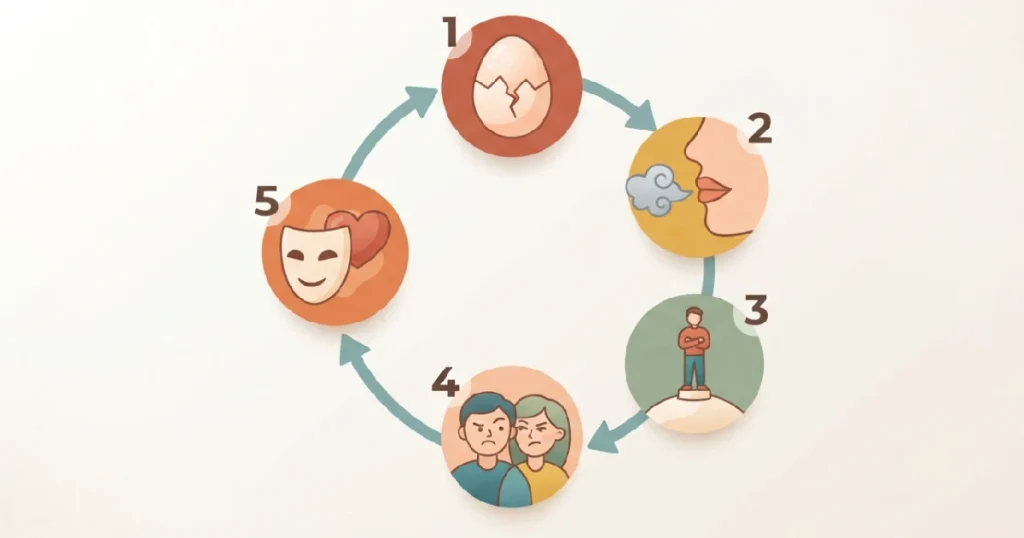
Before the list, one distinction is worth making, because it trips up a lot of thoughtful people. This isn’t the same thing as anxious attachment, though the two get confused constantly. Someone with anxious attachment fears losing connection and tends to move toward repair. A vulnerable narcissist fears losing their position as the injured party, and tends to move toward blame instead.
These five signs rarely show up one at a time. They build slowly, which is exactly why they’re so easy to miss until you’re years into a pattern you can’t quite name.
1. Extreme Hypersensitivity to Criticism
Even mild, kind feedback can trigger hours of silence or days of coldness. You learn to phrase everything carefully, like you’re defusing something. Eventually you stop giving feedback at all, just to keep the peace.
2. Passive-Aggressive Control
Instead of saying what’s wrong, they sigh loudly, go quiet at dinner, or answer “fine” in a tone that clearly means the opposite. This is passive-aggressive behavior at its most effective: there’s no argument to point to, yet you still end up apologizing.
3. Covert Superiority, or the Martyr Complex
They frame their isolation as evidence of depth. “Nobody gets me” isn’t sadness here, it’s a quiet form of superiority. Being misunderstood becomes proof they’re exceptional, not a signal that something might need to change.
4. Anxious Envy and Undermining
Your promotion, your friend’s engagement, your good news, somehow it gets met with a strange flatness or a backhanded comment. It’s not that they want you to fail. Your success reminds them of the emptiness they’re constantly comparing themselves against.
5. Strategic, Shallow Empathy
Early on, they listened to everything. They knew your history, your triggers, your softest spots. Later, in an argument, that same information gets used against you with surgical precision.
But knowing the signs isn’t the same as knowing what they cost you, and the cost is where this gets serious.
How Vulnerable Narcissism Quietly Destroys Relationships

Loving a vulnerable narcissist can feel like tending a plant that wilts no matter how much water you give it, then somehow blames you for the drought.
Left unexamined, this pattern doesn’t just strain a relationship. It can quietly become the reason it ends, long after the resentment has already done its damage.
You start managing their moods before you manage your own. You learn to anticipate what psychologist Heinz Kohut called a narcissistic injury, any moment their fragile self-image feels threatened, and you rearrange your behavior to avoid triggering it.
Then comes the moving goalpost. You apologize, you adjust, you give more, and it’s never quite enough, because the problem was never really about you. It was always about an internal emptiness that no amount of reassurance can fill.
The double standard is often the cruelest part. Your bad day needs to be earned and explained. Their bad day is simply law. Most people in this situation don’t realize how normal it becomes to shrink their own needs down to almost nothing.
How to Protect Yourself From a Vulnerable Narcissism Dynamic
You don’t need the other person to change in order to start feeling like yourself again. Let that sit for a second, because it changes everything about your next move.
Set the Line. Name your limit out loud, even just to yourself, before you’re in the middle of a conflict. Decide what you won’t accept, silent treatment past a certain point, guilt trips over normal requests, and hold that line calmly when it gets tested.
Practice Detached Observation. This isn’t coldness. It’s clarity. Their victim story is a defense mechanism, not an accurate report card on your character, and you’re allowed to hear it without absorbing it as truth.
Retire the Rescuer. A useful question to ask yourself: have you ever loved someone out of a personality pattern before, and did it actually work? For most people, the honest answer is no.
Keep a Reality Log. A short, private record of what actually happened during hard conversations. Covert gaslighting thrives on self-doubt, and a few written lines can remind you that your memory isn’t the problem here.
Healing After Vulnerable Narcissism: Moving Forward
Vulnerable narcissism is a deeply wired pattern, and it rarely shifts without sustained professional treatment on their part, not just good intentions. That isn’t pessimism. It’s respect for how hard real change actually is.
Choosing to protect yourself from this dynamic isn’t cruelty. It’s the same instinct that pulls your hand back from a stove. If you want a deeper, third-party look at practical steps, the HelpGuide resource on managing toxic dynamics offers a grounded next step for building a plan that fits your situation.
The plant metaphor still applies here, but flip it. You’re allowed to stop watering something that was never going to bloom, and put that same care into something that can actually grow back toward you.
You came into this article unsure if what you were feeling was even real. You’re leaving it with language for the pattern, evidence it isn’t your imagination, and a plan that doesn’t depend on anyone else’s willingness to change.
You were never the problem to be solved. You were the one waiting for permission to stop trying.
My Closing Remarks
I’ve sat across from so many kind, self-aware people who spent years convinced they were “too sensitive” for noticing something painfully obvious. You’re not too sensitive. You’re accurately noticing a pattern that was designed to be hard to see. Trust that instinct. It has been right this whole time, and it still is.
More Related Stories for You
- If you’re rebuilding your sense of what healthy love actually looks like, this piece on the qualities of a good partner is a good next stop.
About The Author