
 Sara Carmen
The love felt conditional. The guilt felt endless. Here’s what was really happening, and how to finally set yourself free.
Key Points
- Narcissistic parental abuse rarely looks like abuse from the outside, which is exactly why it took you this long to name it.
- The guilt, anxiety, and self-doubt you carry into adulthood aren’t personality flaws. They’re the physical fingerprints of childhood conditioning.
- Recovery doesn’t require an apology you’ll never get. It requires six specific, learnable moves you can start today.
Contents
Table of Contents
We’re raised to believe a parent’s love is the one constant we can count on, no conditions attached. For some of you, that was never true.
You learned early that affection showed up only after good grades, only after agreeing, only after making yourself smaller. You became fluent in a language most people never have to study: reading a room before you’ve even walked into it.
Maybe you called it “strict.” Maybe you called it “old school.” Maybe you never called it anything at all, because questioning it felt like betrayal.
Someone on the outside might have seen a devoted parent who “just wants what’s best.” What they didn’t see was the negotiation you ran in your head before every phone call.
Someone else might think your parent’s constant health crises were bad luck. What they didn’t see was how every crisis seemed to land right when you finally set a boundary.
Someone might assume you’re just sensitive or that you hold grudges. What they don’t see is the exhaustion of spending decades performing a version of yourself built purely to keep the peace.
I’ve sat with enough adult children of narcissistic parents in therapy to recognize this exact pattern within minutes. That gap between how your childhood looked and how it actually felt has a clinical name. Once you can see it clearly, you can stop carrying blame that was never yours to hold.
What Narcissistic Parental Abuse Actually Looks Like Behind Closed Doors
Narcissistic parental abuse happens when a parent treats their child as an extension of their own ego rather than a separate person with their own thoughts and needs. The child’s unspoken job is to reflect well on the parent. Good grades become the parent’s bragging rights. Struggles become embarrassments to hide or punish.
This isn’t about a parent who loses their temper occasionally or has a rough week. It’s a repeating loop of manipulation, guilt, and rewritten history that keeps one person emotionally in charge of everyone else in the house.
Psychologists sometimes call this “narrative control.” The parent decides what happened, how you should feel about it, and whose fault it was, which is usually yours. Disagree, and suddenly you’re too sensitive or ungrateful. Over time, you stop trusting your own memory of events. That’s not an accident. That’s the mechanism doing exactly what it was built to do.
This pattern isn’t just anecdotal anymore. The World Health Organization’s ICD-11, the diagnostic manual used internationally, has expanded its recognition of prolonged relational trauma, acknowledging what generations of adult children already knew in their bodies long before it had a clinical name, according to Simply Psychology’s overview of narcissistic abuse and PTSD.
Covert narcissistic parents make this even harder to spot from the outside. Overt narcissism looks like control, loud demands, tantrums when things don’t go their way. Covert narcissistic parents work the opposite angle. They play the martyr. They sigh instead of yelling. They make you feel guilty for having a life outside their orbit, then act wounded the moment you notice.
Both versions produce the same result. A child who learns, quietly and thoroughly, that their real self is too much, too inconvenient, or never quite enough.
6 Subtle Signs of Narcissistic Parental Abuse You Missed

Most people in this situation don’t realize how normal these emotional abuse signs from parents can look on the surface. That’s exactly what makes them so hard to name.
1. The “Strings-Attached” Economy
Every gift comes with a hidden invoice. The wedding they helped pay for gets mentioned during every disagreement for the next decade. Generosity was never free. It was collateral, waiting to be collected.
2. Conversational Hijacking
You share a promotion and within two minutes they’re describing how much harder their career was. You mention a hard week and they respond with a worse one. You learned to stop sharing good news and bad news alike, and that silence was never shyness. It was self-protection.
3. Weaponized Incompetence and Medical Drama
The mysterious flare-up starts the moment you announce plans they don’t like. The sudden inability to cope only shows up when you need something for yourself. Real illness deserves real compassion. Manufactured crisis deserves recognition, not automatic guilt.
4. Cruel Criticism Wrapped in Humor
A comment about your weight at dinner, followed instantly by “relax, I’m kidding” the second your face changes. If you can’t explain why a joke hurt without being accused of overreacting, that’s the tell. Humor was never really the point.
5. Sibling Triangulation
One sibling can do no wrong. One can do nothing right. This isn’t favoritism by accident. Keeping siblings comparing themselves to each other instead of comparing notes keeps everyone easier to manage individually.
6. Conditional Love Language
Warmth flows easily when you agree and disappears the moment you say no. If love in your house came with an expiration date attached to your compliance, you weren’t being loved unconditionally. You were being managed.
How Narcissistic Parental Abuse Rewires the Adult Brain and Body
Growing up this way doesn’t just leave memories behind. It leaves a nervous system trained for a life you no longer live.
Psychologists describe one common outcome as chronic echoism, a pattern where a person mutes their own preferences so completely, for so long, that they eventually lose track of what they actually want. Ask an adult child of a narcissist where they’d like to eat dinner and watch the small panic cross their face. That’s not indecision. That’s years of practice.
Then there’s hypervigilance, the nervous system’s habit of scanning constantly for danger even when none is present. A childhood spent reading a parent’s mood before speaking trains the body to stay on alert long after you’ve left the house.
This is a well-documented feature of complex trauma, often called Complex PTSD from childhood, and it behaves differently than the PTSD most people picture. There’s no single event to point to, no clear before and after. Instead there’s a slow buildup of smaller ruptures, each one small enough to dismiss on its own and consistent enough, over years, to leave a lasting mark.
Here’s something rarely discussed openly. Many narcissistic parents quietly recruit their child into an inverted role, where the child becomes the emotional regulator of the household instead of the one being regulated. Psychologists call this parentification.
You weren’t just avoiding your parent’s anger growing up. You were managing it, soothing it, absorbing it so it wouldn’t spill onto anyone else.
That’s not weakness. That’s wiring.
That role rarely ends at eighteen. It usually follows you straight into adulthood, where you find yourself managing a partner’s moods with the same practiced instinct you once used on a parent. Left unexamined, this inherited role doesn’t just shape your relationship with your parent. It can quietly reshape every close relationship you build after them, including your marriage.
Research on parentification, including work by psychologist Lisa Hooper, links this early role reversal to higher rates of adult anxiety and difficulty forming secure attachments later in life. That’s not a coincidence. That’s the blueprint doing exactly what it was built to do.
A narcissistic parent doesn’t just distort how you see yourself. They convince you the distortion is the accurate reflection. You spend years checking a mirror that was broken from the start, wondering why nothing about you ever looks right.
This is also where boundary paralysis comes from, the real physical distress that shows up when you try to say no to something small. A racing heart. A tight chest. Guilt that feels disproportionate to the moment. Your body isn’t overreacting. It’s remembering.
6 Steps to Heal From Narcissistic Parental Abuse
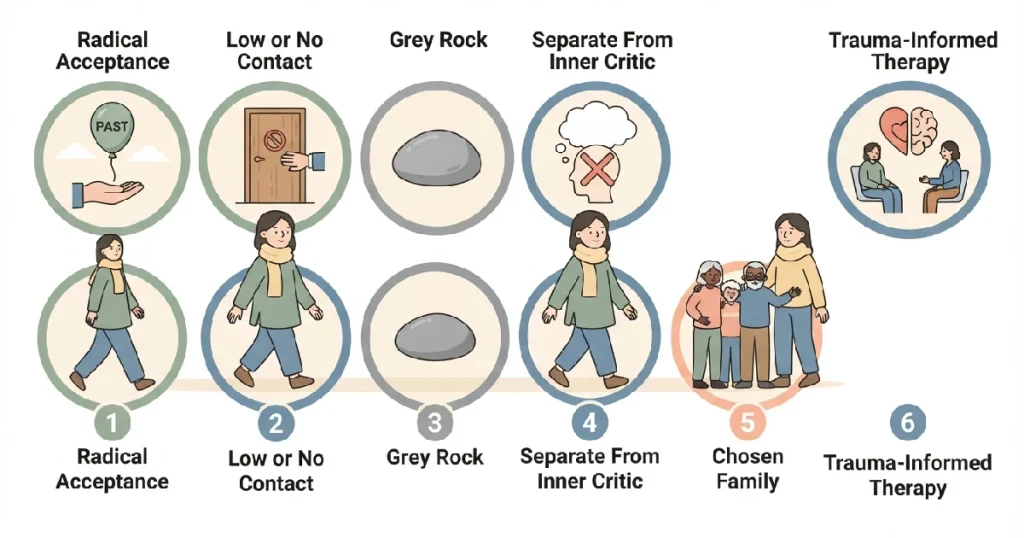
This is the heart of adult children of narcissists recovery work. None of it requires your parent’s cooperation.
Step 1: Practice Radical Acceptance
Your parent is highly unlikely to change, apologize, or suddenly see your side. Radical acceptance means grieving that fact instead of waiting for it to change.
Consider what it would feel like to stop rehearsing the conversation where they finally understand. That closure has to come from you now, not from them.
Step 2: Establish Low or No Contact
Setting boundaries with toxic parents often starts here. For many adult children, real physical and digital distance is the only environment where a chronically activated nervous system can finally settle.
One place to start is deciding what contact, if any, actually feels safe rather than obligatory. That answer is allowed to be “none.”
Step 3: Master the Grey Rock Method
When contact is unavoidable, the grey rock method means becoming as uninteresting and non-reactive as a plain rock. Flat, brief, neutral answers cut off the emotional reaction a narcissistic parent is fishing for.
Try preparing one or two flat lines in advance for predictable topics, something like “That’s not something I’m discussing right now.” Keep it short. Keep it boring on purpose.
Step 4: Separate Your Voice From the Inner Critic
The internal voice telling you that you’re not good enough, too sensitive, or too much often isn’t yours at all. It’s an internalized echo of your parent’s voice, one you absorbed long before you had the tools to question it.
A useful question to ask yourself the next time that voice shows up: would I say this to someone I loved? If not, it isn’t the truth. It’s an old recording.
Step 5: Curate a Chosen Family
Actively invest in friendships and communities that offer respect without conditions attached. These relationships prove, slowly and concretely, that connection was never supposed to require self-erasure.
Notice how your body feels around people who don’t require performance. That calm is a data point, not a coincidence.
Step 6: Engage in Trauma-Informed Modalities
Standard talk therapy helps, but trauma from childhood often lives in the body as much as the mind. Approaches like EMDR or somatic processing work directly with the nervous system rather than only the intellect, which is often where lasting change actually happens.
If you’ve talked about your childhood for years without feeling much shift, that’s not a personal failure. It may simply mean the trauma needs a body-based approach, not another conversation.
You Cannot Change Your Past, But You Can Change What Happens Next
You cannot alter the childhood you were given. No amount of insight rewrites those years.
What you do have is full authority over your adult life, your time, and your boundaries starting today.
Choosing your own well-being over a parent’s dysfunction isn’t cruelty. It’s the first act of a life that finally belongs to you.
The mirror was broken long before you ever looked into it. You’re allowed to put it down.
My Closing Remarks
If there’s one thing I want you to walk away with, it’s this: the guilt you feel for protecting your peace is proof the conditioning worked, not proof you’re doing something wrong. I’ve watched clients spend years apologizing for their own healing. You don’t owe anyone an apology for finally choosing yourself. That choice, quiet as it might feel, is the bravest thing you’ll do this year.
More Related Stories for You
- Curious how these same patterns show up outside the family home? Learn to recognize the traits of a narcissistic man before they shape another relationship in your life.
About The Author